Height is what the eye measures first
People judge the size of a room partly by how far away its highest surface is, and a lantern raises that surface well above the flat ceiling around it.
A typical single-storey extension in Cambridge has a ceiling at about 2.4 metres. Cut a lantern into that roof and the glazing sits on an upstand at least 150mm above the finished roof, with the roof build-up of joists and insulation below it. The hipped glass then rises to a ridge. A lantern 2 metres wide at a pitch of about 25 degrees climbs roughly half a metre from eaves to ridge, so the ridge can end up the best part of a metre above the ceiling line once the roof depth and upstand are added. Standing beneath it, you look up into a volume that the flat ceiling never had.
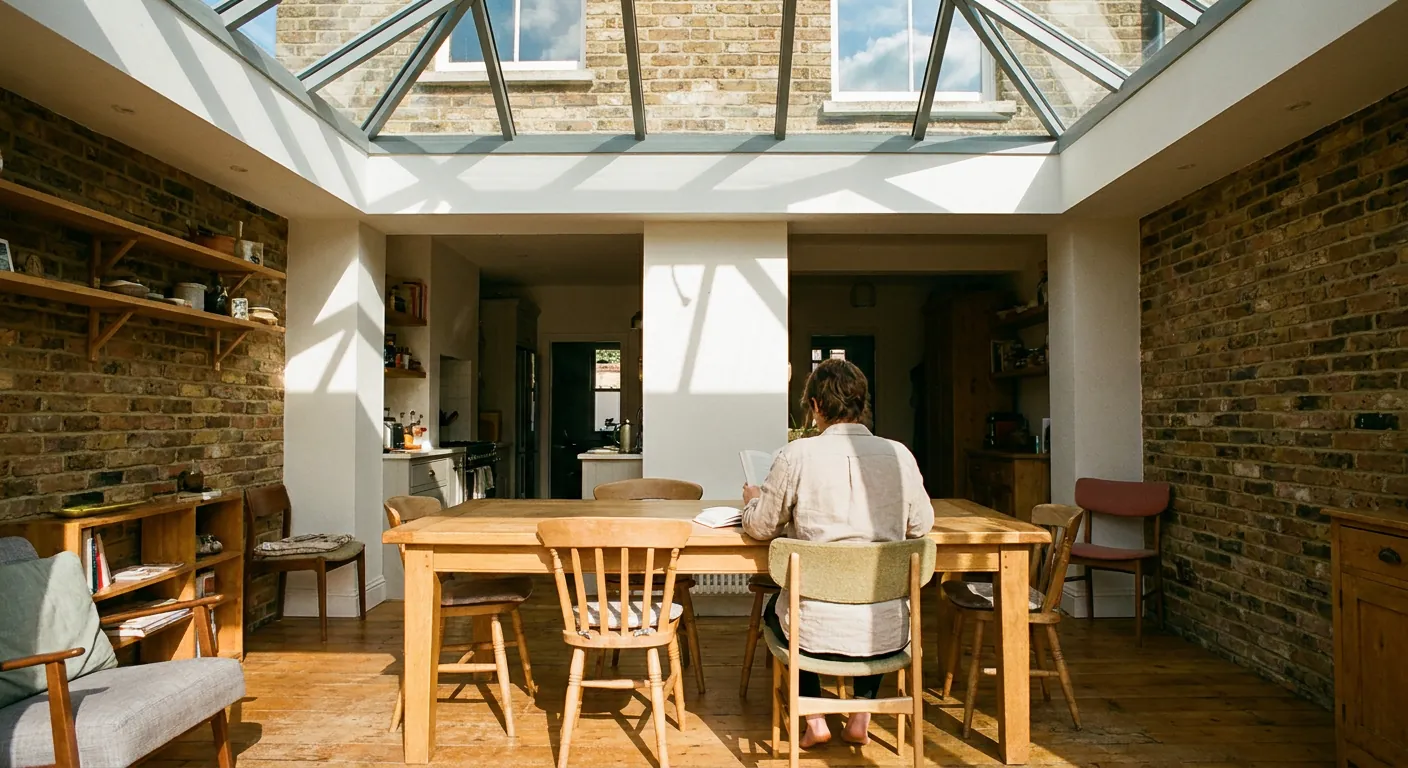
That extra height is concentrated over one part of the room, which is exactly why it works. A uniformly higher ceiling reads as a taller room; a raised zone reads as a destination, a place the eye travels to. In a long kitchen and dining extension behind a Romsey or Mill Road terrace, a lantern over the table breaks the tunnel effect of a narrow plan and gives the room a centre.
Bright walls make a room feel wider than a bright floor does
Spaciousness depends less on how much light enters than on where it lands, and overhead glass puts it on the vertical surfaces and corners that side windows leave in shade.
When the far wall and the corners of a room are dim, the room seems to close in, because the eye loses its edges. Light from a lantern falls down and outwards, washing the walls under it and bouncing off pale floors and worktops into the rest of the space. The walls brighten, the corners lift, and the room reads as open. This is the same reason pale colours are recommended for small rooms: surfaces that return light seem further away.
Overhead light is also more even than light from one side. A wall window leaves a bright zone near the glass and a darker zone at the back, and that contrast makes a deep room feel deeper and narrower. A lantern near the middle of the plan evens out the difference. The companion answer on how much light a roof lantern lets in explains why roof glazing sees so much more of the sky than a wall window of the same size.
A view of the sky borrows space from outside
Seeing moving cloud and open sky overhead makes the ceiling feel less like a lid, which is a large part of why a lantern skylight changes how big a room feels.
A flat ceiling is a hard boundary. Glass above your head replaces part of it with a view that has no visible end. Cambridge suits this well: the land is flat and there are few hills or tall buildings to crop the view, so a lantern on a rear extension usually looks at clear sky rather than at the house next door. On a grey winter afternoon the sky is still there, still changing, and the room still feels connected to it.
Frame choice affects how much of that view you get. Slim aluminium glazing bars interrupt the sky less than thicker frames, which is covered in aluminium vs uPVC roof lanterns. A frame colour that matches the ceiling inside also helps the structure recede, as roof lantern colours and finishes shows.
When a lantern makes a room feel smaller
A lantern can overwhelm a room when it is out of proportion, when its frame dominates the view, or when it throws hard contrast across the space.
In a small room, a large lantern can take over the ceiling. If there is only a thin strip of flat plaster around it, the room loses its sense of a ceiling edge and the lantern becomes the room, which tends to feel busy rather than generous. A utility room, a small study or a narrow side return often feels better with a smaller lantern, or a flat rooflight, than with the largest opening the joists allow. The roof lantern size guide sets out how to balance lantern size against room area and ceiling height.
Other things that shrink the effect:
- A deep, square-sided light well painted in a mid tone, which reads as a dark box above the ceiling instead of an opening to the sky.
- Heavy or dark glazing bars packed close together, which turn the sky into a grid.
- A sharp pool of summer sun on a south-facing extension, which makes the rest of the room look dim by comparison.
- A low ceiling under a tall lantern, where the lantern feels perched on top rather than part of the room.
| Choice | Opens the room up | Closes it down |
|---|---|---|
| Size | In proportion, clear ceiling around it | Fills most of the ceiling |
| Light well | Shallow, splayed, white | Deep, square, mid tone |
| Frame | Slim bars, colour matched inside | Thick or dark bars |
| Glass | Solar control on sunny slopes | Clear glass taking full sun |
Getting the bigger-room effect in a real extension
Position, internal finish and glass decide whether the lantern opens the room up, so they are worth settling before the roof is cut.
Put the lantern over the part of the room you want to feel generous, usually the dining table or the middle of a long plan, not tight against the back wall of the old house. Splay the sides of the light well outwards and finish them white so the light spreads across the ceiling instead of dropping straight down; how a roof lantern is finished inside covers the options. Then match the glass to the slope. A lantern ridge running east to west on a south-facing extension sees a lot of direct sun in summer, and solar control glass keeps the contrast soft; the guide to roof lantern orientation and the sun explains how the ridge direction changes the pool of light through the day.
At a light survey we look at the room, the slope and the times you use the space, and every quote comes with a written light plan giving the position, size, glass and shading we recommend, with the reason for each. You can read more about the approach in how we plan the light, or see the full roof lantern installation service. When you are ready, book a light survey or message us on WhatsApp.
Questions people also ask
Does a lantern make a room feel bigger than a flat rooflight?
Usually, yes, because it adds height as well as light. A flat rooflight brightens the room but leaves the ceiling at its original level, while a lantern raises the highest point and shows more sky through its sloping sides. On a low roof, or where planning limits the height, a flat rooflight can still be the better fit. The comparison is covered in roof lantern vs flat rooflight.
Can a roof lantern work in a small room?
It can, provided it is sized for the room rather than the roof. A modest lantern with a clear margin of flat ceiling around it, a white splayed light well and slim bars will make a small kitchen or snug feel lighter and taller. An oversized one tends to dominate the ceiling and make the room feel cramped.
Does a north-facing lantern still make a room feel bigger?
Yes. A north-facing extension gets steady, soft skylight rather than direct sun, which is well suited to lifting the walls and corners evenly. Without a hard sun patch there is little contrast, so the room tends to feel calm and open throughout the day.
Will blinds cancel out the effect?
Partly, when they are closed, because the view of the sky goes. Light-filtering blinds keep the room bright and still show the height of the lantern, so the sense of space remains. Choosing the right glass first means the blinds are needed less often.