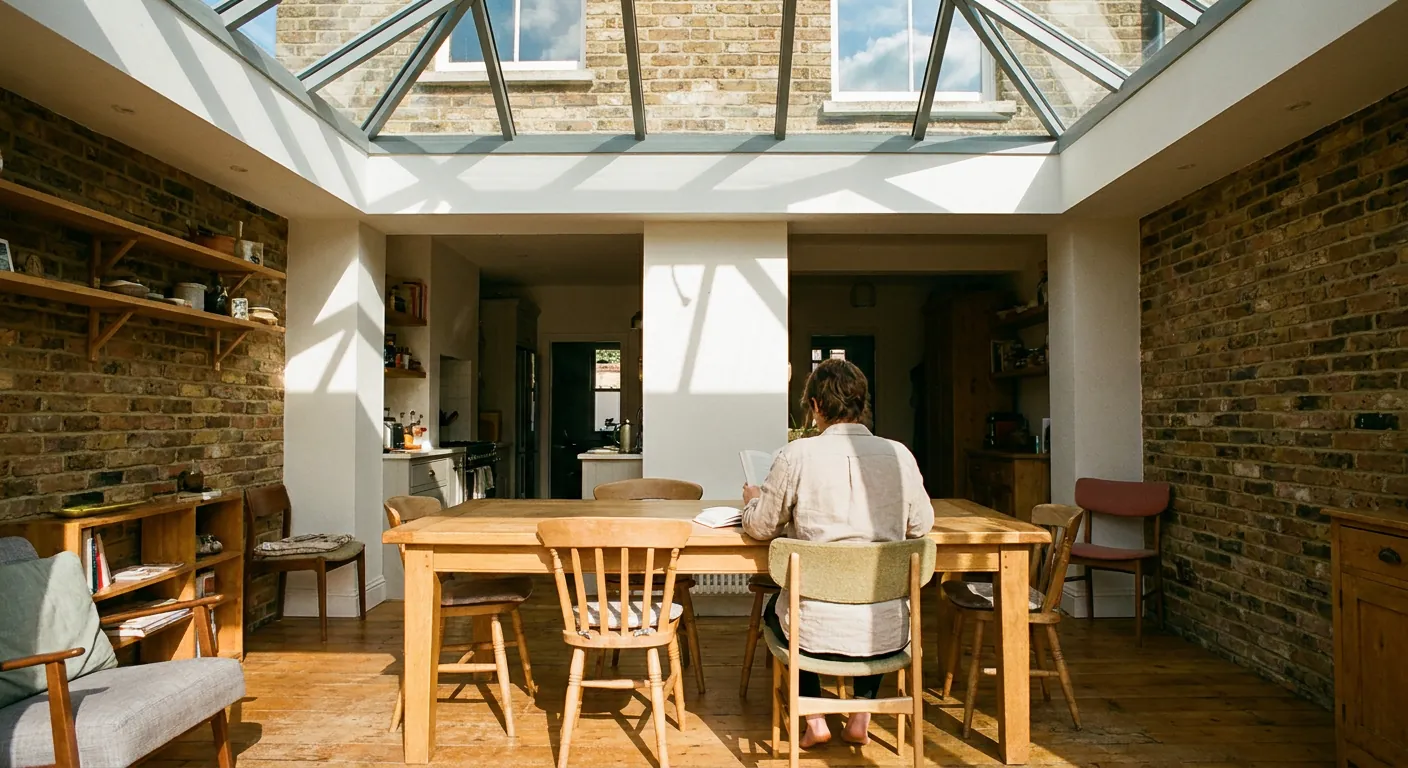
A new, clear flat rooflight in a kitchen extension ceiling with blue sky through the glass

Misted and failed rooflight replacement in Cambridge, with clear light again

A misted or failed rooflight turns clear daylight into a grey haze. We replace the glass or the whole skylight, bring the kerb up to standard and choose glass for the way your roof faces, so the light comes back better than before.

  • The new unit sized to the existing opening
  • An upgrade on the glass you had
  • Upstand checked and brought up to standard
  • Building Control notification handled

Where the light lands through the day

Plan of a room from above showing the opening and where sunlight falls at 9:00, 13:00 and 17:00.
9:00
Morning: clear light where it was grey
13:00
Midday: a sharp, bright panel again
17:00
Evening: no condensation haze

What is included

  • Survey of the old unit and opening
  • Written light plan and quote
  • Old rooflight removed
  • New rooflight supplied and fitted
  • Reveal made good inside
  • 10-year workmanship guarantee

How a rooflight tells you it has failed

A failed rooflight usually announces itself through the light before anything else: the view of the sky turns grey, a milky film sits between the panes that no cloth can reach, or an old dome has gone yellow and brittle. Misted rooflight replacement in Cambridge is about getting that clear light back, and usually getting better light than the room ever had.

Book a light survey

The clearest sign is moisture you cannot wipe away. Condensation on the room side of the glass on a cold morning is a ventilation matter and clears as the room warms. Misting inside the sealed unit is different. It sits between the two panes, comes and goes with the temperature, and over months leaves a white bloom or tide marks where water has dried and left its minerals behind. Once that bloom appears, the glass will not look clear again. Our guide to why rooflights mist between the panes goes through what is happening inside the unit, and the answer on why a rooflight goes cloudy separates misting from dirt, scratches and weathered plastic.

Other signs point to a unit that has reached the end of its life rather than just a failed seal:

  • A cracked pane, whether from a thermal stress crack that starts at an edge or a knock from a falling branch or a dropped tool during other roof work.
  • A yellowed, crazed or brittle plastic dome, typical of acrylic and polycarbonate units that have sat in full sun for decades.
  • Rusting wire in old wired glass, which swells and splits the glass from the edges inward.
  • Staining on the ceiling or the reveal around the unit, or a kerb that feels soft, which suggests water has been getting past a tired frame or a low upstand.
  • Frames that have warped, sagged or lost their finish, and opening units that no longer close firmly.

Any one of these is a reason to look at the whole rooflight, not just the glass. The checklist in the signs a rooflight needs replacing is a useful thing to walk round the house with before a survey. If a pane has cracked, our guide to replacing a cracked rooflight explains what to do in the meantime and how the new unit is specified so it does not happen again.
What goes wrong inside a sealed unit

A double or triple glazed rooflight is two or three panes held apart by a spacer bar and closed by an edge seal, with dry air or argon in the cavity. When that seal lets moisture in faster than the desiccant in the spacer can absorb it, the cavity starts to mist.

Book a light survey

Every sealed unit breathes a little. The spacer bar around its edge is filled with a desiccant, a drying agent that mops up the small amount of moisture that creeps through the seal over the years. The seal slows that creep; the desiccant soaks up what gets through. The unit stays clear for as long as the desiccant has capacity left. Once it is saturated, the next warm, damp day puts water vapour into the cavity, and the next cold night turns it into droplets on the inside of the colder pane.

Roof glass has a harder life than a wall window. It faces the sky, so it takes the full heat of the summer sun and the full chill of a clear winter night. On a July afternoon in Cambridge, with the sun around 60 degrees above the horizon at midday, the outer pane of a flat rooflight can get very hot; by the small hours of a frosty January night it can be well below freezing. That daily and seasonal swing makes the gas in the cavity expand and contract, and the seal flexes every time. Rain and standing water also sit on roof glass in a way they never sit on a vertical window, particularly where a flat rooflight was fitted with too little fall and water ponds against the bottom edge.

Several things shorten the life of a seal:

  • Glass laid too flat, so water stands along one edge for days after rain.
  • Ultraviolet light reaching the edge seal because the frame or cover strip does not shade it.
  • A frame that moves as the roof around it moves, putting the seal under constant strain.
  • A unit that was simply made to a low price, with a thin seal and a small desiccant load.

A good-quality rooflight on a well-built kerb commonly gives twenty years or more before the seal goes, and cheaper or badly detailed units can fail much sooner. The answer on how long rooflight glass lasts covers the variables in more detail. Whatever the age, the physics is the same: once moisture is in the cavity, the seal has already failed, and the argon that gave the unit its insulation has usually leaked out with it.

Glass only, or the whole rooflight

Where the frame is sound and made to take a new sealed unit, replacing the glass alone can be sensible. Where the frame, the kerb or the design of the unit is the real problem, the whole rooflight should come out.

Book a light survey

This is the first decision in any replacement, and it is worth getting right, because a new sealed unit in a tired frame only resets one part of the clock. The questions we ask at the survey are practical ones. Can the glazing unit be taken out of the frame without destroying it? Is the frame still straight, with its thermal break intact and its drainage working? Is the upstand high enough, insulated and dry? Is the unit the right size, in the right place, for the way the room is used now? And will a new pane in this frame meet current thermal standards, or is the frame itself the weak point?

What we findLikely route
Misted pane, sound frameNew sealed unit
Misted pane, tired frameWhole unit
Plastic dome or wired glassWhole unit
Low or soft kerbWhole unit and kerb
Wrong size or positionNew unit, new opening

Frameless flat rooflights, where the glass is bonded directly to a kerb or a slim perimeter, are usually replaced as a complete unit, because the glass is the rooflight. Framed units vary: some are built so the sealed unit lifts out, and some bond the glass into the frame at the factory. Roof lanterns are often glazed with individual panels between bars, so a single misted panel can sometimes be swapped on its own; the answer on replacing a single roof lantern panel explains when that works and when the colour or coating of a new pane will not match its neighbours.

For the full comparison, including how the thermal performance of each route compares, see glass only or full unit replacement, and the shorter answer to can you replace just the glass in a rooflight? Whichever route suits your rooflight, the written quote says which one we recommend and why, before anything is ordered.

The tired rooflights of Cambridge homes

The rooflights that come up for replacement around Cambridge follow the city's building history: plastic domes and wired glass on older flat roofs, first-generation roof windows in loft conversions, and early sealed units on homes that still feel new.

Book a light survey

On the Victorian and Edwardian terraces of Romsey, Petersfield, Mill Road and Chesterton, the back addition behind the kitchen often has a flat roof, and many of those roofs carry a dome or a small flat rooflight put in decades ago to light a galley kitchen or a bathroom. Plastic domes from that era were usually single or twin skin, set on a low kerb, and they have spent their whole lives in the sun. They go yellow, then opaque, then brittle. The light they let through becomes a dull glow with little of the sky left in it. Our guide to replacing dome rooflights covers what a flat glass unit on a proper upstand does for these small rear rooms.

The 1930s semis around Cherry Hinton, Arbury and the roads off Hills Road tend to have later single-storey extensions with polycarbonate or early glass rooflights and lanterns, often from the 1980s and 1990s. Polycarbonate sheet was light and easy to fit, but it loses heat quickly, drums loudly in heavy rain and dulls with age. The guide to replacing polycarbonate rooflights goes through the upgrade to sealed glass, and replacing a failed roof lantern covers the larger raised units found on the same extensions.

Loft conversions across the city and the villages carry pitched roof windows, and the oldest of those are now well past the point where their seals and weather strips can be expected to hold. First-generation units in lofts converted in the 1980s and 1990s often have single-glazed or early double-glazed sashes, worn hinges and flashings that were detailed for a different generation of product. See replacing a misted roof window for how these are handled, usually from inside the loft.

Then there are newer homes. The first houses at Orchard Park, built from the late 2000s, and the earlier phases of other developments on the city edge now have rooflights old enough that an occasional unit has started to mist. Here the frame and kerb are usually modern, which makes a glass-only or like-for-like replacement more likely, and the question becomes whether to take the chance to upgrade the glass for heat and glare while the scaffold tower is up.

Older wired glass also turns up, on outbuildings, porches, stairwell rooflights and 1960s and 1970s additions. The wire mesh was meant to hold the glass together in a fire, but it does not make the pane strong, and rusting wire at the edges cracks it over time. The guide to replacing wired glass rooflights covers the modern laminated alternative.

Replacement as an upgrade to the light

A like-for-like swap gives you back what you had on the day the old unit was new. A replacement planned around the room can do better: glass chosen for the way the roof faces, a laminated inner pane for safety, and far less heat lost on a winter night.

Book a light survey

The old unit was probably chosen without much thought about the light. It may be clear double glazing on a south-facing roof that turns the kitchen into a hothouse from May to September, or a heavily tinted dome on a north-facing roof that makes a small bathroom feel gloomy even at midday. Replacement is the moment to put that right, and it is where our approach to planning the light earns its keep. Before we specify the new glass we look at the orientation of the roof, the hours the room is used, the surfaces the light will fall on and any glare problems you have lived with.

Exploded view of a double glazed and a triple glazed rooflight unit, showing the outer toughened pane, coatings, argon cavities, warm-edge spacers and the inner laminated pane.×2×31234567
Fig. Exploded double glazed (left) and triple glazed (right) rooflight units, outside on the left.
  1. Outer toughened pane: heat-strengthened to take hail, foot traffic during maintenance and thermal stress.
  2. Solar-control coating (optional) on the inside face of the outer pane, cutting heat gain on south and west roofs.
  3. Argon-filled cavity: a denser gas than air, so less heat crosses the gap.
  4. Warm-edge spacer: a low-conductivity edge that keeps the units’ edges warmer and cuts condensation at the frame.
  5. Low-E coating: a microscopically thin metal layer on a cavity face that reflects room heat back inside.
  6. Inner laminated pane: two sheets bonded to an interlayer, so if it ever breaks, the glass stays in place overhead.
  7. Triple glazing only: a third pane and a second argon cavity, usually with a second low-E coating. Warmer, heavier, and it lets in slightly less light.

On a south or west-facing roof, solar control glass is usually the right call. Clear low-emissivity double glazing lets through somewhere around 60 per cent of the sun's energy; a good solar control coating brings that down to around 30 to 40 per cent while keeping most of the visible light. For a room that faced the afternoon sun under the old unit, that difference is the one you will feel. On a north-facing slope, clear low-E glass is often better, because heat is rarely the problem there and every bit of steady, soft daylight is worth keeping. East-facing rooflights over a kitchen or bedroom get bright, low-angle early sun, which is welcome in a kitchen at 7am and less welcome in a bedroom at 5am in June; that is a case for a blind as much as for a coating.

Every new rooflight we fit has a laminated inner pane. Overhead glass has to stay in place if it breaks, and a laminated pane holds together on its interlayer where old annealed or wired glass would drop. It also takes out much of the ultraviolet that fades floors and fabrics under an old unit.

Heat loss improves in almost every case. Part L of the Building Regulations sets a limiting U-value of 2.2 W/m²K for a new or replacement rooflight, measured in the horizontal plane, and good modern flat rooflights with thermally broken frames do considerably better than that. An old single-skin plastic dome loses heat several times faster. The answer on whether a misted rooflight loses heat explains how much of the difference comes from the failed seal and how much from the age of the unit. Our energy efficient rooflights page covers triple glazing and the trade-off between insulation and daylight.

Keeping the size, or changing it

A replacement does not have to be the same size or in the same place as the old one. Keeping the opening is the simplest route; enlarging it, moving it or adding a second unit can make far more difference to the room.

Book a light survey

Many old rooflights were sized to fit between two joists or rafters because that was the easiest opening to form. A 600mm square dome between joists on a rear addition will never light a kitchen properly, however clear its glass. Enlarging the opening means trimming one or more joists and carrying their load on new timbers either side, which is routine work but needs to be planned, checked and in most cases notified. On a pitched roof the same applies to rafters, with the added detail of the tiles or slates around the new frame.

Position matters as much as size. A rooflight that sits over the middle of a room lights the middle of the floor. The same rooflight moved a metre towards the house, over the worktop, the table or the dark end of a side-return kitchen, lights the part of the room you actually use. On a pitched roof, a window set low enough to see out of while seated changes a loft room from a store to a place to work. Our guide to repositioning a rooflight when replacing it covers what moving an opening involves, including making good the old hole in the roof and the ceiling.

If the frame is a standard size, a like-for-like unit is straightforward to source. If it is an old or unusual size, the choices are a made-to-measure unit to fit the existing opening or a standard unit with the opening adjusted to suit. The answer on whether a replacement rooflight has to be the same size sets out both, and whether a new rooflight will be brighter than the old one explains how glass, frame width and position add up.

Changing the shape of the light is also possible. A tired polycarbonate lantern can make way for a slim glass lantern or a large flat rooflight, and an old conservatory roof can be replaced with a solid, insulated roof carrying a lantern, which is covered in replacing a conservatory roof with a lantern. For new openings with no old unit to replace, see our flat roof rooflight installation and roof lantern installation services.

Kerbs, upstands and the roof around the old unit

An old rooflight is often only as good as the kerb under it. Replacement is the time to check the timber, raise a low upstand to a proper height, insulate it, and bring the roof finish up to meet the new frame.

Book a light survey

On a flat roof, the rooflight sits on an upstand, a timber kerb built around the opening and weathered with the roof covering. Guidance for flat roofs calls for the top of the upstand to stand at least 150mm above the finished roof surface, so standing water and wind-driven rain cannot reach the frame. A great many older kerbs were built lower than that, sometimes barely above the felt, and a few have had a new roof covering laid over the top that has made them lower still. A new unit on a low kerb inherits the old problem on day one.

Section through a flat-roof rooflight: joists and trimmers, deck, insulation laid to falls, a kerb at least 150mm above the finished roof with the membrane dressed over it, the rooflight unit and a plastered reveal.150mm1:4012345678
Fig. Section through a flat-roof rooflight on a warm-deck roof, drawn at about 1:20.
  1. Joists, with doubled trimmers either side of the opening to carry the loads of the cut joists around it.
  2. Deck (usually 18mm ply or OSB) with a vapour control layer laid on it.
  3. Insulation boards above the deck (a warm roof), often tapered to give the roof its falls.
  4. Waterproof membrane dressed up the upstand and over its top, so the joint is lapped, not sealed.
  5. Upstand, or kerb: insulated timber, finishing at least 150mm above the finished roof surface to keep standing water and splash off the joint.
  6. Rooflight unit fixed over the kerb, its frame skirt shedding water outside the membrane turn-up.
  7. Plastered reveal lining the opening from the ceiling up to the frame, finished white to bounce the light down.
  8. Roof falls to an outlet: designed at about 1:40 so the finished roof never falls less than 1:80.

Once the old rooflight is off, we check the kerb timbers for rot or softness, look at how the old roof covering was dressed up the kerb, and measure the fall. A flat rooflight needs a fall of a few degrees so rain runs off the glass; units designed for flat roofs either build that fall into the frame or need a kerb that is taller on one side. If the kerb is sound, it may only need to be raised, insulated and re-dressed. If it is not, it comes out and a new one is built, insulated on its inner face so the cold does not bridge into the reveal and cause condensation on the ceiling around the unit.

The roof covering around the kerb then has to meet the new upstand properly. On a single-ply or liquid-applied roof in good condition, that usually means dressing new material up the kerb face and bonding it into the existing covering. On an old felt roof near the end of its own life, the better answer may be to replace the roof covering and the rooflight together; the guide to replacing rooflights during a reroof covers the timing. For older flat rooflights more broadly, including those set almost flush with the deck, see replacing an old flat rooflight.

On pitched roofs, the equivalent is the flashing kit and the lining. Replacement roof windows are usually made so the new frame fits the existing opening, and matching flashings allow the new window to sit at the right depth in the tiles or slates without disturbing the internal lining more than necessary. Where the old window was fitted with a gap around it or no insulation collar, the replacement is the time to fill it.

Replacing a misted roof window in a pitched roof

Pitched roof windows in loft conversions and vaulted ceilings follow slightly different rules. Many can take a new glazed sash in the existing frame; older ones are better replaced as a complete window, usually working from inside the room.

Book a light survey

The large roof window makers design their sashes to be swapped. If the frame of a misted roof window is in good order and the model is still supported, a new sash with a fresh sealed unit can often be fitted into the old frame, with no work to the roof covering at all. That is the quickest route back to clear glass, and it keeps the lining and decoration untouched. The answer on replacing VELUX glass only explains how the model code on the window's data plate tells us which sashes fit.

Older windows are a different case. Windows installed before the early 2000s often sit at a depth in the roof that modern frames do not match, which is why dedicated replacement flashings exist: they allow a current window to sit at the old installation depth so the internal lining can stay. Where the old frame is warped, the timber has been wet for years, or the window is simply too old for the maker to support, the whole window comes out and a new one goes in, often from inside the room with the tiles or slates around it lifted and relaid. Our roof window installation and VELUX window installation pages cover the wider range, including top-hung and centre-pivot windows and loft escape windows.

A replacement roof window is also the chance to add what the old one never had. Electric opening with a rain sensor makes a high window over a stairwell usable; an external awning blind cuts the heat from a south-facing loft bedroom before it reaches the glass. See electric and opening rooflight installation for those options. In a conservation area, where the original window was a standard unit on a visible slope, a flush-fitting conservation style may be worth considering; our conservation rooflight installation page covers the detailing.

Planning, Building Control and conservation areas

Replacing a rooflight like for like rarely needs planning permission, but a change of size, position or profile might, and listed buildings, some conservation areas and flats bring their own rules. The Building Regulations apply to replacement units too, and the work is often notifiable.

Book a light survey

Planning first. Across Cambridge and South Cambridgeshire, planning is handled by Greater Cambridge Shared Planning. A replacement that looks materially the same from outside, in the same position, at the same size and projecting no further from the roof, is generally treated as maintenance rather than development. Adding or enlarging a rooflight on a house usually falls under permitted development, provided it projects no more than 150mm from the roof plane and does not rise above the highest part of the roof. Those rights do not apply to flats and maisonettes, and they can be removed in a conservation area by an Article 4 direction. Listed buildings always need listed building consent for changes that affect their character, and that can include swapping one rooflight for another of a different type. The answer to do I need planning permission to replace a rooflight? covers the common cases, and replacing like for like in a conservation area goes into the detail for the city's many conservation areas and the villages around it. If you are unsure, the council's constraints map on the Greater Cambridge Planning website is the place to check.

Building Control is a separate question. In England, replacing a whole window or rooflight in an existing home counts as building work: the new unit has to meet the thermal standard in Part L, the safety requirements for overhead glazing, and fire rules where the roof is close to a boundary. The work has to be either self-certified under a competent person scheme or notified to Building Control. Where the replacement is notifiable, we handle that notification for you, and you receive the completion paperwork at the end. Replacing only the glass in a sound frame is generally not notifiable, though the new unit should still be specified to current standards.

Where the structure changes, because the opening is enlarged or moved, Building Control will want to see how the trimmed joists or rafters are supported. Our guide to Building Control for replacement rooflights sets out which jobs are notifiable and what the inspector looks at.

Leasehold flats add one more layer. The roof, and often the rooflight itself, usually belongs to the freeholder, and the lease will say whose job replacement is and whose consent is needed. The answer on replacing a rooflight in a leasehold flat covers the questions to ask before booking the work.

Warranties, insurance and what the replacement costs to plan for

Before paying for a replacement, it is worth checking whether the old unit is still under a manufacturer's warranty and what your home insurance says. After that, the cost depends on the route: glass only, a like-for-like unit, or a larger or moved opening.

Book a light survey

Sealed glazing units and branded rooflights commonly carry a manufacturer's warranty against seal failure for a set number of years from supply, and the length varies by maker and product. If your rooflight was fitted recently, the original installer's paperwork or the maker's label on the frame is the place to start. The answer on whether misted rooflights are covered by the manufacturer warranty explains how those claims usually work and what evidence a maker asks for.

Home insurance is less likely to help. Policies generally cover sudden, accidental damage, such as a branch through the glass in a storm, and generally exclude gradual wear, which is how a failed seal is usually classed. Read your own policy wording, and see does home insurance cover misted rooflights? for the distinctions insurers draw.

The main things that move the price of a replacement are:

  1. Whether the glass alone can be replaced, or the whole unit has to come out.
  2. The size and type of the new rooflight, and the glass specification chosen for the orientation.
  3. The state of the kerb or the flashing, and how much of the roof covering around it needs renewing.
  4. Any change to the size or position of the opening, with the structural work that brings.
  5. Access: a single-storey flat roof reached from a garden is a very different job from a rooflight in the middle of a three-storey terrace roof.

Every quote is built from the roof in front of us rather than from a list, because those five factors change from one house to the next. General UK market guidance, and how each factor adds up, is on our skylight and rooflight costs page, and the answer on what affects the cost of replacing a misted rooflight applies it to replacement work. The written quote from the survey sets out the real figure, with the light plan that explains the specification behind it.

From survey to clear glass: how the day runs

A replacement starts with a survey of the old unit and the room under it, then a written light plan and quote. On the day, the old rooflight comes out, the opening and kerb are brought up to standard, the new unit goes in and the reveal is made good.

Book a light survey

At the survey we look at the rooflight from inside and, where it is safe to reach, from outside. We measure the opening and the kerb or frame, note the make and model if there is one, check the orientation of the roof and the way the room is used, and look for any staining or softness around the unit. That gives us the route (glass only, whole unit, or a changed opening), the glass specification for the orientation and the access we will need. The written quote sets all of that out with a short light plan, so you can see where the light from the new unit will land and why we have chosen the glass we have.

Access is planned before the day. A single-storey flat roof can usually be reached with ladders and edge protection or a small tower. A rooflight high on a pitched roof or on a taller building may need a tower or scaffold, while many roof window replacements are done from inside. The answer on whether replacing a rooflight needs scaffolding explains how we decide.

On the day itself, a typical whole-unit replacement on a flat roof runs like this:

  • Floors and furniture under the rooflight are covered, and a dust screen goes up where the room needs one.
  • The old unit is taken off from outside, with the opening covered straight away so the room is never open to the weather.
  • The kerb is checked, raised or rebuilt, insulated and weathered into the roof covering.
  • The new rooflight is bedded and fixed, and its seals and drainage checked.
  • Inside, the reveal is lined, plastered or trimmed and left ready for decoration.

A glass-only replacement or a like-for-like roof window sash can take a few hours. A whole flat rooflight on a sound kerb is usually a day, and a lantern, a rebuilt kerb or a changed opening can take two or three. We pick a dry forecast for the part of the job when the roof is open. People understandably ask about the room below, and the answer on whether replacing a rooflight will damage my ceiling explains how the plaster around the reveal is protected and made good.

The old unit is taken away with us. Glass, aluminium and timber are separated for recycling where the local facilities allow; see what happens to the old rooflight. The installation is then covered by our 10-year workmanship guarantee, alongside the manufacturer's own warranty on the new product.

Questions people ask

Book a light survey

Can a misted rooflight be cleared without replacing it?

Some firms drill and vent misted units, but that removes the visible moisture without restoring the seal, the desiccant or the insulating gas, so the unit still insulates poorly and can mist again. Mineral staining from dried water inside the cavity stays. The answer on whether misted rooflight glass can be cleared explains why replacing the sealed unit or the rooflight is the lasting route.

Is a misted rooflight unsafe?

Misting on its own is a failed seal, not a structural fault, and the glass is no weaker than it was. The concern is what else may be going on: an old unit may have annealed or wired glass rather than a laminated inner pane, and a crack changes things straight away. See is misted rooflight glass dangerous? for how to tell.

Can a misted rooflight cause damp in the room?

The moisture inside a sealed unit stays inside it. Damp around a rooflight usually comes from something else: condensation on a cold, uninsulated kerb or reveal, or water getting past an old frame or a low upstand. Both are reasons to replace the unit and bring the kerb up to standard. The answer on whether a misted rooflight can cause damp covers the signs.

Will the new rooflight look different from outside?

A like-for-like replacement should look much the same, apart from clear glass where there was a grey haze or a yellowed dome. If you change the size, profile or position, it will look different, which is where planning and conservation rules come in. Glass with a solar control coating can look slightly more reflective from above, which is worth knowing if the rooflight is overlooked.

How soon can the work be done?

A glass-only or like-for-like replacement depends mainly on the lead time for the new unit, and made-to-measure glass takes longer than a standard size. Where a change of size or position needs planning or listed building consent, that has to come first. The light plan and quote give you a realistic timeline for your rooflight. To start, book a light survey or message us on WhatsApp, and read more about our work across the city on the skylight and rooflight installation in Cambridge home page.

Book a light survey

Tell us about the room

  • No obligation
  • Light plan in writing
  • 10-year guarantee
Book a survey Call