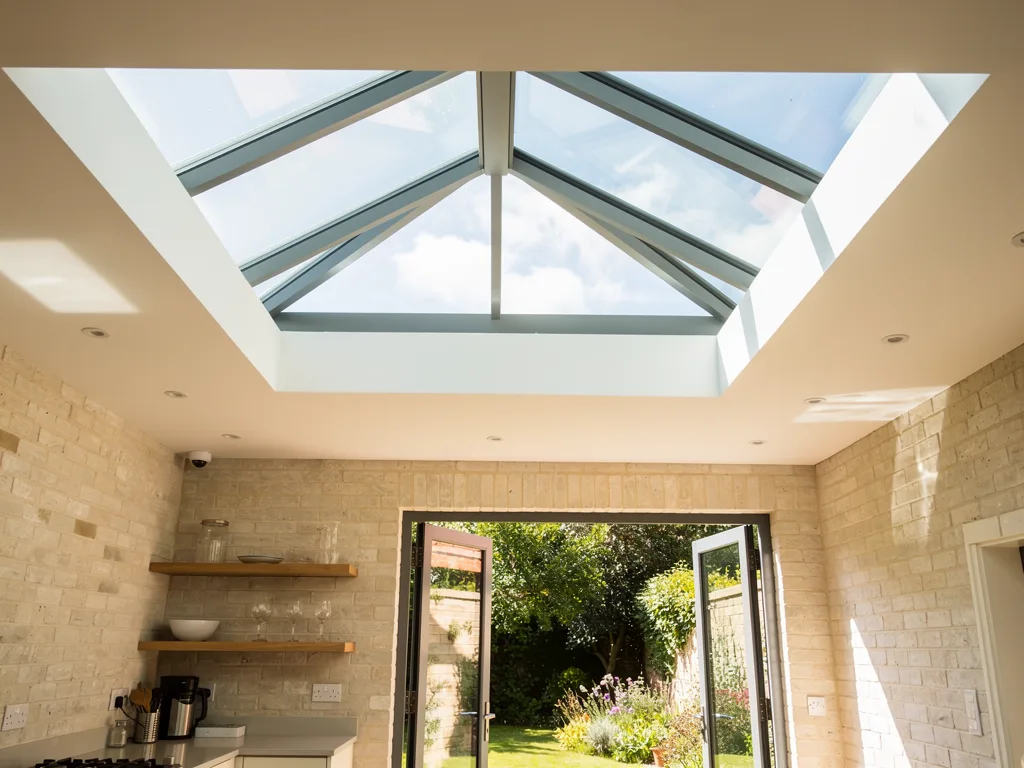
When a lantern really does need blinds
A lantern needs blinds when its pool of sun lands somewhere you sit, look at a screen or sleep, or when the glass alone cannot hold back the summer heat. Everywhere else they are a comfort, not a requirement.
Think of the lantern as a moving spotlight. Through a summer day in Cambridge the sun climbs to around 61 degrees above the horizon at midday, so the bright pool it throws is small, sharp and travels across the floor from west to east as the sun moves. If that pool crosses a sofa facing a television at 3pm, or falls on a laptop at the kitchen island through the working morning, you will want to cut it. If it lands on a tiled floor in a walk-through space, it does little harm.
Three situations make blinds close to essential. The first is clear or standard low-E glass on a lantern that sees the south or west sky, because clear glass passes far more of the sun's heat than a solar control unit (the roof lantern glass options guide compares them). The second is a lantern over a room used for rest: a garden room with a daybed, a snug, or a ground-floor bedroom in a bungalow extension, where early light at 4.45am in June is unwelcome. The third is glare on a screen. Diffuse sky light through a lantern is rarely a glare problem, but direct sun reflecting off a monitor or a glossy worktop is.
Where none of those applies, solar control glass and an opening vent usually do the job on their own. The companion answer on whether roof lanterns make a room hot covers the heat side in detail.
Which orientations benefit most
A lantern looks at the whole sky, but its hips and ridge still favour some directions. The rooms that gain most from blinds are those open to the south and west, where the strongest and latest sun arrives.
On the flat ground around Cambridge there are few hills and, on newer streets, few mature trees to shade a roof, so a single-storey extension roof often sees the sun from dawn to dusk in summer. The table below sets out what each aspect of the extension tends to mean for a lantern skylight. It describes the room below the lantern, not the lantern itself.
| Room faces | What the lantern gives | Blinds? |
|---|---|---|
| North | Soft, steady light, little direct sun | Rarely needed |
| East | Bright early sun, cool afternoons | For bedrooms and early risers |
| South | Strong midday sun, most heat | Usually worth it |
| West | Low evening sun, warmth late on | Often worth it |
A south facing kitchen extension on a Romsey terrace, or a west facing family room on a new home in Trumpington Meadows, are the cases where blinds most often pay for themselves. A north facing side return in Chesterton may never need them, and a north facing extension is one of the best homes a lantern can have for exactly that reason. The orientation guide explains how the direction of the ridge changes where the light falls.
Blind types that fit a roof lantern
Lantern glass is sloped, triangular on the hips and divided by glazing bars, so ordinary window blinds will not work. The options below are made for that shape.
Pleated blinds on tensioned tracks. A pleated fabric runs between side guides fixed to the glazing bars, with one blind per pane. The tension holds the fabric against the slope, so it does not sag, and hip panes take shaped blinds cut to the triangle. Blackout, dim-out and translucent fabrics are available, often with a reflective backing that turns some of the sun's heat back through the glass.
Cellular or honeycomb blinds. These work the same way but trap a layer of air in their cells, which adds a little insulation in winter as well as shade in summer. They are slightly deeper than pleated blinds, which matters on slim aluminium bars.
Motorised versions. The ridge of a lantern can sit well over three metres above the floor, out of reach for a pole. Electric blinds on a remote, a wall switch or a timer are the practical answer at that height, and some can be linked to a sun sensor that closes them when the sun strikes the glass.
Fabric sails. A tensioned sail across the void below the lantern softens light and hides the frame. It diffuses rather than blocks, so it suits glare more than heat.
Plan the blinds before the lantern is made
Blinds fitted as an afterthought can look cramped and fight the frame. Deciding on them at the design stage costs nothing and changes a few small details.
Blind tracks screw into the internal face of the glazing bars, so the bar profile needs enough depth and a flat face to take them. Frame choice matters here, and the aluminium vs uPVC comparison touches on bar sizes. For electric blinds, a cable route to each pane has to be planned before the plasterboard goes up, usually through the upstand and the light well. The finish around the lantern opening also matters: a plastered light well gives a clean edge for the lowest blind rail, while a pelmet can hide motors and wiring, as described in how a roof lantern is finished inside.
At a light survey we mark where the pool of sun will fall across the room at the hours you use it, and the written light plan records whether blinds are recommended, which panes need them and why. That way the lantern is ordered ready for them, and you can add them on the day or later without drilling into the wrong place. The roof lantern installation page and how we plan the light explain the survey in full.
Questions people also ask
Can you fit blinds to an existing roof lantern?
Usually, yes. Made-to-measure pleated blinds are sized to each pane and fixed to the glazing bars, so most lanterns can take them after installation. Very slim bars or awkward hip panes can limit the choice, and electric blinds are harder to wire neatly once the ceiling is finished.
Do blinds stop a roof lantern overheating?
They help, particularly reflective or cellular fabrics, but an internal blind cuts heat less than glass that rejects it at the surface. Solar control glass, an opening vent and blinds together give the most comfortable room under a south or west facing lantern.
Will blinds make condensation worse?
A closed blind can hold cooler air against the glass on a winter night, which raises the chance of condensation on older units. Leaving blinds open overnight in winter and keeping the room ventilated helps, and the answer on whether roof lanterns get condensation goes further.
Are lantern blinds hard to clean?
Pleated and cellular fabrics can be dusted with a soft brush or a vacuum on low power. At ridge height an extendable duster saves climbing, and fabrics with a dust-repellent finish need less attention. Blinds also keep a little dust off the inside of the glass, which the guide on cleaning a roof lantern covers.