Why the compass matters less for a lantern than for a window
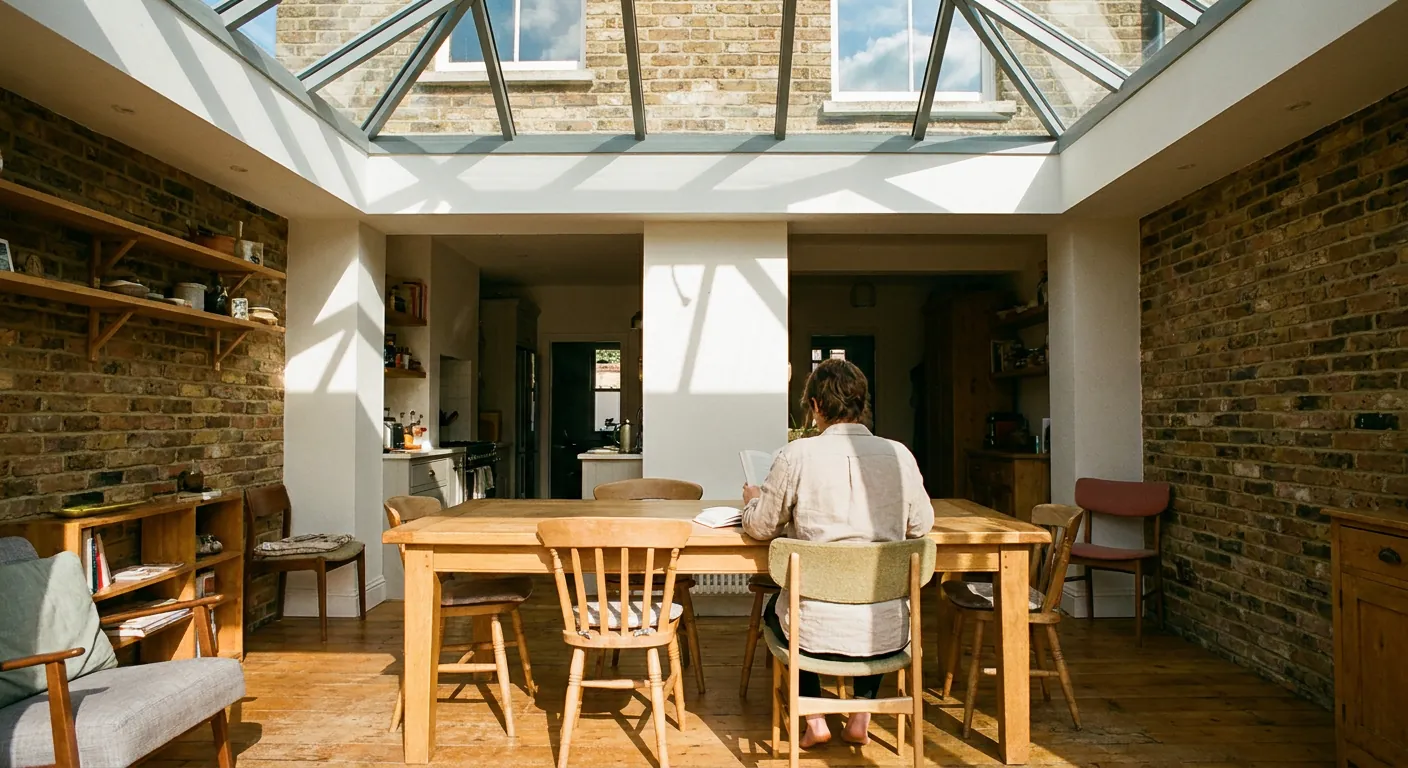
A wall window sees one direction; a lantern on a flat roof sees the sky above it. That is why a north-facing extension that feels gloomy through its doors can feel bright under a roof lantern.
Through a rear window or a set of bifolds on a north elevation, the room only ever receives light reflected from the garden, the fence and the sky low on the northern horizon, which is the dimmest part of the sky. Overhead glazing works differently. The brightest part of an overcast sky is the patch directly overhead, and a lantern faces straight at it. On a typical grey Cambridge day, when there is no direct sun anywhere, a roof lantern on a north extension collects much the same light as it would on a south extension.
Cambridge helps here. The land is flat, there are few hills or tall ridges to cut off the sky, and on most streets the only thing shading an extension roof is the house it is attached to. The lantern's glazed sides and hips face every direction at once, so the south-facing hip still catches sun whenever the sun is high enough to clear the main house.
The feel of the light is the real difference. North-lit rooms read as calm and even: no hard beam crossing the floor, no bright stripe on the worktop that moves through the afternoon, no squinting at a screen. Painters and draughtsmen asked for north light for exactly that reason. For a kitchen, dining space or family room where people sit for hours, it is a quality plenty of south-facing owners would happily swap for. Our guide to roof lantern orientation and the sun explains how the lantern's own ridge line changes the pattern once direct sun does reach it.
The house behind it: winter shadow is the real question
On a north-facing extension the main house stands to the south, between the lantern and the sun. How far its shadow reaches across the extension roof changes a great deal through the year.
At Cambridge's latitude, a little over 52 degrees north, the midday sun climbs to roughly 61 degrees above the horizon in late June, about 38 degrees at the March and September equinoxes, and only about 14 degrees in late December. Take a common case: a two-storey terrace or semi whose rear wall rises around 2.5 metres above the flat roof of a single-storey extension. The table gives the rough length of that wall's shadow across the extension roof at midday.
| Time of year | Midday sun height | Shadow from 2.5m wall |
|---|---|---|
| Late June | About 61° | About 1.4m |
| March, September | About 38° | About 3.2m |
| Late December | About 14° | Over 9m |
So from spring to autumn, a lantern set a couple of metres or more from the house wall catches direct sun through the middle of the day. In midwinter the whole roof sits in the house's shadow and the lantern lives on sky light alone. That is not a failure: sky light is what makes the room usable, and it is the same light a south-facing lantern relies on through the overcast weeks of a Cambridge winter. It does mean a north extension will not get the low winter sun patch that a south extension enjoys. A tall gable, or a three-storey Victorian villa in De Freville or Newnham, pushes these shadows further; a bungalow shortens them. At the survey we measure the real wall height and the real distance rather than working from a rule of thumb.
Glass and size for a north aspect
A north-facing lantern needs the glass that lets the most light through, not the glass that blocks the most heat. The usual specification for a south-facing kitchen is often the wrong one here.
Heavily tinted blue or grey solar control glass is sold to stop summer overheating under south and west-facing lanterns. On a north extension, where direct sun only reaches the glass in the high-summer months and then mostly on the south hip, that tint mainly costs you daylight on the dull days when you want it most. A clear or neutral low-E double glazed unit, with a self-cleaning coating on the outer pane, usually suits a north aspect better. A light, neutral solar control coating can still make sense on a very large lantern. The roof lantern glass options guide compares light transmission and g-values across the common types.
Size deserves a second look too. The familiar starting point of a lantern at around 15 to 20% of the roof area was set with average rooms in mind. On a north-facing extension with a dark, deep plan behind it, sitting towards the upper end of that range is reasonable, because the risk that normally caps the size, overheating, is much smaller. Our roof lantern size guide covers how ceiling height and room depth change the answer.
Heat loss is the one trade-off that grows with size. A north room gains less free warmth from the sun in winter, so the whole-lantern U-value and a good thermal break in the frame matter slightly more. The answer on whether roof lanterns make a room cold sets out what current glazing changes.
Where to place it on the roof
Move the lantern away from the house wall where the layout allows it. Every half metre further out lets it clear the house's shadow for more of the year.
On a south-facing extension, a lantern tight against the old house is a common way to throw light deep into the original rooms. On a north-facing one, the same position sits in shadow for the longest part of the year and receives the least direct sun. Setting it over the middle of the new room, or over a kitchen island or dining table a little further out, gives it more open sky and more months of midday sun, while its sky light still spreads back towards the house. Where the plan needs light at the junction with the old house, a slim flat rooflight along that joint and a lantern further out can do both jobs; the comparison of a roof lantern against a flat rooflight weighs the two.
The internal finish matters more under north light. A deep, square-sided light well can swallow a good share of soft, diffuse light before it reaches the room; splaying the sides of the well and painting them a pale, matt colour bounces more of it down. The page on how a roof lantern is finished inside explains the options. Our written light plan puts the position, size and glass on paper with the reason for each, so you can see where the light will land before the roof is cut.
Questions people also ask
Is a north-facing roof lantern cold in winter?
Not if it is a modern, thermally broken unit with low-E glazing, fitted on an insulated upstand. It will not warm the room with winter sun the way a south lantern can, so the heating plan should allow for that, but it should not create a cold spot or a downdraught.
Will a north-facing lantern overheat in summer?
Far less than a south or west-facing one. From May to August the high sun does reach the glass around the middle of the day, so an opening vent is still worthwhile in a kitchen, but heavy solar control glass is rarely needed. Our answer on whether roof lanterns make a room hot covers the heat side in more detail.
Is a roof lantern better than a flat skylight on a north extension?
Often, yes. The lantern's raised, glazed sides catch light from a wider part of the sky and add height to the room, which suits a north-lit space. A flat skylight is the better choice on a narrow side return or where the roof height is tight.
How do I find out what my extension will actually get?
A light survey measures the wall heights, distances and room layout on site, then sets out the lantern position, size and glass in a written plan. You can book a light survey or read more about roof lantern installation in Cambridge first.