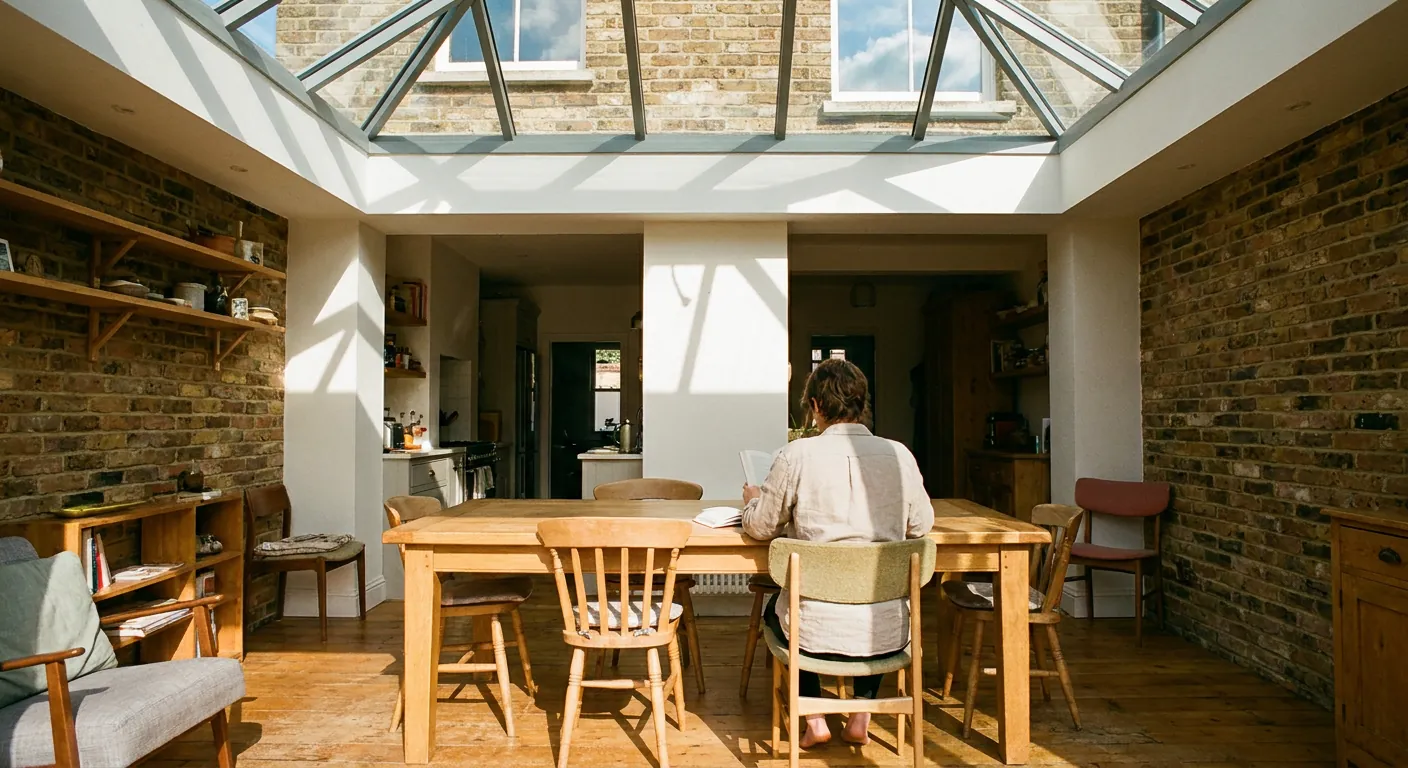
Start with your day, not the floor plan
The best place for a lantern skylight is decided by when the kitchen is busy. Map the hours first, then put the glass where those hours happen.
A kitchen extension plan tempts you to centre the lantern in the roof because it looks tidy on paper. The room does not work like the drawing, though. One household makes coffee at the counter at 7am, works at the table through the morning and cooks at the hob from 6pm. Another barely uses the kitchen until the evening and then lives in it until late. The same room, with the same roof, wants the rooflight in a different place for each of them.
A useful exercise is to write down the three or four activities that fill most of your time in the room and the rough hours of each: breakfast, homework, cooking, eating, sitting with a drink at the end of the day. Then mark where in the room each one happens. The spot that collects the most hours, especially in winter when daylight is short, is the first candidate for the lantern. The light planning page explains how we turn that into a written light plan at the survey.
How the sun moves over a Cambridge kitchen
The sun climbs to about 61 degrees above the horizon at midday in late June in Cambridge, and only about 14 degrees in late December. That single fact decides where a lantern's patch of sunlight falls.
- Winter solstice, about 14°. The lowest noon sun of the year travels furthest: it crosses the whole room and lands high on the back wall.
- Spring and autumn equinox, about 38°. The light lands on the floor, deep in the room.
- Summer solstice, about 61°. The highest, strongest sun drops steeply and lands close under the window.
- South-facing roof window. The same opening lets in a different patch of light every month.
- Deepest reach. In December the sun patch can be on the wall opposite, which is why we plan where it falls, not just how big the glass is.
Sky light through a lantern is fairly even, so the area directly beneath it is always the brightest part of the room. Direct sun behaves differently. It comes through the glass at an angle and lands on the floor or worktop some distance away from the opening, on the side opposite the sun. The lower the sun, the further the sun patch travels.
Take a lantern whose glass sits roughly 2.2 metres above a worktop, which is typical once you add the ceiling height, the upstand and the lantern frame. The table gives a guide to how far from the point beneath the lantern the midday sun patch lands.
| Time of year | Midday sun height | Sun patch lands |
|---|---|---|
| Late June | About 61 degrees | Roughly 1.2m away |
| March or September | About 38 degrees | Roughly 2.8m away |
| Late December | About 14 degrees | High on a wall, if at all |
These are geometry, not promises: the lantern's hips, glazing bars and light well all trim the beam. The point is that summer sun stays close to the lantern, while spring and autumn sun spreads well across the room. Because Cambridge sits on flat ground with few hills to shade an extension roof, the sun reaches the glass for most of its path, so this movement is fuller here than in a valley town.
Matching the position to the hours you use
Once you know when each part of the kitchen is busy, the sun tells you which of them should sit under the glass and which should sit beside it.
Morning use favours the side of the room that catches the east and south east sky. If breakfast and working at the table are your busiest hours, a lantern towards that side gives bright early light, and the sun patch moves off the table as the day goes on. In summer the sun rises in the north east in Cambridge, so even a north facing extension can catch some early sun through the lantern's glass.
Evening use is harder. The sun sets in the north west in June and stays low for hours, which sends long, warm light deep into a west facing kitchen. A lantern placed directly over the hob or the sofa end of a west facing room can bring glare across a screen or into your eyes while you cook. Setting the lantern a little back from where you stand, so the late sun lands on the floor or a wall instead of your face, usually works better. The guide to heat and glare under a roof lantern covers the glass and blinds that help.
All-day use, such as a family kitchen where someone is home most of the time, favours a position that gives even light over the whole working area rather than a bright spot in one corner. That may point towards a longer, narrower lantern running across the room, and the roof lantern orientation guide explains how the direction of the ridge shapes the spread.
What the building decides before the sun does
The ideal spot for the light still has to be a spot the roof can take. A few fixed things narrow the choice, and it is better to know them early.
- Joists and steels. The opening has to be framed, and a steel beam or the line of the old rear wall may rule out part of the roof. The guide to the structural opening sets out what an engineer or builder decides.
- Party walls and boundaries. On a terrace or semi, Building Regulations fire guidance generally keeps roof glazing back from the line of a party wall, so a lantern hard against the neighbour's side may not be allowed.
- The extractor. A ducted cooker hood needs a route out, and steam gathering in a lantern right above the hob makes condensation more likely.
- Drainage falls and outlets on the flat roof, which the upstand must not block.
Sizing then follows position. The roof lantern size guide explains how the room and roof area set the dimensions once the location is fixed.
Weighing up island, table and hob against the clock
The usual targets are the island, the dining table and the cooking area. Each is a good home for a lantern only if it is busy at the hours the lantern serves it well.
The kitchen extensions guide looks at each position in detail. Here the question is simpler: which one fills your day? A table used for breakfast and homework in a south facing Romsey terrace extension often wins, because it gets both the daytime sky light and the long spring sun. An island that is only a landing spot for shopping bags does not need the lantern above it, however central it is. In a north facing side return in Chesterton, where the sun rarely enters directly, you can put the lantern exactly where you want the most light without worrying about glare. The answer on north facing extensions explains why.
If you are still deciding, the roof lantern installation page shows how we set the position, size and glass together at the survey, and you can book a light survey to have it checked in your own kitchen.
Questions people also ask
Should a roof lantern be centred in the kitchen ceiling?
Only if the centre is where you spend your time. A centred lantern looks balanced, but it can leave the table or worktop you use most in shadow. Place it for use first, then adjust for symmetry with the doors and units where there is room.
Is it a bad idea to put a roof lantern over the hob?
Not always, but it brings steam and heat straight up into the glass, which raises the risk of condensation and makes an opening vent more useful. A position slightly to one side of the hob, with a good extractor, is often more comfortable. See whether roof lanterns can open.
Does the lantern need to line up with the bifold or sliding doors?
No. Lining it up can look neat from the garden, but doors already light the part of the room nearest them. A lantern set further back into the plan balances the light and brightens the deep end of the room where daylight is weakest.
Can the position change after the extension is built?
It is far easier to fix before the roof is framed. Moving an opening later means new trimming, a new upstand and remaking the roof covering, so settle the position while the extension is still on paper.
