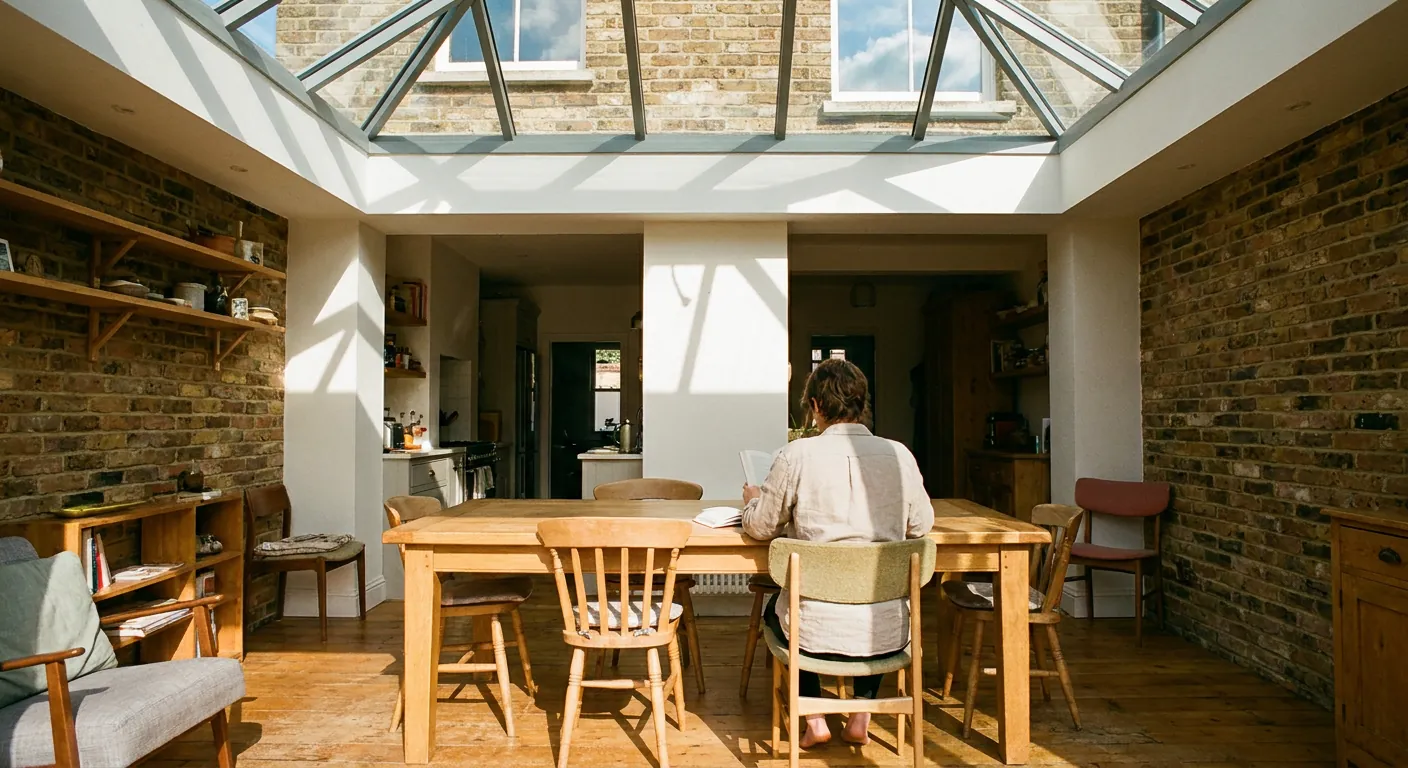
What a lantern changes when a house goes on the market
A buyer does not price a lantern separately. They price a room, and the lantern decides whether that room reads as the best space in the house or as a dim box added to the back.
Think about a common Cambridge case: a Victorian terrace in Romsey or off Mill Road with a single-storey kitchen extension across the back. Without roof glazing, the middle of that plan can sit five or six metres from the nearest window, and the old dining room behind it goes darker than it was before the extension was built. A lantern puts daylight into the centre of the plan, where wall windows cannot reach, so the whole ground floor opens up. The same applies to a 1930s semi with a deep rear extension, or a village cottage where the back room has one small window.
Three things follow from that. The listing photographs are brighter and need less artificial light, so the kitchen looks like the room a buyer wants. The viewing itself feels more generous, because overhead light and the extra height of the light well make a room feel larger than its floor area. And the agent has a feature to describe that buyers already search for. None of that is a number, but together they shape which houses get second viewings.
What a lantern will not do is turn a modest extension into a larger one on paper. Value follows floor area, location and condition first. The lantern improves how well the space you already have is used and presented. For the broader trade-off between cost and light, see are roof lanterns worth it.
Why nobody can honestly give you a percentage
You will see claims that a lantern adds a set percentage to a sale price. Treat them with caution, because there is no reliable way to separate a lantern from the extension it sits on.
A house sells as a whole. Two otherwise identical terraces on the same street rarely come up at the same time with only the roof glazing different, so the effect cannot be isolated in sale records. Any figure you read is an estimate or a marketing line. A local estate agent who knows your street is the right person to ask how buyers there respond to a light, open kitchen, and a surveyor valuing the house will look at the extension as a whole rather than itemising the lantern.
What can be said with confidence is the reverse: features that make a room uncomfortable or raise questions in the legal pack tend to cost a seller time, goodwill or money in negotiation. That is where the value in a lantern is protected or lost.
Where a lantern can work against you
A lantern chosen only for its looks can become a point that a buyer's surveyor or a second viewing picks up. These problems are decided at the design stage.
- Overheating. A large lantern with clear glass over a south-facing kitchen can make the room hard to use on a July afternoon, and a buyer viewing on a hot day notices. Solar control glass, an opening vent and the right size avoid it; our page on whether roof lanterns make a room hot explains why.
- Condensation and cold. An older lantern with streaming glass in winter, or a cold draught falling from it, suggests poor glazing. Modern units deal with this, as covered in are roof lanterns energy efficient.
- Proportion. An oversized lantern with heavy bars can dominate a small extension, and one that is too small looks like an afterthought. The roof lantern size guide covers how size relates to the room.
- Tired frames and misted panes. A failing lantern reads as a job the buyer will have to do. Replacing it with a modern unit before selling is sometimes worth pricing up.
The paperwork a buyer's solicitor will ask for
A lantern added to a new or existing roof usually forms part of work that needs Building Regulations approval, and the completion certificate is one of the documents a buyer's conveyancer is likely to request.
Building Control looks at the structure around the opening, the thermal performance of the glazing under Part L and safety glazing overhead. When the work is notifiable, we handle the Building Control notification so the sign-off exists when the job is finished. Without it, a sale can stall while the seller arranges a regularisation application or an indemnity policy, which is exactly the kind of friction that eats into whatever the lantern added.
Planning is usually simpler. A lantern on a rear extension is normally covered by permitted development as part of that extension, and a lantern added to an existing flat roof should not project more than 150mm above the roof plane. In a conservation area, or on a listed building, the answer can change. Our page on planning rules for roof lanterns sets out the detail. Keep the drawings, the glass specification and the guarantee paperwork in the house file; our 10-year workmanship guarantee covers the installation work, and the glass and frame carry the manufacturer's own warranty.
Choices that tend to hold their appeal
If resale matters to you, the safe choices are the ones that keep the room comfortable in every season and look settled on the house.
| Choice | Why it holds appeal |
|---|---|
| Aluminium frame | Slim bars, crisp lines, long life |
| Solar control glass | Room stays usable in summer |
| Neutral frame colour | Suits most kitchens and gardens |
| Plastered light well | Looks built in, not added on |
| Over the room's centre of use | Light lands where people sit |
Frame material shows at viewings: see aluminium vs uPVC roof lanterns. So does the internal finish; a lantern set in a neatly plastered well reads as part of the architecture. Position is the choice people get wrong. A lantern over the table or island, placed with the sun path in mind, gives the room a bright centre, while one pushed to an end wall lights a corner. That is the work our light plan does before anything is ordered. For what drives the cost of the whole job, see skylight and rooflight costs, and for the service itself, our roof lantern installation page. When you are ready, book a light survey.
Questions people also ask
Is a roof lantern better for resale than a flat rooflight?
Neither is better in every case. A lantern adds height and a strong focal point, which suits a kitchen or orangery; a flat rooflight is quieter and can suit a narrow side return. The roof lantern vs flat rooflight guide compares them on the same roof.
Should I replace an old lantern before selling?
If the glass is misted, the frame is discoloured or the room is cold under it, a buyer will notice. Get a quote and weigh it against what an agent says the condition is costing you. Where the existing upstand is sound, a replacement lantern can often sit on it.
Does a lantern skylight add value to a house in a conservation area?
The same principles apply, with one addition: make sure the position and profile were acceptable in planning terms, because a buyer's solicitor may ask. A lantern on a rear extension that cannot be seen from the street is usually the least contentious.
Will a buyer care which way the lantern faces?
Not in so many words, but they will notice the result: an evenly lit kitchen without glare on a sunny viewing, or one that is too hot or too dim. Orientation drives that, which is why it is planned first.
