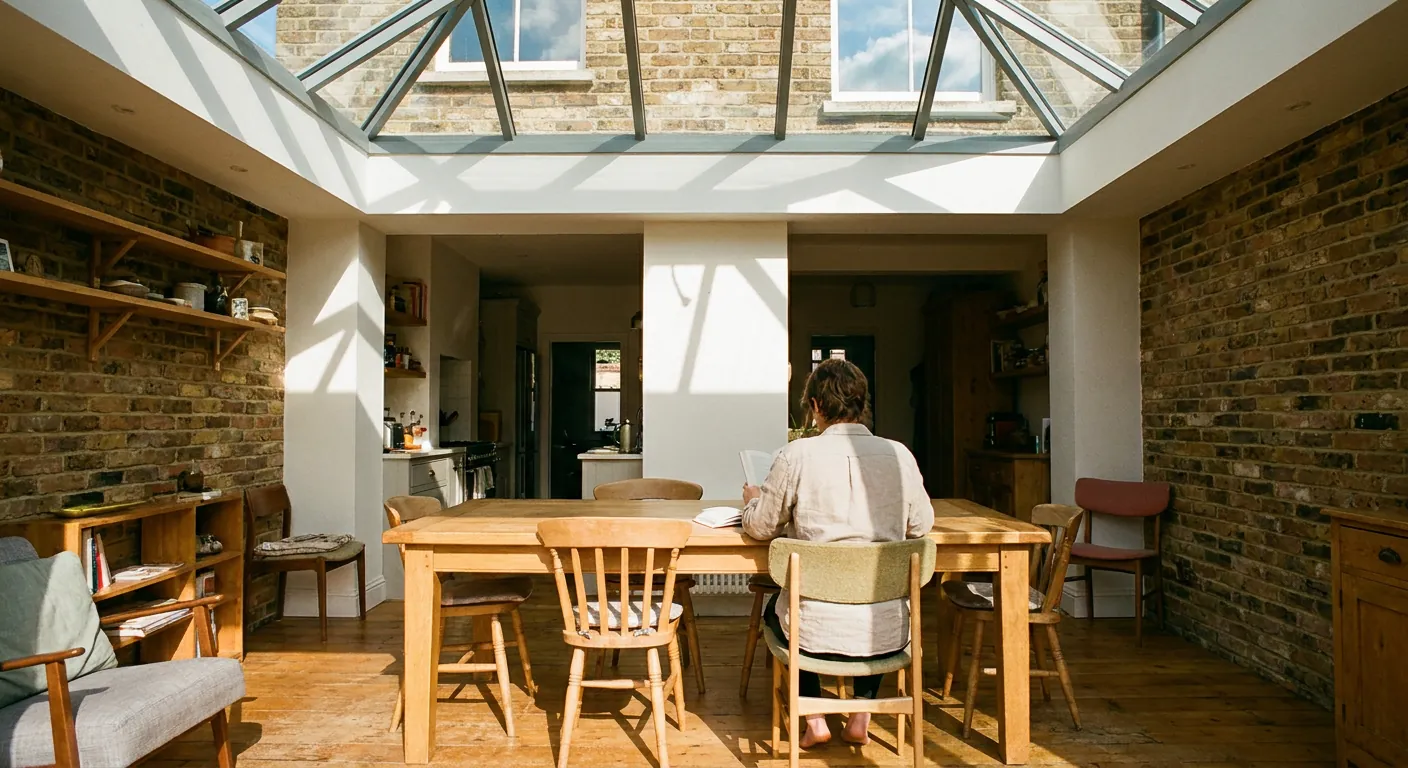
What you are actually paying for
A lantern buys two things a wall window cannot: daylight arriving from above into the centre of the room, and a raised glass volume that lifts the ceiling line where you stand.
Overhead glazing sees the brightest part of the sky, the zenith, while a window in a wall sees the horizon, the garden fence and the house next door. Area for area, glass in the roof therefore delivers more daylight to the floor than glass in a wall, and it delivers it to the middle of the plan rather than the first two metres inside the window. That matters in Cambridge, where the ground is flat and there are few hills to shade a roof: a lantern here sees almost the whole sky and the whole arc of the sun, which is a gift in February and something to manage in July.
The second thing is harder to measure and is the reason people choose a lantern over a flat pane. The hipped glass rises above the ceiling, so from underneath you look up into a small bright room of its own. The extension reads as taller and more open, and you see sky and passing cloud rather than a flat panel. Our answer on whether a lantern makes a room feel bigger goes into how much height it adds and when it tips into feeling top-heavy.
Against no roof glazing at all
For a single-storey rear or side-return extension more than about four metres deep, roof glazing is the difference between a room lit from one end and a room lit throughout.
Take a gault brick terrace in Romsey or off Mill Road where the kitchen has been pushed out into the side return. Bifold or sliding doors at the garden end light the table nearest the glass well. Four or five metres back, where the old back wall stood and where the hob or island tends to end up, daylight has fallen away sharply, and the lights go on at eleven in the morning in winter. A lantern placed over that inner zone brings daylight to the part of the room the doors never reach, and it also lights the join with the original house, which is otherwise the darkest spot in the plan.
Leaving the roof solid is a fair choice in a few cases. A shallow extension, under three metres or so from front to back, can be lit well by generous wall glazing alone. A room used mainly in the evening gains less from daylight. And a solid roof is simpler to insulate and costs less to build. If none of those apply, the question is less whether to glaze the roof and more which kind of roof glazing suits the room.
Against a flat rooflight on the same roof
A flat skylight gives similar daylight for a lower outlay; the lantern earns its extra cost through height, a view of the sky and the way it looks, not through a big jump in light.
Because both sit in the roof and look at the same sky, a flat rooflight and a lantern of the same footprint let in daylight of a similar order. The lantern's sloping sides catch more low morning and evening sun, which can be pleasant on an east or west aspect and a nuisance on a south one. The real differences are elsewhere, as the table sets out.
| Point | Roof lantern | Flat rooflight |
|---|---|---|
| Feel from below | Raised, sense of height | Clean, flush ceiling |
| Outside profile | Visible above the roof | Low, barely seen |
| Frame and glass | More bars, more panes | One pane or a few |
| Relative cost | Higher | Lower |
Looks matter here too. On a contemporary extension at Trumpington Meadows or Great Kneighton, a frameless flat rooflight can suit the crisp lines better than a traditional hipped lantern. On an orangery or a brick extension behind a 1930s semi, the lantern tends to look at home. The full comparison is in roof lantern vs flat rooflight.
What pushes the cost up or down
A lantern's price is set less by the glass box itself than by the opening it sits in and the choices made around it, so the same size can vary widely from one house to the next.
- The structural opening. Trimming joists in a new extension roof is straightforward; forming a large opening in an existing roof can need a steel frame and an engineer. See the structural opening for a roof lantern.
- Size and proportion. Larger lanterns need heavier bars, heavier glass and more handling on the day. The roof lantern size guide explains why bigger is not automatically brighter in a useful way.
- Frame material. Aluminium gives slimmer bars and longer spans; uPVC costs less with chunkier sightlines.
- Glass. Solar control, self-cleaning coatings and triple glazing each add cost and each change what the room feels like. Roof lantern glass options compares them.
- Vents, blinds and the inside finish. An opening vent, fitted blinds and a plastered light well all sit on top of the lantern price.
For general UK market ranges and why a survey sets the real figure, see our page on skylight and rooflight costs.
When a lantern is the wrong answer
A lantern disappoints when it is too big for the room, placed over the wrong zone or fitted on a hot aspect without the glass to control it.
A small utility room or a narrow side return under 2.4 metres wide can feel crowded by a raised lantern; a flat rooflight or two gives the light without the bulk. A lantern added to the existing flat roof of a house, rather than as part of a new extension, may be limited in height under permitted development, and in a conservation area the visible profile can count against it; the planning rules for roof lanterns cover both. The regret that bites hardest, though, is heat. A large lantern with clear glass over a south-facing kitchen will overheat on a still July afternoon, however good the frame.
This is why we plan the light before we price the lantern. At the survey we look at which way the extension faces, where the sun falls through the day and the year, and where you cook, eat and sit, then put the position, size and glass in a written light plan with the quote. If the plan says a flat rooflight would serve the room better, that is what it will say.
Questions people also ask
Does a roof lantern add value to a house?
A well-proportioned lantern makes an extension brighter and more memorable in photographs and on viewings, which helps it present well. Whether that turns into a higher sale price depends on the house and the market, so treat it as a benefit to living in the room first. More on this in does a roof lantern add value.
Is a lantern worth it on a north-facing extension?
Yes, and arguably more so. A north-facing rear room gets little direct sun through its doors, and a lantern brings in steady, soft sky light without the summer heat problem, so you can choose clearer glass. See north-facing extensions.
Is a lantern better value than bigger bifold doors?
They do different jobs. Wider doors brighten the garden end and connect the room to the outside; a lantern lights the middle and back of a deep plan. In a long extension, a modest lantern plus standard doors will light the whole room better than doors alone.
How do I know if my extension suits a lantern?
Book a light survey. We check the roof structure, the aspect and how you use the room, and tell you whether a lantern, a flat rooflight or no roof glazing gives the better result. Details are on our roof lantern installation page, or book a light survey now.
