Two ways to glaze the same opening
A roof lantern and a flat rooflight can sit over exactly the same hole in an extension roof. One raises a small pitched glass roof above it; the other lays a single sheet of glass across the top, and that choice changes the height, the light, the heat and the look of the room.
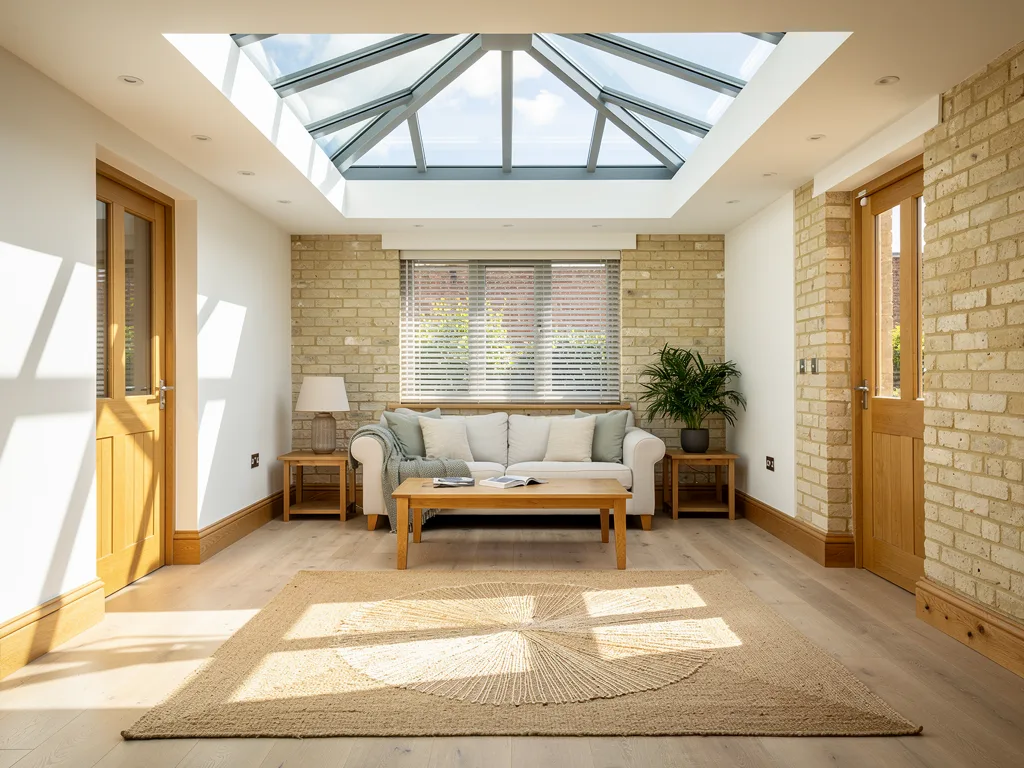
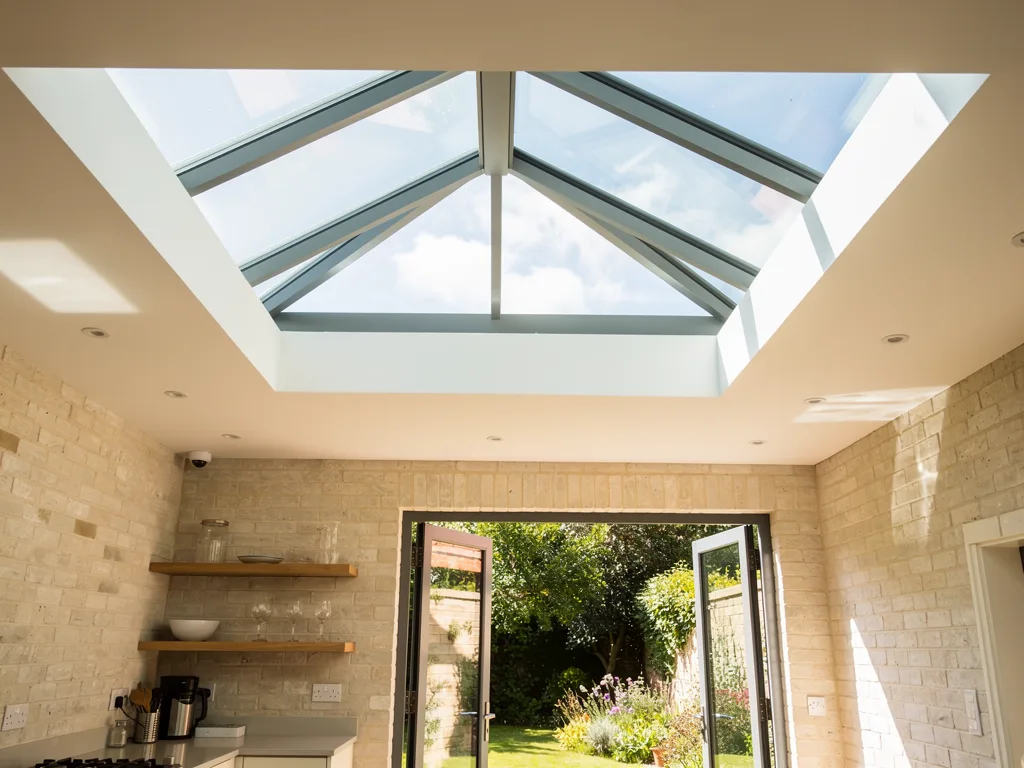
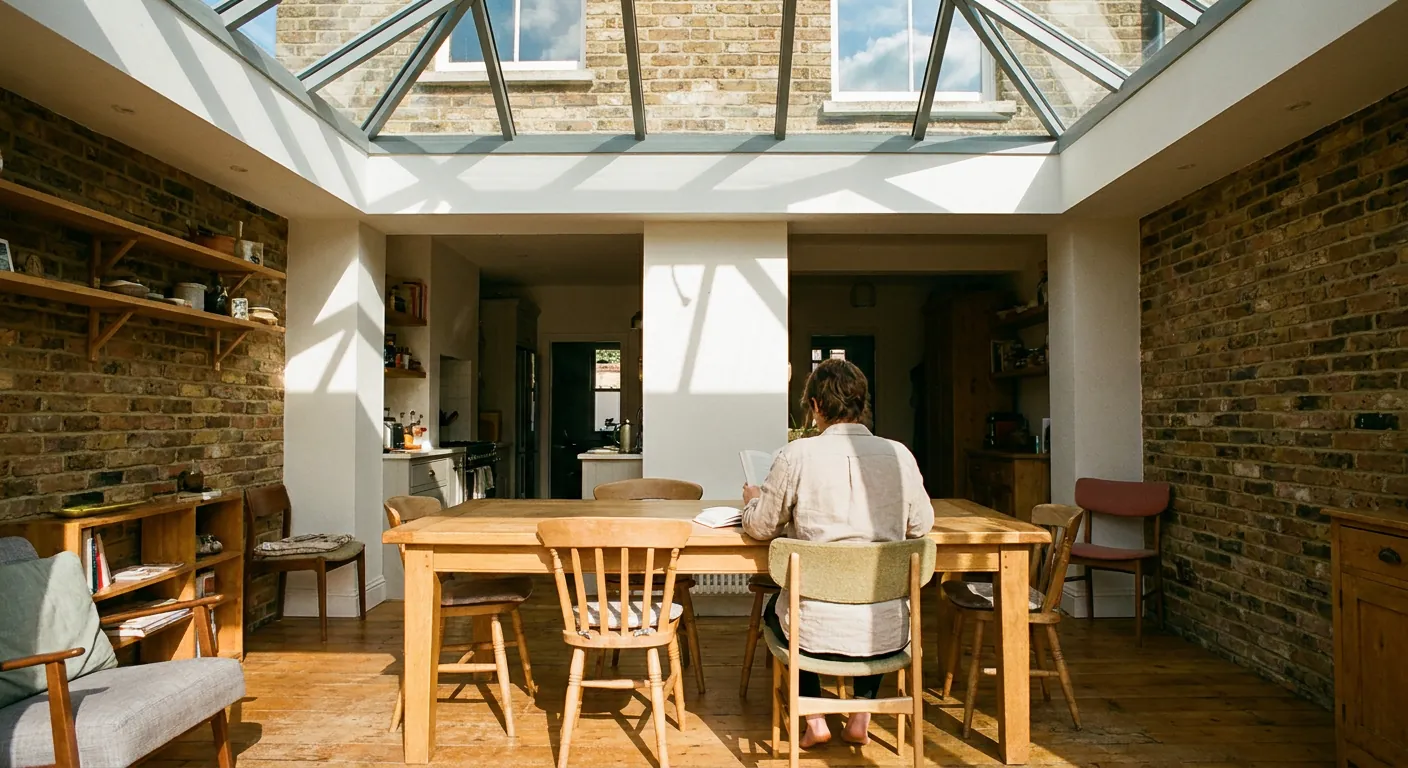
A roof lantern is a framed structure: a perimeter frame fixed to an upstand, a ridge, hips and glazing bars, with sealed glass units set between them at a pitch. Seen from the garden it reads as a small glass roof of its own. Seen from below it is a tent of glass that lifts the ceiling up into the sky.
A flat rooflight, or flat skylight as it is often searched for, is one sealed glass unit sitting on a kerb. It is not truly flat: the kerb or the unit is built to a fall of at least 5 degrees so rain runs off rather than sitting on the glass. It comes framed, with an aluminium or uPVC frame around the edge, or frameless, where the glass is bonded to the kerb and the edge disappears from inside. From the garden it can be almost invisible. From below it reads as a clean rectangle of sky cut into the ceiling.
Both need the same basic things underneath: a structural opening formed in the roof, an upstand at least 150mm above the finished roof surface, and a properly weathered joint between the unit and the roof covering. The comparison that follows assumes the same extension roof, the same opening and the same room, and asks what changes when you put one on it rather than the other.
Height above the roof and height inside the room
A lantern adds height in both directions: it stands proud of the roof outside and it opens a tall, glazed volume above the ceiling inside. A flat rooflight adds almost none, and its light arrives through a well no deeper than the roof itself.
Lantern height is set by span and pitch. Most lanterns sit at around 20 to 25 degrees, which you can read more about on what pitch a roof lantern is. On a lantern about 2 metres wide, that pitch lifts the ridge roughly 350 to 500mm above the eaves of the lantern, and the upstand and ridge cap add to that. A 3 metre wide lantern rises proportionally further. On a single-storey rear extension with a parapet, much of that can hide behind the wall. Without a parapet, the lantern is a visible part of the elevation from the garden and from the bedroom windows above.
Inside, that height is the reason people choose a lantern. The ceiling over the opening lifts by the depth of the roof build-up plus the height of the lantern itself, so standing under it you look up into a pitched glass space. In a kitchen extension with a 2.4 metre ceiling, it gives the middle of the room a sense of volume the flat ceiling around it does not have. The page on whether a roof lantern makes a room feel bigger goes further into when that works and when it overwhelms a small room.
A flat rooflight gives you no extra volume. The glass sits at roughly the level of the roof surface, so the opening you see from below is a light well as deep as the joists, the insulation and the kerb put together, commonly somewhere around 300 to 450mm on a modern warm roof. That depth matters more than people expect. A deep, straight-sided well narrows the spread of light, while splaying the plastered reveals outward at the bottom widens it and makes the opening look larger than the glass. On a low extension where the ceiling is already tight, a flat unit keeps the ceiling line calm and uncluttered.
Height also feeds into planning. A lantern added to an existing flat roof often projects further above the roof plane than the 150mm permitted development allows for rooflights, while a lantern built as part of a new extension is judged with the extension. The planning rules for roof lanterns set out where the lines fall; if the house is in one of the many Cambridge conservation areas, it is worth checking the position with Greater Cambridge Shared Planning before you settle on a raised unit.
How the light spreads through the day
The two units look at different parts of the sky. A flat rooflight faces straight up at the brightest part of an overcast sky; a lantern's sloping panes also face the lower sky on each side, which is where the sun sits for much of a Cambridge winter.
Cambridge sits at about 52 degrees north. At midday in late June the sun climbs to roughly 61 degrees above the horizon; at midday in late December it reaches only about 14 degrees. That difference drives most of what follows.
On a grey day, which is a large part of the year in East Anglia, the sky is brightest directly overhead. Under the standard overcast sky used in daylight design, the zenith is about three times as bright as the horizon. A flat rooflight looks straight at that bright patch, so for its size it delivers a strong, even, shadowless light to the floor below it. This is one reason a flat unit performs well on a north-facing extension or in a deep terrace kitchen where the sky is the only light source worth having.
When the sun is out, the picture changes. In summer the high sun shines almost straight down through a flat pane, throwing a crisp, bright patch onto the floor or worktop that moves slowly across the room. In winter the low sun strikes the flat glass at a shallow, grazing angle, and a large share of that light is reflected off the outside of the glass rather than passing through. A flat rooflight in December gives you sky light, but very little direct sun.
A lantern's pitched panes meet that low winter and early-morning sun at a steeper angle, so more of it comes through. A lantern with a ridge running east to west presents one long slope to the south and catches the winter sun across the middle of the day; the same lantern turned north to south gives you a morning face and an evening face instead. The guide to roof lantern orientation works through what each alignment does on a flat Cambridge roof with nothing to shade it.
The spread inside the room differs too. Light from a lantern enters at the top of a tall glazed volume and has further to travel before it reaches the floor, so it fans out across a wider area, and the glazing bars break any direct sun into softer bands. Light from a flat rooflight arrives as a more concentrated column. Neither is better in the abstract. A column of light over a dining table can be exactly right; a wide wash over a kitchen and sitting area might be what the room needs.
Heat, glare and cold
For the same opening, a lantern has more glass and more frame than a flat rooflight, so it gains more heat in summer and loses more in winter. How much that matters depends on orientation and on the glass you choose.
A lantern over a 2 by 3 metre opening carries more than 6 square metres of glass, because the sloping panes are longer than the opening they cover and the hipped ends add more. Every square metre of glass is a route for solar gain on a bright afternoon and for heat loss on a frosty night. The bars and ridge add edges, and edges are where glazing is coldest and where condensation first appears in a steamy kitchen.
A flat rooflight over the same opening has roughly the plan area of glass and far fewer edges, especially if it is frameless. Its thermal performance for a given opening is usually easier to push down, and triple glazing is simpler to build into one flat unit than into a lantern frame. Current Building Regulations (Part L) set a limiting U-value of 2.2 W/m²K for rooflights, measured in the horizontal plane, and both a good lantern and a good flat unit meet it comfortably. The difference shows in the whole-room balance rather than in a pass or fail.
In high summer the balance tips the other way at midday. The overhead sun hits a flat pane almost square on, which is the angle at which glass transmits the most heat, while a lantern's pitched panes meet it at more of a slant. By late afternoon on a west-facing extension, though, the lantern's western slope faces the low sun directly, and that is when an unshaded lantern can make a kitchen uncomfortable. The page on controlling heat and glare under a roof lantern ranks the glass, vent and blind choices by how much each helps.
How each one looks, inside and out
A lantern is a feature you are meant to notice; a frameless flat rooflight is designed to be noticed as little as possible. The house and the room decide which of those is right.
From the garden, a lantern gives an extension a roofline of its own. On an orangery, or on a brick extension behind a Victorian or Edwardian house, a hipped lantern with slim bars suits the proportions of the older building. On a crisp contemporary box, particularly the heavily glazed new homes around Eddington, Trumpington Meadows and Great Kneighton, a raised lantern can look like an object added afterwards, and a low-profile or flat unit often sits more naturally. The roof lantern styles guide covers the lower, more contemporary lantern shapes that close part of that gap.
From above matters too. In the terraces of Romsey, Petersfield and around Mill Road, a side-return extension is overlooked by your own back bedrooms and by the neighbours on both sides. A flat rooflight reads from an upstairs window as a quiet panel of glass. A lantern reads as a glass roof with a ridge, which is lovely in the right place and a little busy in a narrow slot between two walls.
From inside, the difference is what you see when you look up. Under a frameless flat rooflight you see sky, cloud and the occasional bird, with nothing in the way. Under a lantern you see the structure: the ridge, the hips, the bars and the pitched glass, framing the sky in segments. Some people love that geometry, especially at night with the ridge lit; others find it busy in a small room. Frame colour changes how strong the pattern looks, and a white or pale grey inside finish softens it considerably.
What drives the cost of each
Neither type is simply the cheaper option. The price of each is driven by different things, and on a real project the building work around the unit can outweigh the difference between the units themselves.
With a lantern, the frame is the larger share: a ridge, hips and bars made to size, several sealed units of different shapes, and a more involved weathering detail where the frame meets the upstand. Larger lanterns may need a steel frame or trimmed joists to carry the opening, and the internal finish around a lantern (a plastered well or a pelmet) takes longer to form well. Blinds for a lantern are made to measure for each pane, which adds to the total if the room will need them.
With a flat rooflight, the glass is the larger share. One large sealed unit, particularly triple glazed or with solar control or laminated layers, is heavy and can need lifting gear to reach the roof. Frameless units cost more than framed ones of the same size because the glass itself does the structural work. An electric opening unit or a walk-on rating adds more.
Both share the costs that people forget: forming the structural opening, building or adapting the upstand, making good the roof covering, plastering the reveals, and any Building Control notification. For a guide to general market ranges, the skylight and rooflight costs page lays out what moves the figure. The real price comes from a survey of the actual roof.
Opening, blinds and keeping the glass clear
Day-to-day use differs between the two. Lanterns take vents in their pitched panes; flat rooflights open as a whole unit. Blinds are simpler on a flat pane, and a lantern sheds rain and dirt more readily.
Ventilation matters most in kitchens, where warm, damp air rises and collects at the highest point of the ceiling. A lantern's apex is exactly where that air gathers, and a vent in one of the upper panes lets it out. Whether roof lanterns can open covers manual and electric vents and how many a kitchen needs. A flat rooflight can open too, usually on electric actuators with a rain sensor, and the whole pane lifts to vent; but a fixed flat unit cannot purge any moisture at all.
Blinds are easier to fit to one flat plane than to a set of pitched and triangular panes. A single motorised pleated or roller blind can cover a flat rooflight neatly. A lantern needs a blind for each pane, which is perfectly possible but more involved; see whether roof lanterns need blinds for when they are worth having.
Cleaning favours the lantern slightly. Its 20 to 25 degree slopes shed rain quickly, and self-cleaning glass works well at that angle. A flat rooflight at its minimum 5 degree fall drains, but slowly, so dust, leaves and pollen from the trees in many Cambridge gardens tend to collect along the lower edge. Self-cleaning glass helps on a flat unit, though it works best with steady rain running across it.
Side by side on the same extension roof
With the detail set out, the two types line up like this. Treat it as a guide to the tendencies of each, not a ruling for your roof.
| Factor | Roof lantern | Flat rooflight |
|---|---|---|
| Height outside | Stands well proud | Low, close to roof line |
| Feel inside | Tall, vaulted volume | Calm ceiling, light well |
| Overcast light | Good, wide spread | Strong, from brightest sky |
| Low winter sun | Catches more | Reflects much of it |
| Summer midday heat | More glass, slanted panes | Less glass, sun square on |
| Look from above | A glass roof with a ridge | A quiet glass panel |
| Blinds | One per pane | One for the unit |
| Rain run-off | Quick | Slow at 5 degrees |
A few situations tend to point one way. A narrow side return on a terrace, overlooked from above and lit mainly by the sky, often suits a long flat rooflight or two. A wide kitchen-diner on a detached or semi-detached house, with room for a feature and a south or east aspect, is where a lantern earns its height. A north-facing extension does well with either, since heat is rarely the problem there, so the choice comes down to looks and volume. A small room with a low ceiling can feel crowded under a big lantern but opened up by a flat unit with splayed reveals.
There is no rule that says one roof must have one type. A lantern over the dining table with a slim flat rooflight lighting the dark strip where the extension meets the old house can light a deep plan more evenly than either alone. The roof lantern size guide helps with the proportions if you go that way.
Deciding on your own roof
The better choice comes from the room, not the catalogue: which way the extension faces, what the ceiling height is, where you sit and cook, and how the roof looks from the garden and the windows above.
That is the thinking behind a light survey. We look at the orientation of the roof, the height of the ceiling and the depth of the build-up, where the table, the island and the sofa sit, and when in the day and the year you use each part of the room. We then work out where the sun patch and the sky light will fall under a lantern and under a flat rooflight in the same position, and what glass each would need. How we plan the light explains the method, and every quote comes with a written light plan setting out the position, size, glass and shading we recommend, with the reason for each.
If the answer is a lantern, the roof lantern installation service covers the survey, the upstand, the fitting and the finish, with Building Control handled where the work is notifiable and a 10-year workmanship guarantee on the installation.
Questions people ask
Does a roof lantern let in more light than a flat rooflight?
For the same opening, a lantern has more glass and catches more low-angle sun, especially in winter and early mornings. On an overcast day a flat rooflight, facing the brightest part of the sky, can deliver a very similar amount of light to the floor. The spread differs more than the total.
Is a flat rooflight warmer than a lantern?
Usually, for the same opening, because it has less glass and fewer edges losing heat. A modern lantern with good thermally broken bars and low-E glass is still comfortable in winter; the gap is smaller than it was with older lanterns.
Can I swap a flat rooflight for a lantern later?
Often, if the opening and structure suit the lantern's size and the upstand can be adapted. The extra height above the roof may bring planning into it, particularly on an existing flat roof or in a conservation area, so check that first.
Which looks better on a modern extension?
A frameless flat rooflight or a low-profile lantern tends to suit a crisp, contemporary box. A traditional hipped lantern suits orangeries and extensions on older brick houses. How the roof looks from upstairs matters as much as the view from the garden.