Why a lantern has a direction at all
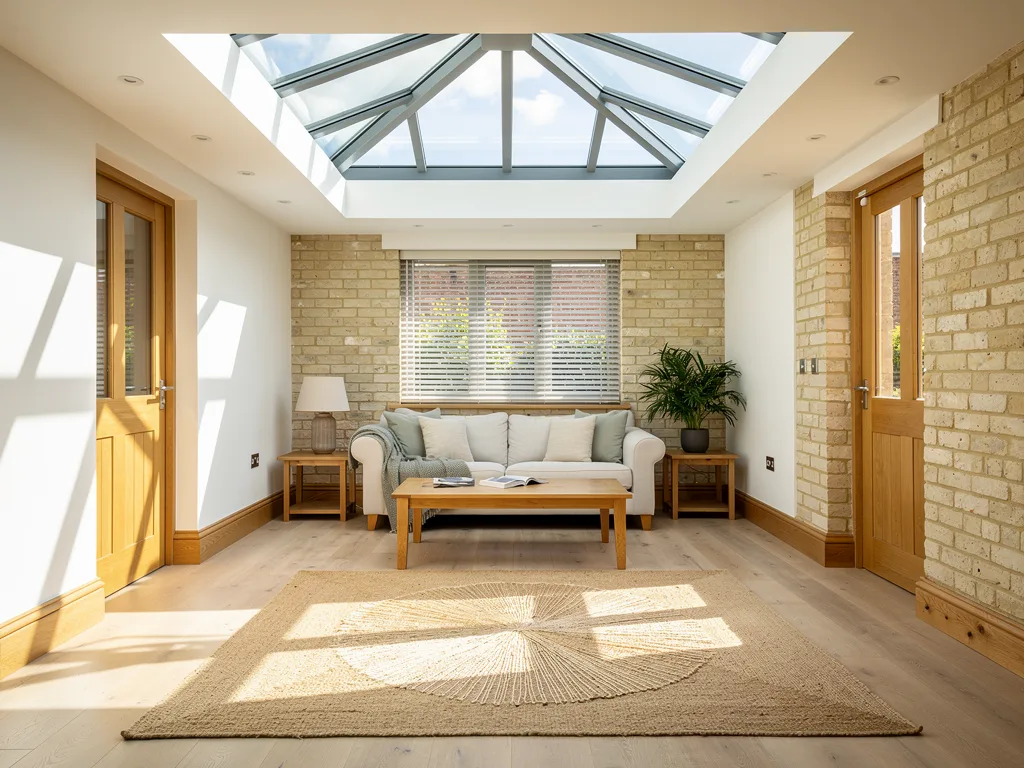
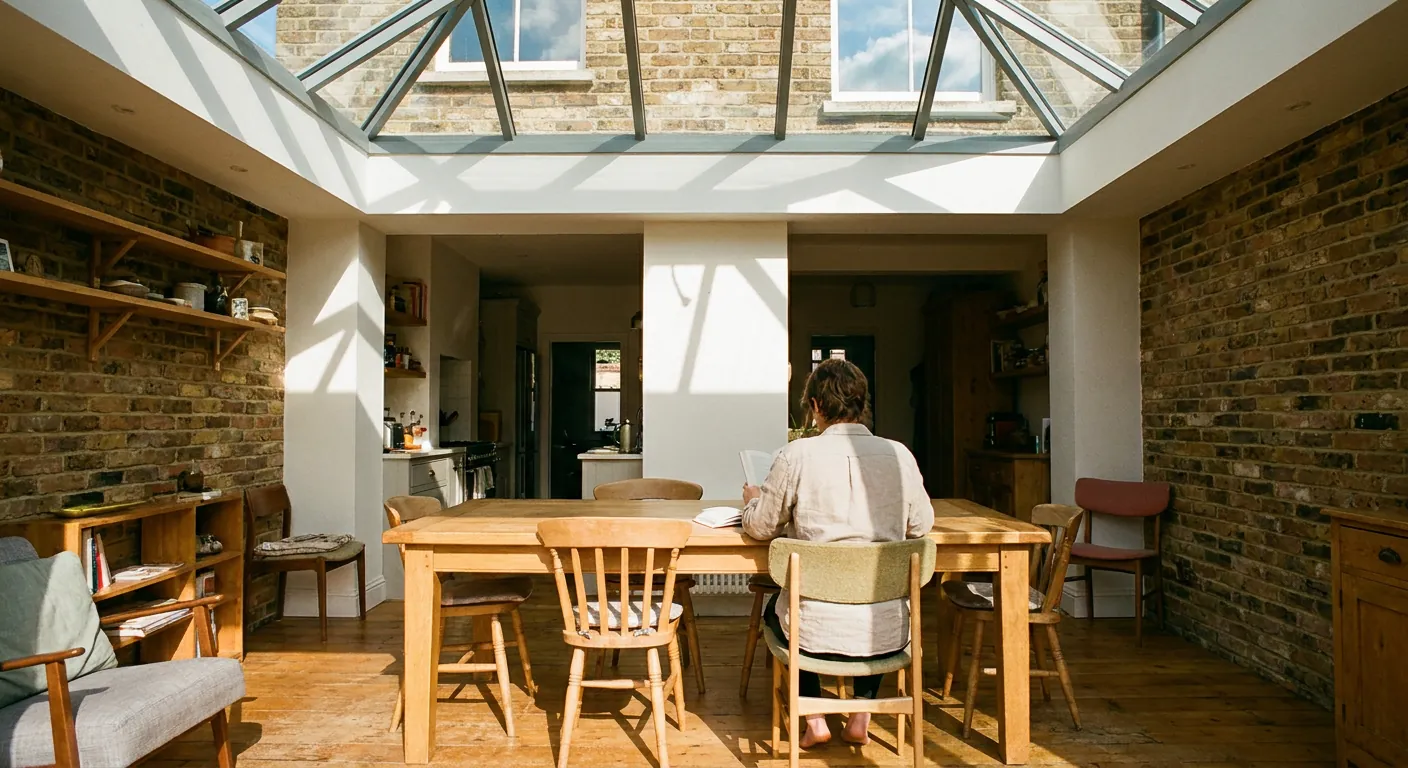
A square roof lantern is a pyramid and looks the same from every compass point, but a rectangular one has a ridge, and the way that ridge runs decides which faces of glass meet the sun and when.
Rectangular lanterns are the usual choice on extensions, because the rooms beneath them are rectangular too. A hipped lantern of 3.0 by 1.5 metres has a ridge along its long axis, two long sloping faces either side of it and two short triangular hips at the ends. With every face at the same pitch, the ridge is 1.5 metres long and the hips each cover a triangle of roof 1.5 metres wide and 0.75 metres deep. Work the geometry through and roughly three quarters of the glass sits on the two long faces. Those long faces are the ones that matter when people talk about roof lantern orientation.
So the question is simple to state. If the ridge runs east to west, the long faces look north and south. If it runs north to south, they look east and west. The same lantern, the same glass and the same room can give a noticeably different day depending on which of those two layouts the extension allows.
The more elongated the lantern, the more it matters. A lantern of 2.0 by 1.8 metres is nearly a pyramid and its orientation barely changes anything. A long lantern of 4.0 by 1.5 metres over a side-return kitchen is close to a strip of glass, and the direction of that strip shapes the light for the whole year. For the range of shapes and how they read from inside, see our guide to roof lantern styles.
The Cambridge sun, season by season
Cambridge sits at about 52 degrees north, which fixes how high the sun climbs and where it rises and sets, and those figures explain almost everything a lantern does.
- Winter solstice, about 14°. The lowest noon sun of the year travels furthest: it crosses the whole room and lands high on the back wall.
- Spring and autumn equinox, about 38°. The light lands on the floor, deep in the room.
- Summer solstice, about 61°. The highest, strongest sun drops steeply and lands close under the window.
- South-facing roof window. The same opening lets in a different patch of light every month.
- Deepest reach. In December the sun patch can be on the wall opposite, which is why we plan where it falls, not just how big the glass is.
The figures below are approximate, for a clear day, and are the ones worth carrying in your head when you think about lantern skylight orientation. Altitude is the sun's height above the horizon at midday; the bearings are measured clockwise from north.
| Season | Midday height | Rises / sets | Daylight |
|---|---|---|---|
| Midsummer | About 61 degrees | North-east / north-west | About 16.5 hours |
| Spring and autumn equinox | About 38 degrees | Due east / due west | About 12 hours |
| Midwinter | About 14 degrees | South-east / south-west | About 7.75 hours |
Three things follow for a lantern. First, in summer the sun spends a long time in the northern half of the sky: it rises in the north-east, swings round through south at a steep angle and sets in the north-west well after 9pm. A north-facing lantern face is not in shade all summer; it catches low sun early and late. Second, at the equinoxes the sun rises and sets on the east to west line, so east and west faces take the morning and evening sun almost square on. Third, in winter the sun barely clears the roofline at midday and stays in the southern sky from rising to setting.
The pitch of the glass softens all of this. A lantern face is typically set at around 20 to 25 degrees, which you can read about in what pitch is a roof lantern. At that angle each face is closer to lying flat than standing up, so a lantern never behaves like a south-facing wall window. Orientation shifts the balance between morning, midday and evening, and it moves the pool of light around the floor. It does not turn a lantern from bright to dark.
A ridge running east to west
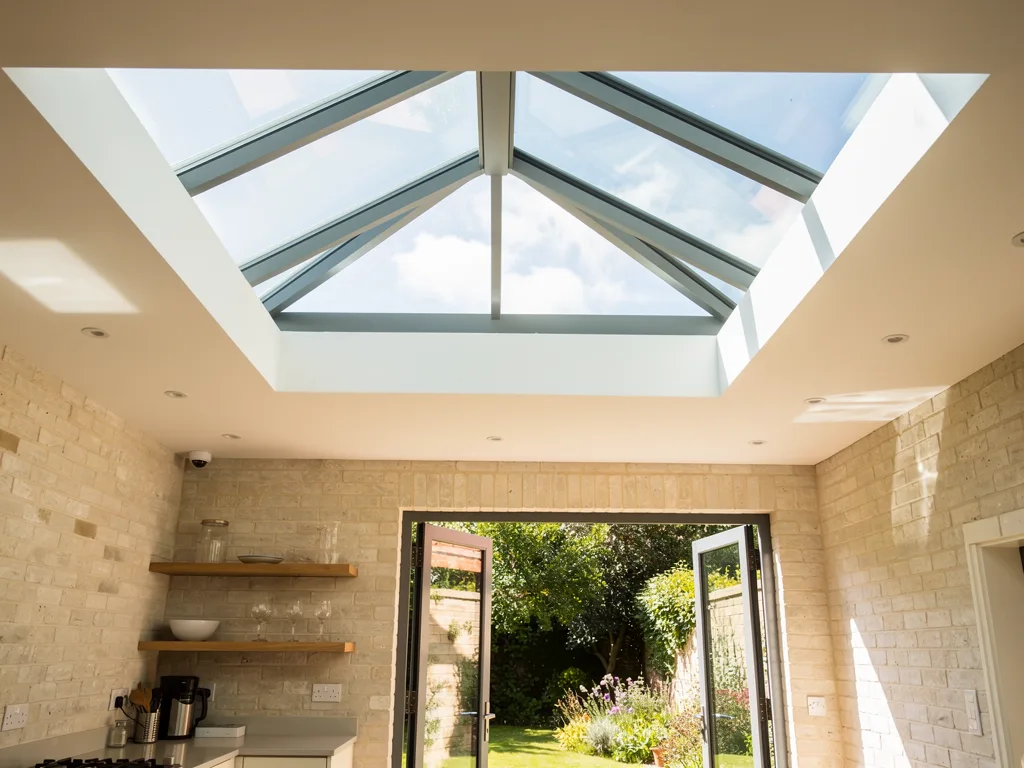
With the ridge on the east to west line, one long face looks south and takes the high midday sun nearly square on in summer, while the opposite long face looks north and gives the room its steady sky light.
At midsummer noon the sun stands about 61 degrees high in the south. A south face pitched at 25 degrees points about 65 degrees up into the southern sky, so the midday sun strikes it almost perpendicularly. That is the moment of greatest solar gain through the glass, and with an east to west ridge the largest single area of glass is aimed at it. For a kitchen used heavily at lunchtime, or a garden room that is occupied through the middle of a summer day, this layout concentrates heat when the room is busiest. The glass and blind decisions then carry more weight, which is the subject of controlling heat and glare under a roof lantern.
The same layout has real winter merits. In December the midday sun is low and in the south, and a south-facing face catches what little direct light there is at a better angle than a flat roof would. The north face, meanwhile, gives an even brightness that does not change much through the day. The two long faces divide the work neatly: one brings the sun, one brings the sky.
In the morning and evening, especially in summer, the low sun comes from the north-east or north-west and meets the lantern along its length. It enters through the hips at the ends and at a glancing angle through both long faces. Because the opening is long in that direction, low sun travelling along it has plenty of room to reach the floor, and the morning and evening sun patches can be long, narrow stripes that stretch across the room.
This orientation suits rooms used most in the early morning and evening, where the midday heat can be handled with the right glass, and rooms that feel dark in winter and need every hour of low southern sun.
A ridge running north to south
Turn the ridge onto the north to south line and the long faces look east and west, which spreads the direct sun more evenly between morning and afternoon and takes the edge off the midday peak.
In the morning the east face does the work. At 8am in June the sun is about 30 degrees high and close to due east, and it meets a 25 degree east face at a good, steep angle. A breakfast table under that face gets bright, warm light early, which suits a kitchen that comes to life early. By mid-afternoon the same thing happens on the west face. At midday the sun comes from the south and falls on both long faces at the same moderate angle, and on the southern hip, which is the smallest face on the lantern. The midday gain is shared rather than concentrated.
The trade-off is the late afternoon and evening. A west face that looks straight at the setting sun from April to August brings low-angle light into the room at the hour when it is hardest to shade and most likely to cause glare, on a television, a screen or across a dining table. The heat that arrives then also lingers into the evening, because the room has had all afternoon to warm up. On a room used mainly after work, a north to south ridge is not wrong, but the west face needs the most thought when choosing glass and blinds. Our answer on whether roof lanterns need blinds sets out which faces benefit most.
A north to south ridge also means the opening is long in the direction the midday sun travels. That lets more of the high summer sun reach the floor at noon, but as a patch that is shorter and closer to square, and it changes the way the light moves through the day, which is the next thing to look at.
Where the pool of light lands through the day
The glass faces decide how much sun enters the lantern; the shape of the opening, the depth of the light well and the height of the room decide where that sun actually lands on the floor and walls.
Direct sun through a lantern does not fall straight down. It lands on the opposite side from the sun, and the lower the sun, the further it travels. Take a room with a 2.4 metre ceiling and a light well of about 500mm between the ceiling line and the base of the lantern frame, a typical depth once current insulation is in the roof. At midsummer noon, with the sun at 61 degrees, the patch lands about 1.3 metres north of the point directly below the opening. At the equinox, with the sun at 38 degrees, the shift is about 3 metres, so in a small room the sun is often on the north wall rather than the floor. In midwinter, at 14 degrees, direct sun reaching the room at all is rare: it lights the top of the north wall of the well and the room receives mostly soft sky light.
The light well also trims the patch. Its south side casts a shadow into the opening whose width depends on the sun's height: about 0.3 metres at midsummer noon, about 0.6 metres at the equinox, and nearly 2 metres in midwinter. This is where the ridge direction comes back in. With an east to west ridge, the opening is narrow from north to south, so the midday sun loses a larger share of its width to the well. With a north to south ridge, the opening is long in that direction and the midday patch survives better, while the low morning and evening sun, coming from the east or west, crosses the narrow dimension and is trimmed harder.
Through a summer day the patch moves in a long arc. Early, with the sun in the north-east, it lands on the south-west side of the room. Around midday it sits north of the opening. In the evening, with the sun in the north-west, it swings to the south-east side. If a kitchen island, a sofa or a desk sits under one of those positions at the time of day it is used, that is where you will feel the orientation. Our answer on where a roof lantern should go in a kitchen uses the same arc to place the opening.
Why Cambridge's flat horizon raises the stakes
On a hillside town, a slope or a line of trees often takes the edge off the early and late sun; across Cambridge and the Fens there is little to stop it, so the low sun reaches the lantern for longer.
The land around the city is some of the flattest in England. Away from the Gog Magog Hills to the south-east, the horizon is close to level in most directions, and a lantern on a single-storey extension sees nearly the whole sky. That has two effects. In summer the sun is on the glass from not long after rising until close to setting, so the early north-east sun and the late north-west sun both play a part that they would not in a valley. In winter the low southern sun is not lost behind a ridge of land, so a south-facing lantern face can pick up direct light in the middle of a clear December day.
The nearer horizon matters more, and it varies street by street. In the Victorian and Edwardian terraces of Romsey, Petersfield, Mill Road and De Freville, a rear or side-return extension usually has the party wall on one side and a neighbour's back addition close by on the other. Those walls are the real horizon. They cut off the low morning or evening sun on one side while leaving the other open, and they often decide the ridge direction indirectly, because the lantern has to fit between them. On a detached house in a village such as Histon or Great Shelford, or on the newer streets at Eddington and Trumpington Meadows, there may be nothing nearby at all, and the lantern takes the full sweep of the sun.
A flat, open setting also means wind finds the roof. The prevailing wind across the region is from the south-west, which is worth keeping in mind when choosing which face carries an opening vent. You can read about vent options in can roof lanterns open.
When the room sets the ridge, and what to adjust instead
In practice the ridge nearly always runs along the long side of the room, so orientation is often decided by the plan of the extension rather than chosen, and the useful work is in the choices that follow.
A lantern that runs across a long, narrow room looks wrong from below and wastes structure, and a square lantern in a long room lights only the middle. So a side-return kitchen that runs front to back gets a lantern that runs front to back, and the compass direction of the house decides the rest. Cambridge streets run in every direction, so two identical terraces a few streets apart can end up with opposite ridge directions from the same plan. Where there is a genuine choice, a room close to square, for instance, it is worth making it deliberately rather than by default.
When the ridge is fixed, these are the levers that change how it behaves:
- Glass by exposure. A south or west long face benefits most from solar control glass with a low g-value. A north-facing lantern can often take a clearer, more neutral glass. The options are compared in roof lantern glass options.
- Position in the room. Moving the opening a metre towards the sunny side of the room shifts the pool of light back over the floor you use, rather than onto the far wall.
- Size. A slightly smaller or narrower lantern on a hot face can give the same useful light with less peak heat. Our roof lantern size guide covers how to settle the figure.
- Shading. Blinds on the exposed long face, or on the whole lantern, handle the hours when orientation works against the room.
- Ventilation. An opening vent near the ridge on the warm side lets the hottest air out where it collects.
A north-facing extension is a special case worth knowing about. There, the lantern is the one part of the room that sees the sun at all, and the orientation question mostly turns into how to get as much sky as possible. Our answer on whether a roof lantern will work on a north-facing extension covers that case in detail.
Reading the orientation of your own extension
You can work out most of this before anyone visits: find north, find the room's long axis, and think about when the room is actually used.
Start with a compass app on your phone, held flat, standing in the extension or where it will be. Note which way the long side of the room runs; that is almost certainly where the ridge will go. Then write down the hours the room is used most on a typical weekday and at weekends. A kitchen used for breakfast and early dinners behaves very differently from one used through the middle of the day by someone working from home.
Next, look at the near horizon. Stand at the lantern's position and look east, south and west. A two-storey back addition next door, a tall fence, a mature tree or the main house itself can shade one face for part of the day. Those obstructions are specific to your garden and they matter as much as the compass. On a clear day, it is worth noting where the sun is at the hours you use the room.
Put those three things together and the orientation tells you where the pressure points are. An east to west ridge with a busy lunchtime room points at the south face's glass. A north to south ridge with an evening room points at the west face. A room used mostly in the morning with a north to south ridge may need very little beyond good standard glazing.
That is the reasoning we write down in the light plan that comes with every quote: the ridge direction, the faces that take the strongest sun, the glass for each, the shading, and where the pool of light will land at the times you use the room. If you would like it worked out on your own extension, book a light survey or read more about how we plan the light. For the product itself, from structure to finish, see roof lantern installation in Cambridge.
Questions people ask
Is it better for a roof lantern ridge to run east to west or north to south?
Neither is better in general. An east to west ridge puts the largest face towards the midday sun, which helps in winter and needs good solar control glass in summer. A north to south ridge spreads the sun between morning and afternoon but brings low evening sun through the west face. The right answer depends on when the room is used.
Does orientation matter for a square lantern?
Very little. A square pyramid lantern has four equal faces, so turning it changes almost nothing. Orientation starts to matter once the lantern is noticeably longer than it is wide, and it matters most on long, narrow lanterns over side-return and galley kitchens.
Can I turn the lantern to get a better orientation?
Sometimes, when the room is close to square and either direction looks right from below. In a long room the ridge needs to follow the room, and the better approach is to adjust the glass, position, size and shading to suit the faces that take the strongest sun.