Two materials doing the same job
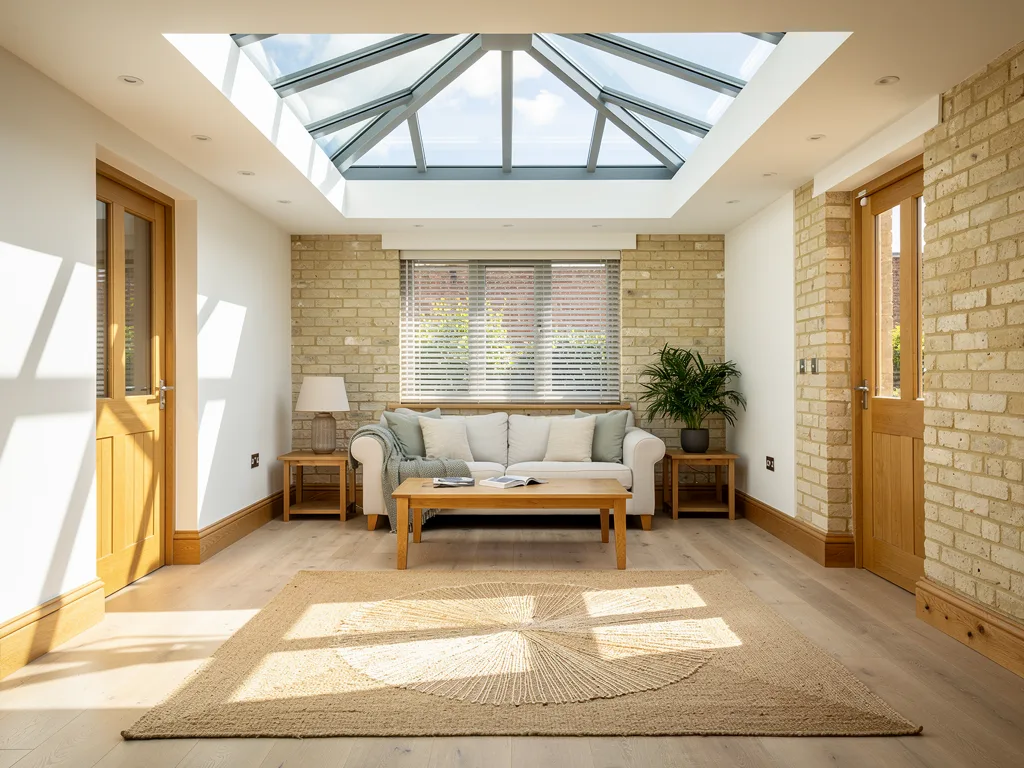
An aluminium roof lantern and a uPVC one are built to the same pattern: a perimeter frame on the upstand, a ridge, hips and glazing bars that hold sealed glass units at a pitch. The difference is what those bars are made of, and that changes how thick they are, how far they can span and how they handle heat and cold.
It helps to be clear about what the frame is for. On a flat extension roof, the lantern skylight is the part of the ceiling that has to carry glass, shed rain, resist snow and wind loads, and stay rigid while the building moves a little with the seasons. The glass does most of the work of letting light in and keeping heat where it belongs. The frame decides how much of the opening is glass and how much is bar, how large the whole unit can be before it needs extra support, and how warm the inside faces of those bars stay on a frosty January morning.
Aluminium lanterns are made from extruded aluminium sections with a thermal break, a strip of low-conductivity material (usually polyamide) that separates the outer and inner halves of each bar. uPVC lanterns are made from extruded plastic sections, and the better systems carry an aluminium or steel reinforcing core inside the ridge and bars to stop them sagging or creeping over time. Some lanterns sold as uPVC are in fact hybrids: an aluminium structure clad in uPVC, or uPVC internal trims over an aluminium frame. The label on a brochure says less than the cross-section of the bar.
So the fair comparison is not "metal against plastic". It is a slim, stiff, thermally broken bar against a thicker, reinforced, naturally insulating one, and the right answer depends on the size of the lantern, the room below it and how much you will look up at it.
Bar thickness and what you see from below
The visible width of the glazing bars is the difference you notice first, and it is the one that stays with you, because you look at it from the kitchen table every day.
Aluminium is stiff for its weight, so a structural bar can be narrow. Across the systems on the market, the internal face of an aluminium glazing bar is commonly somewhere around 40 to 60mm, and the ridge and hips are slim to match. A uPVC bar has to be deeper and broader to reach the same stiffness, even with a reinforcing core, so its internal face is usually noticeably wider and the ridge more pronounced. Exact figures vary by manufacturer, and it is worth asking for the section drawing rather than the photograph when you compare two lanterns.
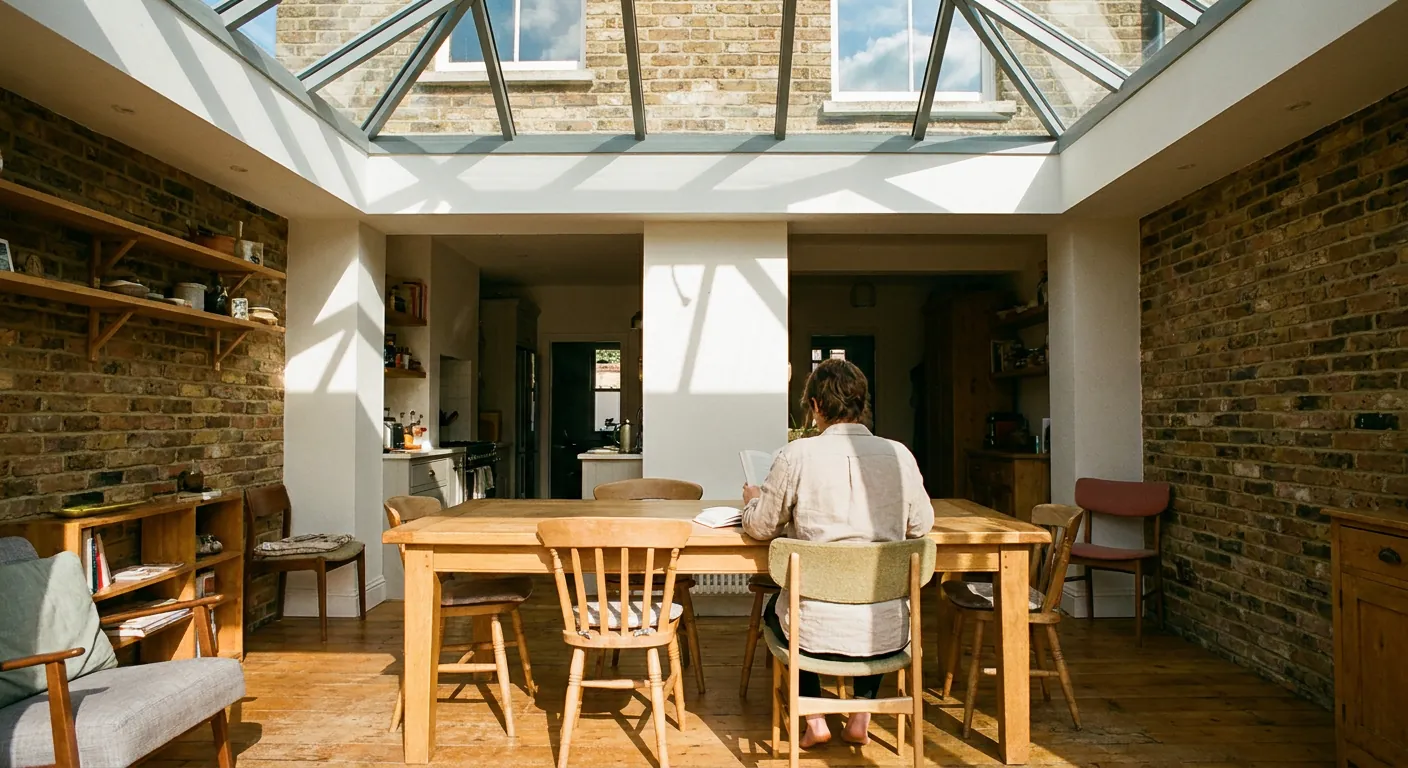
Sightlines are about more than looks. Each bar casts a line of shadow, and a wider bar casts a wider one. On a bright day those lines move slowly across the floor and worktops as the sun crosses the sky. With slim aluminium bars they read as thin pencil strokes. With broad uPVC bars they read as stripes, and on a small lantern they can make the glass feel divided into panes rather than open to the sky.
Bar spacing matters as much as bar width. A lantern of a given size needs a certain number of bars to support its glass, and a material that allows wider glass units between bars needs fewer of them. Aluminium systems can often run wider glass panels, so the same lantern may have fewer bars as well as thinner ones. Add those together and the proportion of the opening that is frame rather than glass can differ in a way you can see from the doorway.
The effect is strongest on narrow lanterns. In a side-return extension behind a Romsey or Mill Road terrace, the lantern may be little more than a metre wide. Two hips, a ridge and a couple of bars take up a larger share of a small lantern than of a large one, so on these lanterns every millimetre of frame is a millimetre of sky you lose.
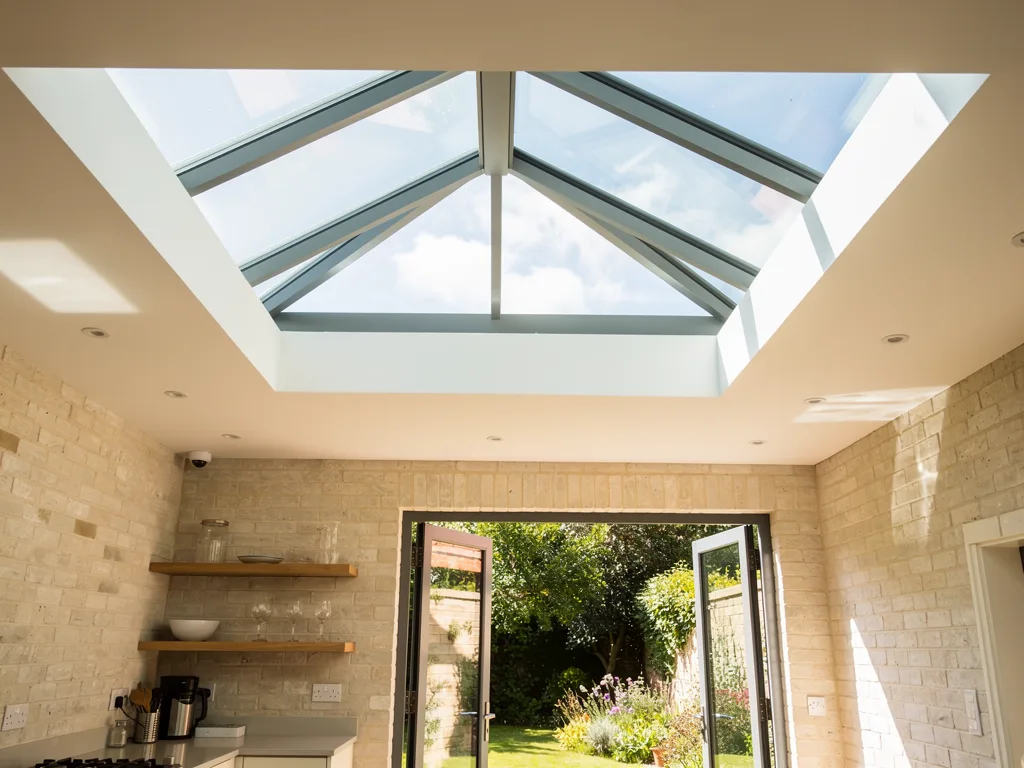
- Ridge: the spine where the slopes meet, usually with an end cap or finial.
- Hip bars run from each corner to the ends of the ridge and carry the most load.
- Glazing bars hold the glass on each slope. Slimmer bars mean more glass and more light.
- Glass panels: sealed units, usually with a solar-control coating, since a lantern takes sun from every side.
- Eaves beam: the perimeter frame the whole roof sits on, carrying the rafters and often housing a thermal break.
- Gutter and drip line: rain runs down the glass, into the eaves beam and off a drip edge clear of the upstand.
- Upstand: the insulated kerb that lifts the lantern clear of the flat roof, with the roof membrane dressed up it.
Span, size and the stiffness of the frame
How big a lantern can be, and how much glass each bay can hold, is set by the stiffness of the ridge and bars. This is where aluminium pulls clearly ahead on larger roofs.
A lantern ridge acts as a beam. It carries the weight of the glass (a double glazed lantern of kitchen size can weigh well over 100kg, and triple glazing adds more), plus snow and wind loads, and passes them down through the hips and bars to the perimeter frame. Aluminium resists bending far better than uPVC, so an aluminium ridge can run longer and an aluminium lantern can grow larger before the manufacturer needs to add intermediate supports, heavier sections or a tie bar across the middle.
uPVC lanterns depend on their reinforcement for span. Within the size range they are designed for, a well-made uPVC lantern is perfectly sound. But their maximum sizes are generally smaller, and as a uPVC lantern gets larger the bars get more numerous or heavier to compensate. If you are planning a lantern over a large open-plan kitchen and dining space, say something in the region of 3 by 2 metres or more, check the manufacturer's stated maximum size and loading for that exact model before you settle on uPVC. The roof lantern size guide explains how to arrive at the size in the first place.
There is also the question of long-term creep. Plastics under constant load can deflect very slowly over years, which is why the reinforcing core matters and why a uPVC ridge with poor reinforcement can develop a slight sag. Aluminium does not creep in that way at domestic loads and temperatures. Both materials expand and contract with heat, aluminium less than uPVC, and good systems of either kind allow for that movement in their seals and fixings.
Weight follows material and size. A uPVC lantern with steel reinforcement is not necessarily lighter than an aluminium one, and the glass usually accounts for most of the total. The roof structure has to carry whichever you choose, which is covered in the guide to the structural opening for a roof lantern.
Thermal performance: U-values, thermal breaks and cold bars
uPVC starts with the thermal advantage, because plastic conducts heat poorly. Aluminium conducts heat well, so it only competes because of the thermal break, and a well-designed thermally broken aluminium lantern can match or beat a uPVC one on the numbers that count.
Building Regulations Approved Document L sets a limiting U-value for rooflights, including lanterns, of 2.2 W/m²K, and since the 2021 update that figure is assessed with the unit in the horizontal plane rather than upright. A roof lantern installed in an existing home, whether new or replacing an older one, needs to meet it. Modern lanterns in both materials can do so, and many sit well inside the limit with good double glazing, and further inside it with triple glazing.
The frame's share of the U-value depends on its share of the area. On a lantern the glass covers far more area than the bars, so the glazing specification usually does more for the whole-unit U-value than the choice of frame material. A uPVC lantern with ordinary double glazing can perform worse overall than an aluminium lantern with a better glass unit, even though its bars are warmer. When you compare quotes, compare the whole-lantern U-value in the horizontal plane, not the centre-pane figure for the glass and not a figure for the bar alone. The guide on whether roof lanterns are energy efficient sets out how that figure is built up.
The cold bar is the practical concern. Warm, moist kitchen air rises and meets the lantern first. If the inside face of a bar is cold enough, water condenses on it. A uPVC bar stays relatively warm on its inner face. A thermally broken aluminium bar stays warm too, provided the break is continuous through the ridge, hips and perimeter and the system is well detailed at the corners. An older aluminium lantern without a proper break, or with a weak one, is the classic source of drips along the bars in winter. The answer page on whether roof lanterns get condensation covers ventilation and glazing as well as the frame.
How each frame changes the light in the room
The frame cannot make a lantern brighter than its glass, but it can make it dimmer and change the character of the light it lets through. Frame area, bar shadows and internal colour all play a part.
Daylight arriving through a lantern is reduced by every square centimetre of frame in the opening. Two lanterns with the same outside dimensions can have noticeably different glass areas once you subtract the perimeter frame, ridge, hips and bars. Slim aluminium sections give up less of the opening, so for the same roof opening they generally deliver a little more light, and the gap widens as the lantern gets smaller or the bar count rises.
The light also looks different. Under a slim-barred lantern the sky reads as one piece, with thin lines crossing it. Under a broad-barred lantern the eye picks out the grid, and on a sunny day the shadow pattern on the floor is bolder. Neither is wrong. Some people like the orangery feel of a stronger frame, especially in a traditional room. Others want the lantern to disappear so the ceiling feels open.
Frame colour on the inside matters to the spread of light. A white internal face bounces light down into the room and makes the bars recede against a bright sky. A dark internal face, anthracite grey being the common choice, frames the sky more sharply and makes the bars more visible, but absorbs some light rather than reflecting it. Aluminium powder coating gives a wide choice of colours inside and out, often with a different colour on each face. uPVC lanterns tend to come in a narrower range, with coloured foils on the outside and white inside. The guide to roof lantern colours and finishes goes further into how this reads from below and from the garden.
Frame material does nothing to control summer heat on a south-facing extension. That comes from the glass, from opening vents and from blinds. A slim-barred aluminium lantern with clear glass over a south-facing kitchen will be brighter and hotter than a uPVC one of the same size, simply because there is more glass. If heat is a worry, choose the frame for its sightlines and span and choose the glass for the sun, using the roof lantern glass options and our notes on controlling heat and glare under a roof lantern.
| Point of comparison | Aluminium | uPVC |
|---|---|---|
| Bar width seen from inside | Slim | Wider |
| Bars for a given size | Fewer | More |
| Largest sizes | Larger spans | Smaller limits |
| Thermal behaviour | Needs a good break | Warm by nature |
| Colour choice | Wide, dual colour | Narrower, foils |
| Upfront cost | Higher | Lower |
Weathering, finish and how they age on a Cambridge roof
A lantern spends its life facing straight up into the weather, so the outer finish takes more sun and rain than a wall window ever will. Both materials last well when the system is well made, but they age differently.
Aluminium lanterns are finished with a polyester powder coating baked onto the metal. A good coating holds its colour and gloss for many years and needs only an occasional wash. It does not become brittle in cold weather and does not yellow in strong sun. Cambridge has no salt air to worry about, but lanterns under trees, or on roofs where leaves and grit collect against the upstand, benefit from the tough surface of a powder coat.
uPVC is coloured through or foiled. White uPVC from a reputable system stays white for a long time, though cheap profiles can dull or yellow slightly after years of full exposure on a flat roof, where the ultraviolet load is higher than on a wall. Foiled colours can be very convincing, but the foil is a surface layer and its long-term life depends on the quality of the product. uPVC also expands more with heat than aluminium, which is managed in the design of the joints, and on a dark-foiled lantern in full summer sun that movement is greater.
In both cases the parts most likely to need attention over the years are the seals and gaskets and the sealed glass units, not the frame itself. That is one reason the frame choice matters when you think about the future: a well-supported aluminium or uPVC system with glass units that can be changed individually makes it far easier to renew a misted unit later than a lantern whose glass is locked in by the frame design.
For extensions in Cambridge's conservation areas and on older village houses, the outside view carries weight. A slim, dark aluminium lantern on a rear extension to a gault brick terrace or a Victorian villa in De Freville tends to look quieter and more deliberate from upper windows and neighbouring gardens than a bulkier white frame. Planning is decided on the whole proposal, not the frame alone, and on many rear extensions the lantern falls within permitted development in any case.
Which rooms suit which frame
The choice follows the room. A large, much-used kitchen or a lantern you will look up at every day leans towards aluminium; a small, practical room with a modest lantern is where uPVC makes most sense.
- Open-plan kitchen and dining extensions. These are the lanterns you sit under, often large, often over an island or a table. Span, slim sightlines and a well-detailed thermal break all count here, and aluminium is usually the better fit. The guide to roof lanterns for kitchen extensions covers where over the kitchen the lantern should sit.
- Narrow side-return extensions on terraces. A lantern around a metre wide gives up a large share of its opening to the frame. Slim aluminium bars keep more of it as sky, which is the whole point in a dark terrace plan.
- Orangeries. An orangery lantern is a design centrepiece framed by a perimeter deck and pelmet. The proportions of the ridge and bars are part of the look, and either material can suit, depending on whether the aim is a crisp contemporary line or a more traditional frame. See roof lanterns for orangeries.
- Utility rooms, boot rooms and garage conversions. A small lantern over a working space, seen less often and for shorter periods, is where a good uPVC lantern gives sound light and thermal performance for less outlay.
- North-facing extensions. Without the summer sun to manage, the lantern gives steady, soft light all day. Here the finer points of sightline matter less for comfort, and budget can steer the choice, though a larger north lantern still benefits from aluminium's span.
On newer homes at Eddington, Trumpington Meadows or Great Kneighton, where many extensions already have slim aluminium doors and windows, an aluminium lantern usually matches the existing frames more closely. On an older house with white uPVC windows throughout, a white uPVC lantern can sit comfortably with what is already there, provided it is sized within the system's limits.
What drives the difference in cost
uPVC lanterns generally cost less to buy than aluminium ones of the same size, and the gap is real. But the frame is only one part of a lantern project, and the difference narrows once the whole job is counted.
The price of the lantern itself depends on its size, the glass specification (double or triple, clear, self-cleaning or solar control), opening vents and their motors, colour options and the manufacturer. The installed cost also includes forming or adapting the opening in the roof, building a timber kerb or upstand to the right height, weathering it into the roof covering, and finishing the light well inside with plasterboard and decoration. Those parts of the work cost the same whichever frame sits on top. The costs page sets out the full list of cost drivers.
Where uPVC saves money, it is best spent on the things that change the room most: the right glass for the orientation, a vent for summer purge ventilation, or an internal blind for a south-facing kitchen. A cheap aluminium lantern with a weak thermal break is a poor trade against a good uPVC one. A good aluminium lantern with the wrong glass is a poor trade too.
The better question is where the money does most for the light. On the light plan that comes with every quote, we set out the position, size, glass and shading we recommend, and the reason for each, so the frame is chosen in the context of the whole room rather than on price alone.
Questions people ask
Is an aluminium roof lantern always better than a uPVC one?
No. Aluminium gives slimmer bars, longer spans and a wider colour choice, and it is usually the better choice for a large lantern or one you look up at every day. A well-made uPVC lantern with good glass is a sound choice for a smaller lantern over a utility room, a boot room or a modest extension, and it costs less.
Will an aluminium lantern be colder than a uPVC one?
Not if it has a continuous thermal break. Modern thermally broken aluminium lanterns can match or beat uPVC on whole-unit U-value, because the glass covers most of the area. Older aluminium lanterns without a proper break are the ones that feel cold and drip condensation along the bars.
Can I have a uPVC lantern in a dark colour?
Many uPVC systems offer foiled colours on the outside, with white inside. The range is usually narrower than the powder-coated colours available on aluminium, and dark foils on a roof in full sun move more with heat, which a good system allows for.
Which frame lets in more light?
For the same roof opening, the one with less frame. Slim aluminium bars, often with fewer of them, leave more of the opening as glass, so an aluminium lantern skylight generally lets in slightly more light than a uPVC one of the same outside size. Glass choice affects light and heat more than the frame does. If you would like us to compare both for your extension, book a light survey or read more about roof lantern installation in Cambridge.