Why the frame colour matters more than it seems
Roof lantern colours decide how the frame reads from two very different places: from the room below, where you look up at the bars against the sky, and from the garden or an upstairs window, where you see the lantern as part of the roofscape.
A lantern is mostly glass, so it is easy to treat the frame colour as a detail to settle once the size and glass are chosen. In practice the frame is the part of the lantern you actually see. The glass is transparent and the sky behind it changes all day, but the ridge, the hips and every glazing bar stay put, drawn as lines across your ceiling. On a hipped lantern of 3000mm by 1500mm there can be a dozen or more bars, and their colour sets whether the lantern looks like a crisp modern opening, a traditional glazed roof or something in between.
Colour also has two jobs that pull in different directions. Outside, the frame has to sit well against the roof covering, the walls and the doors below it, and it has to cope with full sun on a flat roof. Inside, it has to suit the ceiling and the room, and it takes part in how light moves around the space. That tension is why dual-colour frames exist, and why the choice is worth a few minutes of thought before the order goes in. Lantern skylight colours are also one of the few choices you cannot change later without replacing the frame. This guide covers the colours on offer, how finish and texture change them, and how each option reads from inside and from the garden. For the wider picture of lantern design and fitting, start with our roof lantern installation page.
RAL colours and the shades you will be offered
Aluminium lanterns are powder coated, and the colour is specified by a RAL number: a European reference system that lets a manufacturer, a door supplier and a builder all mean exactly the same shade.
In theory almost any RAL colour can be applied to an aluminium frame. In practice each lantern manufacturer keeps a shortlist of standard colours that are coated in regular batches, and anything outside that list is a special order with a longer lead time. The standard lists are similar across the industry, and a handful of shades cover a large share of domestic lanterns.
- RAL 9016 Traffic White or RAL 9010 Pure White: the usual internal colour. Traffic White is a cool, clean white that matches most modern white ceilings. Pure White is slightly warmer and softer.
- RAL 7016 Anthracite Grey: the dark blue-grey that has become the default external colour for extensions, bifold doors and aluminium windows.
- RAL 7021 Black Grey and RAL 9005 Jet Black: darker and more graphic than anthracite, used where the house already has black steel-look doors or a very contemporary finish.
- RAL 7038 Agate Grey and RAL 7035 Light Grey: paler greys that sit well against light brick and render without the weight of anthracite.
- RAL 9001 Cream and heritage greens: softer shades for orangeries, painted timber houses and cottages where a stark white or a dark grey would look out of place.
A uPVC lantern works differently. The frame is white through its body, and colours are applied as a foil or a coating on the outside face, usually from a narrower range. If you want a strong colour choice on both faces, aluminium is the easier route. The trade-offs between the two materials, including bar width and span, are set out in our guide to aluminium vs uPVC roof lanterns.
One practical point: always choose from a physical sample, not a screen. A RAL colour on a phone or laptop is only an approximation, and greys in particular shift towards blue or green depending on the display. A small coated sample held against your brick, your door frame and your ceiling tells you far more.
Dual-colour frames: one colour outside, another inside
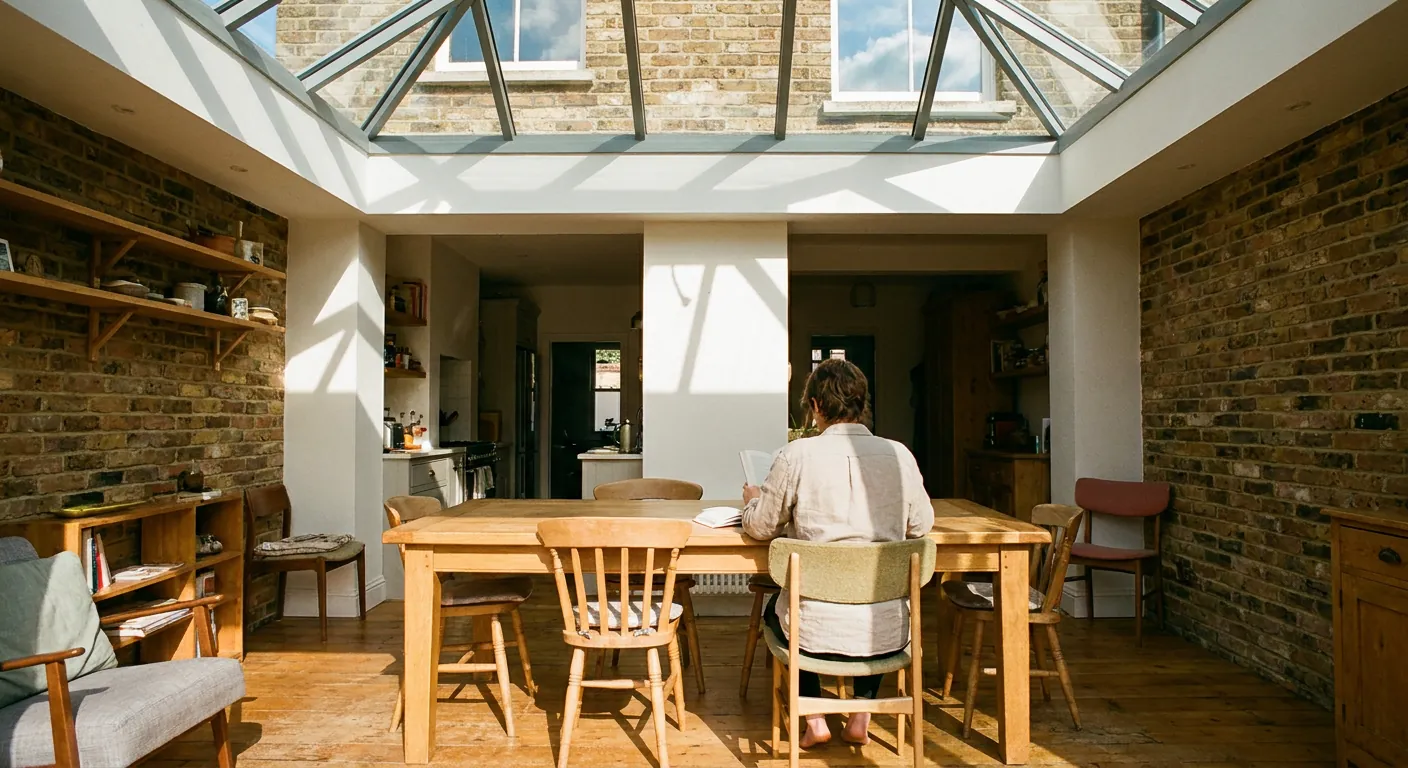
A dual-colour lantern has a different finish on its outer and inner faces, most often anthracite grey outside and white inside, so the frame can suit the roof and the room at the same time.
This is possible because a thermally broken aluminium frame is really two aluminium sections joined by an insulating polyamide strip. The outer and inner halves can be coated separately before they are joined, so each face takes its own colour. The thermal break is there for energy performance and to keep the inner bars warm in winter, and the dual-colour option comes along with it.
The reasons people choose it are simple. Outside, a dark frame looks tidy against a dark single-ply or GRP roof covering, it matches the anthracite doors that so many extensions now have, and it hides the light soiling a flat roof collects. Inside, a white frame blends with a white ceiling and a plastered light well, so the lantern reads as a clean opening rather than a heavy structure.
Dual colour usually costs a little more than a single colour, because the two halves are coated in separate runs, and it can add to the lead time. It is not the right answer for every room. Where the kitchen units, the internal doors or the light fittings are dark, a dark inner frame can tie the lantern into the room and look deliberate. The table below sets out the combinations that come up most and how each tends to read.
| Outside | Inside | From below | Suits |
|---|---|---|---|
| Anthracite | White | Light, bars recede | Most extensions |
| Anthracite | Anthracite | Framed, graphic | Dark kitchens, modern homes |
| White | White | Soft, traditional | Orangeries, rendered houses |
| Black | White | Crisp outline | Black steel-look doors |
| Cream or green | Cream or white | Warm, period | Cottages, painted timber |
How the colour reads from inside the room
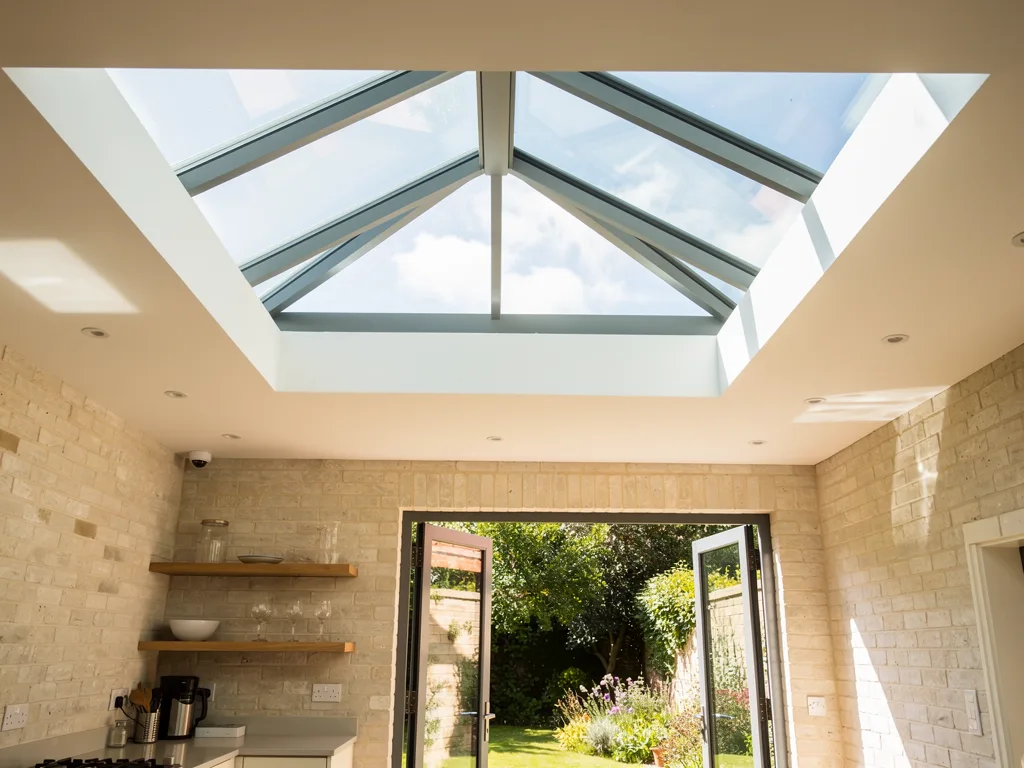
From below, you look at the bars against a bright sky, so every colour appears darker than it is by day, and the real differences between white and dark frames show at dawn, dusk and after dark.
On a bright day the sky behind the lantern is far brighter than anything in the room. Against it, glazing bars read almost as silhouettes. A white bar still looks lighter than an anthracite one, because it picks up light reflected from the floor and worktops below, but the contrast is smaller than the sample suggests. This is worth knowing, because it means a dark inner frame is less oppressive in daylight than people fear, and a white frame is less invisible than they hope.
The difference grows as the light drops. In the early morning, on a grey February afternoon and in the evening, the sky dims and the room lighting takes over. White bars catch the light from downlights and pendants and read as a fine white grid across a dark sky. Dark bars vanish into the night, leaving the glass looking like one uninterrupted black opening. Some people prefer the calm of the dark version at night; others like the white grid because it reminds them the lantern is there. Neither is wrong, but it is better to decide knowingly.
Colour also plays a small part in how light spreads. A white frame reflects most of the light that falls on it and a dark one absorbs most of it. The bars are thin, so the effect on overall brightness is modest, but it adds up with the light well. If the plastered upstand lining is white and the bars are white, light entering at a low angle bounces off both and reaches further into the room. A dark frame over a white light well still works well; a dark frame over a dark painted well gives a moodier, more contained pool of light. How the inside is lined and boxed has as much effect as the bars, and our answer on how a roof lantern is finished inside covers that part.
Direct sun adds one more effect. When the sun is high enough to shine through the lantern, glazing bars cast shadow lines across the floor and the table. White bars cast the same shadows as dark ones, but a glossy white bar can also glint when the sun catches its edge. A matt or fine-textured finish avoids that. On a south-facing kitchen where the sun comes through the lantern at lunchtime, it is a detail you will notice every sunny day, which is why we think about it alongside the sun path in our guide to roof lantern orientation.
How the colour reads from the garden and from upstairs
From the ground a lantern is seen at a shallow angle, so the upstand, the lower frame and the ridge line matter most; from an upstairs window you look down on the whole frame, and colour becomes the main thing you see.
Stand in the garden of a typical extension and the lantern shows as a low glazed shape above the parapet or roof edge. The glass reflects the sky, so the frame colour is what gives the lantern its outline. Anthracite reads as a thin dark line, similar to the frames of modern doors below it, and the lantern looks like part of one composed rear elevation. White reads more strongly against a grey sky and draws the eye upwards, which suits an orangery where the lantern is meant to be a feature.
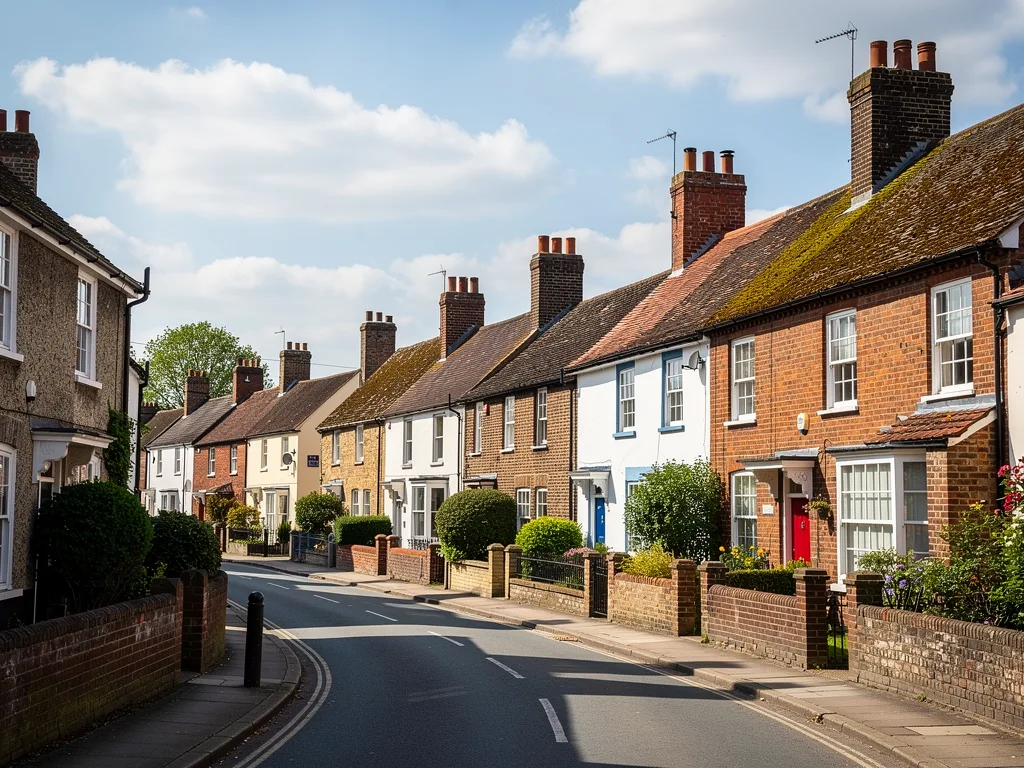
The view from above is the one people forget. On a Victorian terrace in Romsey or off Mill Road, a side-return or rear extension sits directly below the back bedroom windows, and every morning you look straight down on it. The same applies to single-storey extensions on 1930s semis and to neighbours whose windows overlook your roof. From above, the lantern is a grid of bars over glass, set in a flat roof, and colour does most of the work. A dark frame on a dark roof covering sits quietly. A white frame on a dark roof is a bright rectangle that stands out, which some owners like and others find busy.
The surrounding materials matter too. The pale gault brick found across much of older Cambridge is a soft yellow-buff, and it pairs well with anthracite, agate grey or a warm cream; stark white can look slightly cold against it. Red brick in the villages suits darker greys and heritage greens. Render, whether white or coloured, gives most options a clean backdrop. If you are not sure, take the sample outside and hold it against the wall at the height the lantern will be, in daylight, and look at it from the garden and from the window above.
Matching the lantern to doors, windows and the rest of the house
Matching a lantern to bifolds or sliding doors needs the same RAL number, the same finish texture and ideally the same gloss level, because two products in the same colour can still look slightly different side by side.
The most common request is a lantern that matches new doors below it. Both are usually anthracite, and both are usually quoted as RAL 7016. Yet a lantern from one manufacturer and doors from another can sit a shade apart, because powder coatings from different suppliers vary a little, and texture changes how a colour looks. A fine textured anthracite looks slightly lighter and softer than a smooth satin anthracite under the same sky. If the lantern and doors are close together in the same view, ask what finish each will have and try to match texture as well as number.
It is also worth deciding whether the lantern should match the doors at all. A lantern sits on the roof, a metre or more above and behind the doors, and is seen against sky rather than wall. A slightly lighter grey on the lantern can balance a darker door frame, where a perfect match can make the whole back of the house feel heavy. The same thinking applies to rooflights elsewhere on the house, gutters and fascias, and roof coverings: a coherent palette of two or three colours looks calmer than a set of near misses.
For a kitchen extension, consider the room too. White internal bars sit well with white or pale units and a white ceiling. A dark inner frame suits dark cabinetry, black taps and metal light fittings, and it gives the ceiling a defined frame that can look intended rather than accidental. Our guide to roof lanterns for kitchen extensions covers where the lantern goes; the inner colour is the part that ties it to the room once it is there.
Finish, texture and gloss
The same RAL colour is available in smooth gloss, satin, matt and fine textured finishes, and the choice affects how the frame looks under changing light, how it shows marks and how it weathers on a flat roof.
- Fine texture is widely used on aluminium lanterns and doors. The slight grain diffuses reflections, hides fingerprints and small marks, and keeps its look well outside.
- Matt gives a soft, contemporary look with no glint. It can show greasy marks inside a kitchen more readily, so it suits outer faces or rooms away from cooking.
- Satin sits between matt and gloss, with a gentle sheen that lifts white inner frames.
- Gloss is the traditional window finish. It is easy to wipe clean but reflects sunlight and room lights, and it shows scratches more.
Some aluminium systems can also be finished with a wood-grain effect, and some manufacturers offer anodised finishes, though both are less common on domestic lanterns and not every system carries them. Whatever the finish, the coating quality matters more than the colour. A good powder coat applied to a recognised standard, such as Qualicoat, over properly pretreated aluminium holds its colour and gloss for many years. Ask the manufacturer what coating guarantee comes with the product; that is a manufacturer warranty on the finish, separate from our 10-year workmanship guarantee on the installation.
The parts that are not bars need thought too. Ridge caps, hip caps, end finials and any decorative cresting are usually coated to match the external frame, but check whether the manufacturer offers the ridge detail in your chosen colour. Internally, gaskets and glazing seals are normally black or grey, and on a white inner frame they show as a thin dark line along each bar. On close inspection that is normal, and on some systems a white or grey gasket option is available if the line bothers you.
Colour in conservation areas, orangeries and older houses
In a conservation area or on a period house, the colour of a lantern is part of how it is judged, and a restrained shade that respects the house usually sits better than a fashionable one.
Cambridge has many conservation areas, from the city centre and Newnham to villages such as Grantchester and Great Shelford. A rear extension with a lantern may still fall within permitted development in some of them, but where planning permission is needed, the materials and colours are part of the application, and the local planning authority may comment on them or attach a condition. There is no single approved colour. The aim is a lantern that looks considered next to the existing house: often a dark grey, black or heritage green on a traditional profile, kept low. Our answer on roof lanterns in conservation areas covers when permission is needed, and the details of each case are for the council to decide.
Orangeries are a different case. Here the lantern is meant to be seen, often above a painted timber or rendered structure with a deep perimeter deck and a pelmet inside. White, cream and soft greys have long been the traditional choices, and a pale lantern over pale columns keeps the whole structure reading as one piece. A dark lantern on a white orangery can work, but it becomes a strong contrast rather than part of the building. More on proportion and pelmets is in our guide to roof lanterns for orangeries.
For a village cottage or a period house with painted timber windows, look at the colours already on the building. A lantern that picks up the window paint colour, or a close RAL equivalent, will look as though it belongs. The shape matters as much as the colour here, and a traditional hipped profile in a heritage shade looks very different from a low contemporary lantern in the same colour; the options are compared in our guide to roof lantern styles.
Choosing a colour at the survey
The colour is best chosen at the survey, standing in the room and the garden with samples, once the position, size, orientation and glass are known.
By the time we talk about colour, the light plan has already set where the lantern goes and which glass it needs. Glass choice interacts with colour more than people expect: a blue-tinted solar control pane gives a cooler cast to both the light in the room and the look of the lantern from outside, while a neutral coating keeps colours true. If you are weighing glass options, see our guide to roof lantern glass options first, because a colour chosen against clear glass can look different against a tinted one.
At the survey it helps to have a few things to hand: your door and window colours and suppliers if they are already ordered, a photo of the kitchen or room finishes, and some idea of how you use the room in the evening, since that is when inner frame colour shows most. We then note the external colour, the internal colour, the finish and any matching points in the written light plan that comes with every quote, so the colour is agreed in writing before the lantern is made. Powder coated frames are made to order, so a change after ordering is not a simple swap.
If you are planning a lantern and want to see how the options would look on your house, book a light survey or message us on WhatsApp. Our light planning page explains how we work out the rest of the specification.
Questions people ask
What colour roof lantern do people usually choose?
Anthracite grey outside with white inside is a very common combination for extension lanterns. It matches dark aluminium doors, sits quietly on a flat roof and keeps the inside of the lantern light and unobtrusive against a white ceiling.
Can I have a different colour inside and outside?
Yes, on a thermally broken aluminium lantern. The outer and inner sections are coated separately before assembly, so each face can take its own RAL colour. On uPVC lanterns the choice is usually limited to a coloured outer face over a white frame.
Do dark lantern frames make the room darker?
Only slightly. The bars are thin and the glass does nearly all the work. A dark frame reflects less light into the room than a white one, which you may notice at the edges of the room on dull days, but the effect is much smaller than the choice of position, size or glass.
Will my lantern colour fade?
A good quality powder coating keeps its colour and gloss for many years. Dark colours in full sun can dull very gradually over a long life. Washing the frame with mild soapy water when you clean the glass, and avoiding abrasive cleaners, keeps the finish at its best.