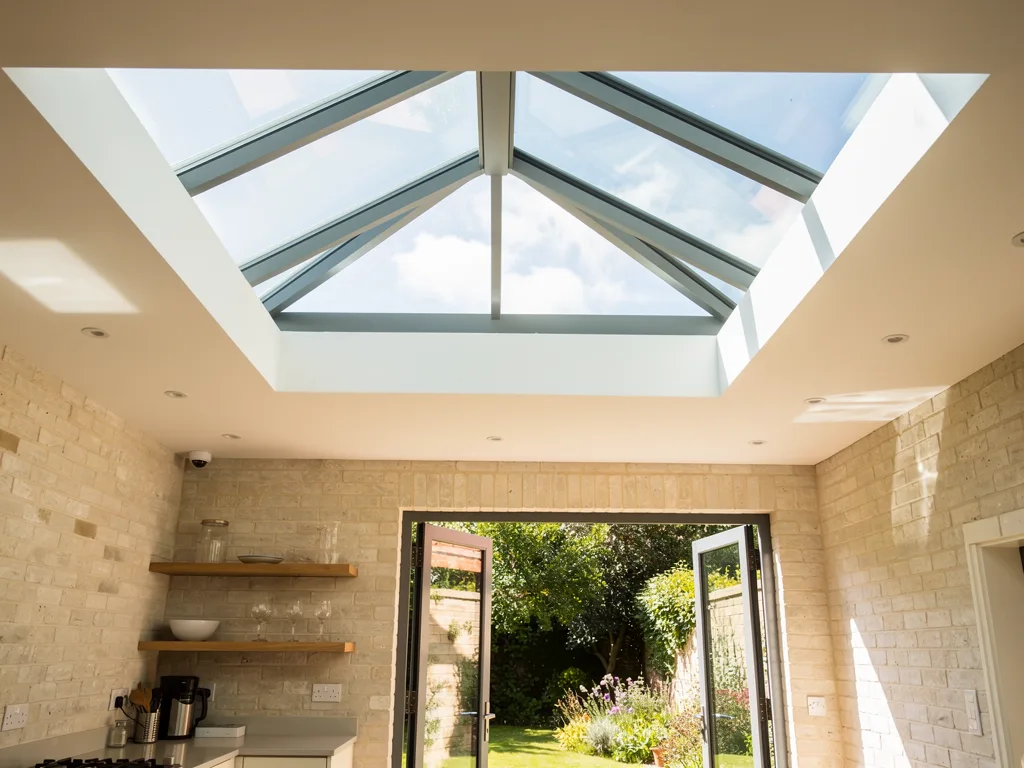
Where the weight comes from
Most of a lantern skylight's weight is glass, and glass weighs about 2.5kg per square metre for every millimetre of thickness.
That one figure explains nearly everything. A typical double glazed lantern unit pairs a 4mm toughened outer pane with a 6.4mm laminated inner pane, which is 10.4mm of glass in total, or about 26kg for each square metre of glass. A triple glazed unit adds a third pane, usually another 4mm, which takes it to around 36kg per square metre. The gas in the cavities and the spacer bars add almost nothing.
The glass area is also larger than the footprint. Because the roof slopes rise to a ridge, commonly at somewhere between 20 and 25 degrees, each slope is about ten per cent longer than the flat distance it covers. A lantern that sits over two square metres of roof carries a little over two square metres of glass.
The frame makes up the rest: the aluminium ridge, the hip bars at the corners, the glazing bars between panes, the perimeter base that sits on the upstand, and the internal and external cappings. On a mid-sized lantern that adds somewhere between a fifth and a third to the glass weight, more if the design has many bars or decorative cresting on the ridge. The roof lantern glass options guide covers what each glass choice does to light and heat; here the point is simply that every extra pane or thicker laminate is weight the roof has to carry.
Typical weights by size
The table below is worked from glass density and typical frame weights, so treat it as a planning guide rather than a manufacturer's figure.
| External size | Double glazed | Triple glazed |
|---|---|---|
| 1.0 x 1.5m | 50 to 70kg | 65 to 90kg |
| 1.0 x 2.0m | 70 to 90kg | 90 to 120kg |
| 1.5 x 2.5m | 130 to 170kg | 170 to 220kg |
| 1.5 x 3.0m | 160 to 200kg | 210 to 260kg |
| 2.0 x 4.0m | 280 to 360kg | 370 to 470kg |
Weight rises with area, not length, so a lantern that is half as wide again and half as long again is more than twice as heavy. That is why the jump from a modest lantern over a Romsey side return to a long one over a Trumpington kitchen extension matters more to the structure than the drawings suggest. The roof lantern size guide looks at choosing the size for the room; the weight follows from that choice.
Frame material and glass choices
Frame material changes the total less than people expect, while the glass specification changes it more.
Aluminium and uPVC lanterns of the same size end up within a similar range, because uPVC systems carry steel or aluminium reinforcement inside the profiles to span the same distances, and their bars tend to be bulkier. The difference between the two is mostly about sightlines and thermal performance, which the guide to aluminium vs uPVC roof lanterns compares.
The glass choices that add weight are easier to spot:
- Triple glazing, which adds a full extra pane across the whole lantern.
- Thicker laminated inner panes on large or wide lanterns, where longer spans between bars call for stiffer glass.
- Thicker outer panes on bigger units to resist wind and snow.
Solar control and self-cleaning coatings add nothing measurable. They are microns thick, so the choice between clear, neutral or blue-tinted solar control glass can be made purely on how the light and heat behave on your roof's orientation.
Why the weight matters to the roof
The lantern's own weight is only part of the load; the structure around the opening also has to take snow, wind and the fact that joists have been cut.
Forming the opening means cutting the joists that cross it and hanging their ends on trimmers, so the lantern's weight, plus the weight of the timber upstand it sits on, is delivered onto a few joists either side rather than spread across the whole roof. An engineer designing that opening also adds imposed loads from the British Standards for snow and maintenance access. On a low flat roof in Cambridgeshire those loads are commonly around 0.6kN per square metre, roughly 60kg per square metre, which is more than the lantern itself weighs per square metre. The glass does not need to be designed as if people will stand on it, but the perimeter does have to take a person leaning on it during cleaning or maintenance.
In practice this means a small lantern on a well-built extension may need only doubled joists around the opening, while a large one usually calls for a steel or engineered timber frame. The detail is in our guide to the structural opening for a roof lantern, and if the roof already exists, fitting a roof lantern to an existing flat roof covers what the joists need to offer. Because the work is structural, it is normally notifiable under Building Regulations; where it is, we handle the Building Control notification.
Getting it onto the roof
A lantern of any size arrives in parts and is assembled on the upstand, so no single piece is anywhere near the finished weight.
The frame comes as a kit, and each glass unit is lifted and bedded separately. Individual panes on a mid-sized lantern commonly weigh 20 to 50kg, and the long side panes on a large lantern can weigh more, which is why larger jobs need extra hands on the roof, suction lifters for the glass, and sometimes scaffold or a lifting platform where the extension is tucked behind a terrace with no side access. Those are planned at the survey, alongside the delivery route. The guide to the roof lantern installation process sets out the order of work on site.
Questions people also ask
Is a roof lantern heavier than a flat rooflight?
Size for size, a lantern carries more glass because its sloping sides cover more area than the footprint, and its frame has more bars. A flat rooflight of the same footprint with a similar glass build-up is usually a little lighter, though walk-on units are much heavier. The comparison of a roof lantern vs flat rooflight covers the other differences.
Can an old extension roof take a heavy lantern skylight?
Often yes, once the opening is trimmed properly. Joist depth, span and condition decide how much strengthening is needed, and a survey checks them before the lantern is sized.
Does the weight change the light?
Not directly, but the choices that add weight, such as extra panes and thicker laminates, slightly reduce how much light gets through. Our light planning weighs that against the gain in comfort.
Who decides whether the roof is strong enough?
For anything beyond a small opening, a structural engineer's calculation, checked by Building Control. See our roof lantern installation page, or book a light survey and we will check your roof.
