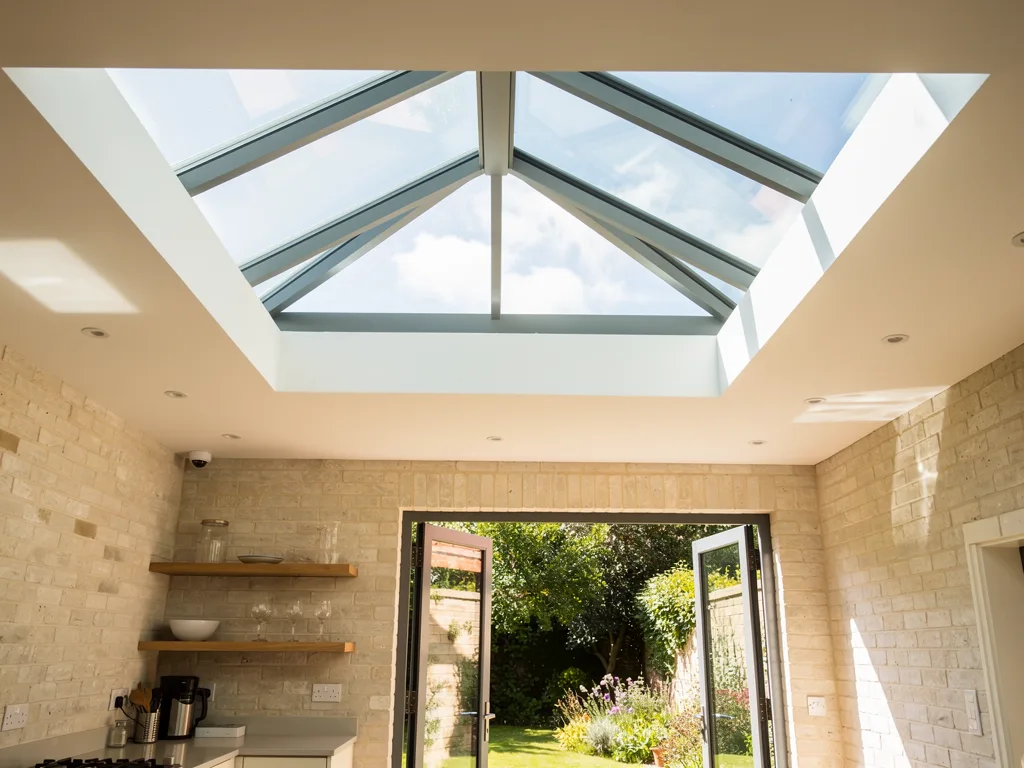
A lantern and a wall window of the same size, side by side
Put a 1 metre by 2 metre lantern in a flat roof and the same 2 square metres of glass in the back wall, and the lantern wins on two counts: it sees more sky, and the sky it sees is brighter.
A vertical window can only ever look at half the sky, and the lower part of its view is taken up by the ground, the fence, the shed and the house behind. In a Cambridge terrace with a side return, that view is often a gault brick wall a couple of metres away. The glass is the same size, but the useful sky in front of it is a small strip above the neighbouring roofline.
A lantern faces the whole dome of the sky. On an overcast day, which is the condition daylight is designed around in the UK, the sky overhead is roughly three times as bright as the sky near the horizon. So the lantern is not only seeing more sky, it is seeing the part that carries the most light. That is where the widely quoted rule of thumb comes from: a rooflight gives two to three times the daylight of a vertical window with the same glazed area. Treat it as a guide rather than a promise, because the exact figure depends on the glass, the frame and the depth of the opening, which the sections below cover.
The hipped sides of a lantern add a little more. Because the glazing slopes up to a ridge, the glass area is larger than the flat opening it sits over, and the sloping faces catch low winter sky that a flat rooflight would see only at a glancing angle.
Why light from above reaches the whole room
Side light fades quickly as you walk away from the window; overhead light falls onto the floor, the worktops and the walls in the middle of the plan, where a deep room is darkest.
A wall window lights a room usefully to a depth of about two to two and a half times the height of its head above the floor. With a window head at 2.1 metres, the good light runs out somewhere around 4.5 to 5 metres in. Many Victorian and Edwardian terraces in Romsey, Petersfield and around Mill Road are far deeper than that once the kitchen is extended, so the old middle room becomes the darkest part of the house, however large the new bifold doors are.
A lantern over that middle zone changes the shape of the light rather than just the amount. Instead of a bright band by the garden and a gloomy core, you get an even wash across the centre of the room, with the walls either side picking up reflected light. The ceiling around the lantern also gets lit from below by light bouncing off the floor and worktops, which is why a room with a lantern tends to read as brighter than a light meter alone would suggest. The companion answer on whether a roof lantern makes a room feel bigger looks at that effect on the sense of space.
What takes light away before it reaches the floor
Not all the light that falls on a lantern arrives in the room. Glass, frames, the upstand and the finish around the opening each take a share, and they add up.
The glass is the first filter. A clear double glazed unit with a low-E coating typically passes around 70 to 80 per cent of visible light. Solar control glass cuts heat by reflecting part of the sun's energy, and the stronger products also pass less visible light, sometimes down to around half. Triple glazing takes a little more again. The roof lantern glass options guide compares the choices; the point here is that the darkest tint is not always the right answer on a north or east facing extension.
| Element | Effect on light |
|---|---|
| Clear low-E double glazing | Passes about 70 to 80% of visible light |
| Solar control glass | Passes less, depending on grade |
| Glazing bars and ridge | Block a small share of the opening |
| Deep upstand or light well | Narrows the spread into the room |
| Pale, splayed reveals | Bounce light back into the room |
Frames come next. Glazing bars, hips and the ridge are opaque, so a lantern with slim aluminium bars leaves more of the opening as glass than one with chunkier sections. The aluminium versus uPVC guide explains the difference in sightlines.
Then there is the depth between the glass and the ceiling. A thick insulated roof, a tall upstand and a deep plastered box all act like a short tunnel: light that arrives at a steep angle passes through, but light from the lower sky strikes the sides of the well. Pale, smooth, and ideally splayed reveals return much of that light to the room; a dark or narrow box loses it. How the inside is finished is covered in how a roof lantern is finished inside.
Sky light and sunlight are two different things
Most of the time a lantern is delivering soft light from the whole sky. On clear days it also throws a sharp pool of direct sun, and that pool moves and changes size with the season.
Outdoors, a dull overcast day in Cambridge might give around 10,000 lux, while bright summer sun can pass 100,000. Indoors, a comfortable kitchen needs only a few hundred lux on the worktop, which is why even a modest lantern can make artificial light unnecessary through most of the day. The steady sky component is the useful part; direct sun is a bonus in winter and something to manage in July.
At midday in late June the sun stands about 61 degrees above the Cambridge horizon, so its pool of light through a lantern is small, bright and close to directly below. In late December it is only about 14 degrees up, and the sun enters mainly through the south facing hip, landing as a long, low stripe across the room. Because Cambridge and the surrounding Fen edge are so flat, very little shades a lantern from that low winter sun, which makes orientation matter more here than in a hilly town. The roof lantern orientation guide works through ridge direction in detail, and controlling heat and glare covers the summer side.
Getting more light from the lantern you choose
Size helps, but position and finish decide how much of the light reaches the part of the room you use.
- Place the lantern over the deepest, darkest part of the plan, not simply in the middle of the new roof. In a terrace extension that is often the join with the original house.
- Keep the light well as shallow as the roof build-up allows, and finish it in a pale matt paint.
- Choose glass for the orientation: strong solar control where the south and west sky dominate, a clearer grade where the lantern mainly sees north or east sky.
- Pale floors and worktops under the lantern reflect light onto the walls and ceiling, lifting the whole room.
This is the work of the light plan that comes with every quote: where the lantern goes, what glass it takes and why. For the wider picture on specification and fitting, see roof lantern installation in Cambridge, or book a light survey and we will look at your room with you.
Questions people also ask
Does a bigger roof lantern always mean a brighter room?
Up to a point. A larger lantern lets in more light, but it also brings in more heat, and a large one in the wrong spot can leave the busy end of the room no brighter. The roof lantern size guide explains how to size one against the room.
Does a lantern skylight let in more light than a flat rooflight?
For the same opening, a lantern has a little more glass because its sides slope, and those faces catch more low sky. A flat rooflight has a slimmer frame and no bars. The difference is modest; looks, height and the roof usually decide. The lantern versus flat rooflight guide compares them.
Will a lantern on a north facing extension be bright enough?
Yes. It will not throw much direct sun, but it sees the same bright overhead sky as any other lantern, so the daylight is steady and even. See roof lanterns on north facing extensions.
Can I still use a blind without losing all the light?
Yes. Pleated and translucent blinds soften direct sun while letting diffuse sky light through, so the room stays bright when the blind is drawn.
