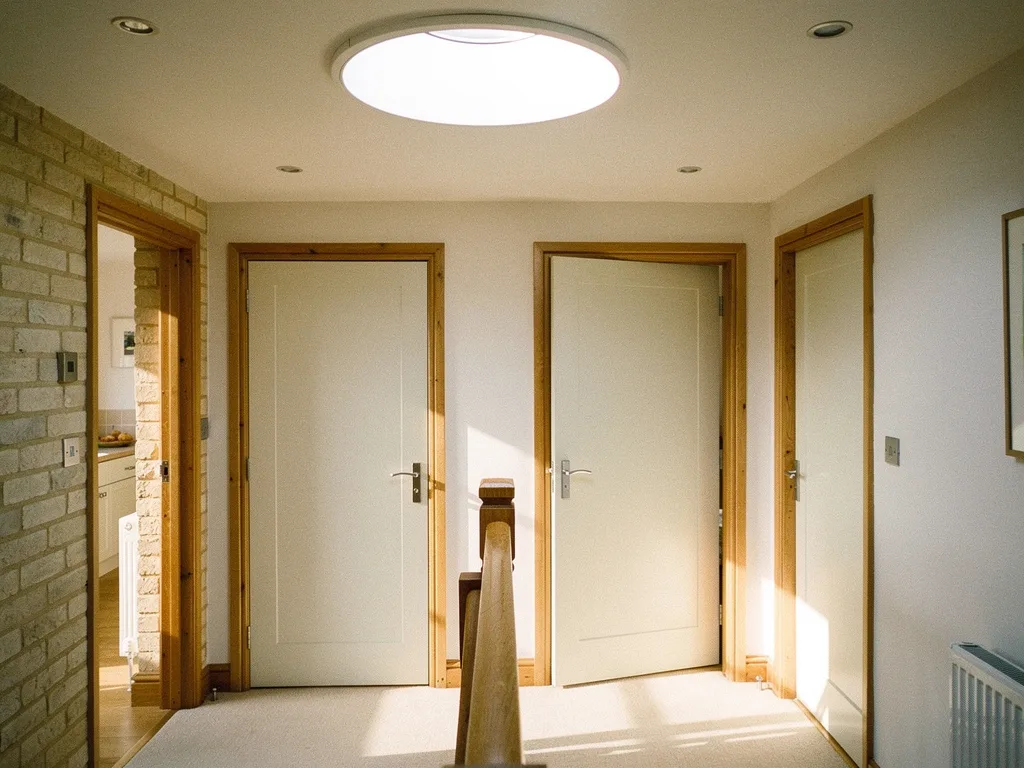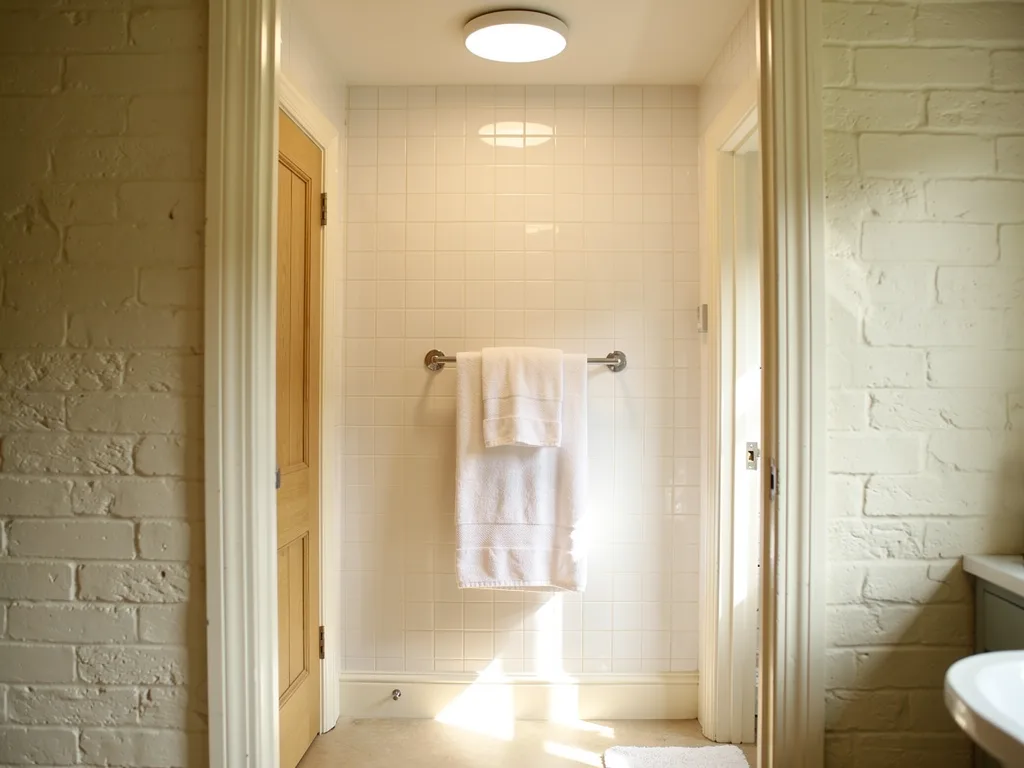
One circle on the ceiling, day and night
A sun tunnel LED light is a small electric lamp mounted inside the tube, just above the ceiling diffuser, so that after dark the same circle that gave you daylight gives you electric light. You get one fitting on the ceiling instead of two, and the landing or bathroom never has a dead grey disc in it at night.
Without a kit, a tubular skylight is purely a daylight device. When the sky goes dark, so does the diffuser, and it hangs there as a pale, unlit ring next to whatever ceiling light you already had. That is fine in plenty of rooms. Where the sun tunnel sits in the middle of a small ceiling, though, there may be no sensible place left for a second fitting, and fitting the lamp inside the tube solves the problem neatly. Our answer on whether sun tunnels work at night deals with the short version of that question; this guide goes into how the kits are built, how they are wired, what the rules say about the electrical work and how to decide whether one is worth adding.
The kit does not change how the tube handles daylight. Light still enters through the dome, travels down the mirrored tube and spreads out through the diffuser, as described in how sun tunnels work. The lamp simply sits in the path, small enough that it takes a very modest share of the tube's cross section and casts no shadow you would notice on the room below.
Why Cambridge evenings make the case
A sun tunnel is at its best around midday in summer and at its weakest on a December afternoon, which is exactly when a dark hall or landing needs light most. An LED kit covers the hours the tube cannot.
At midwinter the sun over Cambridge climbs to only about 14 degrees above the horizon at noon, and it sets before four in the afternoon. A dome on a south-facing slope still collects useful light at that angle, and a clear dome picks up the bright diffuse sky on overcast days (the diffuse daylight from cloud still reaches the tube). But from mid-afternoon onwards in November, December and January, the output falls away quickly. Anyone coming home from work to a terrace in Romsey or a bungalow in Histon will reach for a switch in the hall well before the evening meal.
That seasonal swing is the reason we talk about the kit at the light survey rather than treating it as an optional extra on the order form. If the room is a windowless bathroom used first thing in the morning, the tube will be dark at 7am for much of the winter, and the LED becomes the main light for those months. If the room is a landing that is walked through a few times a day and already has a pendant, the kit adds less. Our page on how we plan the light sets out how orientation and season feed into that judgement.
- Dome: a clear, UV-stable dome that catches daylight from a wide angle.
- Flashing: a flashing plate that sits into the tiles or slates, like a roof window flashing.
- Rigid reflective tube: a highly reflective lining bounces the light down its length. Rigid tube loses far less light than flexible.
- Adjustable bends step the tube around joists, purlins or tanks. Every bend and every metre costs some light, so the run is kept short and straight.
- Ceiling diffuser: a ring and a frosted lens that spread the light evenly and seal the ceiling.
- Light into the room: a hallway, landing or bathroom with no window gets real daylight.
- Loft insulation made good around the tube, which is often sleeved in the loft to limit condensation.

How the kits are built
Makers take slightly different approaches, but the pattern is similar: a lamp module in the lower part of the tube, a driver or transformer out of sight in the loft, and a cable run to a switch in the room.
The lamp itself usually takes one of three forms, depending on the manufacturer and the model of tube:
- A lamp holder fixed across the tube, into which a standard replaceable LED lamp is fitted. This is the simplest arrangement and makes renewing the lamp straightforward.
- An integrated LED module, a slim disc or bar carrying the LED chips, fixed to a bracket just above the diffuser. The light source is not meant to be swapped on its own; when it reaches the end of its life the module is replaced.
- A ring of LEDs built into the diffuser frame or the lower tube section, lighting the diffuser from its edge. Some makers offer this on specific diffuser designs only.
Whichever form it takes, the lamp is designed to sit where it blocks as little daylight as possible while still lighting the diffuser evenly. That matters because the diffuser is what you see: a well-placed lamp fills the whole circle with an even glow, while a poorly matched one can show a brighter spot in the centre. The kit also has to suit the diffuser you choose, so the two are specified together. Our guide to sun tunnel diffusers covers the different lenses and the light pattern each one gives.
Not every tube accepts every kit. A kit is normally sold for a specific range and diameter, and some ranges have no kit at all. Before recommending one we check that the maker offers a kit for the exact tube, diameter and diffuser in the light plan, and we do not mix components from different makers inside a sealed system.
The wiring, and where Part P comes in
An LED kit is fixed electrical work, not a plug-in accessory. It needs a supply from the lighting in the house, a switch, and connections that meet the current wiring regulations, BS 7671, and it should be done by a qualified electrician.
In England, electrical work in homes falls under Part P of the Building Regulations. Under Approved Document P, some jobs are notifiable and some are not. As a general guide, installing a brand new circuit is notifiable, and so is work in a special location such as the zones around a bath or shower. Adding a light point to an existing lighting circuit in an ordinary room is usually not notifiable, though it still has to be done safely and to BS 7671. Whether a particular sun tunnel kit counts as notifiable depends on how it is connected and where the room is, so it is a question for the electrician on the day, not something to guess at.
Where the work is notifiable, an electrician registered with a competent person scheme can notify it through that scheme and issue the paperwork, and you should keep that record with the house documents. If the electrician is not in such a scheme, the work has to be notified to Building Control before it starts. Either way, the homeowner should receive confirmation that the installation has been tested and complies.
In practice the wiring is coordinated with the tube installation so there is only one visit into the loft and one opening in the ceiling. We plan the cable route at the survey, and a qualified electrician makes the connections. The sun tunnel itself, meaning the dome, tube and diffuser, is covered separately in the answer on whether sun tunnels need building regulations.
The driver, which converts mains voltage for the LED, usually sits in the loft beside the tube. It needs to be accessible for replacement, fixed clear of the loft insulation so it does not overheat, and positioned where it will not be buried when the insulation is topped up later. We mark its position on the light plan so a future loft insulation job does not smother it.
Bathrooms, kitchens and moisture
Many sun tunnels go into bathrooms and en suites, which is exactly where the electrical rules are strictest. The kit has to carry an ingress protection rating suitable for its zone, and the whole assembly has to keep steam out of the tube.
The zones around a bath or shower are defined in BS 7671. A diffuser fitted directly above a shower tray is in a more demanding zone than one in the corner of a larger bathroom, and the kit's IP rating has to match. The manufacturer states the rating and the zones a kit is suitable for, and that is part of what the electrician checks. If a kit is not rated for the position, the answer is to move the diffuser or choose another kit, never to fit it and hope.
Moisture is also a light problem. Warm, damp air rising into a cold tube will condense on the mirror and dull it, and water collecting around electrical parts is a hazard. Every cable entry into the tube has to be sealed, the diffuser has to seal properly to the ceiling, and the tube needs its insulating sleeve through the loft. Our answer on whether sun tunnels cause condensation covers the insulation side in full.
In a bathroom without an opening window, there is also the question of extraction. Some makers offer a combined unit that brings in daylight, provides a light, and extracts air through the same ceiling opening. Whether that suits your room depends on the extract rate the bathroom needs and the route to the outside. See our guide to sun tunnel ventilation kits before deciding between a light kit, a ventilation kit or both.
Kitchens are simpler. A diffuser over a worktop or at the back of a deep terrace kitchen is outside the bathroom zones, and a kit there is usually a straightforward addition to the lighting circuit. The main question in a kitchen is whether the tube's light and the LED's light fall where you work, which is a question of position more than product.
What the light looks like after dark
The diffuser does the same job at night as it does in the day: it spreads the light out so there is no bare bulb in view. What changes is the colour and strength of the glow, and both are set by the kit you choose.
Daylight through a sun tunnel is cool and white at midday and warmer late in the day. An LED can be anything from a warm white, similar to an old incandescent bulb, to a cool white closer to daylight. Makers describe this as the colour temperature, in kelvin. For a hall or landing used in the evening, a warm white in the region of 2,700 to 3,000 kelvin tends to feel comfortable and matches ordinary household lamps. In a bathroom used for shaving or make-up, a neutral white gives truer colours. If your other lights are warm white, choosing a much cooler kit will make the sun tunnel stand out as a cold circle in the evening.
Brightness is where care is needed. Kits vary widely, and the tube and diffuser absorb some of the lamp's output before it reaches the room. We do not quote a lumen figure for a kit we have not specified, and you should be wary of anyone who promises a number without knowing the tube and diffuser. The sensible comparison is to take the maker's stated output for the kit and set it against the fitting it replaces or sits beside. If the kit is to be the only light in a room, the survey is the time to check that it will be enough on its own; our guide to sun tunnels for halls and landings discusses spaces where it may have to be.
It is also worth knowing what the kit does not do. An LED in the tube lights the diffuser; it does not throw a focused beam onto a worktop or a mirror. For task light in a kitchen or bathroom, you may still want a separate fitting.
Switches, dimmers and sensors
How the light is controlled matters as much as the lamp. The choice is usually between a normal switch, a dimmer, a motion sensor, or a combination with the sun tunnel's own daylight dimmer.
| Control | Suits | Check |
|---|---|---|
| Wall switch | Most rooms | Switch position |
| Dimmer | Landings, bedrooms | Kit is dimmable |
| Motion sensor | Halls, stairs, WCs | Sensor sees the door |
| Smart control | Existing smart home | Driver compatibility |
Not every LED driver will dim, and those that do need a compatible dimmer switch, or the light will flicker or buzz at low settings. If you want a dimmer, say so at the survey so the right driver is specified from the start. On a landing, a motion sensor can be a good fit: the light comes on when someone reaches the top of the stairs at night and goes off on its own, so nobody leaves it burning. Some sensors also read the ambient light level and stay off while the tube is delivering enough daylight.
Electric dimming of the LED is different from dimming the daylight. Some sun tunnels can be fitted with a shutter or daylight dimmer that closes off the tube, which is useful in a bedroom where the dome would otherwise let in early summer light. That shutter and the LED kit have to be compatible and both fit inside the same tube, so check with the maker before assuming you can have both. Our answer on whether you can dim a sun tunnel covers the daylight side.
Fitting a kit at installation or adding one later
The easiest moment to add an LED kit is when the sun tunnel goes in. The tube is open, the loft route is clear and the cable can go in with the tube before the insulation is made good.
Retrofitting a kit to an existing sun tunnel is sometimes possible, but it depends on whether the maker still offers a kit for that range and diameter. The diffuser has to come down, the kit goes in above it, and a cable has to be brought through the loft to a supply and a switch. On a tube that is several years old, the mirror surface, seals and diffuser may also be due for attention. If the tube has dulled or the dome has yellowed, it can make more sense to replace the whole system and fit the kit to the new tube in one go than to add an electric light to a tube that no longer carries much daylight. The survey is the time to judge whether the old tube is worth keeping.
Where no kit is available, the fallback is a separate ceiling light close to the diffuser. That works perfectly well, but it means two fittings in a small ceiling, which is exactly what the kit was meant to avoid. On a terraced landing where the ceiling is barely a metre across, the placement of the two fittings becomes part of the light plan.
When a kit is worth it, and when it is not
An LED kit is most useful where the sun tunnel is the only sensible position for a ceiling light, and least useful where there is already a good fitting nearby.
It tends to earn its place in these situations:
- A windowless bathroom or en suite where the diffuser takes the centre of the ceiling.
- A narrow landing in a Victorian or Edwardian terrace, where the ceiling is too small for two fittings.
- A central hall in a bungalow, lit by a short tube through the loft.
- A walk-in wardrobe or utility room, where one fitting on a sensor is all the room needs.
It adds less where the room already has good electric lighting in a sensible place, or where the sun tunnel is in an unusual spot chosen for the daylight rather than as the natural centre of the ceiling. In a kitchen with downlights over the worktops, the tube's LED may just duplicate what is there.
It also helps to be clear about what the kit is not. It does not make a sun tunnel a substitute for good lighting design, and it does not change the daylight performance. If the real question is whether a sun tunnel beats a well-designed electric light for a windowless room, our answer on whether a sun tunnel is better than LED lighting sets out the difference in light quality. For the cost of the kit and the electrical work alongside the tube, skylight and rooflight costs explains what drives the price, and the full service is described on our sun tunnel installation page.
Questions people ask
Does an LED kit reduce the daylight from the tube?
Slightly, because the lamp and its bracket sit in the tube. The makers design the kits to be small and placed low in the tube so the loss is modest, and in the room below you would not normally see a shadow or a dark spot on the diffuser.
Can I fit the kit myself?
The kit is fixed wiring connected to your lighting, and in a bathroom it sits in a special location under the wiring regulations. It should be connected by a qualified electrician, and any notifiable work has to be notified under Part P. The sun tunnel side, including opening and sealing the tube, is part of our installation.
How long does the LED last?
That depends on the kit. Makers quote a rated life for the LED module, and a replaceable lamp can be renewed like any other bulb. The driver in the loft is a separate part and can be replaced on its own if it fails, which is why it is kept accessible and clear of the insulation.
Will the light be visible from outside?
A little. The mirrored tube carries light in both directions, so from outside at night the dome may show a faint glow. It is much less noticeable than a lit rooflight or roof window, and from the street it is easy to miss.