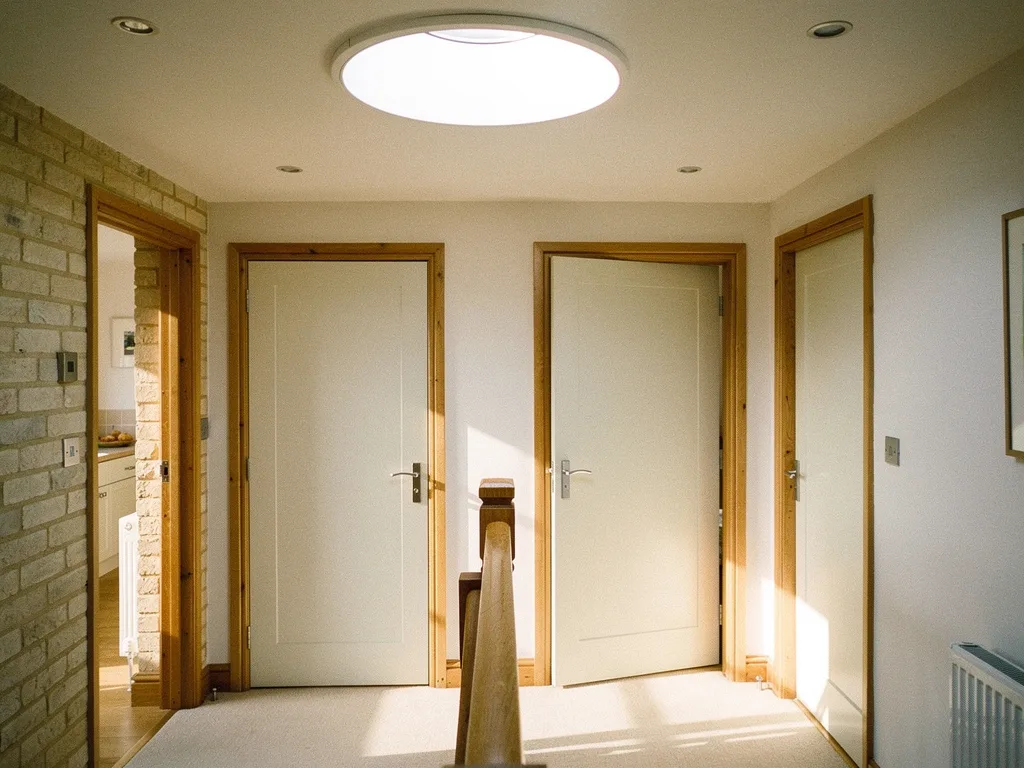
Three parts and one job
A sun tunnel is a light pipe: a clear dome on the roof catches daylight, a mirror-lined tube carries it down through the loft, and a diffuser in the ceiling spreads it across the room. Everything about how well it works comes down to how much light survives that trip.
People call the same product a sun tunnel, a sun pipe, a light tube or a tubular skylight. The names differ; the principle does not. Unlike a rooflight or skylight, which is a window you look through, a sun tunnel is closer to a periscope with the optics taken out. It gives you no view of the sky and no sense of the weather outside. What it gives you is daylight, in a room that would otherwise have none, delivered through a hole in the ceiling no bigger than a dinner plate or a bicycle wheel.
That makes it the right tool for a particular set of spaces. The windowless landing in the middle of a 1930s semi. The internal bathroom squeezed into a Mill Road terrace when the back bedroom was split. The hall of a bungalow in Histon or Cottenham, where the front door has a small pane and everything beyond it relies on a switch. In each of these, the room sits under a loft and the roof above is only a metre or two away, so the light has a short journey to make.
The rest of this guide follows a beam of light from the sky to your floor, stage by stage, and explains what happens to it at each point. If you already know you want one and are wondering what fitting involves in a Cambridge home, the sun tunnel installation page covers the practical side.
- Dome: a clear, UV-stable dome that catches daylight from a wide angle.
- Flashing: a flashing plate that sits into the tiles or slates, like a roof window flashing.
- Rigid reflective tube: a highly reflective lining bounces the light down its length. Rigid tube loses far less light than flexible.
- Adjustable bends step the tube around joists, purlins or tanks. Every bend and every metre costs some light, so the run is kept short and straight.
- Ceiling diffuser: a ring and a frosted lens that spread the light evenly and seal the ceiling.
- Light into the room: a hallway, landing or bathroom with no window gets real daylight.
- Loft insulation made good around the tube, which is often sleeved in the loft to limit condensation.
At the roof: the dome that collects the light
The dome is the collector. Its job is to accept as much sky as possible, from as many directions as possible, and turn that light downward into the tube while keeping the weather out.
Most domes are moulded from clear acrylic or polycarbonate. Both are tough, light and resistant to hail, and both let almost all visible light through when new. The shape matters more than the material. A flat pane would reflect a large share of low-angle light off its surface, the way a lake looks like a mirror at sunset. A dome presents a curved face, so some part of it is always turned towards the sun, whatever the hour or the season.
Some makers add features inside or on the dome to catch more of the low sun. You will see prismatic bands moulded into the lower edge, small reflector fins set on the side facing the sun, or lens patterns that bend shallow rays downward. The makers quote these as improving winter and early morning performance. How much they help depends on the roof and the orientation, and we would treat any single figure in a brochure as a best case measured on an ideal test rig rather than a promise for your roof.
The dome sits on a flashing: a shaped base that is dressed into the roof covering so rain runs around it. On a pitched roof with concrete tiles, plain clay tiles or slate, the flashing is profiled to suit. On a flat roof it sits on an upstand. The flashing has nothing to do with light, but it decides whether the unit stays dry for decades, so it is the part of the job we spend most time on. Where the dome goes on the roof also matters a great deal; choosing the right spot on the roof covers slope, shading and chimneys in detail.
What the Cambridge sun does to a dome through the year
The sun climbs to very different heights over Cambridge in summer and in winter, and that single fact explains most of the seasonal change you will notice from a sun tunnel.
At noon on the shortest day, the sun stands only about 14 degrees above the horizon in Cambridge. Hold your arm out and it is roughly the width of your fist and a half above the rooftops opposite. At noon in late June it stands at about 61 degrees, high overhead. In between, it moves steadily through spring and autumn.
A low sun reaches a dome at a grazing angle. Less of its light strikes the dome face-on, and the light that gets in heads into the tube at a steep slant rather than straight down. A high summer sun drops its light almost directly into the opening. So a sun tunnel over a Romsey landing will give its strongest light at midday in June and a gentler, shorter burst in December, even on a bright clear day.
Flat Cambridgeshire helps. With no hills to cut off the low winter sun, a dome on a clear roof sees the sun from sunrise to sunset. The things that do shade a dome here are closer to home: a neighbour's taller extension, a chimney stack on the terrace, a mature lime or plane tree in the garden. A few metres along the roof can make a real difference in winter, when shadows are long.
The sky itself also matters. On an overcast day, light arrives from the whole dome of cloud rather than from one bright point. That is covered in how sun tunnels cope with cloudy days, but the short version for this guide is that a sun tunnel works on grey days too, just at a lower level, because the cloud itself is a large, even light source.
Down the tube: how mirrors carry the light
The tube does the real work. Its inner surface is a highly polished mirror, and light travels down it by bouncing from wall to wall until it reaches the ceiling.
A ray of light that enters perfectly straight down would never touch the wall at all. In practice almost none do. Sunlight enters at an angle, and every time a ray hits the wall it reflects off at the same angle and crosses to the opposite side, zigzagging its way down. Each reflection keeps most of the light but loses a little. Even an excellent mirror is not perfect, so the losses add up with every bounce.
This is why the lining is the heart of the product. Rigid tubes are usually aluminium with a specially coated or laminated mirror finish, and the makers quote reflectivity in the high nineties per cent for their premium linings. Flexible tubes use a thinner reflective foil over a wire spiral; they bend easily, but the ribbed surface scatters light in every direction instead of mirroring it cleanly, so more is lost on each contact. The trade-offs between the two are set out in rigid vs flexible sun tunnels.
The angle of the light and the width of the tube together decide how many bounces a ray makes. Simple geometry gives a feel for it. In a vertical tube 350mm across and one metre long:
| Sun height | When, in Cambridge | Bounces per metre (approx.) |
|---|---|---|
| 61 degrees | Midsummer noon | 1 to 2 |
| 38 degrees | Equinox noon | 3 to 4 |
| 14 degrees | Midwinter noon | About 11 |
These are geometry, not a manufacturer's claim, and they ignore what the dome does to bend the light. They still show the pattern clearly: in winter, light takes many more reflections to travel the same distance, so a good lining matters most in the months when you have least daylight to spare.
Why length, bends and diameter change the result
Because every bounce costs a little light, anything that adds bounces reduces what reaches the room. Length adds bounces, bends add bounces, and a narrow tube adds bounces.
A longer tube simply gives the zigzag more distance to travel. Double the length and you roughly double the number of reflections for the same sun angle. On a bungalow, where the dome sits a metre or so above the ceiling, the run is short and the loss small. Through a deep loft in a Victorian villa, or down through an upper floor to a ground-floor room, the run gets longer and the light at the bottom gets noticeably weaker.
A bend throws the light against the wall at a new angle, which adds reflections and scatters some light backwards. On a pitched roof, the tube usually needs at least one adjustable elbow to get from the slope of the roof to a vertical drop into the ceiling. Keeping the number and sharpness of bends down is one of the main things we plan when we route a tube through a loft. There is more on this in sun tunnel length and bends, including the practical limits.
Diameter works the other way. A wider tube collects more sky at the dome, and each ray crosses a wider gap between walls, so it makes fewer reflections per metre. That is why a larger tube is not only brighter because it is bigger: it is also more efficient over the same run. The common UK sizes range from about 250mm, which suits a small bathroom or a cupboard, up to 350mm and beyond for halls and landings. Matching the size to the space is covered in choosing a sun tunnel diameter.
At the ceiling: the diffuser that spreads the light
By the time light reaches the bottom of the tube it is concentrated and directional. The diffuser turns it into a soft, even glow that fills the room instead of throwing a bright spot on the floor.
Without a diffuser you would see a hard disc of sunlight on the carpet, moving slowly across the floor as the sun moved. That is attractive for a moment and useless for lighting a room. A diffuser scatters the light in many directions so it spreads across walls and ceiling as well as the floor. It works in much the same way as a lampshade on a bare bulb.
Diffusers come in several forms. A frosted or opal lens gives the softest, most even light and looks like a flush ceiling light. A prismatic lens, moulded with fine ridges, spreads light more widely and can send more of it towards the walls. Some are designed to look like a normal round light fitting so the unit blends into a plain ceiling. The choice changes both the look and the pattern of light, which is why sun tunnel diffusers has its own guide.
The diffuser also closes the system. Most kits pair it with a sealing ring, and many include a second pane, so the tube becomes a sealed column of still air between the dome and the room. That still air is part of how the unit keeps heat in during winter.
Keeping the heat in and the damp out
A sun tunnel crosses a cold loft between a warm room and the open sky, so it has to manage heat and moisture as well as light. The design handles this with sealing, still air and insulation around the tube.
The dome, the sealed tube and the diffuser together form a narrow column with a much smaller area of glazing exposed to the outside than a rooflight of similar light output would need. That keeps heat loss modest, and it also means a sun tunnel lets in little summer heat compared with a large south-facing pane. There is more on that in whether sun tunnels let heat in.
The weak point is the stretch of tube running through the cold loft. If warm, moist air from a bathroom or kitchen reaches the inside of a cold tube, it can condense on the mirror. The answer is a well-sealed diffuser at the ceiling and insulation wrapped around the tube where it passes through the loft space, fitted so it meets the existing loft insulation without gaps. How this is done, and why it matters most over bathrooms, is covered in do sun tunnels cause condensation.
What you see in the room, hour by hour
A sun tunnel is not a constant light. It follows the sky, so the room brightens and dims through the day and the year in a way that feels natural rather than switched.
On a clear summer morning the landing will start to brighten well before you might expect, as the dome catches early light, then rise to its brightest around the middle of the day. On a grey February afternoon it will give a softer, cooler light that fades as dusk comes on. A passing cloud shows up as a gentle dip. For a lot of households this becomes the best part of having one: the hall tells you what the day is doing outside.
At night, a plain tube gives nothing, because there is nothing to collect. Some kits add an LED ring inside the diffuser so the same fitting works as your evening light; whether sun tunnels work at night explains how. For rooms where you sometimes want the light off during the day, dimmer or shutter kits close a baffle inside the tube.
What a sun tunnel cannot do is give you a view, open for air (unless you choose a ventilation kit), or light a large open-plan space evenly on its own. For a kitchen extension or a loft bedroom, a rooflight is usually the better choice; sun tunnel vs skylight sets the two side by side.
How we plan the journey before fitting
Every stage above is something we can plan on a survey: where the dome will see the most sky, how short and straight the route can be, which diameter suits the room, and where the diffuser should sit so the light lands where you use it.
- The dome position: the slope, its orientation, and anything that will shade it in winter when the sun is low.
- The route: the loft layout, joists, purlins, water tanks and wiring between the roof and the ceiling, and the fewest bends that will clear them.
- The size: the tube diameter matched to the room area and the length of the run.
- The ceiling position: over the stairs, the middle of the landing or the basin, depending on what you need to see.
- The extras: an LED ring, a dimmer or a ventilation kit if the room calls for one.
All of this goes into the written light plan that comes with every quote, alongside the reasoning for each choice. It is the same thinking we apply to every rooflight and skylight, explained more fully in how we plan the light. When you are ready, book a light survey and we will trace the route on your own roof.
Questions people ask
Does a sun tunnel use any electricity?
No. A plain sun tunnel is entirely passive: the dome, tube and diffuser move daylight with no power at all. Only optional extras such as an LED ring, an electric dimmer or a powered ventilation fan need a supply.
Why is my neighbour's sun tunnel brighter than I expected mine to be?
Brightness depends on the size of the tube, the length of the run, the number of bends, the type of lining and how much open sky the dome sees. Two units that look identical from the ceiling can perform quite differently if one has a short straight drop and the other a long route with elbows.
Does the dome need cleaning?
Rain keeps most domes reasonably clear, and the curved shape helps it run off. Under trees, leaves and algae can build up over time and dull the light, so a gentle rinse when you can reach it safely is worth doing. The sealed tube inside should stay clean.
Can a sun tunnel work on a north-facing roof?
Yes, though it will collect less direct sun than a south slope, especially in winter. A dome on a north slope still sees a large area of bright sky, and a wider tube or a dome with a reflector on the sunward side helps make up the difference.