Two tubes, one job
A rigid sun tunnel and a flexible one both carry daylight from a dome on the roof to a diffuser in the ceiling, but they do it with very different linings, and that difference decides how bright the ceiling disc looks on a grey Cambridge morning.
A rigid tube is a run of straight aluminium sections, each with a highly polished, mirror-like lining on the inside. The sections slide into one another, and changes of direction are made with angled elbow pieces that are also rigid. A flexible tube is a concertina sleeve of reflective foil held open by a spiral of wire. You can pull it out, squash it back, and bend it around a purlin or a water tank with your hands.
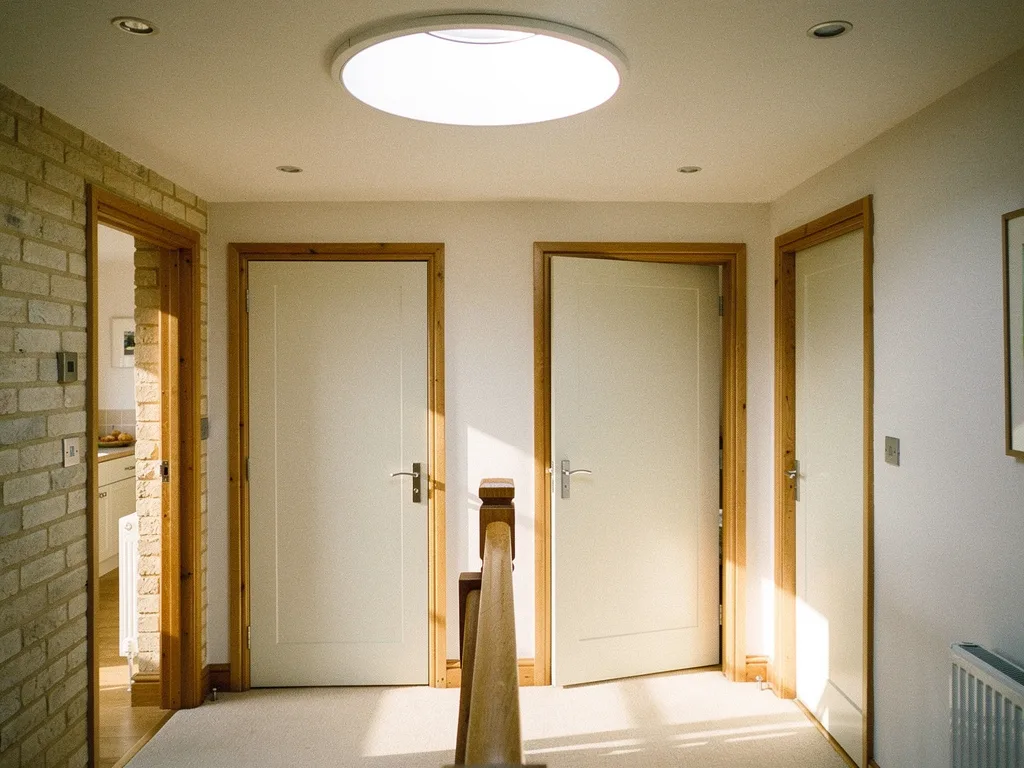
Both are sold as complete kits with a dome, a roof flashing or upstand, the tube and a ceiling diffuser. From the landing below, a finished rigid tunnel and a finished flexible one look almost identical: a white or frosted disc in the ceiling. The difference only shows when the sun goes in, when the run is longer than a metre or so, and when you stand under both and compare them. This guide sets out why that happens, where each type earns its place, and what moves the cost of each. If you want the basic mechanics first, how sun tunnels work covers the dome, tube and diffuser in turn.
Why the lining matters more than the dome
Daylight travels down a sun tunnel by bouncing off the tube wall, and every bounce costs a little light, so the quality of that wall decides how much arrives at the ceiling.
In a rigid tube the lining is smooth and flat along its length. Light that enters the dome at an angle strikes the wall, reflects at the same angle, and continues down in an orderly zig-zag. Because the surface is mirror-like, each reflection returns almost all of the light that hit it. Makers of rigid systems quote very high reflectance figures for their linings, typically in the high nineties as a percentage, and those figures are measured on flat samples in good conditions. Treat them as a sign of a good surface rather than a promise about your ceiling.
In a flexible tube the foil is pleated into ridges around the wire spiral. Each ridge presents a slightly different angle to the incoming light. Instead of one clean reflection, a ray meets a sloping fold, scatters off in a new direction, meets another fold, and scatters again. The foil itself may be quite reflective, but the ray makes many more contacts with the wall on its way down, and some of it is sent back upward towards the dome. The result is that a flexible tube loses light far more quickly per metre than a rigid one of the same diameter.
That is why swapping a clear dome for a slightly better one makes little difference to a room, while swapping two metres of old flexible tube for rigid sections can make the ceiling disc markedly brighter. The dome collects the light; the tube decides how much of it survives.
- Dome: a clear, UV-stable dome that catches daylight from a wide angle.
- Flashing: a flashing plate that sits into the tiles or slates, like a roof window flashing.
- Rigid reflective tube: a highly reflective lining bounces the light down its length. Rigid tube loses far less light than flexible.
- Adjustable bends step the tube around joists, purlins or tanks. Every bend and every metre costs some light, so the run is kept short and straight.
- Ceiling diffuser: a ring and a frosted lens that spread the light evenly and seal the ceiling.
- Light into the room: a hallway, landing or bathroom with no window gets real daylight.
- Loft insulation made good around the tube, which is often sleeved in the loft to limit condensation.

Light loss: reading the figures makers quote
Manufacturers publish light transmission figures for their tubes, and they are useful for comparing products from the same maker, but they are not a forecast of what a particular room will get.
Figures you will see in brochures are usually given per metre of straight tube, or for a standard run with a set number of bends, at a set diameter. They assume the tube is fitted straight, clean and fully extended. A flexible tube that is left partly compressed, or allowed to sag between supports, has deeper folds than the test sample and loses more. A rigid run with poorly sealed joints lets dust in over the years and dulls the lining at the joints.
A few points help when comparing two quotes or two product sheets:
- Compare like diameters. A wider tube carries more light for the same length and gives fewer bounces per metre, so a 350mm flexible run and a 250mm rigid run are not a fair test of the lining.
- Check what the figure includes. Some figures cover the tube only; others include the dome and diffuser. The whole-system figure is the one that matters to the room.
- Look at the run you actually need. A figure for a 600mm straight drop tells you little about a three-metre run through a hipped loft with two changes of direction.
- Ask about the length limit. Rigid systems are generally sold with extension sections that take the total run to about six metres. Flexible kits are usually recommended for much shorter runs, and makers themselves tend to advise keeping flexible sections short and straight.
We do not put a percentage on the light a tube will give your hallway, because the sky over the dome, the roof slope and the colour of the room below all change it. What we do in the light plan is describe the run, the diameter and the tube type, and say plainly what the disc will do on a bright day and a dull one. Our answer on how much light a sun tunnel gives compares output with familiar lamps.
Getting round obstacles: elbows against bending
The strongest argument for a flexible tube is that it will go where a straight line will not, while a rigid system has to reach the same place with fixed elbow pieces.
A loft is rarely empty. In a Victorian terrace off Mill Road or in Romsey you may find a purlin, a party wall corbel, a chimney breast and a run of old cables between the best spot on the roof and the landing ceiling. In a 1930s semi in Cherry Hinton or Chesterton, the hipped roof slopes in from three sides and the tank, if it is still there, sits right over the stairwell. In a new home at Trumpington Meadows or Great Kneighton, the roof is built from trussed rafters whose diagonal webs cannot be cut.
A rigid system handles these with adjustable elbows, typically allowing an angle to be set within a range, and with offsets built from two elbows and a short straight section. Each elbow is a smooth, mirrored bend, so it loses more than a straight section but far less than a sharp fold in foil. The planning happens before anyone goes up the ladder: we measure the roof, the loft and the ceiling position, and choose a route that uses the fewest and gentlest changes of direction. Where the structure allows, the best rigid run is a straight vertical drop from a flat roof or a short, single-angle run from a pitched slope.
A flexible tube simply bends around the obstacle. That makes it quicker to fit and tolerant of a dome that is not quite above the diffuser. The cost is paid in light: every bend in foil creates tighter, more irregular folds on the inside of the curve, and those folds scatter the light that meets them. A gentle sweep over half a metre loses much less than a tight kink, which is why a flexible link needs support and tension along its length. The separate guide to sun tunnel length and bends goes into how each change of direction adds up over a full run.
A side-by-side view
Laid out together, the two types trade brightness and reach against flexibility of route and speed of fit.
| Point | Rigid tube | Flexible tube |
|---|---|---|
| Lining | Smooth mirror finish | Pleated foil on wire |
| Light per metre | Loses little | Loses much more |
| Practical run | Up to about 6m with extensions | Short links only |
| Changes of direction | Set elbows | Bends by hand |
| Loft access needed | Room to join sections | Can go through tight gaps |
| Best use | Main run, longer drops | Short offsets, awkward last metre |
The table is a guide to how the types behave, not a ranking. A well-planned flexible link of a metre, stretched straight and supported, can be the right answer in a cramped eaves space. A rigid tube fitted with three unnecessary elbows can underperform a tidier route. What matters is that the tube type is chosen for the run, rather than the run being bent to suit whatever tube was in the van.
Heat, condensation and the loft
Both tube types pass through the cold loft space, so both need the same care with insulation, and the rigid tube is the easier of the two to wrap and keep tidy.
In winter the air inside the tube is warmed by the room below, while the loft around it is close to outdoor temperature. If warm, moist air from a bathroom or landing reaches a cold tube wall, it can condense. The answer for either type is an insulating sleeve around the whole run through the loft, a well-sealed diffuser at the ceiling, and loft insulation made good right up to the tube. Rigid sections give the sleeve a straight, even surface to sit on, with joints that can be taped and sealed. A flexible tube is harder to sleeve neatly, particularly on a bend, and any gap at the inside of a curve leaves a cold spot.
In summer the concern is heat rather than condensation. A sun tunnel admits much less heat than a skylight of similar glazed area, because the light arrives through a small diffuser rather than a large pane. The tube type makes little difference to heat gain on its own. For more on this, see whether sun tunnels cause condensation.
What drives the cost of each
A flexible kit is usually the cheaper product to buy, but the price of the tube is only one part of what a finished sun tunnel costs, and the gap narrows once the whole job is counted.
The main things that move the cost of either type are:
- Diameter. A 350mm or wider tube costs more than a 250mm one in either type, for the dome, flashing, tube and diffuser alike.
- Length of run. Rigid runs need extension sections and more elbows as they get longer. A flexible kit comes in a set length, but a long flexible run is rarely worth fitting because of the light it loses.
- Roof type. A tiled pitched roof, a slate roof and a flat roof each need a different flashing or upstand, and a slate or conservation setting may need a lower-profile dome. See sun tunnels for pitched roofs.
- Access and structure. A clear loft over a landing is quicker than a shallow bungalow eaves or a trussed roof that forces an offset. Scaffolding or a tower may be needed on a tall or steep roof.
- Extras. An LED kit for evening light, a ventilation kit for a bathroom, or a dimmer shutter each add to the kit and the fitting time.
- Making good. Cutting and finishing the ceiling, sealing the diffuser and restoring loft insulation take the same time whatever the tube.
Because the labour, roof work and making good are much the same for both types, choosing flexible to save on the tube saves less than the difference in kit prices suggests. The general market ranges for sun tunnels and other roof glazing are on our costs page, and the survey sets the real price for your roof.
Which Cambridge homes suit which tube
The right choice follows the roof and the route, so it helps to think in terms of the house types we survey around Cambridge rather than in terms of one tube always being better.
Single-storey extensions with a flat roof. The side-return extensions behind terraces in Petersfield and De Freville, and the rear kitchen extensions on semis across Arbury and Cherry Hinton, often have a flat roof sitting only a few hundred millimetres above the ceiling. A short rigid drop straight down from an upstand is the brightest possible sun tunnel, and a flexible tube gains nothing here.
Terraced houses with a straight loft. A dark landing or a windowless first-floor bathroom under a pitched slate or tile roof is a classic sun tunnel room. The run is typically one to two metres with a single angle to bring the tube from the slope to vertical. Rigid sections with one adjustable elbow suit this well; see sun tunnels for halls and landings.
Bungalows and chalet homes in the villages. Places like Histon, Milton and Sawston have plenty of bungalows with deep central hallways. The loft is usually generous and the run short, so rigid again, with an eye on where the purlins fall. Sun tunnels for bungalows covers the layout.
New homes with trussed roofs. In Eddington, Great Kneighton or Cambourne, truss webs cross the loft at angles and must not be cut. A rigid run with a planned offset usually threads between them. Where the gap is too tight for the elbows to turn, a short flexible link over the last metre may be the practical route.
Long drops through two floors. Taking daylight from the roof to a ground floor room through a cupboard on the floor above is only realistic with rigid tube, because the length is at the top of what any system will carry. Our answer on sun tunnels through two floors explains when it works.
Combining the two, and replacing an old flexible run
Many good installations are neither purely rigid nor purely flexible: a mainly rigid run with a short flexible link where the geometry demands it keeps most of the light and still reaches an awkward spot.
Several makers sell rigid kits with an optional flexible section for exactly this purpose. The rule we work to is simple to state: rigid for every metre that can be straight, flexible only for the shortest link that solves a problem, stretched taut and supported so its folds stay shallow. That way the light loss of the flexible part is confined to a short length, and the rest of the run does the heavy lifting.
Older sun tunnels are a different story. Some early installations used a long flexible tube for the whole run, sometimes left slack between the roof and the ceiling. Over time the foil can dull and sag, and dust settles in the folds, so the diffuser gives less light each year. If yours looks grey even on a sunny day, replacing the tube with rigid sections, often reusing the same ceiling position, is usually the upgrade that makes the biggest difference. Depending on age and condition, the dome and flashing may also be worth renewing at the same visit. How long sun tunnels last covers the service life of each part.
Whichever route we propose, the light plan with your quote says which tube type we will use, why, the diameter, the route through the loft and where the diffuser will sit on the ceiling. You can read more about how we plan it on the sun tunnel installation page, or book a light survey and we will look at your loft and roof in person.
Questions people ask
These are the points that come up when homeowners weigh a rigid tubular skylight against a flexible one.
Is a flexible sun tunnel worth fitting at all?
Yes, for the right job. A short flexible link, kept taut and straight, can get light past an obstacle that a rigid elbow cannot clear. It is a poor choice for a long run or a whole installation, because the pleated lining scatters and loses light at every fold.
Can I tell which type I already have?
Look in the loft. A rigid tube is a smooth, hard metal cylinder with visible joints between sections. A flexible tube looks like a large ducting hose with ribs, and it gives when you press it. If you cannot reach the loft, the survey will confirm it.
Does a rigid tube need more loft space?
A little. The sections have to be joined and the elbows set, so there needs to be room to work around the run. In a very shallow loft or tight eaves, a rigid main run with a short flexible link at the tightest point is often the answer.