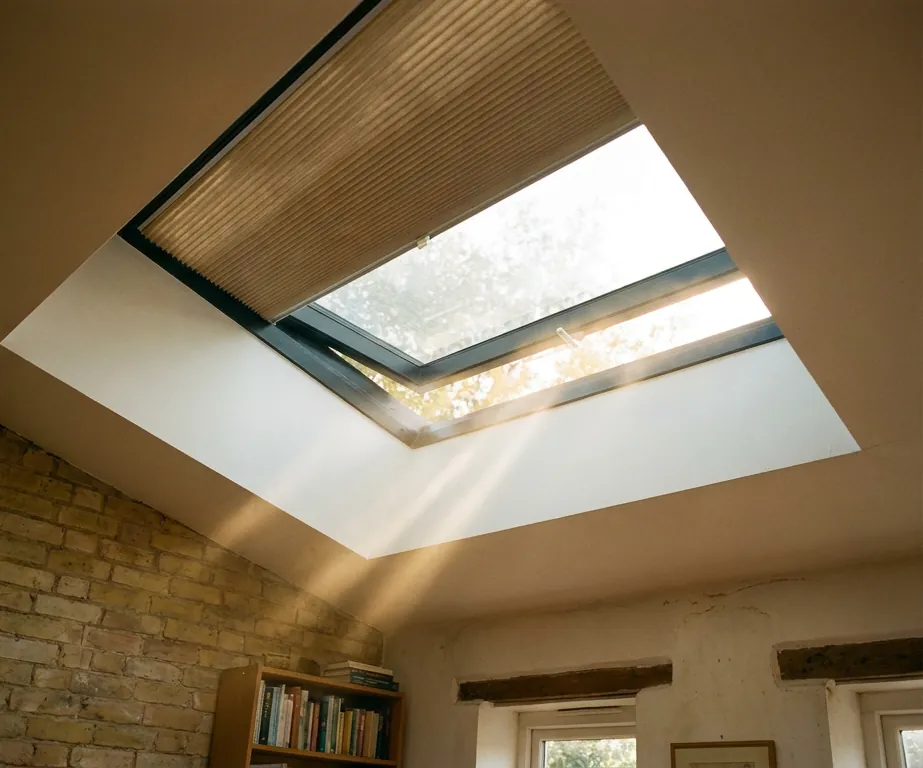
Where the gas goes, and how fast
Argon leaves a sealed unit by passing very slowly through the seals around its edge, not through the glass, and the rate is set by how well those seals were made.
A double or triple glazed skylight unit is two or three panes held apart by a spacer bar and bonded at the perimeter. The cavity is filled with argon at the factory, usually to around 90 per cent, with the rest being ordinary air. Glass itself is effectively gas tight, so the only way out is through the edge. The first barrier is a thin bead of polyisobutylene (butyl) between the spacer and each pane. This is the seal that holds the gas in. Behind it sits a secondary seal of polysulphide, polyurethane or silicone that gives the unit its strength and protects the butyl.
No sealant is perfectly impermeable, so a few argon molecules find their way out every year and a little air diffuses in to replace them. The European standard for sealed glazing units, EN 1279, includes a gas leakage test in which a unit must lose less than 1 per cent of its fill per year. Good units made on automated lines often do far better than that limit. The loss is also not a straight line: it depends on the unit, the sealant, the temperatures it sees and how much the edge is worked over its life.
So the honest answer to "does argon escape from rooflights" is yes, but a sound unit leaks it at a pace measured in fractions of a per cent a year. It is a slow fade, not an event.
Why a flat rooflight works its seals harder than a wall window
Glass lying near horizontal sees bigger swings in temperature than a vertical pane, and every swing flexes the edge seal a little.
On a clear July afternoon the outer pane of a flat rooflight on a Cambridge extension faces almost straight up at a high sun. On a clear January night the same pane looks at an open, cold sky and can drop below the air temperature. The gas in the cavity expands in the heat and contracts in the cold, so the panes bow out and in very slightly. Glaziers call this pumping. Each cycle puts a small load on the butyl, and over many thousands of cycles a weak or thin seal is where a unit starts to lose its fill faster than it should.
This is one reason a rooflight unit is built differently from a window unit. Rooflight glass is usually thicker, often toughened outside and laminated inside, and the edge seal is specified for the heat and movement of a roof. It is also why the sealed unit is set in a frame that drains and ventilates its edge: butyl that sits in standing water for years does not last. A dark coloured frame on a south facing slope, or a unit under a solar control coating that absorbs some heat, runs warmer still. None of this is a fault. It simply means the quality of the seal matters more on a roof than in a wall, and it is worth asking how the unit is made rather than only what its U-value is on day one.
The sun path matters here too. A south slope gives the glass its hottest days, while a north slope gives colder nights with less daytime warmth to balance them. Our light planning starts from orientation for the light inside the room, and the same information tells us how hard a given unit will be worked.
What losing some argon does to heat loss
Losing a few per cent of argon makes a very small difference to the U-value; replacing all of it with air makes a noticeable one.
Argon conducts heat less readily than air, and in a unit with a low-E coating that difference is worth a useful slice of the insulation. The low-E coatings and argon fill guide explains how the two work together. The figures below are typical centre-pane values for a double glazed unit with a soft low-E coat and a 16 mm cavity, measured vertically. A rooflight lying flat performs worse than these numbers, which is covered in rooflight U-values explained, but the gap between the rows is what matters here.
| Cavity fill | Centre-pane U-value (about) |
|---|---|
| 90% argon, as made | 1.1 W/m²K |
| Around 80% argon | 1.15 W/m²K |
| Air only | 1.4 W/m²K |
A unit that has slipped from 90 to around 80 per cent argon over many years has lost very little, perhaps a few hundredths on the U-value, which you would not feel standing under it. A unit that has lost all its gas is roughly a quarter worse at the centre of the pane: still far better than old single glazing, but no longer the unit you paid for. You also cannot tell which of these you have by looking. Argon is colourless, and a clear unit that has lost gas looks the same as one that has not. A specialist can measure the fill through the glass with a non-destructive analyser, although in a home the more useful signs are the ones below.
When gas loss becomes a failed unit
Slow diffusion is normal ageing; a broken seal is different, because once the edge is open the gas goes quickly and moist air follows.
The spacer bar holds a desiccant that soaks up the small amount of moisture that creeps in over a unit's life. While the seal is sound it keeps the cavity dry for decades. When the seal fails, through age, poor manufacture, water sitting on the edge or a unit that was twisted in fitting, damp air enters far faster than the desiccant can cope with. The argon is diluted to little more than air, and condensation starts to form inside the cavity on cold mornings. At first it clears as the day warms; later it stays, and the inner faces of the glass can mark permanently.
That is the point at which the unit has lost both its insulation and its view of the sky. Misting between the panes is not the same as the condensation on the room side covered in rooflight condensation, which is about room humidity and a cold inner pane. Gas cannot be pumped back into a sealed unit in place, and a cavity that has taken in moisture will not recover. The answer is a new sealed unit or a new rooflight, and on older frames with no thermal break the whole unit is usually the better upgrade. Is it worth replacing an old rooflight to save energy? weighs up when that makes sense.
Choosing a skylight that keeps its gas
The best protection against gas loss is a well-made unit, fitted so its edge stays dry and unstressed, from a manufacturer that tests to the standard.
When we plan a rooflight we look at the glass line, not only the headline U-value. A sealed unit made to EN 1279, with a butyl primary seal and a secondary seal suited to gas filled units, is the starting point. A warm edge spacer helps too: it keeps the edge warmer, which reduces condensation there and eases the temperature swing the seal sees. On a south slope, choosing the right solar control glass keeps the unit, and the room, cooler through summer; what is a good g value for a south facing rooflight covers the choice.
Fitting matters as much as the product. The upstand has to be level and square so the frame is not twisted, the unit must bed evenly, and the frame drainage must be kept clear. Krypton, which some slimline triple glazed units use, is held by the same seals and behaves in the same way. For the full range of glass and frame choices, see our energy efficient rooflights page, and every quote comes with a written light plan naming the glass we propose and why.
Questions people also ask
How long does argon last in a rooflight?
In a sound unit made to EN 1279 the fill falls by less than 1 per cent a year, so after 20 years a good unit still holds most of its argon. A quality sealed unit is commonly expected to last 20 to 30 years before the seal gives out.
Can argon be topped up in an existing skylight?
No. Refilling would mean drilling the spacer and closing it up again, which breaks the factory seal and does not remove moisture already in the cavity. A unit that has lost its gas is replaced, not refilled.
Does gas loss void the rooflight's warranty?
That depends on the manufacturer's product warranty, which normally covers seal failure that causes misting within a set period. Check its terms; our 10-year guarantee covers the installation work.
Is a triple glazed rooflight more likely to lose gas?
Not in itself. It has two cavities and two sets of seals, but each is made the same way. The weight of triple glazing is a separate question, covered in is triple glazing too heavy for a rooflight.
