What actually fades a sofa or a floor
Fading is caused by ultraviolet light first, then by strong visible light and heat. Stopping the UV slows fading a great deal, but it does not stop it altogether.
Dyes and finishes break down when energetic light breaks the chemical bonds that give them their colour. Ultraviolet carries the most energy per photon, so it does the most damage for its share of the sunlight. Short-wave visible light, the violet and blue end of the spectrum, also contributes, and heat speeds up the chemistry in the same way it speeds up most reactions. Humidity plays a smaller part, particularly for paper and textiles.
That is why a room can still show a faded stripe on the floorboards years after a UV-blocking pane went in. The glass removed most of the damage, but the bright visible light and the warmth of a daily sun patch kept working, slowly. Anything that reduces all three (UV, the intensity of direct sun and the heat) protects your furniture best.
Some materials are far more sensitive than others. Silk, wool rugs, velvet and cotton upholstery dyed in strong colours, aniline leather, watercolours, prints, old photographs and newspaper all fade quickly. Timber floors change colour under sun too: oak tends to go golden, walnut tends to lighten, and cherry darkens. Pigmented leather, painted surfaces and most modern outdoor-grade fabrics hold up much better.
Why overhead glass is harder on furniture than a wall window
A skylight faces the sky, not the horizon, so it catches the high summer sun almost square on. On a clear June day that puts more light and more UV through a square metre of roof glass than through the same area of wall.
A vertical window facing south receives the midsummer sun at a steep, glancing angle and much of it reflects off. A flat rooflight or a roof window on a south-facing 35 degree slope meets that same sun far more directly. In Cambridge, where the land is flat and there are few hills or tall ridges to shade a roof, a rooflight usually sees the sun from mid morning until early evening in summer.
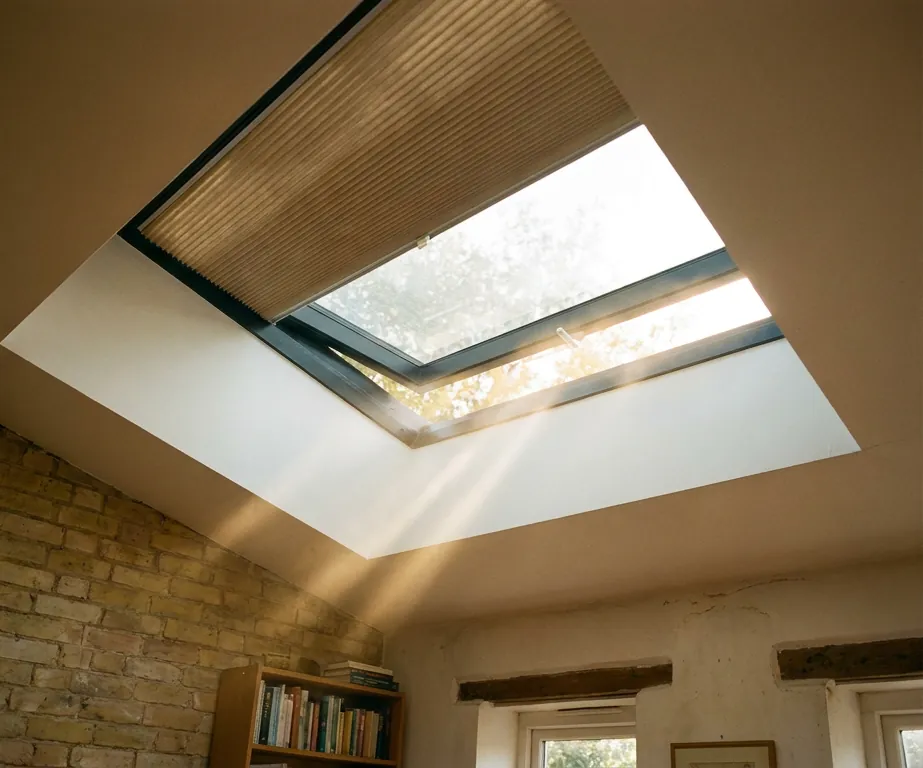
The light also lands in a different place. A wall window throws its patch across the floor near the wall, and the furniture there is often the obvious thing to move. A skylight drops its sun patch into the middle of the room, which is exactly where the sofa, the dining table and the rug tend to be. The patch travels across the room as the day goes on, so a whole run of furniture can spend an hour or two in direct sun each afternoon. Our page on rooflight overheating in summer explains the geometry of summer sun on horizontal glass.
How much UV different rooflight glass lets through
Plain float glass stops most UVB but passes a good share of UVA. Low-E coatings cut it further, and a laminated pane blocks nearly all of it.
The figures below are general values for common glass types as published by glass makers, given as a guide. Exact numbers depend on the coating, the interlayer and the thickness, so check the data sheet for the unit you are buying.
| Glass type | UV let through (as a guide) | Visible light |
|---|---|---|
| Single clear float | around 60 to 70% | High |
| Double glazed, low-E | around 25 to 40% | High |
| Solar control double | around 10 to 25% | Lower |
| Any unit with a laminated pane | under 1% | Barely changed |
The laminated pane is the most useful of these for furniture. Its plastic interlayer, usually PVB, absorbs ultraviolet up to around 380 nanometres. Many rooflights already carry a laminated inner pane because it holds together if the glass breaks, which is what overhead glazing above people needs for safety. You get the UV protection as a side effect of the safety glass. The glass sections of our energy efficient rooflights hub cover how these layers are put together in a modern unit.
Glass choices that cut fading without darkening the room
The aim is to take out the UV and the worst of the heat while keeping the daylight. Laminated inner glass plus the right solar control coating for the slope does most of that.
- Laminated inner pane. Blocks almost all UV with very little loss of light. For a room with a good rug, antique furniture or artwork, it is the first thing to ask for.
- Solar control coating. Reflects a large part of the sun's heat and trims the visible light a little. On a south or west slope it keeps the sun patch cooler, which slows fading and keeps the room comfortable. Solar control glass for rooflights explains which slopes need it.
- A sensible g-value. The g-value measures how much solar heat passes through. A lower figure means a cooler patch of sunlight. Our answer on a good g-value for a south-facing rooflight gives the working range.
- Neutral tint. A strongly tinted pane can shift the colour of the light in the room. If you care how fabrics and paint look, a neutral coating is usually the better pick, as blue or neutral solar control glass sets out.
People often worry that protective glass will make the room gloomy. A laminated pane barely changes the light, and a good neutral solar control coating keeps the room bright to the eye, as does solar control glass make a room darker? explains.
Placement, blinds and the light plan
Where the rooflight sits decides where the sun patch lands. Planning that before the roof is cut is the cheapest protection your furniture will ever get.
In a Romsey terrace with a side-return kitchen, a flat rooflight over the worktop sends its sun patch onto tiles and stone that do not mind it, while one over the dining end lands on the table and chairs every summer afternoon. In a loft room under a south slope, moving a roof window a rafter bay along can keep the direct sun off a bed or a bookcase for much of the day. When we draw up the light plan for a quote, we trace where the patch falls through the seasons and mark anything valuable in its path.
Blinds finish the job. A blackout or translucent blind inside the unit stops direct sun reaching the room at the times you choose, though it holds the heat on the room side of the glass. External shading stops the sun before it reaches the glass at all, which protects both the furniture and the room temperature; see external shading for rooflights. Applied films are sometimes suggested for older glass, but they carry risks for sealed units, covered in does window film work on rooflights?
If you have an older single-glazed or plastic skylight over a room with good furniture, replacing it with a modern laminated unit is a real improvement for colour as well as warmth. Book a light survey and we will show you where the sun will fall before anything is fitted.
Questions people also ask
Do skylights fade furniture more than windows?
They can, because overhead glass meets the summer sun more directly and drops the sun patch into the middle of the room. With a laminated pane, solar control glass on a sunny slope and a blind, a skylight need not fade furniture any faster than a well-specified wall window.
Does double glazing stop UV?
Ordinary double glazing cuts UV but does not stop it; a low-E double unit still lets a noticeable share of UVA through. Adding a laminated pane is what takes UV transmission down to almost nothing.
Will an old plastic dome rooflight fade my carpet?
Older polycarbonate and acrylic domes vary a lot, and some lose UV resistance as they age and yellow. The diffused light is gentler than a clear pane, but a modern glass unit with a laminated inner pane gives far more dependable protection. Are polycarbonate rooflights energy efficient? compares the two.
Can a rooflight fade wooden floors?
Yes. Direct sun changes the colour of most timber floors, lightening some species and darkening others, and a square of different colour under a rug is a familiar sign. Cutting UV slows it, and moving rugs now and then evens out the change.