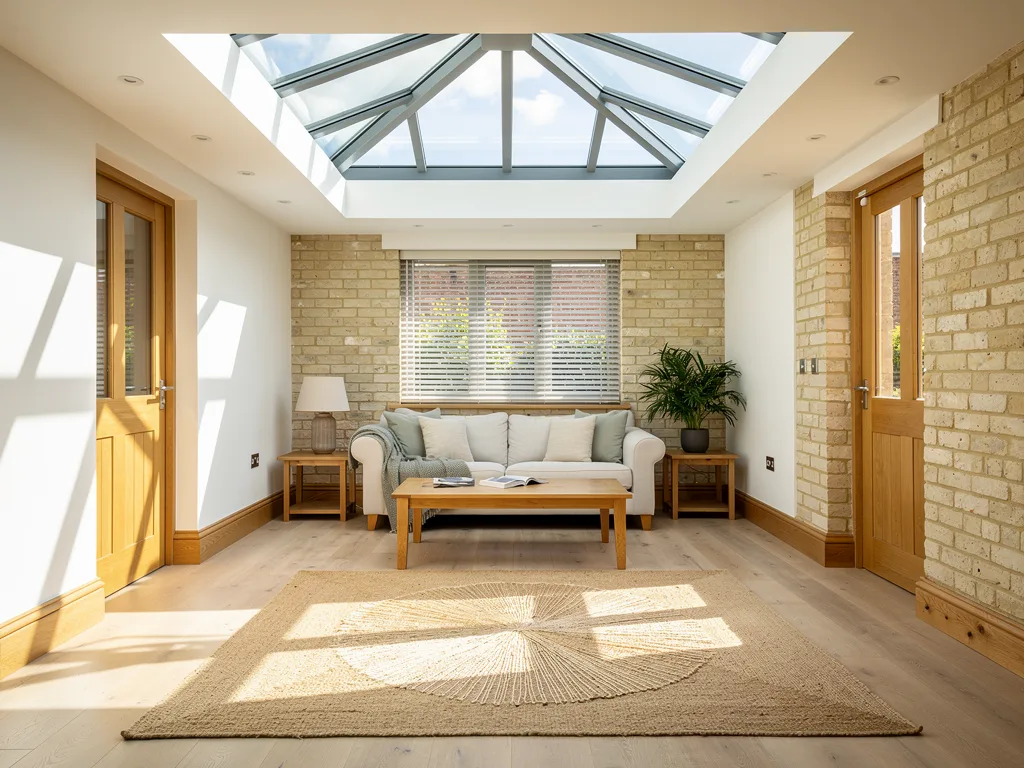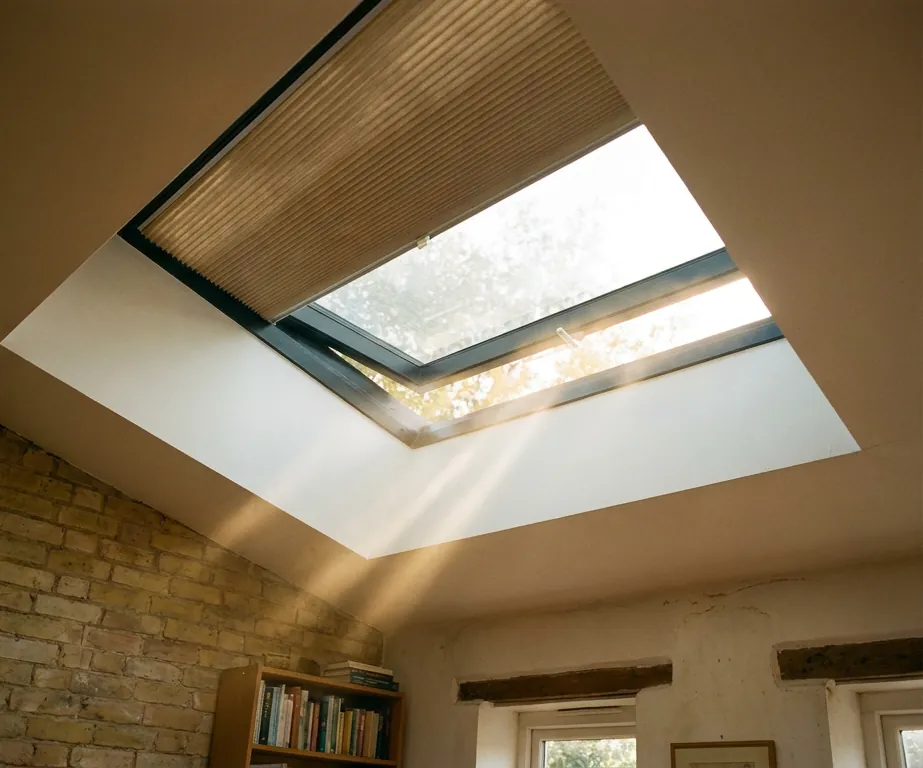
A roof opening faces the summer sun, a wall opening does not
Rooflight overheating starts with geometry. Glass laid flat or at a shallow pitch looks straight up at the high summer sun, while a wall window sees that same sun at a glancing angle, so the same square metre of glass collects far more heat on the roof than in the wall.
Cambridge sits at roughly 52 degrees north. At midsummer the sun climbs to about 61 degrees above the horizon at solar noon. A beam arriving from that height strikes horizontal glass close to square on, and nearly all of its energy passes into the pane. The same beam meets a south facing wall window at a steep slant: the glass presents a much narrower target to the sun, and a larger share of what does arrive reflects off the outer face instead of entering. A wall window in a south elevation is, in effect, partly self shading in June and wide open to the sun in December, which is exactly the pattern a house needs. A flat skylight does the reverse.
That is why a room can have a big south facing patio door and stay comfortable, then become uncomfortable the summer after a modest rooflight goes in above it. Nothing was wrong with the product or the fitting. The glass was simply pointed at the part of the sky where the summer sun spends its day. This guide explains the mechanism in plain terms and then walks through the design decisions that stop a roof opening from turning a room into a greenhouse. For the wider context on energy performance, start at the energy efficient rooflights hub.
Sun height and day length through a Cambridge year
The table below shows how much of the direct noon sunbeam a flat pane and a south facing wall pane intercept at each season. It is pure geometry, but it explains why skylight overheating is a summer problem and why the same glass is welcome in winter.
| Season | Noon sun height | Flat glass | South wall glass |
|---|---|---|---|
| Midsummer | about 61° | 87% | 48% |
| Equinox | about 38° | 62% | 79% |
| Midwinter | about 14° | 25% | 97% |
The percentages are the share of a direct beam that a pane of each orientation faces, before any reflection or glass coating is counted. Two things stand out. In June the flat pane catches close to twice the beam that the wall pane does, and in December the relationship flips completely.
Day length adds to the imbalance. Around the longest day the sun is up for more than sixteen and a half hours over Cambridge, rising well round towards the north east and setting towards the north west. A south facing wall window receives no direct sun at all in the early morning or the long evening, because the sun is behind the house. A flat rooflight sees it from soon after sunrise to shortly before sunset. The flat pane is therefore collecting a stronger beam for many more hours of the day.
- Winter solstice, about 14°. The lowest noon sun of the year travels furthest: it crosses the whole room and lands high on the back wall.
- Spring and autumn equinox, about 38°. The light lands on the floor, deep in the room.
- Summer solstice, about 61°. The highest, strongest sun drops steeply and lands close under the window.
- South-facing roof window. The same opening lets in a different patch of light every month.
- Deepest reach. In December the sun patch can be on the wall opposite, which is why we plan where it falls, not just how big the glass is.
The fen landscape makes it sharper again. With almost no hills and few tall buildings to shade a roof outside the city centre, a rooflight in Histon, Cottenham or Cambourne sees the whole of that long arc. Cambridge is also one of the sunnier and warmer parts of the country: the Botanic Garden recorded 38.7°C in July 2019, a UK record at the time. Summer heat through roof glass is a local design issue, not a theoretical one.

Where the heat goes once it is inside
Sunlight passing through a rooflight is not hot air. It is radiation that turns into heat when it lands on a floor, a worktop, a sofa or a person, and that heat then warms the air around it and rises back towards the ceiling.
This two stage process matters because it explains why a room under a skylight can feel hotter than a thermometer on the wall suggests. You feel the direct radiation on your skin and your head when you sit in the sun patch, and you feel the warm air layer that builds up under the ceiling when you stand or climb the stairs into a loft room. Both are real, and they need different answers.
The warm air layer is where roof glazing works against itself. The rooflight is already at the highest point of the room, which is where the rising warm air collects. If the unit is fixed shut, that air has nowhere to go. In a single storey rear extension with a flat roof and a lantern, the ceiling zone can sit several degrees above the air at seated height. In a loft conversion the effect compounds, because warm air from the whole house is already rising up the stairwell into the top floor.
What the heat lands on also counts. A pale timber floor reflects some of the light back up and out through the glass. A dark stone floor or a dark kitchen worktop absorbs it and releases heat slowly into the evening, which is pleasant in March and less so in July. Dense materials such as a concrete slab or brick walls soak up heat through the day and even out the peaks, while a lightweight loft room with plasterboard on insulation has very little mass to absorb anything, so it warms fast and stays warm.
The rooms that run hottest
Three types of room run hottest under new roof glass: loft bedrooms on a south or west slope, single storey extensions with a large lantern, and top floor flats and studies with little way to ventilate.
Loft bedrooms. A dormer or roof window conversion in a Romsey or Chesterton terrace puts roof glass in the room where you sleep, at the top of the house, often on the rear slope. If that slope faces south or west, the evening sun arrives low through the glass just as the room is needed for sleep, and the lightweight structure gives the heat straight back. A west slope is arguably worse than a south one for a bedroom, because the peak gain comes late in the day when the outside air is at its warmest.
Kitchen extensions with a lantern. The lantern over an open plan kitchen and dining room in a 1930s semi in Cherry Hinton or a Victorian house off Mill Road is often the largest area of glass in the house. Kitchens already generate heat from cooking, and a dining table directly under the glass puts people in the sun patch at lunch and dinner. The popular rule of thumb that a lantern should cover 15 to 20% of the flat roof area exists partly for this reason: go much larger and the heat builds faster than the room can shed it.
New build top floors. Homes at Eddington, Trumpington Meadows and Great Kneighton are built to high airtightness and insulation standards. That keeps winter heat in very well, and it keeps summer heat in just as well. Adding roof glazing to an already well sealed top floor needs more care about ventilation than the same job on a draughty Victorian house.
Design choices that prevent it before the roof is cut
Overheating is far easier to design out than to fix later. The biggest levers are which slope the opening goes in, how large it is, where it sits over the room, and the pitch of the glass.
- Choose the slope. On a pitched roof with a choice of slopes, a north facing rooflight gives steady, soft light all day with very little direct sun, and it almost never overheats a room. East slopes take morning sun, which is gentle on heat because the air is still cool. South and west slopes need the most thought.
- Size to the room, not the roof. A deep terrace kitchen needs enough glass to reach the back of the room, not enough to cover it. Two moderate units spaced along the length can light a room more evenly, with less peak heat, than one large one.
- Place the glass over circulation, not over seats. Setting the opening over a walkway, a stair or the far end of a worktop means the summer sun patch falls where nobody sits for long. The light still spreads across the room from the reflected surfaces.
- Pitch matters. A roof window in a 45 degree slope faces the summer sun less directly than a flat rooflight on a 5 degree kerb. Where a flat roof extension could take either a flat rooflight or a small pitched lantern, the geometry of each changes the heat.
- Plan for opening. A rooflight that opens lets the hot air at the ceiling escape. Paired with a window or door lower down, it drives a stack effect that pulls cooler air through the room.
None of these costs anything extra in materials. They are decisions made on paper, which is why we work out the sun path and the sun patch for the actual room before we quote. The light planning page explains how that assessment works and what it looks at.
Glass that lets light in and keeps heat out
Once the position is right, the glass does the next share of the work. The figure to look at is the g-value: the fraction of the sun's total energy the glazed unit lets into the room.
A clear double glazed unit typically has a g-value somewhere around 0.6 to 0.7. A good solar control unit can bring that down to around 0.3 or below while still passing a large share of visible light, because modern coatings reflect the infrared part of sunlight far more than the visible part. Roughly half of the energy in sunlight is infrared that you feel but cannot see, so a coating that turns much of it back cuts the heat without making the room gloomy. The solar control glass guide explains how the coatings work, and g-value and light transmission covers balancing the two figures on a datasheet.
There is a trade to make. The lower the g-value, the less passive warmth the rooflight gives in winter, and the more the light transmission tends to drop. On a north slope, low g glass gives away winter gain for no summer benefit. On a flat roof or a south slope, the balance tips firmly the other way. For a specific figure to aim at, see what is a good g value for a south facing rooflight, and for the worry that a coated unit will dim the room, see does solar control glass make a room darker.
Two related points. Adding a third pane lowers heat loss but does little on its own for summer gain, because the thing that controls solar heat is the coating, not the number of panes. And applied films on the inside of a sealed rooflight unit can make the glass run hot enough to stress it; does window film work on rooflights covers the risks before anyone reaches for that option.
Shading, ventilation and blinds
Shading and airflow deal with the heat the glass still lets through. The order of effectiveness is clear: stop the sun outside the glass if you can, then move the warm air out, then use internal blinds for glare and privacy.
External shading intercepts the radiation before it reaches the glass, so the heat never enters the room. On pitched roof windows that usually means an external awning blind, a fine mesh that clips over the outside of the window and still lets you see out. On flat rooflights and lanterns there are external blinds and, on larger glazed roofs, fixed louvres. The options and their limits are set out in external shading for rooflights.
Internal blinds work differently. Once sunlight has passed through the glass and hit the blind, the blind itself warms up and that heat is already in the room. A pale, reflective blind sends some of it back out through the glass, while a dark one mostly adds to the warm air layer. Internal blinds are good at stopping glare and the direct heat on your skin, and they work best alongside low g glass rather than in place of it. Can internal blinds stop a rooflight overheating goes into the detail.
Ventilation completes the picture. An opening rooflight, manual or electric with a rain sensor, releases the warm air layer at the top of the room. Left open overnight on a secure setting, it lets the room purge the heat gathered through the day so it starts the next morning cooler. That night cooling is worth a great deal in a loft bedroom, and it costs nothing to run.
Planning rules and what they expect
Building Regulations Approved Document O sets overheating limits for new homes, but it does not apply to an extension or loft conversion on an existing house. The design concern remains, even where no regulation measures it.
Part O came into force in June 2022 and covers new dwellings, including some conversions that create new homes. For a rooflight going into your existing house, the regulations that apply are mainly Part L for heat loss (a limiting U-value of 2.2 W/m2K for rooflights, set out in Part L requirements for rooflights), Part K for the safety of overhead glazing and Part F where an opening unit forms part of the room's ventilation. None of those sets a summer comfort target for your room. That leaves overheating as a matter of design judgement, which is exactly why it is worth getting right on paper. Local planning rules may also shape the answer: in a conservation area a flush conservation style unit may be preferred, and an external blind may need to suit the roofscape. Greater Cambridge Shared Planning can confirm what applies to a particular street.
Questions people ask
Will a north facing rooflight overheat?
Very rarely. A north slope receives little or no direct sun for most of the year, so the heat gain through the glass is small and the light is steady and even. On a flat roof, though, there is no north facing option: a flat skylight faces the whole sky, including the summer sun overhead.
Is a roof lantern hotter than a flat rooflight?
For the same floor area, a lantern has more glass because of its sloping sides and hips, and some of those faces point towards the south and west. It also lifts the ceiling, giving warm air somewhere to gather. Solar control glass and an opening vent in the lantern matter more as the lantern gets larger.
Can an existing hot room be improved?
Yes. An external awning or blind is the quickest change on a roof window. Where the glass itself is old or clear, replacing the unit with a low g, solar control version is the lasting answer, and changing a fixed unit for an opening one adds ventilation. Upgrading the glass also brings the U-value up to current standards.
Do rooflights fade furniture as well as heating the room?
Overhead glass admits more ultraviolet than wall glass for the same geometric reasons it admits more heat. Laminated inner panes and some coatings cut UV sharply; do rooflights fade furniture covers it. If a room under a rooflight is already too warm or you are planning one on a south slope, book a light survey and we will show you where the sun patch falls through the year before anything is ordered.