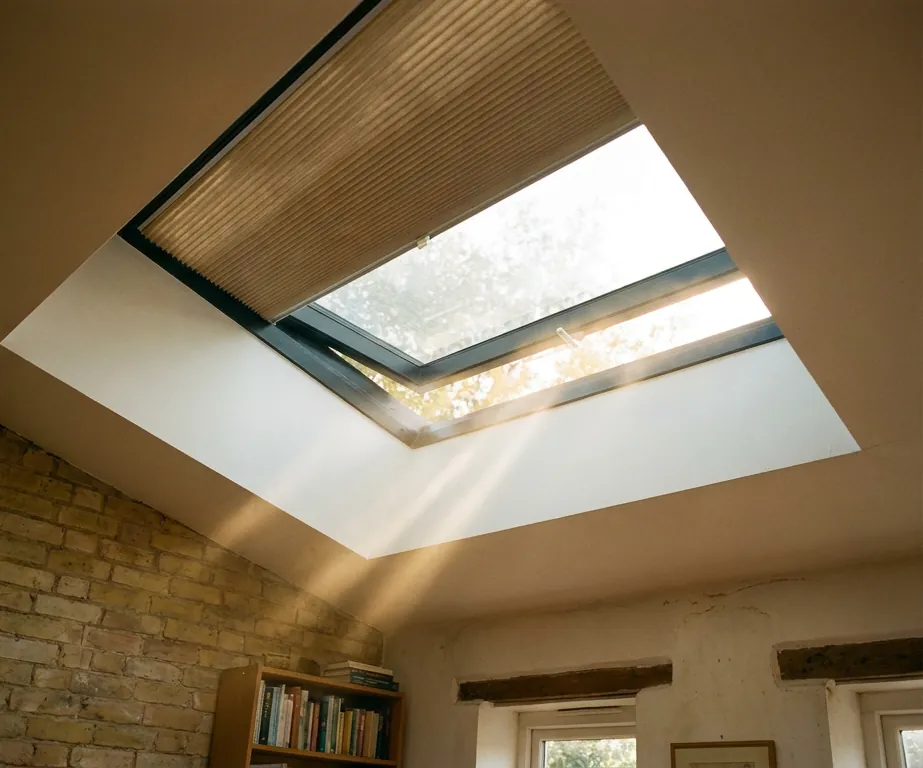
Why a south slope needs a lower g-value than the rest of the roof
A south facing slope meets the summer sun almost head on, so the glass in it collects more solar heat per square metre than glass on any other slope or in any wall.
The g-value is the share of the sun's total energy striking the glass that ends up inside the room, heat and light together. A clear low-E double glazed unit sits at roughly 0.55 to 0.65, which means well over half of the solar energy arriving at the pane passes straight through. On a north slope that hardly matters, because the glass sees sky rather than sun. On a south slope it matters a great deal.
Cambridge sits at about 52 degrees north. At midday on the summer solstice the sun climbs to roughly 61 degrees above the horizon, and on a typical 35 to 45 degree terrace or loft roof that puts the sun close to square on to the glass for the middle of the day. A flat rooflight on a rear extension is little better off, since it faces straight up at a high summer sun. The flat Fenland landscape adds to it: there are no hills and few tall buildings to shade a roof, so a south facing skylight here gets the full length of a clear afternoon. In December the same sun peaks at around 14 degrees, low and weak, which is why a south slope can give you welcome winter warmth and unwelcome summer heat through the same pane. Our guide to rooflight overheating in summer explains the geometry in more detail.
Matching the number to the room below
There is no single right g-value for a south slope: the right figure depends on who uses the room, when, and how much glass there is.
A kitchen used mainly in the morning and evening can take more solar gain than a bedroom that has to cool down before night. A room with one small roof window over a staircase has far less glass per cubic metre than a loft room with four large units in a row. The figures below are a starting point for glass on a south facing slope or a flat roof, as a guide, before the survey looks at the actual room.
| Room | Glass area | Suggested g |
|---|---|---|
| Hall, landing, stairwell | Small | 0.40 to 0.55 |
| Kitchen or living extension | Medium | 0.30 to 0.40 |
| Home office | Any | 0.25 to 0.35 |
| Loft bedroom | Any | 0.25 to 0.30 |
| Large flat rooflight or lantern | Large | 0.25 to 0.33 |
The office and bedroom rows sit low for different reasons. In an office, the problem is afternoon heat and glare on a screen while you are trying to work. In a loft bedroom, it is heat stored in the room during the day that is still there at 11pm, when the slates and the plasterboard behind the lining are radiating it back. A Mill Road loft conversion with a pair of roof windows on the south slope and a rear dormer is a good example of a room that needs the lower end of the range, whereas a small rooflight over a hallway in a 1930s semi in Cherry Hinton can sit comfortably on clear low-E glass.
Why the lowest g-value is not automatically the best
Pushing the g-value down too far costs you daylight, winter warmth and sometimes the colour of the room, so the aim is the lowest figure that still gives a bright, natural room.
Every solar control coating removes some visible light along with the heat. The best coatings are selective: they reflect much of the invisible infrared part of sunlight while passing most of the visible part, so a unit can have a light transmission of 60 to 70% alongside a g-value in the low 0.30s. Cheaper or heavily tinted glass reaches a similar g-value by simply cutting everything, and the room underneath looks grey or blue on an overcast day. A quick check on a data sheet is to divide the light transmission by the g-value: a figure close to 2 points to a selective coating, while a figure nearer 1 suggests tint is doing most of the work. Our pages on solar control glass for rooflights and on whether blue or neutral solar control glass is better cover the options.
Winter gain is the other side of the trade. A low sun through a south facing skylight on a clear January morning is free heat, and very low g glass throws some of that away. For a living room that is cold in winter and only warm on a handful of summer afternoons, a figure nearer 0.40 can make more sense than 0.25. Our answer on whether a skylight can warm a room in winter looks at how much that gain is worth.
When the right glass is still not enough
Glass sets the baseline, but on a south slope the size of the opening, ventilation and shading can each matter as much as the g-value.
Two square metres of south facing glass at g 0.30 can still admit more heat than one square metre at g 0.50. That is why the light plan looks at size and position first: a slightly smaller unit placed where the sun lands on the part of the room you actually use can give better light and a cooler room than a large one chosen for maximum brightness. An opening rooflight at the top of the slope lets warm air escape where it collects, under the ceiling. External blinds and awnings stop heat before it reaches the glass at all, which glass alone cannot match; see external shading for rooflights. Internal blinds help with glare and privacy but hold the heat inside the room once it has passed through, as our answer on whether internal blinds can stop a rooflight overheating explains.
The balance between heat and daylight is the subject of our full guide to g-value and light transmission, and the wider approach to orientation, sun path and placement is set out in how we plan the light. For glass, frames and U-values across every slope, start at energy efficient rooflights in Cambridge.
Questions people also ask
Is a g-value of 0.5 too high for a south facing rooflight?
For a small rooflight over a hall or stairwell, 0.5 is usually fine. For a kitchen extension, loft room or office with a medium or large area of south facing glass, it is high enough to cause warm afternoons in June and July, and a figure between 0.25 and 0.40 is a safer choice.
Does a lower g-value make the room darker?
Only a little, if the coating is selective. A good neutral solar control unit can keep light transmission above 60% while roughly halving solar heat gain compared with clear glass. Heavily tinted glass with a similar g-value will look noticeably dimmer, so compare light transmission alongside g on the data sheet.
Does Part L set a g-value for rooflights?
Part L sets a limiting U-value for rooflights in existing homes, not a g-value. The overheating requirements in Part O apply to new dwellings rather than extensions to existing homes, so for a rooflight added to an existing house the g-value is a comfort decision made with your installer rather than a legal minimum.
Can I change the g-value of an existing south facing skylight?
Not by adding anything to the glass without risk to the sealed unit. The reliable route is to replace the unit with one specified for the slope, or to add external shading. If you are weighing that up, book a light survey and we will look at the room, the slope and the glass together.
