What the spacer does in a sealed unit
The spacer sets the gap between the panes, carries the drying agent that keeps the cavity dry, and forms the base that the edge seals bond to.
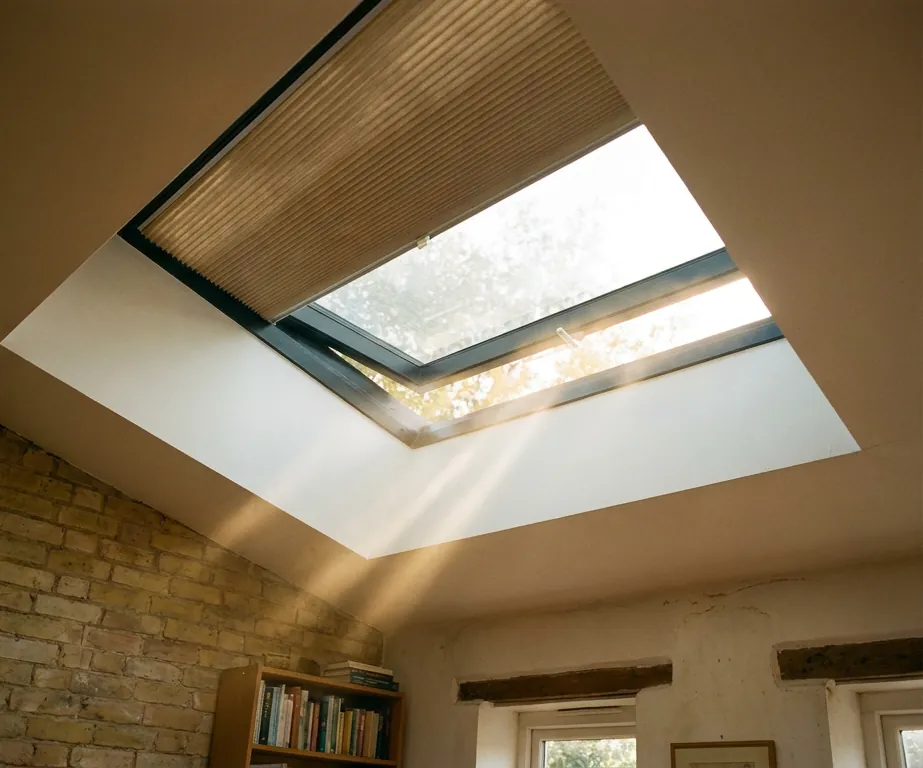
Look up at a double or triple glazed skylight and you will see a narrow band, usually black or grey, running round the inside edge of the glass. That band is the spacer. In a double glazed unit it is typically 12 to 20mm wide, which sets the cavity that is later filled with argon. It is hollow or porous, and it holds a desiccant that soaks up any moisture trapped when the unit was made, so the cavity stays clear. A bead of butyl seals the spacer to each pane, and a secondary sealant around the outside holds the whole edge together. You can read more about the gas and the coatings inside that cavity in our guide to low-E coatings and argon fill.
For decades the standard spacer was a folded aluminium box section. Aluminium is cheap, stiff and easy to bend into corners, but it conducts heat very well. It forms a bridge between the cold outer pane and the warm inner pane, right at the edge of the glass.
Why aluminium makes a cold edge
The centre of a modern rooflight pane is well insulated by its coating and gas fill, so the weakest part of the glass is now the edge, where the spacer connects the panes.
Heat always takes the easiest route. In the middle of the pane it has to cross a gas-filled cavity with a low-E coating on one side, which is slow. At the edge, an aluminium spacer gives it a metal path straight through. The result is a band, a few centimetres wide, around the perimeter where the inside surface of the glass runs noticeably colder than the centre. The effect is measured as a linear thermal transmittance, the psi value, in watts per metre of edge per degree. Published figures for aluminium spacers are typically several times higher than those for good warm edge spacers.
That matters more on a rooflight than on a wall window. A small skylight has a lot of edge for its area, so the edge makes up a bigger share of the whole-unit heat loss. Horizontal glass also looks at an open night sky and loses heat by radiation, so the outer pane of a flat rooflight on a clear January night in Cambridge can drop below the air temperature. Our guide to rooflight U-values explains how that edge loss is folded into the whole-unit figure.
The kinds of warm edge spacer
Any spacer that conducts much less heat than aluminium can be called warm edge, and the main families differ in stiffness, sightline and how they age.
The European standard for window thermal calculations, EN ISO 10077-1, sets a simple test: a spacer counts as warm edge when its wall thicknesses multiplied by the conductivity of their materials add up to no more than 0.007 W/K. In practice the options fall into four groups.
| Spacer type | What it is | Edge warmth |
|---|---|---|
| Stainless steel | Thin-walled steel box | Good |
| Plastic composite | Polymer box with a thin metal foil | Better |
| Structural foam | Flexible silicone foam strip | Better |
| Thermoplastic (TPS) | Extruded butyl-based bead | Better |
Stainless steel conducts heat at roughly a tenth of the rate of aluminium and can be made very thin, so it is a large step up while still behaving like a traditional spacer. The composite, foam and thermoplastic types go further. Foam and thermoplastic spacers are also flexible, which becomes important when we look at how long the unit lasts.
Edge condensation and what you see from below
A warmer glass edge means the inside surface near the frame stays above the dew point for longer, so the familiar line of droplets around the perimeter is less likely to form.
Condensation forms wherever warm, moist room air meets a surface colder than its dew point. On a rooflight over a kitchen or bathroom, with the humidity from cooking or showering, the coldest surface in the room is often the bottom edge of the glass. With an aluminium spacer you can get a strip of mist or droplets around the edge on cold mornings, and on a shallow-pitched or flat unit the water can run to the lowest side and drip. A warm edge spacer lifts the inside edge temperature by a few degrees, which on many winter nights is enough to keep it dry.
The spacer also works alongside the frame. A warm edge in the glass sitting in a cold metal frame only solves half the problem, which is why it belongs with thermally broken frames. On frameless units, where the glass edge sits directly on the upstand, the spacer carries even more of the load; see are frameless rooflights less energy efficient. The same cold edge is one cause of the chilly air that slides off older glass, explained in why a rooflight feels cold underneath.
There is a visual side too. From inside the room the spacer is the dark line you look at framing the sky. Black and dark grey spacers disappear against the frame far better than bare silver aluminium, and on frameless units a printed black border on the glass hides the spacer and sealant completely.
Why the spacer affects how long the unit lasts
A sealed unit usually fails at its edge, and the spacer decides how much movement and moisture that edge has to cope with over twenty or more years.
Horizontal glass works its seals hard. On a Cambridge summer afternoon the sun is high and falls almost square on a flat skylight; on a winter night the same glass faces a clear, cold sky. The gas in the cavity expands and contracts with every swing, so the panes bow in and out and the edge flexes. A rigid metal spacer passes that movement straight into the butyl seal. Flexible foam and thermoplastic spacers absorb some of it. Temperature stress matters too: a cold aluminium edge next to a warm pane centre sets up a larger difference across the glass than a warm edge does.
When the seal eventually lets moisture in, the desiccant soaks it up until it is saturated, and then the unit mists between the panes. That is the point where the unit needs to be replaced. A well made warm edge unit with a sound secondary seal simply takes longer to reach it. The slow loss of gas through the same edge is covered in does argon gas escape from rooflights.
Is it worth asking for?
On any new or replacement rooflight, a warm edge spacer is a small part of the cost of the unit and a sensible part of the specification.
Many quality rooflights now come with warm edge spacers as standard, but not all, and some product sheets quote a centre-pane U-value that leaves the edge out entirely. When we write the light plan for a job we list the glazing build-up, including the spacer, alongside the glass and shading choices for that slope. It matters most over humid rooms, on north-facing slopes that never get winter sun on the glass, and on small units where the edge is a large share of the area. For the full energy specification, start with our page on energy efficient rooflights in Cambridge, or book a light survey and we will look at the room with you.
Questions people also ask
Can I see whether my rooflight has a warm edge spacer?
Often, yes. A bright, silver edge band that feels cold to the touch on a winter morning usually means aluminium. Black or grey spacers are more likely to be warm edge, though colour alone is not proof, so the product data sheet is the reliable check.
Can a warm edge spacer be fitted to my existing skylight?
No. The spacer is built into the sealed unit at the factory. To get one, the sealed unit or the whole rooflight is replaced, which is also the moment to improve the glass and frame.
Does a warm edge spacer change the U-value?
It improves the whole-unit U-value slightly, and the gain is larger on small rooflights where edge makes up more of the area. It does not change the centre-pane figure, which is why whole-unit values are the ones to compare.
Do triple glazed rooflights need warm edge spacers more?
They have two spacers, and with a very well insulated centre the edge becomes the weakest point, so a warm edge matters even more. Our guide to double vs triple glazed rooflights compares the two builds.
