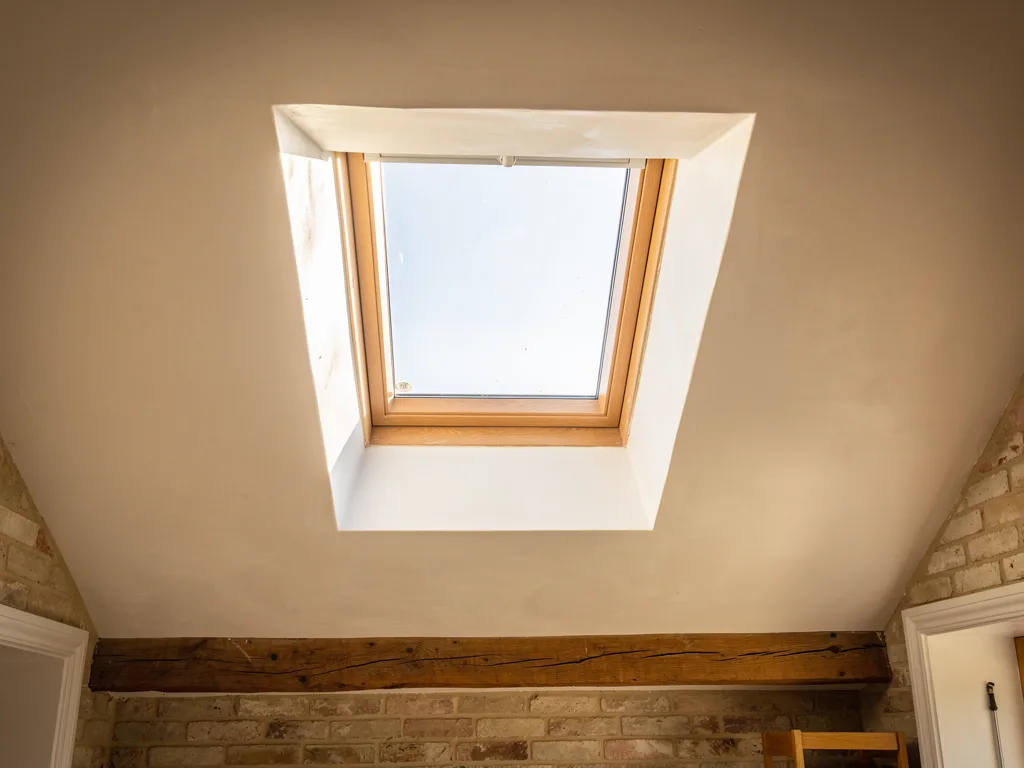
What a third pane actually changes
A triple glazed rooflight adds one more sheet of glass and one more sealed cavity, which cuts heat loss and warms the inner surface, but it also adds weight, depth and a small loss of daylight. Whether that trade is worth making depends on the slope, the room and the frame around the glass.
When people compare a double vs triple glazed rooflight, the conversation tends to stop at the U-value. That figure matters, but it is only one of five things that change when the third pane goes in. The others are the temperature of the glass you stand under, the weight the roof and any opening mechanism have to carry, how much light and solar heat reach the room, and how the unit handles the noise of rain and traffic. A double vs triple glazed skylight decision made on heat loss alone can leave you with a heavier, slightly dimmer unit that solves a problem the room never had.
It helps to picture the build-up. A good modern double glazed rooflight has a toughened outer pane, a cavity filled with argon, and a laminated inner pane with a low-emissivity coating on one of the cavity faces. A triple glazed unit keeps the toughened outer and laminated inner, then adds a middle pane and a second gas-filled cavity, usually with a second low-E coating. Each cavity is a layer of still gas that slows heat on its way out. Each coating reflects long-wave heat back towards the room. Each extra pane also absorbs and reflects a little of the daylight on its way in.
- Outer toughened pane: heat-strengthened to take hail, foot traffic during maintenance and thermal stress.
- Solar-control coating (optional) on the inside face of the outer pane, cutting heat gain on south and west roofs.
- Argon-filled cavity: a denser gas than air, so less heat crosses the gap.
- Warm-edge spacer: a low-conductivity edge that keeps the units’ edges warmer and cuts condensation at the frame.
- Low-E coating: a microscopically thin metal layer on a cavity face that reflects room heat back inside.
- Inner laminated pane: two sheets bonded to an interlayer, so if it ever breaks, the glass stays in place overhead.
- Triple glazing only: a third pane and a second argon cavity, usually with a second low-E coating. Warmer, heavier, and it lets in slightly less light.
None of this is new technology, and both types are made to a high standard by the established rooflight manufacturers. The question is not which is better in the abstract. It is which one suits a north-facing loft bedroom in a Romsey terrace, a flat-roof kitchen extension in Trumpington facing south, or a stairwell in a cold, exposed village house out towards the Fens. The chapters below take each of the five differences in turn, then bring them back to the room.
Heat loss: how far apart the two really are
Triple glazing roughly halves the heat loss through the centre of the glass compared with good double glazing, but the gap for the whole unit is smaller, because the frame and edge seal lose heat at the same rate whichever glass sits in them.
Rooflights are now assessed with the glass in the horizontal position, which is how most flat rooflights sit and close to how a shallow roof window sits. Glass loses more heat lying flat than standing upright, because warm air in the cavity rises against the cold outer pane and sets up a circulation. That is why a rooflight's declared U-value is higher than the figure for the same glass in a wall window, and why you should always check which way a figure was measured. Our guide to rooflight U-values explains the difference between whole-unit and centre-pane figures in detail.
As a guide, the declared whole-unit figures for current products tend to fall in these bands:
| Measure | Double glazed | Triple glazed |
|---|---|---|
| Whole-unit U-value | about 1.2 to 1.6 | about 0.7 to 1.1 |
| Light transmission | about 70 to 75% | about 60 to 68% |
| g-value (clear low-E) | about 0.5 to 0.6 | about 0.35 to 0.5 |
| Glass weight | about 30 to 38 kg/m2 | about 42 to 52 kg/m2 |
U-values are in W/m2K. These are typical ranges across the market, not the figures for any one product, and solar control coatings pull light transmission and g-value lower on both types.
What does that gap mean in practice? Take a 1.5 m2 rooflight and a difference of 0.5 W/m2K between a good double unit and a good triple unit. On a winter evening with 20°C inside and 0°C outside, the double unit loses about 15 watts more than the triple. Across a Cambridge heating season, that works out in the region of 30 to 40 kWh a year. It is a real saving, but a modest one for a single opening, and it grows only in proportion to the glass area. Five rooflights on a long, flat-roofed extension make a bigger difference than one roof window on a landing.
Both types clear the Building Regulations comfortably. The Part L requirements for rooflights set a limiting value of 2.2 W/m2K, assessed horizontally, and a well-made double glazed unit sits well inside it. Triple glazing is a choice about comfort and running costs, not a legal requirement for an ordinary home extension or replacement.
Two things shrink the gap further. The first is the frame. A thermally broken frame with double glazing can outperform a poor frame with triple glazing, because heat takes the easiest path and a cold aluminium edge is exactly that. The second is the upstand or kerb on a flat roof. An uninsulated timber kerb around a triple glazed unit wastes much of what the third pane saves, and it is one of the first things we look at when we survey an older flat roof.
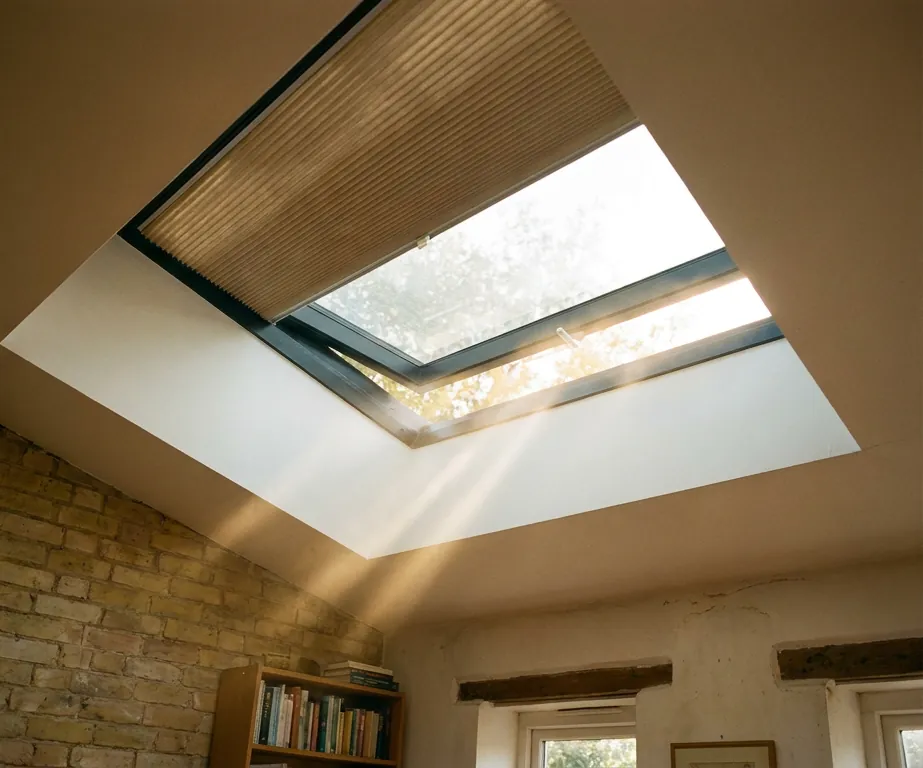
Condensation and the cold surface overhead
A third pane keeps the inner glass a degree or so warmer on a cold night, which lowers the risk of condensation across the middle of the glass, but the edge of the unit is where condensation starts, and the edge depends more on the spacer and frame than on the pane count.
Condensation forms when warm, moist room air meets a surface colder than its dew point. The glass surface temperature depends on the U-value: the lower the U-value, the closer the inner pane stays to room temperature. Working through the physics for a room at 20°C with 0°C outside, the centre of a good double glazed rooflight sits at roughly 17°C, and a good triple glazed one at roughly 18°C. An old single glazed rooflight in the same conditions would be down around 8°C, which is why older units stream with water on winter mornings.
Now compare those figures with the dew point. Air at 20°C and 60% relative humidity has a dew point of about 12°C. A kitchen with a pan boiling, or a bathroom after a shower, can push humidity high enough that the dew point climbs to 15°C or more. In both cases the centre of either modern unit stays above it. That is the point people miss: over the middle of the glass, good double glazing and triple glazing both do the job in a normally ventilated room.
The difference shows at the edges. Around the perimeter of every sealed unit, the spacer bar that holds the panes apart bridges the cold outside to the warm inside. A traditional aluminium spacer makes the bottom edge of the glass the coldest part of the whole rooflight, and on a flat unit the coldest edge is the full perimeter. Triple glazing helps here only if the spacer is a warm edge spacer and the frame is thermally broken. Put a third pane into a unit with a metal spacer and a cold frame, and you still get a line of droplets around the edge on a frosty morning.
The warmer inner surface has a second benefit that is easy to overlook: comfort. Sitting under cold glass, you feel your body radiating heat towards it, and a cold surface overhead also drives a slow downdraught of chilled air. A triple glazed unit reduces both effects. Over a sofa or a bed directly beneath the glass, that is a noticeable change on a still January evening, even when the energy saving is small.
Weight, unit depth and what carries them
The extra pane adds about 10 to 15 kg for every square metre of glass and makes the sealed unit roughly 12 to 20 mm deeper, which affects the frame, the kerb, the roof structure and any hinge, motor or gas strut that lifts the glass.
Glass weighs about 2.5 kg per square metre for every millimetre of thickness. A double glazed rooflight with a 6 mm toughened outer pane and a laminated inner pane around 7 to 9 mm thick carries something like 30 to 38 kg of glass per square metre. Add a middle pane of 4 to 6 mm and you are into the mid-forties or low fifties. On a 1,000 by 1,500 mm flat rooflight, that is the difference between roughly 50 kg and 70 kg of glass sitting on the kerb.
For a fixed flat rooflight on a properly built timber kerb, that extra weight is well within what the roof can carry, provided the joists and trimmers around the opening were sized for it. On an older flat roof, where the joists may be undersized, notched for pipes or softened at the ends, it is one of the reasons we look closely at the structure before recommending triple glazing. The upstand also needs to be deep enough for the frame and still leave at least 150 mm above the finished roof surface.
Opening units are where weight matters most. An electric rooflight lifts the glass on an actuator chain or spindle, and each model is rated for a maximum sash weight. A manual roof window pivots on hinges and relies on its balance springs to hold the sash where you leave it. Heavier glass needs a stronger mechanism, and some opening sizes are available in double glazing only for that reason. Our answer on whether triple glazing is too heavy for a rooflight looks at the mechanisms in more detail.
Depth matters on replacements too. A triple glazed unit is thicker, and a frame designed for it sits a little differently in the opening. When we replace an older double glazed rooflight with triple glazing, we check that the new frame suits the existing kerb, lining and roof finish, rather than assuming a like-for-like swap.
Light transmission and solar gain: the cost of the extra pane
Each extra pane and coating takes a small share of the daylight and a larger share of the solar heat, so a triple glazed unit is a little dimmer and noticeably cooler in sun than a double glazed one with the same coatings.
Light transmission, the share of visible daylight that passes through, drops by several percentage points with a third pane. A clear double glazed low-E unit might pass around 70 to 75% of the light that falls on it; a clear triple unit around 60 to 68%. Low iron glass narrows that gap and removes the faint green tint that ordinary float glass adds to the light, which matters more in a triple unit because the tint builds up with each pane.
Is that loss visible? In a well-lit room with a generous opening, rarely. Overhead glass sees the whole sky, and a rooflight passes far more light than a wall window of the same size. A drop from 72% to 64% is a reduction in brightness that the eye adjusts to within seconds. Where it can matter is a small opening over a deep plan: the rear room of a terrace lit by one modest rooflight, or a windowless bathroom, where every bit of daylight counts. We cover this in more depth in do energy efficient rooflights let in less light.
Solar heat is the other half. The g-value measures the share of solar energy that passes into the room. Triple glazing lowers it, which cuts summer heat under a south or west facing slope but also cuts the free winter warmth a rooflight can collect on a bright February day. On a south slope, that winter gain is worth something. On a north slope, there is almost none to lose. Our guide to g-value and light transmission shows how to balance the two for each orientation.
One more point on colour: a triple unit with two low-E coatings can give a faintly cooler cast to the light than a clear double unit. It is subtle, and hard to spot without a side-by-side comparison, but it is worth seeing a sample if you are fussy about how white walls and oak floors look under the glass.
Rain noise and sound from outside
A third pane helps a little with road and aircraft noise, but for the drumming of rain on overhead glass the laminated inner pane and uneven pane thicknesses do more than the pane count.
Rain on a rooflight is louder than rain on a wall window because the drops hit the glass square on. The sound is carried through the panes and the gas between them, and the way to reduce it is to make the glass layers behave differently from each other. A laminated inner pane with a plastic interlayer damps vibration. Panes of different thickness resonate at different frequencies, so one does not simply pass its vibration to the next. Some manufacturers offer an acoustic interlayer in the laminated pane, which is the most effective single upgrade for rain noise in a bedroom.
A triple glazed unit brings a third pane and a second cavity, and if the panes are of unequal thickness it will be quieter than a double unit with identical panes. But a double unit with a thick acoustic laminated inner pane can match or beat a triple unit with three thin panes of equal thickness. If sound is your main reason for considering triple glazing, ask about the glass build-up rather than the number of panes.
For homes near busy roads, such as a house close to the A14 or on one of the main routes into the city, or near the railway, a well-specified triple unit does give a modest improvement against low, steady traffic noise. For a quiet side street in Chesterton or a village lane, the difference will be hard to hear.
Matching the glazing to the slope and the room
Triple glazing earns its weight on north slopes, over rooms used at night and in exposed spots; good double glazing with the right coating is usually the better fit on south slopes and over rooms that need every bit of daylight.
This is where the light plan and the glazing choice meet. The same unit behaves differently depending on where the sun is and what the room is for, which is why we decide the glass at the survey rather than from a catalogue. Here is how we think it through.
- North facing slope: the glass gets almost no direct sun in winter, so it is a net loser of heat from October to March. There is no solar gain to give up, and the lower light transmission barely matters because north light is soft and even. Triple glazing makes good sense here. Our answer on whether north facing rooflights lose more heat explains the balance.
- South facing slope or flat roof in open sun: the risk is summer overheating, not winter heat loss. A solar control coating does far more for comfort than a third pane, and it keeps light transmission higher. Double glazing with a well-chosen solar control coating is usually the stronger choice, with triple glazing worth considering only for a large area of glass over a bedroom.
- East and west slopes: low morning or evening sun brings glare and a burst of heat at particular times of day. The coating and the shading matter more than the pane count; triple glazing is a reasonable option where the room is also used in the evening in winter.
- Bedrooms and loft rooms: comfort at night and rain noise count for more here, which tilts the choice towards triple glazing or an acoustic laminated double unit.
- Small openings over deep, dark rooms: the daylight is precious, so the higher transmission of double glazing, ideally with low iron glass, is the priority.
Cambridge adds one local factor. The flat land and open skies mean a rooflight here sees the full sky with little shading from hills or neighbouring high ground, and villages out on the Fen edge can be cold and windy in winter. A north-facing roof window in an exposed village house loses more heat on a clear, windy night than the same window in a sheltered street in Newnham. That exposure is a fair reason to lean towards triple glazing where the slope faces away from the sun. Our light planning page shows how we map the sun path across the year before choosing the glass.
Replacing an older unit: when triple is worth the step up
If your current rooflight is single glazed or an early double glazed unit, the biggest improvement comes from the move to any modern sealed unit; the step from good double to triple is smaller, and worth taking only where the slope, room and structure favour it.
An old single glazed or wired glass rooflight has a U-value somewhere around 5 W/m2K or worse. Replacing it with a modern double glazed unit cuts the heat loss through that opening by roughly three quarters. Replacing it with triple glazing cuts it by a little more. The first step is dramatic; the second is incremental. That is a useful way to frame the decision, because it keeps attention on the frame, the upstand and the fit, which is where older openings lose most of their heat once the glass is sorted.
Early sealed units from the 1990s and 2000s are a different case. They may have lost much of their gas fill and their low-E coatings will be less effective than today's. If the unit is misted between the panes, the seal has failed and the unit needs replacing anyway. At that point the choice between double and triple is open, and we will set out both options in the written light plan with the reasons for each. Our guide to low-E coatings and argon fill explains what the gas and coatings do and why older units lose performance.
A replacement rooflight also has to meet the current Part L limiting value, which any modern double or triple unit does. Where the work is notifiable, we handle the Building Control notification as part of the job, and every installation carries our 10-year workmanship guarantee. If you would like to see how the options compare on your own roof, book a light survey or message us on WhatsApp, and we will look at the slope, the room and the structure together. You can also read more about our wider approach on the energy efficient rooflights page.
Questions people ask
Is triple glazing always warmer than double glazing in a rooflight?
The glass itself loses less heat, but the whole unit is only as good as its frame, spacer and kerb. A thermally broken double glazed rooflight on an insulated upstand can keep a room warmer than a triple unit in a cold aluminium frame on an uninsulated kerb.
Will a triple glazed skylight stop condensation completely?
It lowers the risk across the middle of the glass, but condensation depends on the humidity in the room and the temperature at the edge of the unit. Good ventilation, a warm edge spacer and a thermally broken frame matter as much as the third pane.
Can I swap my double glazed rooflight for a triple glazed one in the same opening?
Sometimes, but not always. The triple unit is deeper and heavier, so the frame, kerb and any opening mechanism have to suit it. We check the opening, the structure and the roof finish at the survey before recommending it.
Does triple glazing make a big difference to heating bills?
For one rooflight, the saving over good double glazing is modest, in the region of tens of kilowatt hours a year. It adds up across several large rooflights, and the comfort under the glass on cold evenings is often the more noticeable gain.