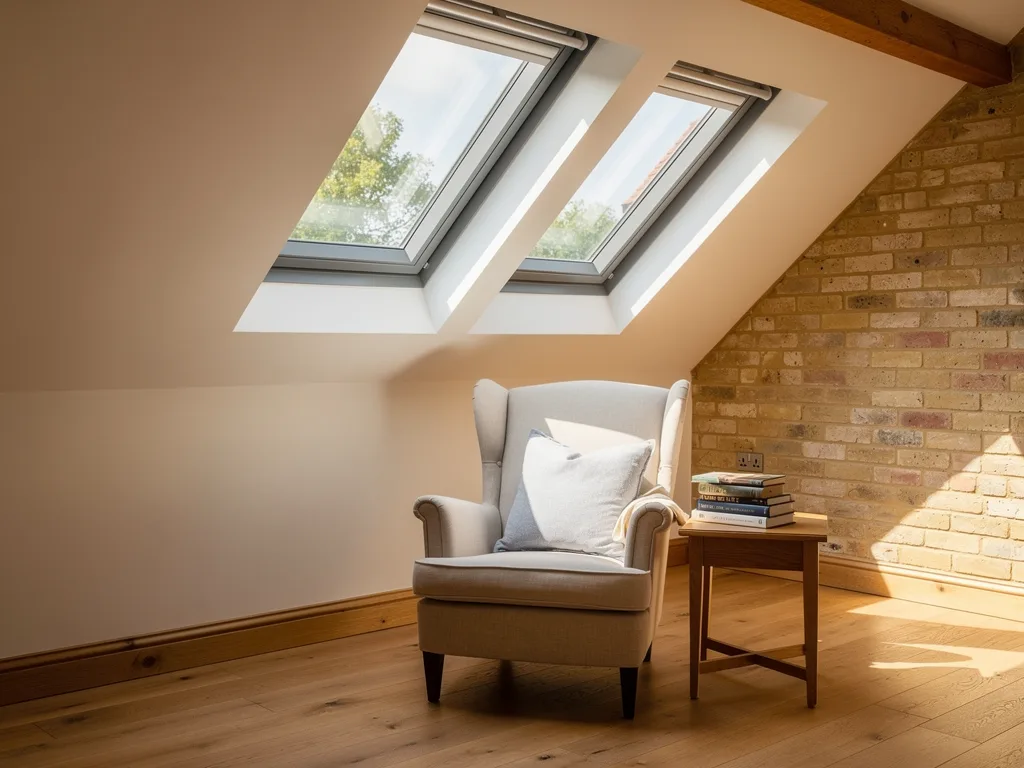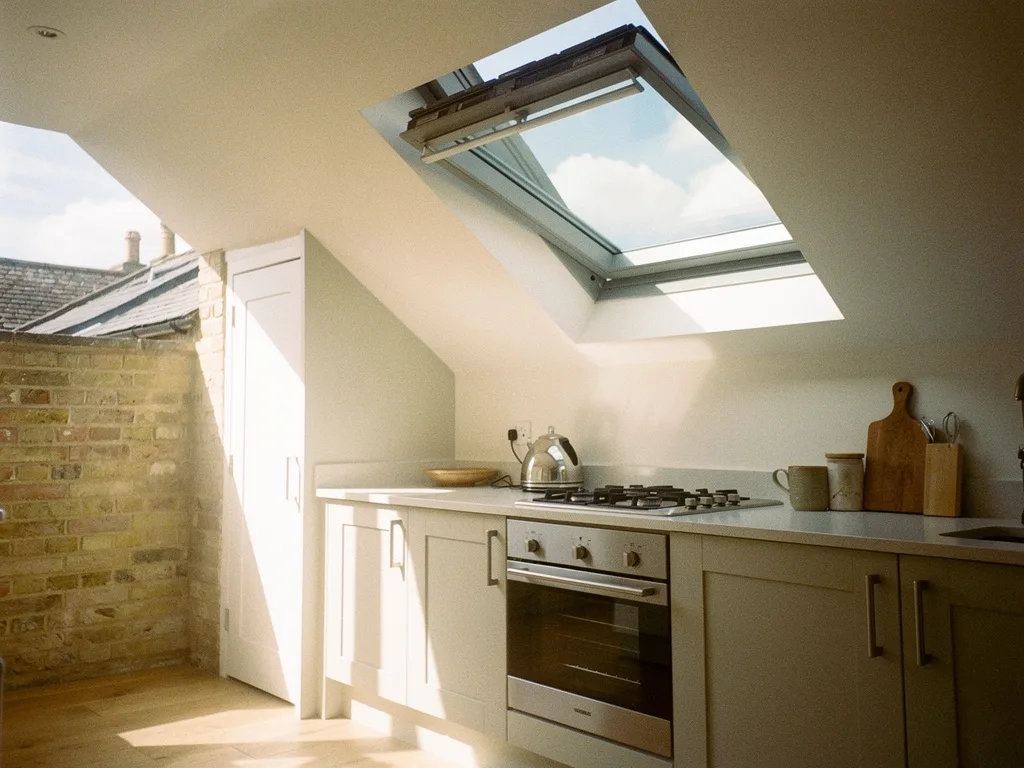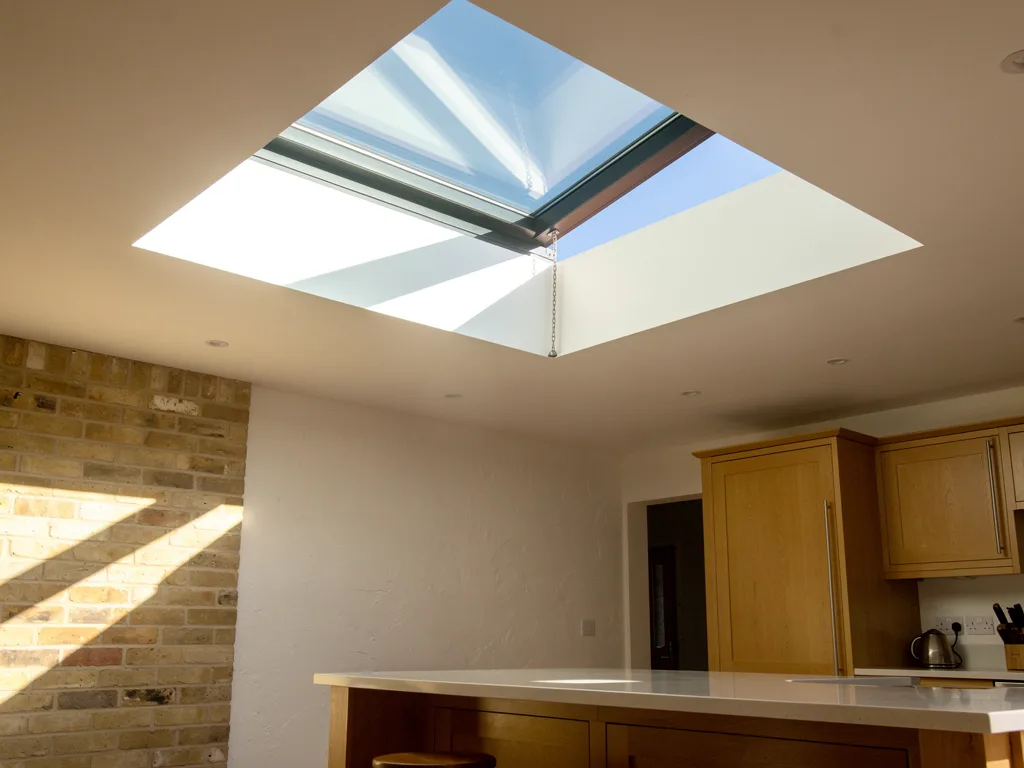
An electric rooflight is a normal rooflight with a small motor, a box of electronics and a power supply added to it. Knowing how electric rooflights work, and what each part does, makes it much easier to judge a specification, place the switch sensibly and understand why the glass behaves as it does on a wet afternoon.
Four parts doing one job
Every electric opening rooflight, whether it is a hinged flat unit over a Romsey side return or a roof window in a loft on a 1930s semi, is built from the same four pieces: a frame that moves, an actuator that moves it, a control unit that decides when, and a power supply that feeds the lot.
The frame is the glazed sash itself, hinged along one edge or running on rails. It is heavier than people expect. A double glazed sash around a metre square can weigh well over 30 kilograms, and a triple glazed or laminated one considerably more, so whatever lifts it has to be sized for the glass that is actually in it, not for a catalogue average.
The actuator is the motor and gearbox that pushes the sash open and pulls it closed. It is usually tucked into the frame or the kerb, out of sight from the room below. The control unit is a small circuit board, sometimes built into the actuator housing and sometimes in a separate box, which listens to switches, remotes and sensors and turns their signals into motor movement. The power supply converts household mains into the low voltage the actuator and controller run on, or in some systems passes mains straight to a mains-rated motor.
None of these parts is exotic. The engineering is closer to an electric garage door or a motorised blind than to anything specialist. What makes a good electric skylight is how well the four are matched: an actuator with the right force and stroke for the sash, a controller that knows when to stop, and a supply that is correctly rated and sensibly located. The rest of this guide takes each in turn, then follows a single open and close cycle from the press of a button to the moment the seals compress. If you are still deciding between a crank and a motor, the separate guide comparing manual and electric opening rooflights covers that choice.
The actuator: how the glass is pushed and pulled
The actuator converts the fast spin of a small electric motor into a slow, strong straight-line movement, and there are three common ways of doing that on a domestic rooflight.
The chain actuator is the most familiar. Inside a slim aluminium housing, a motor turns a sprocket that drives a chain made of links which lock together as they leave the housing, so the chain becomes stiff when pushed out and folds back neatly inside when pulled in. The housing is fixed to the frame or kerb and the chain end is fixed to the sash. Because it stores its own length coiled inside, a chain actuator gives a useful stroke from a compact body, which is why it appears on so many hinged flat rooflights and top-hung roof windows.
The spindle or linear actuator uses a threaded rod. The motor turns a nut or the rod itself, and a tube extends like a telescope. It is very stiff and handles heavy sashes well, but it needs more room along its length, so it tends to sit under larger hinged units where there is depth in the upstand to hide it.
A rack, belt or screw drive along rails is used on sliding rooflights, where the glass travels horizontally rather than lifting. The motor moves the sash along its track, and because it is not fighting gravity in the same way, the force needed is mostly about friction, seals and any snow or debris on top.
All three rely on gearing. The motor itself may spin thousands of times a minute, and the gearbox trades that speed for force, which is why the sash moves at a steady, unhurried pace. That gearing is also what holds the glass in place when the motor stops: a well-geared actuator is self-locking, so wind pushing on an open sash cannot back-drive it closed or push it further open. Larger or heavier lids often use two actuators, one near each corner of the opening edge, and these are wired through a synchronising controller so both sides rise together and the frame is not twisted.
How far the actuator pushes is set by its stroke. A chain actuator with a 300 millimetre stroke on a hinged flat unit gives a very different opening from one with 500 millimetres, and the stroke also sets the angle, which is covered in more detail in how far an opening rooflight opens.

The control unit: the part that makes decisions
The control unit is the small brain of the system: it takes every input, applies a set of priorities, and tells the actuator which way to run and when to stop.
Its inputs fall into a few groups. There are commands, such as a wall switch, a handheld remote or a signal from a smart home hub. There are sensors, most importantly a rain sensor, and sometimes wind, temperature or a link to a thermostat. There are internal readings: the controller watches how much current the motor is drawing and, on many systems, counts motor turns or reads limit switches so it knows where the sash is. And there are interlocks, such as a child lock setting or a link to an alarm system that forbids opening.
What matters is the order in which it listens. A rain signal outranks an open command, so pressing open during a shower does nothing or opens briefly and then closes. A close command normally outranks an open command. An obstruction reading outranks everything and stops the motor. The controller also looks after timing, for example closing the rooflight after a set period, running a morning airing on a schedule, or ignoring repeated button presses while the sash is already moving. The detail of rain and wind sensors and the wider choice of smart home control each have their own guide; here the point is simply that all of them feed the same controller.
Wall switches are wired directly to the control unit in some systems, while others use a battery wall pad that talks to it by radio. Radio remotes are paired to the controller once at installation, and a single remote can usually drive several rooflights and their blinds as a group or one at a time. Manufacturers use their own radio protocols, and that choice decides which other devices will talk to the rooflight later, so it is worth knowing before the unit is ordered, not after.
Power: low voltage, mains and solar
Most domestic electric rooflights run their motors and controls at 24 volts DC, supplied from a transformer that is fed from the house mains; some use mains-rated 230 volt actuators instead, and some run from a solar panel and battery.
In a 24 volt system, the transformer (often called the power supply unit or PSU) sits somewhere accessible, such as the loft, a cupboard or a ceiling void with an access panel, and is fed from a fused connection on a household circuit. From the PSU, a low-voltage cable runs to the controller and actuator. Low voltage is safer to route through a roof void close to glazing and is easy to extend to sensors and blinds. The trade-off is that low voltage loses more over long, thin cable runs, so the cable size is chosen for the distance and the current the actuators draw.
A 230 volt system sends mains power all the way to the motor. It avoids a separate transformer and suits some commercial-style actuators, but every cable in the roof is then a mains cable, and more of the work falls under the rules for electrical installations in dwellings. Which approach suits a particular house, and what each means for the fitting, is set out in whether electric rooflights are 24v or 230v, and the routes and connections themselves are in wiring an electric rooflight.
Solar units carry a small photovoltaic panel on the frame, a rechargeable battery and a radio controller. The panel charges the battery through the day and the battery drives the actuator. There is no cable from the house at all, which is why they suit replacing a manual roof window in a finished loft without disturbing the plaster. Their limit is winter charging on a shaded or north-facing slope, covered in solar powered roof windows.
Whatever the supply, the running cost is small. The motor draws power only for the seconds the sash is moving, and the controller sits in standby the rest of the time, listening for its remote and sensor.
One cycle, from button to seal
Following a single opening and closing, step by step, shows how the parts hand over to one another and explains most of the behaviour people notice day to day.
- The command arrives. You press open on the wall pad. The signal reaches the control unit, by wire or radio.
- The controller checks its conditions. Is the rain sensor dry? Is a child lock or an alarm interlock active? Is the sash already moving? If any rule says no, nothing happens, which is why an electric skylight sometimes appears to ignore a button on a damp morning.
- The motor starts, gently. Many controllers ramp the motor up rather than switching it on at full speed. This soft start takes the shock off the gearbox and the hinges and stops the sash jerking off its seals.
- The seals release and the sash lifts. The first few millimetres take the most force, because the actuator is pulling the frame away from compressed gaskets. After that, the load settles as the sash rises.
- The actuator reaches its set position. It stops at the end of its stroke, at a limit switch, or at a position the controller has counted to, such as a partial vent opening. The gearing then holds the glass where it is.
- The rooflight waits. The controller keeps watching. A raindrop on the sensor, a timer ending or a close command will all start the return.
- Closing: direction reversed. For a DC motor, the controller simply reverses the polarity and the actuator runs the other way, drawing the sash down.
- The final pull. In the last few millimetres, the actuator pulls the sash firmly onto its seals. The current rises as the gaskets compress, and the controller reads that rise as the signal that the rooflight is shut and stops the motor. That last squeeze is what makes the unit weathertight and airtight.
The same current reading is how the system notices trouble. If the motor suddenly works harder part-way through closing, something is in the way, and the controller stops or reverses. Those protections, and how they are set, are described in electric rooflight safety features.
The sound you hear through the cycle is mostly the gearbox, a low hum lasting as long as the sash moves. Whether that is noticeable in a bedroom is the subject of a separate answer on motor noise.
What each part is responsible for
When something about an electric rooflight seems odd, it usually helps to know which part owns that behaviour, and this table sets them side by side.
| Behaviour | Part responsible |
|---|---|
| How far and at what angle it opens | Actuator stroke |
| How fast it moves | Motor and gearing |
| Holds open in wind | Self-locking gearbox |
| Closes when it rains | Rain sensor and controller |
| Ignores a button press | Controller rules and interlocks |
| Stops if something is in the way | Controller current sensing |
| Shuts tight on its seals | Actuator final pull |
| Works with no cable | Solar panel and battery |
Reading the table from right to left is also a useful way of thinking about a specification. If a large, heavy triple glazed sash is planned over a kitchen in a new home at Trumpington Meadows, the actuator force and possibly a second synchronised actuator matter. If a loft room faces north and the owners want a cable-free unit, the question is the solar charging. If the rooflight sits above a stair where the switch will be out of reach, the choice of remote and its placement is the thing to get right.
When the power or the weather misbehaves
Because the rooflight depends on electricity and a sensor, it is sensible to understand what it does when either is interrupted.
In a power cut, a mains-fed rooflight without a battery stays exactly where it was, because the self-locking gearbox holds the sash. If it was open, it stays open until the power returns. Some systems add a battery backup so the controller can still close the glass when rain is detected, and many actuators allow the chain or spindle to be released so the sash can be closed by hand. Both are covered in what happens to an electric rooflight in a power cut.
Frost brings a different issue. The seals can freeze to the frame on a hard night, and the first few millimetres of opening then need more force than usual. A controller that watches current may read that extra load as an obstruction and stop, which is the system protecting itself rather than failing. On the flat, open ground around Cambridge, clear winter nights are often the coldest, and a rooflight on a low-pitched extension roof can carry a thin layer of ice at breakfast time. The practical advice is simply not to force it, and to let the morning sun do the work, which the answer on frost and cold weather covers in more detail.
How the mechanism fits the light in the room
The motor and controller are invisible once fitted, but where they go and how the sash opens still affect the daylight and the air in the room below.
A hinged rooflight opens along one edge, so the open sash tilts up and away from the room. Which edge is hinged matters more than it sounds. On a south-facing flat roof over a Mill Road side return, hinging the sash so it opens away from the sun lets warm air escape at the high side while the raised glass shades a little of the opening. On a roof window in a loft, the actuator is typically fitted at the top of the frame so it stays out of the line of sight from the bed or desk. For a larger lantern-style opening, a pair of actuators keeps the lift even, so the frame stays square and the light through it is not interrupted by a sagging edge.
Automation also changes how people use the glass across the day. A rooflight that opens on a timer at dawn in July lets the night cool air through before the sun reaches the roof, and closes again before the heat builds. Linked to a temperature sensor, it can vent only when the room passes a set point. If an electric blind is fitted, the same controller or hub can close the blind on a bright south slope in the afternoon while leaving the sash open for air, which is where the light planning and the mechanism meet: the glass lets the light and heat in, and the automation decides when the room gets it.
That is also why we ask how a room is used before we specify the motor. A kitchen extension that needs quick purge ventilation when cooking, a bedroom where silence matters at night, and a stairwell where the rooflight is out of reach all lead to different choices of actuator, control and power.
Questions people ask
How long does the motor in an electric rooflight last?
Actuators are rated by manufacturers for a set number of open and close cycles, and a domestic rooflight uses only a few cycles a day, so the motor is rarely the first thing to wear. Keeping the seals clean and the chain free of debris helps. More detail is in how long an electric rooflight motor lasts.
Can an electric rooflight be opened by hand?
Many can, using a release on the actuator that frees the chain or spindle so the sash can be moved manually, but not all units offer this, so it is worth confirming at specification stage. See whether an electric rooflight can be opened manually.
Does the control unit need its own circuit?
Normally no. A domestic electric rooflight draws little power, and it is usually fed from an existing circuit through a fused connection, with the transformer placed where it can be reached. The electrical work is carried out and signed off by a qualified electrician where the regulations require it.
Can the electrics be added to a rooflight we already have?
Some roof windows accept a retrofit motor kit, and some flat rooflights can be swapped for an opening version on the same upstand. The frame, the sash weight and where power can reach all decide it. If you are planning an opening skylight in Cambridge or the surrounding villages, our electric and opening rooflight installation page explains how we specify and fit them, or you can book a light survey.