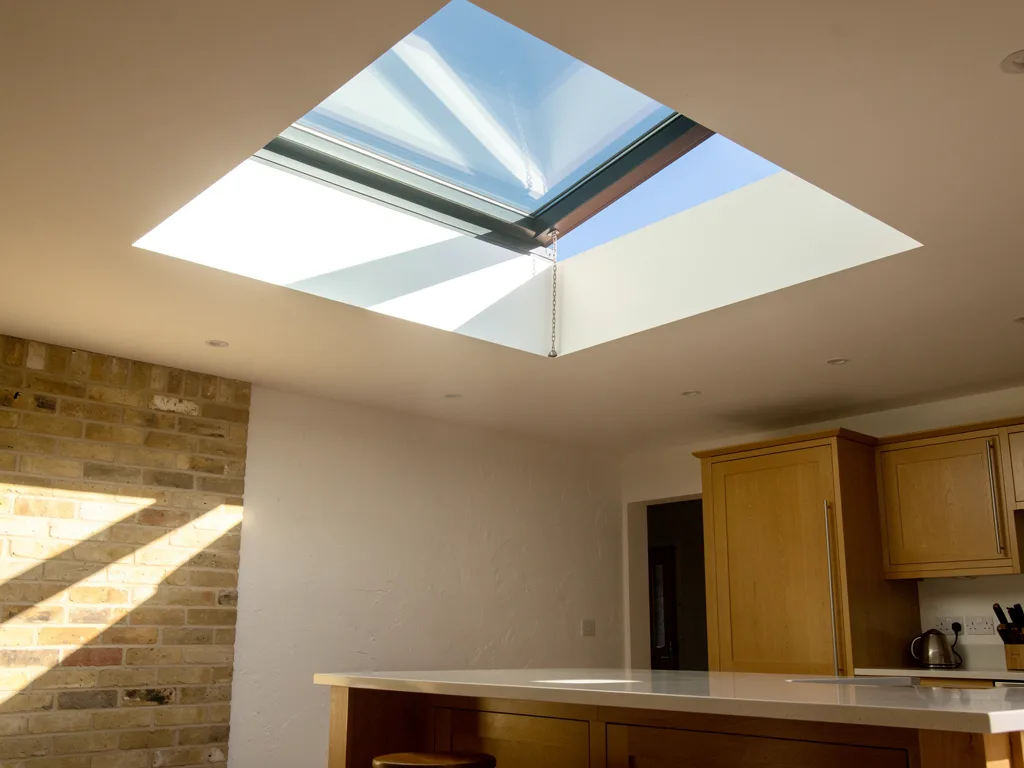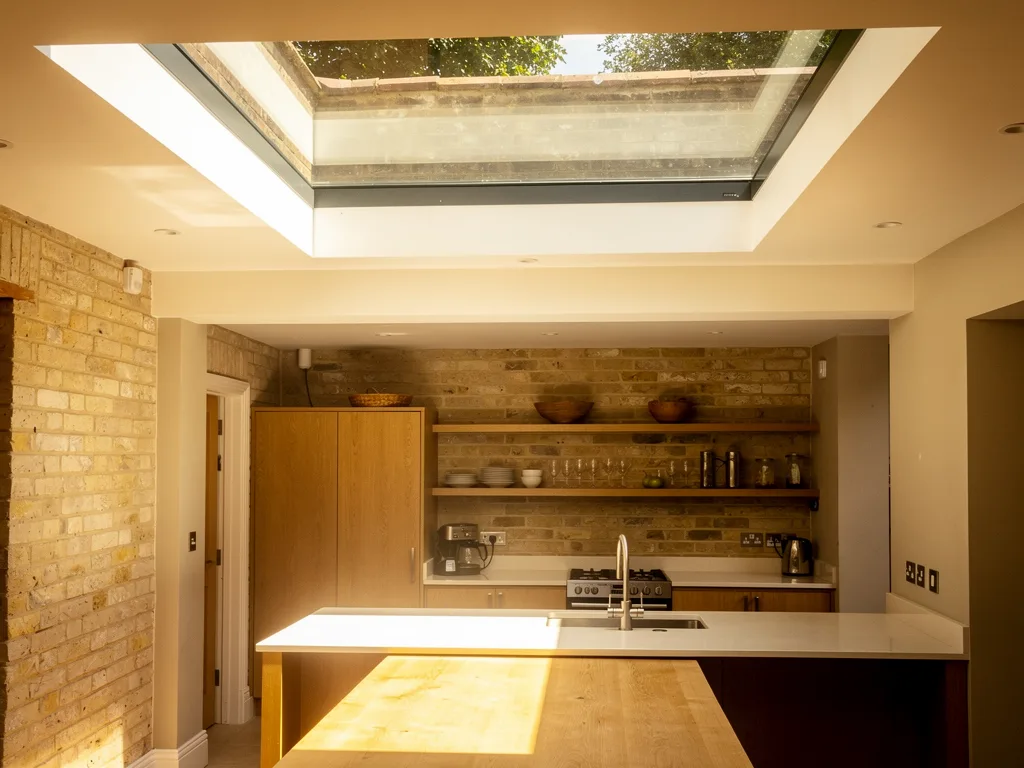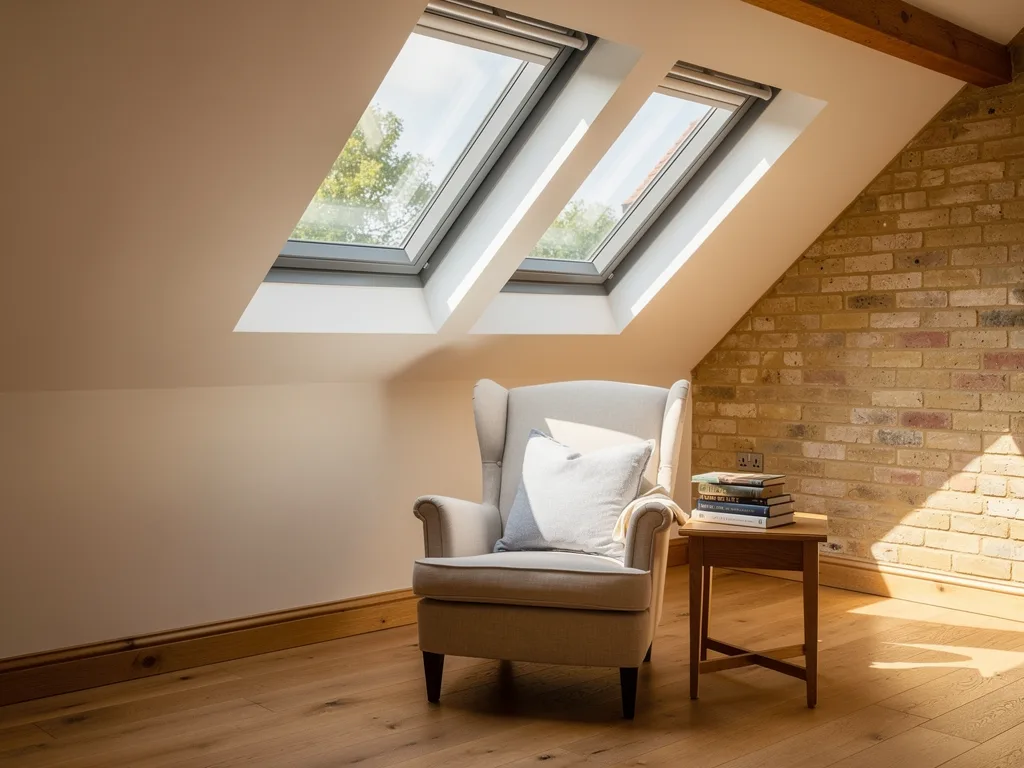
A solar powered roof window is an electric opening roof window that carries its own small photovoltaic panel and a rechargeable battery, so it needs no cable from the house. It opens and closes on a remote or a wireless wall keypad like any other electric unit. The question worth asking is not whether it works, but when it is the better choice than a wired window, and what it does in a Cambridge December when the sun barely clears the neighbouring roofs.
What sits inside a solar roof window
The solar version keeps everything a wired electric roof window has, and swaps the mains feed for a panel and a battery built into the window itself.
Look along the top of the sash or the head of the flashing and you will find a narrow strip of photovoltaic cells, usually no wider than a hand. That strip charges a sealed battery pack housed in the frame, out of sight from the room. The battery feeds a low-voltage actuator, the same kind of chain or spindle motor used on wired units, and a small control board that listens for signals from a handheld remote or a wall-mounted keypad. Many versions also carry a rain sensor on the outside of the frame so the sash closes when the first drops land.
The result is a complete, self-contained electric skylight. Nothing crosses the ceiling, nothing runs down the wall to a fused spur, and nobody needs to lift floorboards to find a route. Our guide to how electric rooflights work explains the actuator and control side in depth; this page concentrates on the part that is different, the power.
Solar power is offered mainly on pitched roof windows, because that is where the product has been developed furthest. A solar powered pitched roof skylight fits the same rafter opening, takes the same flashing and accepts the same lining as the equivalent manual or wired model. Solar kits for flat opening rooflights exist too, but the choice is narrower and the panel has to be placed with more thought, since a flat unit sees the sky differently from a sloping one.
Solar blinds follow the same idea. A roller or blackout blind with its own panel and battery can sit inside the frame and run from the same remote as the window, which is useful on a slope where the heat and glare need managing as much as the airflow.
Where no wiring really pays off
The strongest case for solar is a room that is already finished, where running a cable would mean cutting into plaster, decoration or a ceiling you have only just paid for.
Picture a loft bedroom in a Mill Road terrace, converted some years ago with two manual roof windows high on the rear slope. The plaster is sound, the room is painted, and the windows are simply too high to reach without standing on the bed. A wired upgrade would need a cable from a lighting circuit or a new spur, chased down the wall or fished behind the lining, then made good and redecorated. A solar replacement goes into the same opening from the roof side, and the only change inside the room is a keypad stuck to the wall by the door.
The same logic applies in several other situations:
- A stairwell roof window over a landing, where the glass is well out of reach and there is no nearby circuit to take a feed from.
- A vaulted kitchen extension with a finished ceiling, where the owner wants to add one opening window to an existing set of fixed ones.
- A 1930s semi in Cherry Hinton or Chesterton with a boarded loft used for storage, where a manual window is fine for now but a motor would make it usable for airing.
- A replacement on an older property where the owner would rather keep electrical work away from original lath and plaster.
In each case, the saving is not the electricity, which is tiny either way. It is the disruption: no electrician in the room, no chasing, no redecorating and no second visit to finish the wiring once the window is in. If you would like to understand what the wired route involves, our guide on wiring an electric rooflight sets out the cable routes and the trades involved.

How the battery is charged and how long it lasts
The panel does not run the motor directly: it tops up a battery, and the battery does the work, which is why the window still opens at night or on a grey afternoon.
An opening cycle uses very little energy. The motor runs for well under a minute to open a sash fully and the same to close it, and between movements the controller draws a trickle to keep listening for the remote. The panel only has to replace that small amount over the course of each day, and in daylight it usually has plenty of time to do so. On a bright summer day the battery will be back to full within hours of any use; the battery exists precisely so that a run of dull days does not stop the window working.
Rechargeable batteries age. Every cycle of charge and discharge wears them a little, and heat wears them faster, which matters because the top of a roof window on a south slope gets hot in July. Manufacturers design the pack as a replaceable part, and their stated service lives are measured in years rather than months, but no battery lasts as long as the window frame around it. It is sensible to plan on renewing the pack at some point in the window's life, and to choose a product where the battery can be reached and swapped without removing the sash.
A battery that is losing capacity usually gives warning. The window may move more slowly, stop part way, or refuse to open while still accepting a close command. Many controls are set up to keep a reserve so that a closing command still works when the battery is low; that way a window that can no longer open is at least left shut rather than stuck open in the rain. For what happens if power is lost entirely on a wired system, see what happens to an electric rooflight in a power cut.
Winter light over a Cambridge roof
Winter is the real test for a solar roof window, because in December the Cambridge sun rises late, sets before four and climbs only about 14 degrees above the horizon at midday.
Cambridge sits at a latitude a little over 52 degrees north. At the June solstice the midday sun stands over 60 degrees high and the day runs to well over 16 hours; at the December solstice it barely reaches 14 degrees and daylight lasts under eight hours. A panel on a roof slope therefore sees a small fraction of its summer energy in the depth of winter, and on overcast days, which are common from November to February, it relies on diffuse light from the whole sky rather than direct sun.
- Winter solstice, about 14°. The lowest noon sun of the year travels furthest: it crosses the whole room and lands high on the back wall.
- Spring and autumn equinox, about 38°. The light lands on the floor, deep in the room.
- Summer solstice, about 61°. The highest, strongest sun drops steeply and lands close under the window.
- South-facing roof window. The same opening lets in a different patch of light every month.
- Deepest reach. In December the sun patch can be on the wall opposite, which is why we plan where it falls, not just how big the glass is.
Two things work in the window's favour. First, it needs very little: a few openings a day, short movements, and a controller on standby. Second, winter is when you open a roof window least. On a cold, wet January day, the window may not open at all, and the battery simply sits there holding charge. The combination of low demand and a battery sized to bridge dull spells means a well-placed solar unit carries on working through the winter in normal use.
Where it can struggle is at the margins. A window used for daily airing of a steamy shower room, or one set to open automatically on a timer every morning, will draw more than a storage loft window opened twice a week. Snow lying on the panel stops charging until it slides or melts, and a panel beneath overhanging branches loses most of its winter input. Frost and ice bring their own questions for the motor and seals, covered in do electric rooflights work in frost.
The flat, open landscape around Cambridge helps here. With no hills to throw a shadow across a roof, the thing that decides winter charging is the building itself: which way the slope faces, what the neighbouring roofs and chimneys do to the low sun, and whether a mature tree stands in the way. That is exactly what we look at when we plan the light in a room, and our page on how we plan the light shows the same sun-path thinking applied to where the light lands inside.
Which roof slope suits a panel
A south, east or west slope gives the panel direct sun for part of the day, while a north slope leaves it on sky light alone, which works but leaves a smaller margin in winter.
A south slope gives the panel the most winter charge, and it is also the slope that makes the room hottest in summer, so it pairs well with a heat-reducing blind. An east slope catches the morning sun, which suits a bedroom window opened first thing to air the room. A west slope charges through the afternoon, and brings evening glare that a blind helps with, for the room and for the battery, which lasts longer when it is not baking. A north slope charges from sky light alone.
North slopes deserve a fair word. Plenty of Cambridge loft conversions put their roof windows on the north-facing front slope of a terrace, because the rear takes a dormer. A north slope still receives useful daylight from the open sky above, and a solar window there will charge, just more slowly. It suits a window that opens to air the room occasionally rather than one on a busy daily schedule.
Pitch has an effect as well. A steep slope stands its panel more upright, which faces the low winter sun better when the slope is south-facing, but also sheds snow faster. A shallow slope catches more of the high summer sun and more of the overcast sky. The difference is modest either way; orientation and shading matter much more.
Solar or wired: choosing honestly
Solar is the right answer when a cable would be awkward and demand is light; a wired supply is the better answer when you are building from scratch, running several windows together or asking a lot of them.
The comparison below puts the two side by side for a pitched roof window.
| Question | Solar powered | Mains wired |
|---|---|---|
| Cable into the room | None | Needed |
| Disruption in a finished room | Very little | Chasing and making good |
| Heavy daily use | Limited by charge | No limit |
| Deep winter reliability | Depends on slope and use | Unaffected |
| Parts that wear | Motor and battery | Motor |
| Grouped control of many windows | Possible, per window | Simpler centrally |
A new loft conversion or extension is the case where wired usually wins. The walls and ceilings are open, the electrician is on site anyway, and running a low-voltage cable to each window costs little extra at that stage. A wired window has no battery to renew and will open as often as you like, including automatic night cooling through a summer heatwave. Our guide to manual versus electric opening rooflights covers the wider choice, and the electric and opening rooflight installation page sets out how we specify and fit both.
A finished room with a window out of reach is the case where solar usually wins. There is also a middle path: some homeowners fit solar windows now and keep the option of wiring later if they redecorate, since many systems use compatible controls either way.
Sensors, remotes and smart control on battery power
A solar window can carry the same rain sensor and remote as a wired one, but every extra device drawing on the battery shortens the margin, so it pays to keep the control set simple.
The rain sensor matters most. It is the feature that lets you leave a roof window open while you are out, knowing it will close when the weather turns, and on a solar unit it is usually built in. Because the sensor has to be awake to notice rain, it draws a steady trickle of power, and a closing command triggered by rain is always given priority over everything else. Our guide to rooflight rain and wind sensors explains how they detect the first drops and why dew can occasionally close a window early on a still summer morning.
Remotes and wall keypads are wireless and battery powered themselves, which means the keypad can go wherever it is useful: by the loft door, at the foot of the stairs or beside the bed. Linking the window to a home hub for app or voice control is often possible with the right gateway, though it depends on the product range. The options are set out in our guide to smart home control for rooflights.
Schedules deserve care. An automatic routine that opens every window for twenty minutes each morning is easy on a wired system, and quite possible on a solar one in summer. Through the winter, on a north slope, a daily routine adds up, and the sensible approach is to keep automatic cycles for the warmer months and let the rain sensor and remote handle the rest.
Replacing a manual window with a solar one
Swapping an existing manual roof window for a solar electric version is usually a same-size replacement from the roof side, and the inside of the room is left as it was.
The work follows the pattern of any roof window replacement. We check the existing size and the frame depth, remove the old sash and frame, fit the new frame into the same opening, and fit a flashing made for the roof covering, whether that is slate, plain tile or interlocking concrete tile. On older windows, a replacement flashing designed to match the original installation depth can let the new frame sit where the old one did, so the internal lining does not need disturbing. Once the window is fixed, weathered and sealed to the roof, the controls are paired, the rain sensor is tested and the keypad goes on the wall.
A new battery arrives with some charge, but it is worth letting a fresh unit settle for a day or so in good light before asking much of it. Fitting in spring or summer gives the battery an easy first season, although an autumn or winter installation works perfectly well with sensible use.
On the regulations side, replacing a roof window is controlled work under the Building Regulations, which set a limit on heat loss through the new unit under Part L. We install to current Building Regulations and handle the Building Control notification where the work is notifiable. Because a solar window brings no mains wiring, the electrical side of the Building Regulations is generally not involved. Where a property is listed or in a conservation area with an Article 4 direction, check with Greater Cambridge Shared Planning or the relevant district council before any change to the roof, since a conservation-style frame may be required. If you already have a fixed unit and want to know whether it can be made to open, see can a fixed rooflight be changed to an opening one.
Questions people ask
Does a solar powered roof window work on a cloudy day?
Yes. The panel charges from diffuse daylight as well as direct sun, just more slowly, and the battery carries the window through dull spells. A run of grey winter weeks combined with heavy daily use is the situation that can run it down.
Can a solar window be opened by hand if the battery is flat?
That depends on the product. Some have a manual release, others are designed to be operated only by the motor. Ask before you choose, and read our answer on whether an electric rooflight can be opened manually.
Is a solar powered pitched roof skylight any less weathertight?
No. The frame, glass and flashing are the same as the wired and manual versions, and the panel is part of the factory-made sash or cladding. Weather performance comes from the flashing and the fitting, not from the power source.
Can solar and wired windows share one remote?
Within the same manufacturer's system, frequently yes, which is handy when a loft has a wired window added during a renovation and a solar one retrofitted later. We confirm compatibility at the survey. To plan where each window should go and how it will light the room, book a light survey.