Start with where you will be standing
The choice between a manual and an electric rooflight is mostly a question of reach: how high the opening sits above the floor, and what is underneath it. Price, sensors and reliability all matter, but they only settle the choice once you know whether a hand can get to the glass.
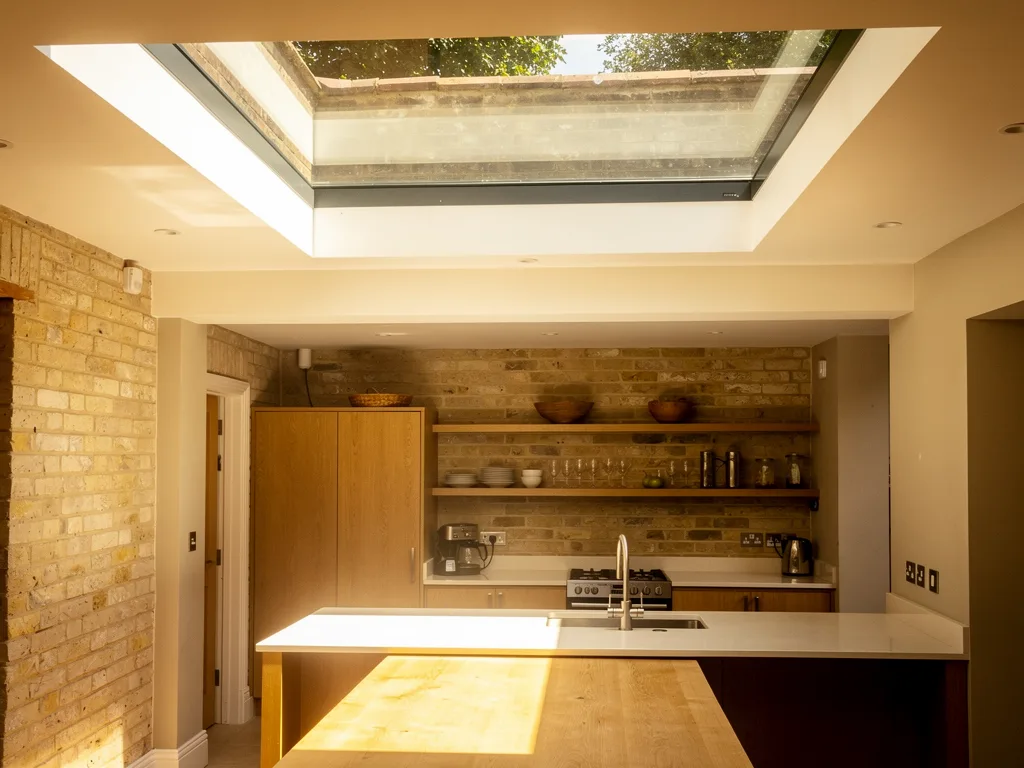
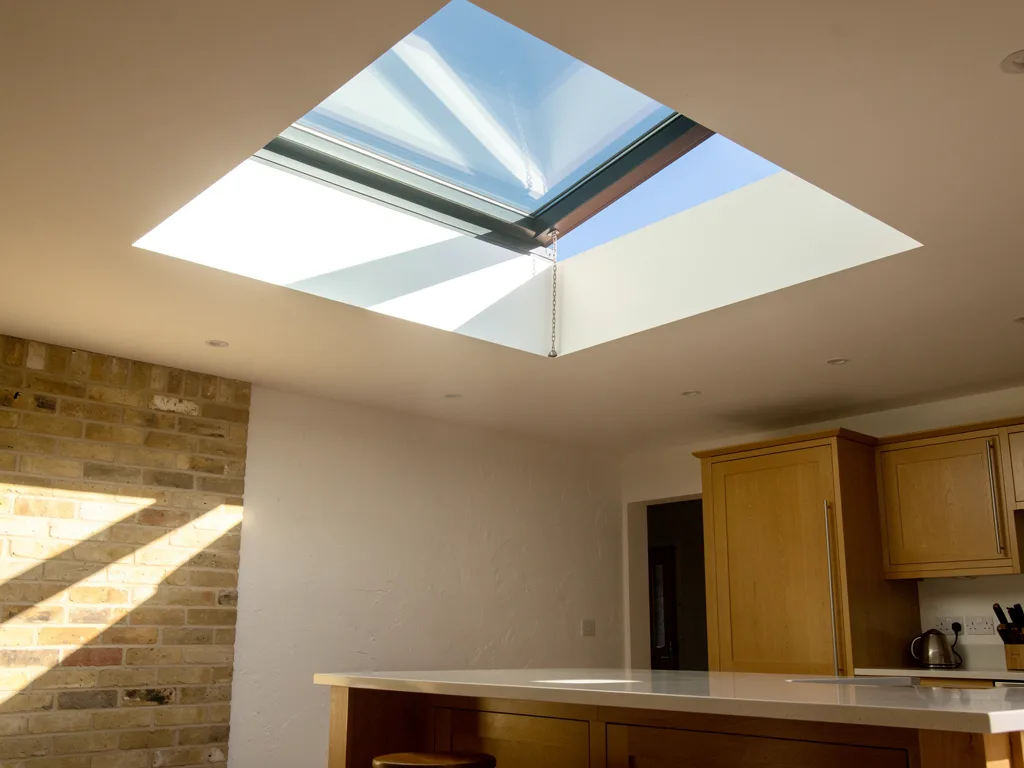
Picture the rooflight open on a warm evening. If it sits in a loft bedroom with a sloping ceiling, and the bottom of the roof window is at shoulder height, you can reach up, pull the handle and tilt the sash in a second. A manual window there is simple, quiet and cheap to run, and there is very little to go wrong. Now picture a flat rooflight in the middle of a single-storey kitchen extension, 2.8 metres above a kitchen island, with a hob and a stool in the way. Nobody will climb up to open that. If it is manual, it will be opened with a pole on the first hot day, then left shut for the rest of the summer because the pole lives in a cupboard.
That second picture is the one to guard against. An opening rooflight that never opens gives you the cost of an opening unit and the performance of a fixed one. So before looking at motors and handles, stand in the room, look at where the opening will go, and ask honestly whether you will use it every day in June if it takes a pole, a step or a stretch.
In Cambridge this question comes up in two very different kinds of room. The first is the loft conversion in a Romsey or Chesterton terrace, where roof windows sit low in the slope and reach is easy. The second is the side-return or rear extension with a flat roof, where the rooflight is set high and often over a worktop. The same household can reasonably choose manual for one and electric for the other.
How manual rooflights are opened
Manual does not mean one thing. There are four common ways to open a rooflight by hand, and each has its own limit on how high and how far away the glass can be.
- A handle on the sash. Pitched roof windows usually carry a bar or handle along the top of the sash. On a centre-pivot window you pull it down to tilt the glass; on a top-hung window you push it out. It works well when the handle is within easy reach standing on the floor.
- A winder with a detachable pole. The handle or a small gearbox has an eye or hook, and a pole engages it so you can turn or pull from below. This extends reach into a higher ceiling, but it asks for a pole kept close by and a clear line of approach.
- A fixed rod or spindle winder. Some hinged flat rooflights use a winder operated by a rod that hangs down into the room. It is dependable, but you live with the rod.
- A push-up hinged lid with a stay or gas struts. Common on access-style flat rooflights. You push the whole lid up and the struts hold it. That is fine for reaching a roof from a ladder or stair, less so as everyday ventilation.
All four rely on the person being there. A manual rooflight is exactly as open or shut as it was when you last touched it, and that one fact drives most of what follows in this guide: the rain question, the holiday question and the summer night question.
For a manual unit to be used well, the handle or the winder point wants to be within comfortable reach, the approach should be clear of worktops and furniture, and the opening should be visible from where you stand so you can see whether it is open. A roof window over a stair void or a flat rooflight above a bath can be hard to reach even at a modest height, simply because of what is underneath.

What an electric rooflight adds
An electric rooflight moves the effort from your arm to a small actuator in the frame, controlled from a wall switch, a handset or an app. The reach problem disappears, and a new set of possibilities arrives with it.
The obvious gain is that you can open a rooflight you could never comfortably reach. Less obvious, and often more useful, is that the rooflight can close itself. A rain sensor on the frame closes the sash when water lands on it; a timer can open it for half an hour on a summer morning and shut it again; a temperature input can open it when the room warms. None of this is possible with a manual unit, because a manual unit cannot act on its own.
There is also a practical gain in small steps. With a switch by the door, people open a rooflight a little, then a little more, and close it when they leave the room. With a pole or a stretch, people tend to open it fully or not at all. Fine control is what makes an opening rooflight comfortable to live with, especially on a bright south slope where a small gap at the top of the room can take the edge off the afternoon heat without letting in a draught.
If you want the detail of how the actuator, control unit and power supply work together, the guide to how electric rooflights work covers the order of operation. Here the interest is simply in what that control changes for the person in the room.
Rain, holidays and the unattended rooflight
The biggest practical difference between the two is not convenience but what happens when nobody is watching. A manual rooflight left open in a shower stays open; an electric one with a rain sensor closes.
East Anglia is one of the drier parts of the country, but the summer weather here still turns quickly. A hot, still afternoon over the Fens can end in a thunderstorm, and a flat rooflight left open over a kitchen floor or a bed will take in rain for as long as it takes someone to notice. The same applies to a loft room left open while you are at work, or a bathroom rooflight opened to clear steam and forgotten.
A rain sensor answers that. It sits on the outside of the frame and signals the control unit to close the sash as soon as it detects water. Wind sensors can do the same when gusts get strong enough to strain an open sash. How they are set, and how to stop dew from triggering them on a still morning, is covered in the guide to rooflight rain and wind sensors.
This is also where the summer night question lives. The most effective way to cool a warm upstairs room is to let hot air out at the top overnight, which is what stack ventilation does. With a manual unit, leaving it open all night means trusting the forecast. With an electric one and a rain sensor, the rooflight can stay open and shut itself if the weather changes. The guide to stack ventilation with rooflights explains how high openings pull cooler air through the house.
What drives the difference in cost
An electric rooflight costs more than a manual one of the same size, and the gap is made up of several separate items rather than one. Knowing what they are helps you see where a quote is going.
The unit itself is the first part. An electric version of a rooflight carries an actuator, a control unit and usually a rain sensor, all built in or supplied as a kit, and that adds to the product price. For pitched roof windows, manufacturers typically offer manual, electric and solar versions of the same size, so the choice is made at the point of ordering.
Power is the second. A mains-powered rooflight needs a supply brought to the frame, usually from a fused spur, with a cable route through the ceiling or the roof void. In a new extension that route is easy to plan before the ceiling goes up. In a finished room it may mean lifting boards, chasing a wall or running the cable in a neat surface channel. The parts of that work that need a qualified electrician, and how it fits around the installation, are set out in the guide to wiring an electric rooflight.
Where wiring is awkward, a solar-powered version with its own battery avoids the cable entirely, at a higher product cost. That trade is worth weighing on a loft room where the plaster is finished and you do not want it disturbed. The guide to solar powered roof windows looks at when that makes sense and how the battery fares in winter.
The remaining items are the extras that sit on top: a wall switch rather than a handset, a link to a smart home system, and an electric blind that can be controlled alongside the sash. None is essential, but each adds cost and each is easier to add at the start than later.
A manual unit has almost none of these costs. There is no cable, no electrician, no control unit, and a pole for a high window is a small item. For a low roof window in a loft bedroom, that saving is real, and there is no reason to spend it on a motor you do not need. For general market ranges, and why a survey sets the real figure for your roof, see the skylight and rooflight costs page.
Reliability over the years
A manual rooflight has fewer parts, so fewer things can wear. An electric rooflight has more parts, but they are well-proven and, fitted properly, they give years of quiet service. The failure points are different, not simply more or fewer.
On a manual unit the parts that wear are the ones you touch: the handle and its catch, the hinge or pivot, the winder gearbox, the eye that the pole hooks into. Hinges and pivots on a quality roof window are built to last the life of the window, and a stiff handle is usually a matter of adjustment. The weak point is often the pole: it gets lost, the hook bends, or a new ceiling height means the old one no longer reaches.
On an electric unit the parts that wear are the actuator, which is the motor and the chain or spindle it drives, and to a lesser extent the control unit and sensor. Actuators are rated for a number of cycles and have a working life, which the answer on how long an electric rooflight motor lasts discusses in plain terms. A rain sensor that has got grimy may need cleaning to stay sensitive. In most systems the actuator is a replaceable component, so an ageing motor can be renewed without replacing the glazed unit or disturbing the roof finish.
Both types share the same underlying reliability question, which is how well the unit was installed. A frame set out of square will make a manual sash stiff and make an actuator strain against it. A flat rooflight on an upstand without enough fall will hold water against the seals whichever way it opens. The opening mechanism is only as good as the kerb and the flashing it sits on.
One worry comes up about electric units in particular: what happens if the power fails with the sash open. Systems handle this in different ways, from battery backup that lets the unit close to a manual override that lets you wind it shut by hand. The answer on whether an electric rooflight can be opened manually sets out the options, and it is worth confirming which one your chosen unit has before it is ordered.
The light and heat side of the choice
The way a rooflight opens changes how well you can control the light and heat it brings in. That makes the opening method part of the light plan, not an extra chosen afterwards.
A south or west-facing rooflight in Cambridge will put direct sun into the room for several hours on a clear summer day, and on the flat land here there is little to shade it. Solar control glass and a blind take most of that heat before it builds up, but on the warmest afternoons you will still want to let the hot air out at the top of the room. That is exactly the moment when reach matters: the rooflight you need to open is the one over the warmest part of the room, and you need to open it at the hottest time of day, often when you are not at home.
An electric rooflight on a south or west slope can open a little on a timer before the room warms, or respond to a temperature input, and close again at dusk. A manual one on the same slope is only as useful as the person who remembers to open it. On a north slope the picture is gentler: the light is steady and soft, heat gain is modest, and opening is mostly about fresh air and steam. A manual unit there often does everything the room needs.
This is why we look at orientation before recommending an opening method. The same roof window can be the right manual choice on the north slope of a loft and the wrong one on the south slope of the same house. The light planning page explains how we read a slope and a room before any glass is chosen.
Matching the method to the room
Most decisions become obvious once the room, the height and the orientation are known. The table below is a starting point for the rooms that come up most often in Cambridge homes.
| Room and position | Reach | Sensible choice |
|---|---|---|
| Loft bedroom, window low in slope | Easy by hand | Manual |
| Loft room, window high or over bed | Awkward | Electric or solar |
| Flat roof kitchen extension | Out of reach | Electric with rain sensor |
| Bathroom, over bath or shower | Awkward and wet | Electric |
| Landing or stair void | Out of reach | Electric |
| Roof access to a terrace | From a stair | Manual or electric access unit |
A few points sit behind the table. A loft bedroom window that is easy to reach can still justify electric control if it faces south and you want it to open for cooling while you sleep with a rain sensor keeping watch. A kitchen rooflight on a flat roof is almost always out of reach, and it is the room where steam and cooking heat make opening most useful. A bathroom rooflight is a poor place for a pole, because the approach is over a bath or a shower tray.
Some households choose a mix: manual roof windows at the front of a loft, where they sit low and face north, and an electric rooflight on the rear flat roof over the kitchen. There is nothing wrong with that. The aim is for every opening to be used, not for every opening to match.
It is also possible to change your mind later, within limits. A manual roof window can sometimes be converted with a retrofit motor kit, and a fixed flat rooflight can sometimes be replaced by an opening one on the same upstand. The answer on whether a fixed rooflight can be changed to an opening one explains what that swap involves. It is simpler and tidier to decide at the start, though, while the ceiling is open and the power can be run without disturbing a finished room.
Questions people ask
Is a manual skylight more reliable than an electric one?
It has fewer parts, so there is less to wear, and on a window within easy reach it is a sound choice. An electric skylight has a motor and controls that have a working life, but the actuator can usually be renewed on its own. The bigger reliability risk with a manual unit is human: being left open in rain, or never opened because it is hard to reach.
Can I have one electric rooflight and leave the others manual?
Yes. Each rooflight can be chosen for its own position. A common and sensible pattern is manual windows where they are easy to reach and electric ones where they sit high, over a worktop or bath, or on a slope that gets strong afternoon sun.
Does an electric rooflight need a rain sensor?
It is not compulsory, but it is what lets you leave the rooflight open without worrying about a shower. Many electric units include one as standard. Without it, an electric rooflight behaves like a manual one that happens to be easier to reach: it still stays open until someone closes it.
If you are weighing up the two for a particular room, the electric and opening rooflight installation page sets out what we fit, and a light survey will look at the height, the orientation and how you use the room before recommending one. You can also message us on WhatsApp with a photo of the space.