What a rain sensor is actually sensing
A rooflight rain sensor is a small plate on the outside of the roof that tells the control unit "this surface is wet", and the control unit answers by closing the glass. It does not forecast anything and it does not know whether you want the window open; it reacts to water landing on it.
The common type on domestic rooflights is a conductive sensor. Look closely and you will see two sets of fine metal tracks laid side by side like interlocking combs, with a narrow gap between them. When the plate is dry, almost no current can cross that gap. When a raindrop lands and bridges two tracks, the resistance falls sharply, and the control unit reads that change as rain. A single drop in the right place can be enough, which is why a good skylight rain sensor closes the window at the first few spots of a shower rather than once the downpour has started.
Sensors of this kind usually carry a small heating element under the plate. The heater has two jobs. It dries the plate quickly after the rain stops, so the sensor stops reporting "wet" within a reasonable time and the window can be used again. It also keeps the plate a few degrees warmer than the air around it, which matters a great deal for dew, as the section further down explains. A few systems use optical or capacitive sensing instead, reading water on a surface without exposed tracks, but the principle is the same: detect a wet surface, send a close command.
What the sensor cannot do is judge how much rain is coming, or tell drizzle from a thunderstorm. It is a yes or no signal. All the intelligence about what happens next sits in the control unit, which is described in our guide to how electric rooflights work. That split is useful to understand, because when people talk about "adjusting the rain sensor" they are usually adjusting the controller's response to it.
From the first drop to a closed rooflight
When the sensor trips, the control unit overrides whatever the window was told to do before and drives it shut. On a hinged flat rooflight or a roof window the whole cycle takes seconds; on a large sliding rooflight it takes longer because the glass has further to travel.
The sequence runs like this. The sensor reports wet. The controller cancels any open command, including one from a timer, a thermostat link or a smart home routine, and runs the actuator in the closing direction. The window closes onto its seals, the motor stops at its limit, and the controller then holds a lockout: while the sensor still reads wet, any attempt to open the window from the wall switch or remote is ignored, or allowed only as a short override depending on the make. Once the heater has dried the plate and a set delay has passed, normal control returns.
Whether the window then reopens by itself is a setting, not a given. Some systems remember the previous position and return to it after the rain; others stay closed until someone presses a button. For a kitchen that you ventilate on purpose while cooking, staying closed is usually the calmer choice, because a window that reopens on its own after every passing shower can surprise you. For a loft room you are cooling on a summer evening, an automatic return to the earlier position can be welcome. We set this at handover and write down which way it has been set, so nobody has to guess later.
Closing speed is rarely a concern for keeping the room dry. A rooflight open 300mm on a still day lets in very little rain in the few seconds before it closes, because rain falls almost vertically and the open gap faces sideways under the raised edge of the glass. Wind-driven rain is different, and that is where the wind sensor earns its place.
Rain closing also sits inside the window's safety logic. On electric units with obstruction detection, it still works during an automatic close, so a hand or a bag on the upstand stops the motor. Our guide to electric rooflight safety features covers how that interacts with a rain command.

Where the sensor sits on a Cambridge roof
A sensor only works if it gets wet when the roof gets wet, so its position matters as much as its specification. It needs open sky above it, no overhang, and no surface that sheds water onto it or shelters it from a shower.
On a flat roof the sensor usually fixes to the rooflight frame, the upstand or a small bracket beside it, angled so water runs off the plate rather than pooling. On a pitched roof window it is usually built into the top of the frame or the control unit housing. Either way, it should not sit under a parapet coping, in the lee of a chimney stack, or tucked behind the raised glass of the rooflight itself when that glass is open. A sensor hidden behind an open hinged pane can stay dry for the first minute of a shower that is already blowing in from the other side.
Cambridge helps here. The ground is flat and the sky is big, so a rear extension off a Romsey or Mill Road terrace sees rain from most directions, and a sensor on the outer edge of the upstand catches it quickly. The places that need more thought are the tight ones: a side-return roof squeezed between the house wall and a neighbour's boundary wall, where the wall shelters one side; a flat roof below a two-storey gable that throws a rain shadow when weather arrives from the west; or a loft rooflight near a tall tree in Newnham or De Freville that drips for an hour after the rain has stopped.
Trees deserve a specific mention. Drips from branches will trip a sensor on a dry day after a shower, and leaves and pollen settle on the plate. If a mature tree overhangs the roof, we would rather place the sensor on the side of the rooflight away from the canopy and say so in the light plan than leave it to find out in the first autumn.
The cable from the sensor runs back to the control unit, usually inside the upstand or the window frame. Details of the cable route and power sit in our guide to wiring an electric rooflight.
Dew, frost and the rooflight that closes on a dry night
A familiar complaint about a skylight rain sensor is that it shuts the window on a clear, dry evening. The usual cause is dew forming on the sensor plate, and it is predictable enough to design around.
On a still night with no cloud, any surface facing the open sky loses heat by radiation faster than the air around it. A roof sensor is exactly that kind of surface. Its plate can drop a few degrees below the air temperature, and once it passes the dew point, moisture from the air condenses on it as fine droplets. To the tracks on the plate, dew looks the same as rain. The controller receives "wet" and closes the window, even though not a drop has fallen.
Cambridge is well placed for this. The land is low and flat, the river and the fen drains keep the air humid, and clear anticyclonic nights in spring and early autumn bring heavy dew and morning mist along the Cam and across the villages to the north. A loft rooflight opened for night cooling after a warm September day is precisely the window most likely to close itself at midnight for no visible reason.
The heater is the main answer. By keeping the plate slightly above the surrounding air temperature, it stops the plate reaching the dew point in the first place. Heaters vary: some run all the time at low power, some switch on only when the sensor detects moisture, and some run harder in cold weather. A sensor with a weak or failed heater is the usual reason one rooflight on a street behaves perfectly and another closes every clear night.
Frost adds a second question. In winter, ice on the plate can read as wet, or can leave the sensor reporting wet long after the morning has cleared, so the window stays locked shut. That is rarely a problem, because few people want a rooflight open on a frosty morning, but it can confuse anyone who tries to open it for a minute of fresh air. Cold weather behaviour of the motor and seals, and how sensor settings change in winter, is covered in our answer on whether electric rooflights work in frost.
Wind sensors and what gusts do to an open pane
A wind sensor closes the rooflight when the wind passes a set speed. It protects the hinges, the actuator and the glass from being levered by a gust, and it stops rain blowing sideways into the room before the rain sensor has caught up.
There are two main types. The first is a small cup anemometer, the familiar spinning cups, mounted on or near the roof. It measures wind speed directly and the controller compares it with a threshold. The second, used on some integrated units, senses movement or vibration of the open sash itself, closing when the pane is being shaken harder than it should be. The anemometer is the more precise of the two; the movement sensor is neater because nothing extra sits on the roof.
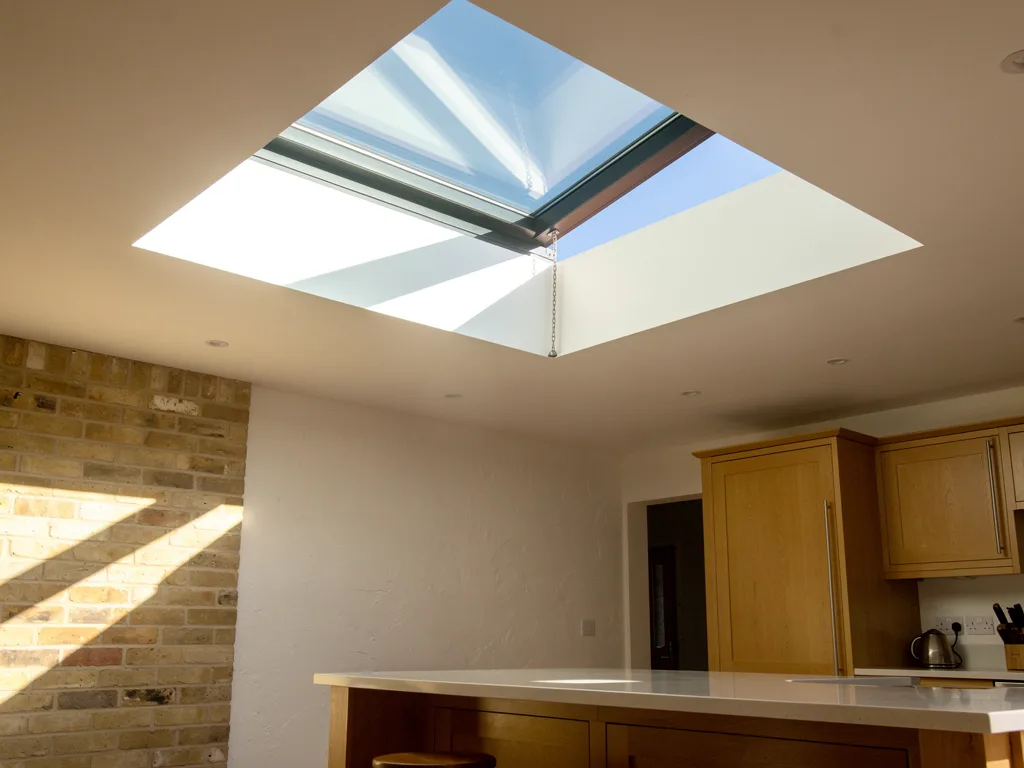
A hinged rooflight is the type that needs wind protection most. When it opens, the pane stands up at an angle to the roof like a sail, and a gust under the raised edge pushes it further open against the actuator. A sliding rooflight is less exposed because the glass moves flat across the roof and presents little edge to the wind, though a strong gust across an open slot can still drive rain in. Our guides to hinged opening rooflights and sliding rooflights compare the two in more detail.
East Anglia is not known for storms on the scale of the west coast, but the flat land around Cambridge gives wind very little to slow it down. A single-storey extension in Cherry Hinton or a new home at Northstowe or Cambourne, with open fields to the west, sees fresh breezes cross the roof at full strength. The prevailing wind comes from the south west, so a hinged rooflight whose raised edge faces that way catches more of it. When we plan a hinged unit, the direction the pane opens is part of the light plan as well: which way the raised edge faces decides both where the wind hits it and which part of the sky you see through the gap.
Wind sensors have a lockout just as rain sensors do. After a gust trips the window shut, the controller waits for the wind to stay below the threshold for a set time before it will let the window open again. Without that hold time, a blustery afternoon would have the rooflight opening and closing every few minutes.
Sensitivity settings and what each one changes
Every sensor system has a few settings, and an automatic rooflight that annoys its owner has usually been left with settings at a default that does not suit the room. Some are adjusted on the control unit, some in an app, some only with the installer's tool.
Which settings can be changed, and how finely, depends entirely on the make and model. The table below describes the adjustments found across common systems, so you know what to ask about. It is not a list of any one product's menu.
| Setting | What it changes | When to adjust |
|---|---|---|
| Rain trip level | How wet the plate must be before it closes | Dew or pollen false alarms |
| Trip delay | Seconds of "wet" needed before closing | Single drips from trees |
| Heater mode | Always on, on demand or off | Clear nights closing the window |
| Wind threshold | Speed at which it closes | Exposed roofs, hinged panes |
| Hold time | How long before it may reopen | Showery or gusty days |
| Return to position | Reopen after rain, or stay shut | Night cooling versus kitchens |
There is a balance in every one of these. Lower the rain sensitivity too far and the window stays open through the first minute of a real shower; raise it too far and it closes for every heavy dew. Lengthen the trip delay and a single drip from a branch no longer shuts the window, but light rain gets a few extra seconds. The right setting is the least sensitive one that still closes before water reaches the room, and that depends on the position of the sensor, the type of window and what the room is used for.
Our approach is to commission at the settings the manufacturer recommends, then change one thing at a time if the window behaves oddly in the first few weeks. Changing two settings at once makes it impossible to tell which one fixed the problem. If a rooflight closes on dry nights, the heater and the rain trip level come first; if it closes on dry afternoons under a tree, the trip delay and the sensor position come first. Nothing should be adjusted so far that the sensor stops protecting the room, because a missed shower over a kitchen worktop or a bedroom carpet costs more than a window that closed once too often.
Sensors, ventilation and the light in the room
An opening rooflight is fitted for air as much as for light, and sensors decide how freely you can use that air. Set well, they let you leave the window open without watching the sky; set badly, they close it on the very evenings you wanted it open.
The value shows most in rooms you are not sitting in. A loft bedroom on a south slope in Chesterton warms through the afternoon, and the best time to vent it is while you are out or asleep. With a rain sensor, you can leave the rooflight open all day and let heat escape through the highest point of the house, knowing a shower will close it. Opening a low window as well gives a real draught upward through the stairwell, which our guide to stack ventilation with rooflights explains.
The same goes for time away. A rain sensor does not make an open rooflight secure, and the answer on leaving an electric rooflight open on holiday sets out the other points to weigh. But it does mean an open vent will not flood the room if the forecast turns while you are away.
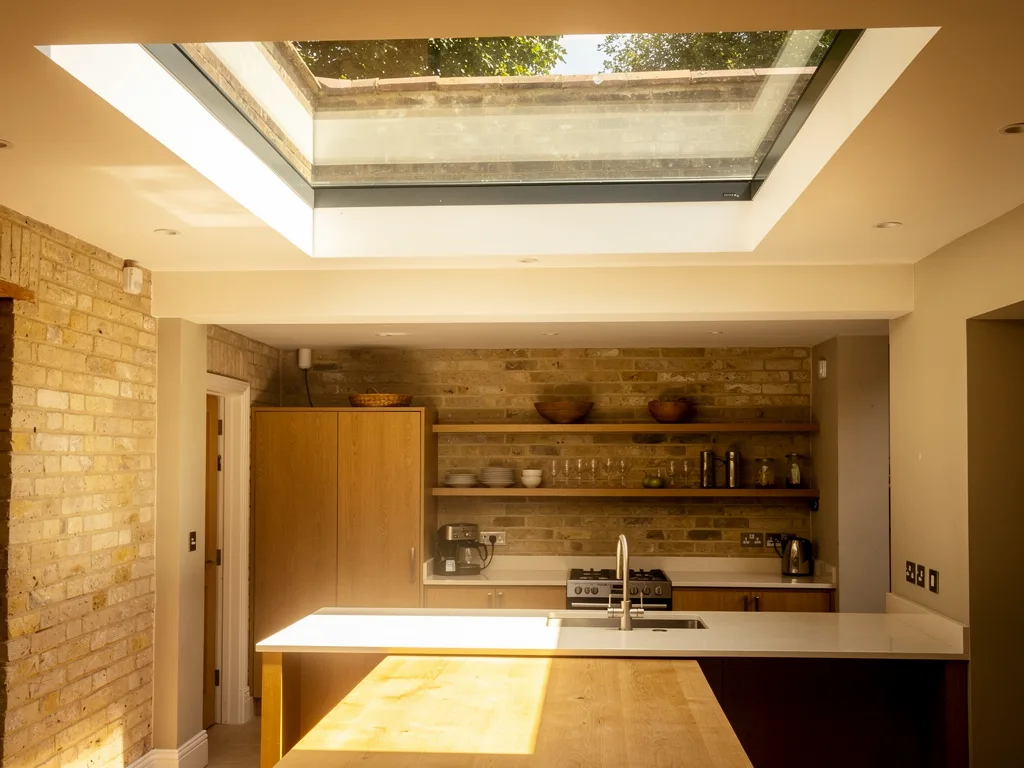
There is a light side to this too. The glass of a rooflight is the thing you look through, and the sensor is a small box on the roof that the glass looks past. On a slim frameless flat rooflight over a kitchen, a bulky sensor bracket at the wrong edge sits right in the view of the sky. We place it at the edge you see least from where you sit, usually the edge nearest the house wall, and the light plan shows that position alongside the glass and the shading. If the rooflight also has an electric blind, the sensors and blind can be linked, so the blind and the glass behave sensibly together; our guide to smart home control for rooflights covers linking them with apps, thermostats and routines.
A sensor also changes how a morning feels. A rooflight that opened for airing at seven and closed itself at eight when a shower came through is not something you notice, which is the point. The room stays fresh, the glass stays dry, and nobody has to climb onto a chair to wind a handle.
Adding sensors, looking after them and when to replace
A rain sensor is standard on many electric rooflights and an option on others, and it can sometimes be added to a window already fitted. The limits are the control unit, which must accept a sensor input, and the cable route to the roof.
For a new installation we specify the rain sensor as part of the electric package, with the wind sensor added where the roof is exposed or the pane is a large hinged one. For a window already in place, the question is whether its controller will accept a sensor from the same make, and whether there is a way to get the cable from the roof to the controller without disturbing the finished ceiling. Our answer on adding a rain sensor to an existing rooflight walks through those compatibility checks. Where an older unit cannot take one, the sensible route is to replace it with a current electric rooflight that includes a sensor from the start.
Care is simple. The plate needs to be clean enough for water to reach the tracks and for the heater to dry it evenly. Bird droppings, lichen, a film of pollen or a stuck leaf can either stop it sensing rain or hold moisture that keeps it reading wet. A wipe with a soft damp cloth when you clean the rooflight glass is usually enough; no solvents or abrasive pads, which can damage the tracks. It is worth testing the sensor now and then too: with the window open, a few drops of water from a spray bottle on the plate should close it within seconds.
Sensors and their heaters are electronic parts, and like any outdoor electronics they can fail after years of weather. If a sensor stops closing the window, keeps it locked shut in dry weather, or closes on every dry night despite a clean plate, the sensor or its heater has probably reached the end of its life. The fix is to replace the sensor with the correct part for that controller, or, on an older rooflight with other signs of age such as misted glass, to plan a new unit. Either way, it is worth doing promptly, because a sensor that no longer trips gives no warning until the day a shower lands on an open window. For an idea of what an electric rooflight costs to install in the first place, our skylight and rooflight costs page sets out the general factors.
Questions people ask
How fast does a rooflight rain sensor close the window?
The sensor itself reacts almost instantly to a drop bridging its tracks. The controller may wait a short delay to rule out a stray drip, then drives the window shut, which takes seconds on a hinged rooflight or roof window and a little longer on a large sliding unit.
Why does my skylight close on dry, clear nights?
Usually dew. The sensor plate cools below the air temperature under a clear sky, moisture condenses on it, and it reads as rain. A working heater prevents this; if the heater is on and the plate is clean, the rain trip level or delay may need a small adjustment.
Can I override the rain sensor to open the window while it is raining?
Some systems allow a short manual override, others lock the window shut until the sensor is dry. It depends on the make. The lockout is there to stop the room getting wet, so it is best not to disable it permanently.
Do I need a wind sensor as well as a rain sensor?
For a large hinged rooflight or an exposed roof with open land around it, a wind sensor is worth having, because gusts can lever an open pane and drive rain in sideways. For a small roof window or a sliding unit on a sheltered roof, a rain sensor alone is usually enough. We will say which in the written light plan, and you can book a light survey or read more on our electric and opening rooflight installation page.