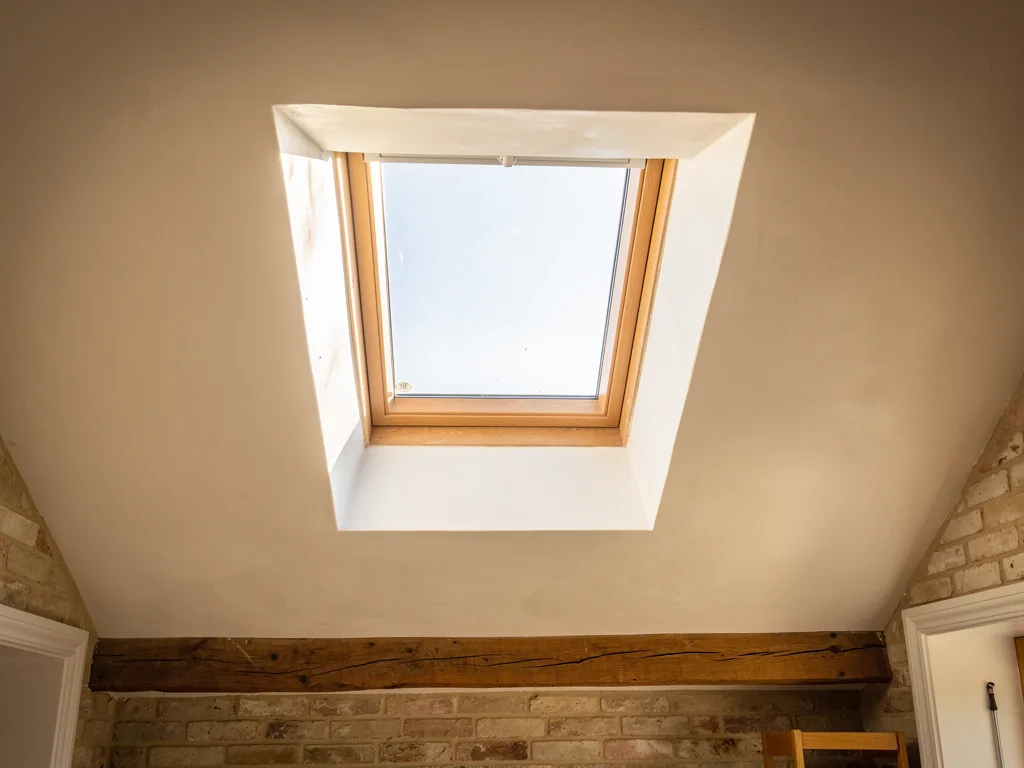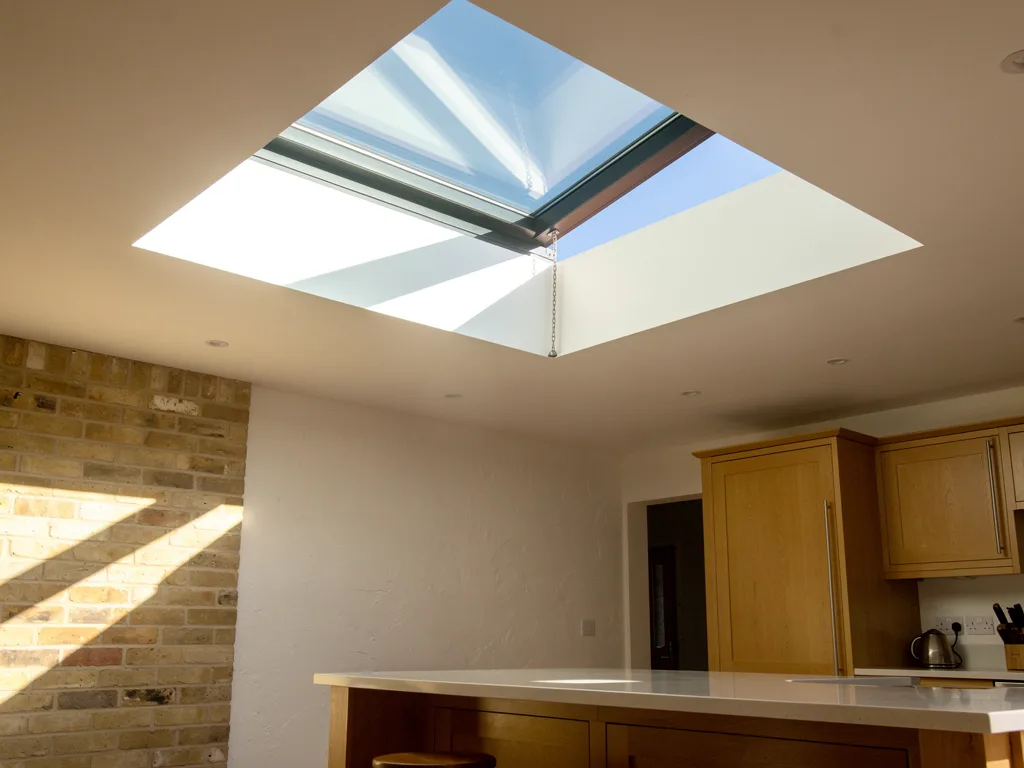
A pane of glass that moves over your head
Electric rooflight safety comes down to three questions: what stops the glass closing on something, who is allowed to open it, and where it goes when power, signal or weather changes. Each has its own feature, and each is worth checking before you choose a unit.
A fixed rooflight is a window in the ceiling. An electric skylight is a machine: a sash weighing anything from 20 kg on a small roof window to well over 100 kg on a large flat rooflight, driven by a motor that does not tire and does not look where it is going. On most days it opens a few centimetres for air, closes again when it rains, and nobody thinks about it. Safety features exist for the other days: the day a child reaches into the gap on a loft stair, the day a cable or a towel is left across the frame, the day the power trips with the glass wide open and a storm arriving from the west.
The mechanism itself, with its actuator, control unit and power supply, is explained in how electric rooflights work. This guide looks only at the protections layered on top of that mechanism: what each one does, where it matters in a real Cambridge house, and what to ask for when you compare products. It sits under our wider page on electric and opening rooflight installation.
It helps to separate the hazards before looking at the answers. There is trapping, where the closing edge meets the frame. There is unintended opening, by a child, a mis-set schedule or a smart speaker that misheard. There is being stuck open, when the power or the controls fail at the wrong moment. And there is the glass itself, which has to stay in the roof even if something hits it. The features below map onto those four.
Obstruction detection and the closing edge
The closing edge is the one place an electric rooflight can hurt someone, so good systems watch the motor as it closes and stop, then back off, the moment it meets resistance it does not expect.
The usual method is current sensing. The control unit knows how much current the actuator draws to move the sash through its normal stroke. If a hand, a broom handle or a rolled towel sits in the gap, the motor has to work harder, the current rises above the expected curve, and the controller cuts the drive. Better controllers then reverse a short distance, typically a few centimetres, so whatever was trapped is released rather than held under load. Cheaper drives simply stop, which prevents crushing but leaves the object pinched until someone presses open.
Three details separate a considered system from a basic one:
- Force limit. The controller caps how hard the actuator can push while closing. A lower cap is kinder to fingers but may stall against a stiff seal in a cold snap, so the setting is a balance made at commissioning, not a factory figure to leave alone.
- Soft close. Many drives slow down over the last part of the stroke. The final few millimetres are where the seals compress and where trapping forces are highest, so a slower approach gives the sensing more time to react.
- Learning the stroke. Some control units record the current curve during the first cycles after fitting. If the sash later drags because of a warped upstand or a blind rail fouling it, the unit notices the change instead of treating it as normal.
Power-operated window drives sold for homes are built to the household appliance safety standard for drives for gates, doors and windows (BS EN 60335-2-103), and products that fall under machinery rules carry their own conformity marking. Ask the manufacturer which applies to the unit you are considering. It is a fair question and a good supplier will answer it plainly.

Where the trapping risk really sits in a house
How much obstruction sensing matters depends on whether anyone can reach the moving edge. A rooflight three metres up in a kitchen extension is a different case from a roof window beside a loft bed.
Picture the typical jobs across the city. In a Romsey or Mill Road terrace, an opening flat rooflight in the side return usually sits well above head height: nobody can touch the sash from the floor, and the risk is mostly to things on the roof side, such as leaves, a cat, or a hose left over the kerb. In a dormer loft in Chesterton or a new home at Great Kneighton, an electric roof window can sit low in the slope, with the bottom rail at chest or even waist height beside a bed or a desk. That window is within reach of anyone in the room, including a small child standing on the mattress.
For reachable units, the choice of control mode matters as much as the sensor. Two modes exist:
One-touch: a single press sends the sash all the way open or closed. Convenient, and fine where nobody can get to the edge.
Hold-to-run: the sash only moves while the button is held, and stops the instant it is released. The person closing it has to be present and, ideally, looking at it. For low roof windows in bedrooms and nurseries, many control units can be set to hold-to-run for closing while keeping one-touch for opening.
There is a light-related wrinkle that people do not expect. When you look up at a south or west-facing opening on a bright afternoon, you are looking into the sky and often into the sun. Your eyes adjust to the glare and the frame edge falls into shadow, so it is genuinely harder to see what is in the gap. A wall switch placed where you can see the whole sash, with the sun behind you rather than in your face, is a small safety choice that comes straight out of a light plan. We mark switch positions on the plan for that reason.
Child locks, control placement and who can press open
Preventing an unwanted opening is easier than dealing with one, and it is done with settings and positions as much as with hardware.
Current control systems usually offer a lock of some kind. On some it is a key switch at the wall; on others it is a setting in the keypad or app that disables local controls, or a paired remote that has to be present before anything moves. The options vary by manufacturer, so check what the specific unit supports rather than assuming. The question of whether a child can open a unit, and how to stop them, is covered in its own answer, can children open an electric rooflight?, so here are only the points that tie into the installation.
- Wall switch height. A switch at the usual 1.2 m sits within a toddler's reach once they can climb. Where the room is a nursery or playroom, a higher position, or a switch with a cover, is agreed at the survey.
- Remote handsets. A remote on a bedside table is a toy. Wall-mounted cradles, or a remote kept by the door, change that.
- Smart and voice control. A voice assistant does not know who is speaking. If a skylight is linked to one, the open command can often be restricted, or given a confirmation step. See smart home control for rooflights for the options.
- Restricted stroke. Some units can be limited to a vent position, so the sash lifts far enough for air but never far enough for a child to put a head or arm through.
Two rooms deserve extra thought: a loft bedroom where the window is reachable from the bed, and a stairwell where a roof window sits above a drop. In both, a lock and a restricted stroke together are worth more than either alone.
Fail-safe closing: where the glass goes when things go wrong
A fail-safe rooflight is one that moves to its safest position when it loses something it depends on. In a house, the safest position is nearly always closed.
The triggers a good system responds to are rain, high wind, a lost signal from a sensor, a fault on the drive, and loss of mains power. The first two are the job of the weather sensors, and their thresholds and false alarms are covered in rooflight rain and wind sensors. The others are about the control unit's own behaviour, and they vary much more between products.
Questions worth asking about any electric skylight:
- If the rain sensor is unplugged or damaged, does the unit close and refuse to open, or carry on as if the sky were dry? The safer answer is the first.
- If the wireless link to a wall switch or hub drops, does the sash stay where it is, or close after a set time?
- Is there a battery backup that closes the unit if the mains fails, and how many closing cycles does a full battery allow?
- After a power cut, does the unit resume its old schedule, or wait for someone to press a button?
The power cut case is covered in detail in what happens to an electric rooflight in a power cut?. The short point here is that a battery-backed closing function is the feature that turns a power cut from a problem into a non-event. Without it, a wide-open rooflight stays wide open until the power returns or someone winds it shut by hand, and it is worth knowing how that manual route works before you need it.
Security while it is open and while you are away
An opening rooflight on a single-storey extension is a way into the house. The features that deal with that overlap with fail-safe closing but are worth taking on their own.
Flat roofs on rear extensions are easy to reach from a garden wall or a bin store in a terrace, and a rooflight open by 300 mm is an invitation. Useful protections include:
- Alarm interlock. Some control units accept a signal from the intruder alarm. Setting the alarm closes every rooflight and blocks opening until it is unset.
- Close on leaving. A single "all close" button by the front door, or a scene in a smart home app, shuts every opening unit as you go out.
- Night vent limit. A restricted night position allows airflow through a small gap while keeping the opening too narrow to climb through.
- Locking hardware. On many electric units the actuator itself holds the sash shut, and the unit cannot be levered open from outside without breaking it. Ask how the specific product is held closed.
Leaving a skylight open overnight, or while the house is empty, raises weather and security questions together. Those are answered in can a rooflight be left open at night? and can you leave an electric rooflight open when on holiday?
The glass, the frame and the fall risk
Safety is not only about the motor. The glass over your head, and the opening in the roof, carry their own rules under the Building Regulations.
Approved Document K deals with protection from falling and impact, and overhead glazing is expected to behave safely if it breaks. In practice, rooflight manufacturers use a laminated inner pane, so that if the glass is struck and cracks, the fragments stay bonded to the interlayer rather than dropping into the kitchen below. The outer pane is usually toughened. That combination is standard on quality flat rooflights and roof windows, and it is what we specify for opening units in every room, not only the obvious ones.
The laminated pane is not the same as a walk-on rating. An ordinary opening rooflight is not designed to take a person's weight, open or closed. Where a flat roof will be used as a terrace or for access, or where the rooflight doubles as a hatch, the unit and the guarding around it follow a different specification: see rooflight roof access hatches.
The frame has a safety role as well. An opening sash is heavier and more mobile than a fixed pane, so the upstand and fixings have to take the extra load of a sash held open against a gust. A tall, rigid kerb fixed through into the roof structure is part of what keeps an opening unit in the roof on a windy day at Trumpington Meadows or out on the open land around Cambourne, where there is little to shelter a roof.
Features side by side
This table puts the main protections against the risk each one deals with, so you can see what a unit offers and what it leaves to you.
| Feature | Deals with | Matters most |
|---|---|---|
| Obstruction sensing | Trapping | Reachable roof windows |
| Hold-to-run closing | Trapping | Bedrooms, nurseries |
| Child lock | Unwanted opening | Low switches, lofts |
| Restricted stroke | Falls, entry | Stairwells, nights |
| Battery closing | Stuck open | Any exposed roof |
| Rain sensor fail-safe | Weather | Every opening unit |
| Alarm interlock | Intrusion | Single-storey rears |
| Laminated inner pane | Falling glass | All overhead glazing |
No single unit needs every line. A sash three metres up over a kitchen island needs battery closing and a working rain sensor far more than hold-to-run. A roof window beside a child's bed needs the reverse. The survey decides which features the room actually calls for.
Setting up, handing over and checking over the years
Safety features are only as good as their settings, and the settings are made on the day of fitting. They should be written down and shown to you, not left in an installer's memory.
When we commission an electric rooflight, the order is fixed: confirm the drive runs its full stroke, set the closing force and let the controller learn its normal load, test obstruction sensing with a soft object at several points along the edge, confirm the rain sensor closes the unit, pair any remotes and wall switches, then set locks, vent limits and schedules. The electrical side, including the fused spur and who signs it off, is described in wiring an electric rooflight.
At handover you get a demonstration of each feature and a note of how it is set: which controls are one-touch and which are hold-to-run, where the child lock is, what the rain sensor does, and how to close the sash by hand. Keep the manufacturer's manual with it.
After that, a few habits keep things working:
- Once a year, test the obstruction stop with a soft object and wipe the rain sensor clean.
- Keep blind rails, cables and plant pots clear of the moving edge; a new obstruction can make the controller stop short every time.
- If the unit starts stopping or reversing for no clear reason, do not raise the closing force to make it finish. Something is dragging, and that deserves a look.
- Change any battery backup when the manufacturer says to. A battery that has aged out will not close a sash in a power cut.
If you are planning a new opening rooflight or replacing an older electric one with a unit that has better protections, book a light survey. We will look at who uses the room, where the switch should go, and which safety features the unit needs, then write it into the plan with the position, glass and shading.
Questions people ask
Does every electric rooflight have obstruction detection?
Not every one, and not to the same standard. Current electric units from established manufacturers generally include it, but some stop without reversing and some older units have none. Ask for the product's closing behaviour in writing before you choose it.
Can I switch off the automatic closing if the rain sensor is too sensitive?
You can usually adjust sensitivity or add a delay, but disabling the rain sensor removes the main weather protection. Adjusting it is the better route, and a heated sensor helps with dew on cool mornings.
Is a solar-powered roof window as safe as a wired one?
The same sensing and locking features are available on many solar units, and they carry their own battery by design. The difference is winter charge. A short December day may not top the battery up fully, so check how the unit behaves when charge runs low.
Should the closing force be set higher in winter?
No. If a unit struggles to close in cold weather, the cause is usually a stiff seal or ice on the frame, and a higher force setting weakens the trapping protection all year. Clear the cause instead.