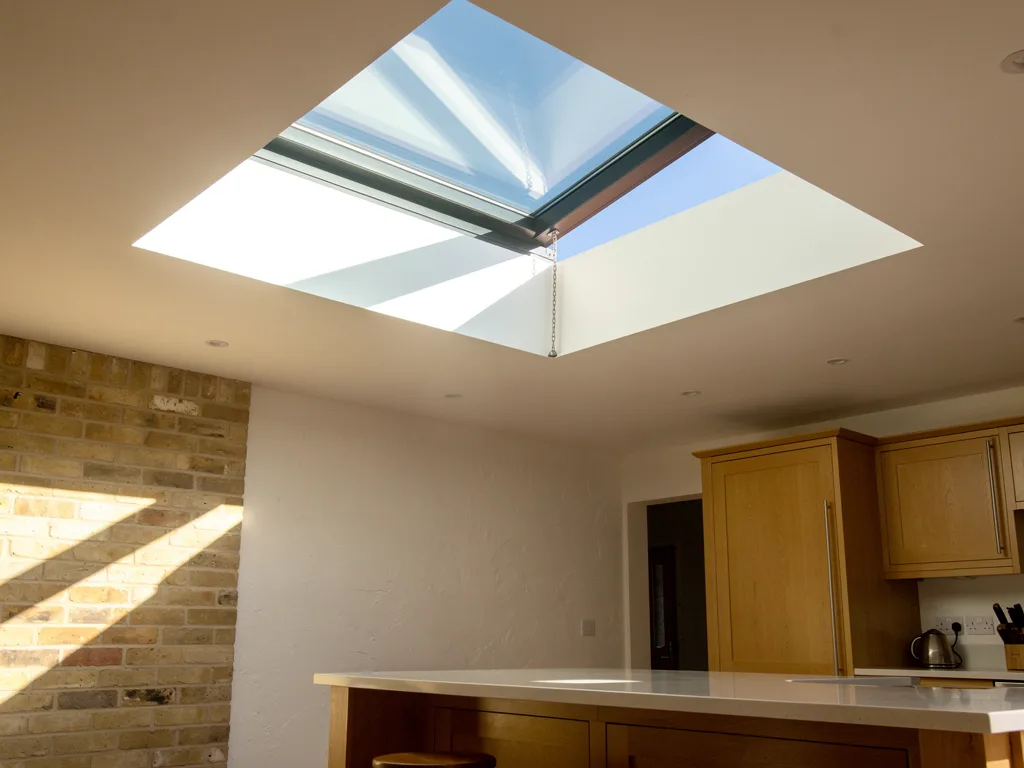
Where the glass ends up when the mains drops
Nothing moves on its own: the rooflight holds whatever position it was in at the moment the power went, whether that is shut, fully open or somewhere in between.
The reason is the gearing inside the actuator. The chain or spindle that pushes the sash open is driven through a worm gear or a similar self-locking drive, and that kind of drive cannot be turned backwards by the weight of the glass or by wind pushing on it. When current stops flowing, the motor stops, and the gear holds the sash as firmly as if it were bolted. Our guide on how electric rooflights work walks through the actuator and control unit in more detail.
For a closed rooflight, that is the end of the story. The sash is held against its seals, the locking points remain engaged, and the unit is exactly as weathertight and secure as it was a minute before. A power cut on a winter evening, with the skylight shut, makes no difference to the room at all.
An open rooflight is the case worth thinking about. If you had the glass open for airing on a warm afternoon and the supply fails, it stays open. The wall switch, the remote and the app all go quiet, and the rain sensor on the frame can still feel the rain but has nothing to drive the motor with. That is why the next two sections, battery backup and manual release, matter.
What a battery backup changes
A backup battery keeps the controller alive long enough to close the glass, so an open rooflight does not have to wait for the mains to come back.
Some control units for flat opening rooflights can be supplied with a battery pack, or with a controller that has one built in. The battery sits in the control box, is kept topped up by the mains while everything is normal, and takes over when the supply fails. Depending on the system, it will do one of two things:
- close the rooflight straight away when the mains is lost, as a fail-safe, whatever the weather is doing;
- stay on standby and close the rooflight only if the rain or wind sensor asks it to, so the room keeps its ventilation through a dry outage.
Either arrangement protects the room below from a summer storm arriving during a cut. The first is the simpler and safer choice for a bedroom or a rooflight over a stair; the second suits a kitchen where you would rather keep the air moving. Batteries age, so a backup pack is something to test now and then and to renew when it no longer holds a charge. The control arrangements are covered alongside other fail-safe behaviour in electric rooflight safety features, and the sensors themselves in rooflight rain and wind sensors.
Solar powered roof windows already work this way by design. Their panel charges an onboard battery that runs the motor, so a power cut in the house does not reach them at all, and the rain sensor carries on closing the window as normal. Solar powered roof windows explains where they suit and how they behave through a dull Cambridge winter.
Closing it by hand
Where there is no battery, a manual release on the actuator lets you close an open rooflight yourself, so you are not relying on the power returning before the rain does.
Manufacturers approach this in different ways. Some chain actuators have a release point that disengages the drive so the sash can be lowered gently by hand; some spindle drives accept a removable crank; some rooflights have to be closed from outside or not at all without power. The detail depends entirely on the make and model, which is why it belongs in the handover rather than in a hurried search with a torch. We cover the options, and the care needed on a heavy sash, in can an electric rooflight be opened manually.
When the power comes back
Once the supply returns, the rooflight waits for an instruction rather than moving by itself, though a few things are worth checking.
A basic wired system simply comes back to life: press close and it closes. Some controllers run a short reference move after an outage so they know the sash position again, which can mean a brief movement you did not ask for. Timers and schedules may need their clock setting again, and a rooflight linked to an app or a voice assistant has to wait for the router and any hub to reconnect before remote control works. Smart home control for rooflights covers how those links are set up.
If the rest of the house has power but the rooflight does not, the problem is local rather than a power cut. Check the consumer unit and the fused spur that feeds the control unit before anything else. The way that supply is arranged is set out in wiring an electric rooflight.
| Set-up | During a cut | If left open |
|---|---|---|
| Mains only | Stops, holds position | Stays open, close by hand if possible |
| Mains with battery | Controller keeps running | Closes on loss of mains or on rain |
| Solar | Unaffected | Rain sensor closes it as normal |
| Manual winder | Unaffected | Close it as usual |
Choosing a set-up with outages in mind
The right answer depends on where the rooflight sits, how often it is left open, and whether anyone is at home to close it.
A skylight over a flat-roofed kitchen extension in a Romsey terrace, opened for a few minutes while cooking, rarely needs more than a mains supply and a rain sensor, because someone is usually in the room. A rooflight above a loft bedroom or a stairwell, left open for night cooling through a hot July, is a stronger case for a battery backup or a solar unit, because it is open for hours when nobody is watching the sky. The same thinking applies to a house left empty for a week, which can you leave an electric rooflight open when on holiday looks at in full.
It also connects to the light plan. An opening rooflight on a south-facing slope is the one you will want open most on summer afternoons, since that is where the heat builds, so it is the one where outage behaviour matters most. We note the power arrangement in the written plan alongside position and glass, so you know what you are getting before the roof is cut. The wider product choices are on our electric and opening rooflight installation page, and you can book a light survey to talk it through in your own room.
Questions people also ask
Will a power cut leave my electric skylight unlocked?
No. A closed electric skylight stays closed and locked, because the self-locking actuator holds the sash against the frame. Losing power does not release it.
Can the rain sensor work without mains power?
Only if something powers the motor. With a battery backup or a solar window, the sensor still triggers a close. On a mains-only system it can detect rain but cannot act on it until the supply returns.
Does a power cut damage the actuator?
A normal outage does not. The motor stops and the gear holds. A controller may need to find its position again afterwards, and timers may need resetting, but the drive itself is unaffected.
Is a battery backup worth adding to an existing rooflight?
It depends on whether the control unit accepts one, which varies by manufacturer. It is most worthwhile on a rooflight that is often left open with nobody nearby, such as over a loft room or a stair.
