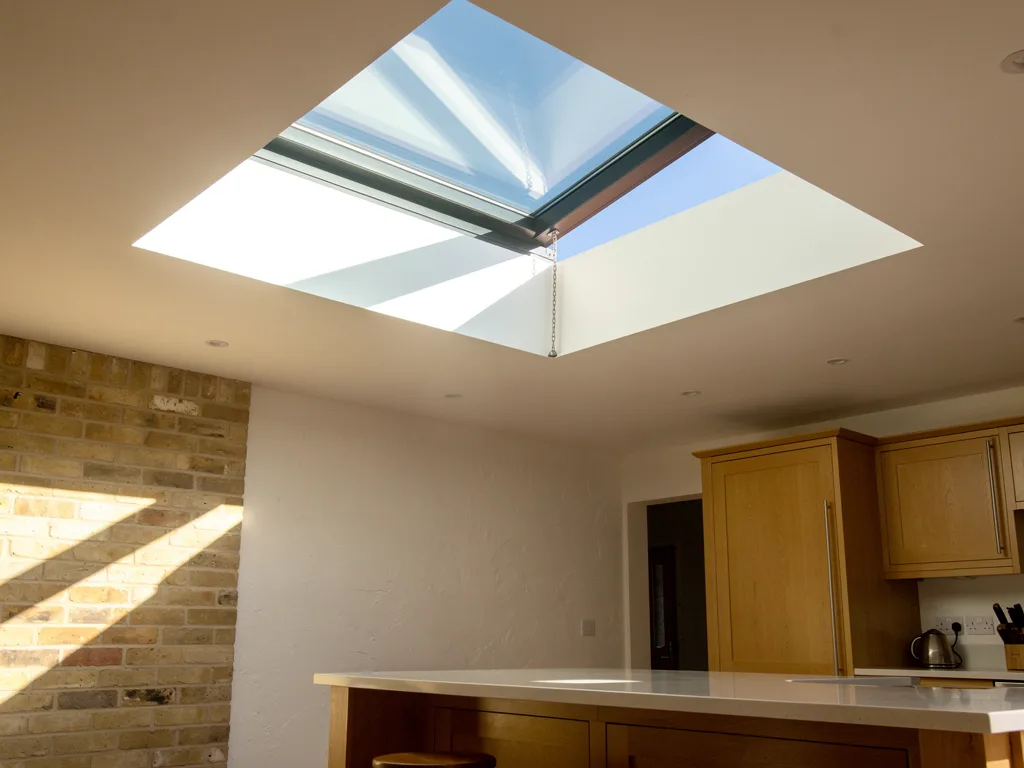
What cold actually does to an electric rooflight
Cold on its own is rarely the problem. The motor, gearbox and control unit run happily below freezing; it is water turning to ice around the moving frame that can hold it shut.
An electric opening rooflight or skylight has three parts that meet the weather: the glazed frame that moves, the compressed seals it closes onto, and the actuator that drives it. The actuator is a small low-voltage motor inside a sealed housing, lubricated with grease rated for outdoor use, so a frosty morning barely changes how it runs. The grease stiffens a little as the temperature drops, which can make the first opening of the day a touch slower and a note deeper, but that is all. Our guide to how electric rooflights work shows where the actuator sits and how it is powered.
Water is a different matter. Rain, melting snow or condensation can sit in the gap where the frame meets its gaskets. On a clear, still night that water freezes, and a thin film of ice can glue the frame to the seal with surprising strength. The frame is not harmed by this, and the seal still keeps the weather out, but until the ice lets go the rooflight will not open.
What happens if you press open when the frame is frozen
The rooflight should simply refuse to move and stop. Electric rooflights are built to protect themselves when something resists the motor, and ice counts as resistance.
The control unit watches the current the motor draws. When the frame cannot move, the current rises, and the control unit cuts the power within a second or two. This is the same overload protection that stops the frame closing on a hand or a broom handle, which we cover in electric rooflight safety features. You may hear a brief hum and then nothing, or see an indicator light flash on the keypad, depending on the make.
Three habits keep the motor and seals in good order on icy mornings:
- Press the button once. Repeated presses against a frozen frame put strain on the gearbox and the chain for no gain.
- Do not lever, knock or pour hot water on the frame. Hot water on cold glass can crack it, and a pushed frame can tear a frozen seal.
- Wait until the sun or the warmth rising from the room below has loosened the ice, usually by late morning, then try again.
If the rooflight still will not move once the day has warmed up, the cause is probably not ice. Our page on whether an electric rooflight can be opened manually explains the override on most units.
Snow on the glass is a separate question
Frost is a thin layer that clears quickly. A covering of snow is weight and water sitting directly over the opening, so it is better to leave the rooflight closed until the glass is clear.
A hinged flat rooflight lifts its glazed lid upwards, so any snow on top has to be lifted with it, and as the lid tilts the snow slides back off into the upstand gap or, worse, into the room. A sliding rooflight runs its glazed section over the fixed roof on tracks, and packed snow on those tracks can stop it part way. A pitched roof window in a loft sheds snow faster than flat glass, because of the slope, but a drift can still build against the bottom of the frame.
In flat, open country like the land around Cambridge, snow is usually light and short-lived. Flat roofs on side-return extensions in Romsey or Chesterton, shaded between terrace walls, can hold it for a day or two longer than a pitched roof in the sun. The glass itself is made to carry normal snow loads; the only question is when to open it.
Sensors, timers and winter settings
Automatic features that are useful in summer can work against you on a frozen morning, so it is worth reviewing them when the first frosts arrive in October or November.
Most rain sensors have a small heating element that keeps the sensor surface dry after rain and stops dew from triggering it. In winter that heater also clears frost from the sensor, so it reads the real weather rather than a coating of ice. Our guide to rooflight rain and wind sensors covers how they are set and why dew can cause false alarms.
Timers and temperature triggers need more thought. A schedule that opens the rooflight at 7am for morning airing, set up as described in can a rooflight open on a timer, will try to open a frozen frame on a hard frost. The motor protection will stop it, but some control units then log a fault and wait for a manual reset before running the schedule again. The table sets out sensible changes for the colder months.
| Setting | Summer | Winter |
|---|---|---|
| Morning timer | Early, longer airing | Late morning, 5 to 10 minutes |
| Warm-room opening | On | Off, or a high set point |
| Rain sensor | On | On, heater active |
| Night venting | On in heatwaves | Off |
A short, wide opening in winter changes the air in a room far better than a long, narrow one, and it loses far less heat, because the walls and furniture stay warm while the air is replaced. If the rooflight is part of a smart home system, a rule that blocks opening below a set outdoor temperature is easy to add and saves the motor from pushing against ice.
Solar and battery rooflights in cold weather
A solar-powered rooflight carries a small battery, and batteries give less in the cold and charge less on short, grey days. It still works through winter, but it has less in reserve.
In December, Cambridge gets under eight hours of daylight, and the sun stays low in the southern sky. A solar panel on a north-facing slope, or on a flat roof shaded by a neighbouring terrace wall, collects very little. The battery is sized to cover this, and most units warn you when charge is low, but a run of frosty mornings where the motor tries and fails to open will use up charge on nothing. Keeping winter openings to deliberate, short airings looks after the battery as well as the room. Our guide to solar powered roof windows covers winter charging in more detail, and what happens in a power cut explains the backup on mains units.
How installation reduces frost problems
Much of what decides winter behaviour is fixed at installation: the fall on the glass, the height of the upstand and how water drains away from the frame.
A flat rooflight should sit on an upstand at least 150 mm above the finished roof, with the glass laid to a fall so rain and meltwater run off rather than pooling on the frame. Water that drains away cannot freeze into the seal line. On a pitched roof the flashing kit has to carry water clear of the frame on all four sides. When we install an electric opening rooflight in Cambridge, the upstand, fall and flashing are set to the manufacturer's details, and the control unit, sensor and any schedule are set for the season before we leave. If an older opening unit in your home sticks or loses heat every winter, book a light survey and we will show you what a replacement would change.
Questions people also ask
Can frost harm the rooflight motor?
Not on its own. The actuator is sealed and rated for outdoor temperatures. Wear comes from pressing open again and again against a frozen frame, which is why the control unit cuts the power when it senses resistance. Our page on how long an electric rooflight motor lasts covers what shortens and extends its life.
Will an electric skylight close if it starts to snow?
Yes, if it has a rain sensor. The sensor reads snow and sleet as moisture and closes the rooflight within a short time. Without a sensor it stays where you left it, so close it yourself before a cold night.
Is it worth opening a rooflight at all in winter?
Yes, briefly. Five to ten minutes of wide opening clears moisture from a kitchen, bathroom or loft bedroom and helps keep condensation off the glass, with little heat lost from the room.
Does ice on the outside mean the glass is failing?
No. Frost on the outer pane on a clear night is normal, and a sign that the glazing is keeping the heat inside. Misting between the panes is different, and means the sealed unit should be replaced.
