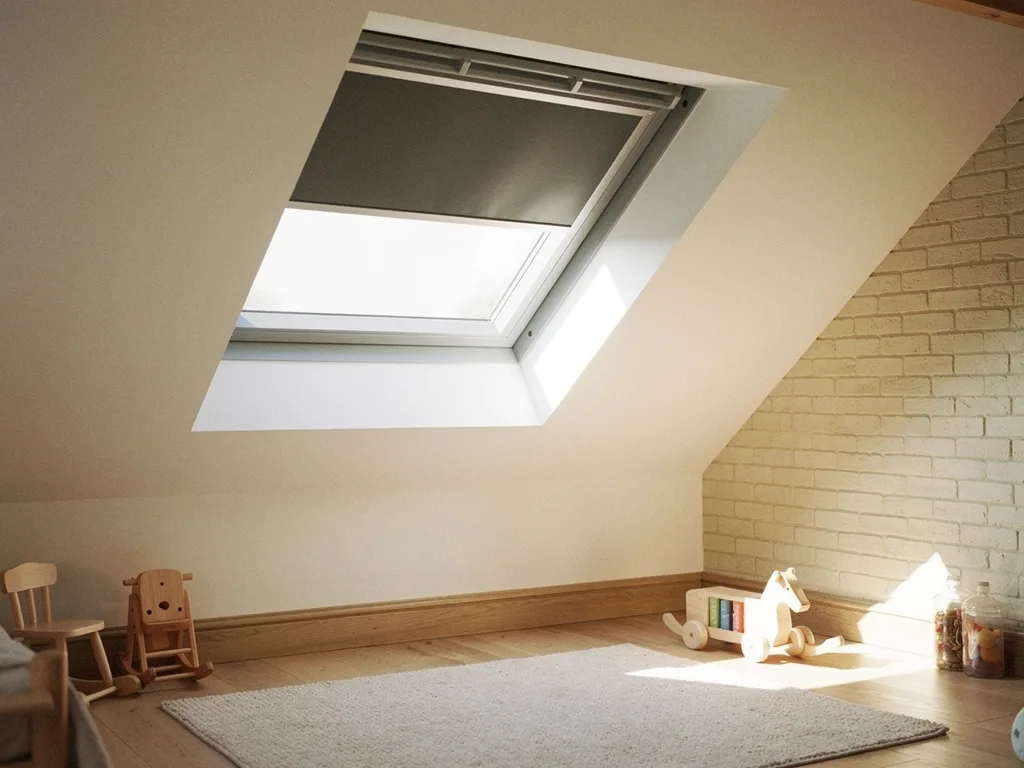
Where the codes live: the data plate
Every VELUX roof window carries a small data plate that states exactly what the window is, and reading it takes about ten seconds once you know where to look.
Open the sash as if you were letting air in. On a centre pivot window, the plate sits at the top of the frame, facing you once the sash has tipped out of the way; on a top hung window it is in the same place, behind the handle bar at the head of the frame. On older windows it may be a stamped metal plate, on newer ones a printed label. It lists a string of letters and numbers, and sometimes a production mark and a country of manufacture as well.
The part that matters for sizing and replacement is usually printed together, something like GGL MK04 2070. That single line tells you the type of window, its size, and the model version and glazing. Photograph the plate on your phone before you do anything else: it is the most useful thing you can send to anyone quoting for a new VELUX skylight, a blind or a flashing, and it saves a second visit up the ladder.
In a loft bedroom that has been painted a few times, the plate can end up under a coat of emulsion. A gentle wipe with a damp cloth often brings the print back. If it has been painted over properly or has fallen off, the window can still be identified by measuring it, which is covered further down.
Reading the size code
On any VELUX window made from 2013 onwards, the size is a two-letter, two-digit code: the first letter gives the width, the digits give the height, and the K in the middle marks the current generation.
The dimensions the code refers to are the outside of the window frame, not the plasterboard lining you see from the room and not the glass. That is why the numbers never quite match a tape measure held against the inside reveal. The width letters step up from narrowest to widest, and the height numbers step up from shortest to tallest, so a code reads a little like a grid reference.
| Width letter | Frame width | Height number | Frame height |
|---|---|---|---|
| C | 55 cm | 01 | 70 cm |
| F | 66 cm | 02 | 78 cm |
| M | 78 cm | 04 | 98 cm |
| P | 94 cm | 06 | 118 cm |
| S | 114 cm | 08 | 140 cm |
| U | 134 cm | 10 | 160 cm |
Put the two halves together and a code decodes itself. CK02 is 55 by 78 cm, a small window of the kind often used in a bathroom or over a stairwell. MK04 is 78 by 98 cm, one of the most common sizes in UK lofts. MK06 is 78 by 118 cm, and PK08 is 94 by 140 cm, a generous window for a loft bedroom or a converted roof space.
Not every letter comes with every number. The range is built around the combinations that suit real roofs, so you will find MK04, MK06, MK08 and MK10, but not every width is offered in every height, and the offer varies between window types. A few other codes sit outside the simple grid for special products. Check the current range for your window type before settling on a size, and treat the table above as a way to read a code, not a list of everything that can be ordered.
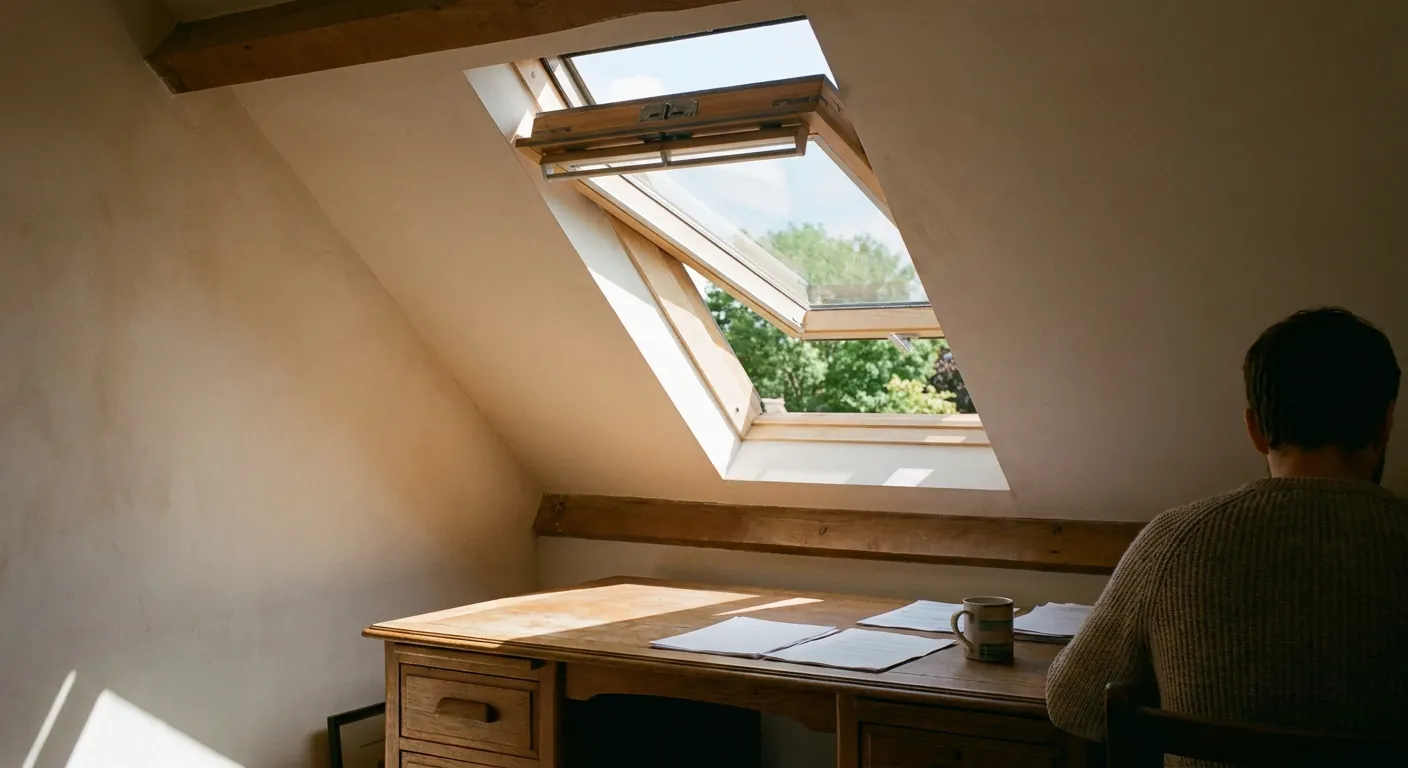
What the size does to the light in the room
The height number matters more than people expect, because on a sloping roof it decides how far down the slope the glass reaches and so where the light and the view start.
Picture a loft room in a Romsey or Mill Road terrace with a rear slope at around 40 degrees. A 98 cm tall window (an 04 height) set at a comfortable handle height gives a good panel of sky and a band of light across the floor, but standing up you mostly see clouds. Go to a 118 cm window (06) or a 140 cm window (08) and the bottom edge comes lower, so you can see the gardens and rooftops as well as the sky, and the light reaches further down the wall and across the room.
Width works differently. A wider letter spreads light sideways across the room, which suits a long loft where a desk or bed runs along the slope. It also has a structural cost: rafters in older Cambridge houses are commonly set at around 400 mm centres, and many newer trussed roofs at around 600 mm. A C width often sits between rafters at wider spacing, while an M, P or wider window usually needs a rafter trimmed and the load carried by new timbers around the opening. That is a design job in its own right, and it is covered in can you fit a bigger VELUX window.
Orientation then decides what the size will actually feel like. On a north slope, a larger window gives steady, even light all day with little risk of overheating. On a south slope, the same size lets in several hours of direct sun in summer, and the glazing and shading choices matter as much as the code. The way we think through position, size and glass together is set out on how we plan the light.
The type code and the four-digit suffix
The letters in front of the size tell you how the window opens and what it is made from, and the digits after the size identify the model version and the glazing unit.
The type code is usually three letters. The two most common on UK roofs are these:
- GGL: a centre pivot window with a clear lacquered pine frame.
- GGU: the same centre pivot window with a white polyurethane finish over a timber core, a common choice for bathrooms and kitchens because it shrugs off moisture.
- GPL and GPU: top hung windows, again in pine and in white polyurethane, which open outwards from the top and give a clear view out.
The last letter of the pair follows the same pattern across the range, L for pine and U for polyurethane, so once you have spotted it on one window you can read it on the next. Electric, solar, balcony and conservation versions carry their own type codes or additional words such as INTEGRA or SOLAR on the plate. For how the finishes and the opening styles compare, see VELUX window ranges compared.
After the size comes a four-digit number, such as 2070 or 3066. The leading digits identify the version of the model, and the final pair identifies the glazing unit fitted at the factory. This is where you find out whether a window has a standard double glazed unit, a noise reducing unit, a triple glazed unit or solar protection glass. VELUX publishes the meaning of each glazing code, and it changes over time as new units are introduced, so the safest thing is to read the full string from the plate and check it against the current VELUX information rather than guessing from memory.
For a replacement, the suffix is useful for another reason: it tells you what you have today. If your existing window has a basic double glazed unit on a hot west slope, the replacement is the moment to choose a better one, and the suffix is the reference point for that conversation.
Older codes from earlier generations
Windows made before 2013 use older size codes, and windows made before 2001 use a different system again, but they map onto today's sizes more closely than you might expect.
Between roughly 2001 and 2013, VELUX used a letter and two digits with no K: C02, C04, M04, M06, M08, S06 and so on. The letters and numbers mean the same widths and heights as today's codes. A GGL M04 from 2008 and a GGL MK04 from this year share the same outer frame size, which is why a swap between these two generations is usually straightforward and the existing flashing can sometimes stay.
Before 2001, sizes were three-digit numbers such as 104, 304, 306, 308, 606 or 808. These line up with later codes in a predictable way: 304 corresponds to M04 and today's MK04, 306 to M06 and MK06, 104 to C04 and CK04. The frame size is broadly matched, but the depth at which the window sits in the roof is different. That is why a pre-2001 opening is often fitted with a dedicated replacement flashing that sets the new window at the old depth, so the internal lining can stay as it is. The flashing side of this is explained in VELUX flashing types explained.
If you are not sure which era your window belongs to, the plate format itself is a strong clue: a three-digit size points to the oldest generation, a letter and two digits to the middle one, and a letter, a K and two digits to the current one. Other clues, such as the handle and the ventilation flap, are set out in how to identify your VELUX window generation.
When the plate is missing: measuring the window
If the plate is gone or unreadable, measure the outside of the window frame, not the lining, and the nearest standard size is almost always obvious.
Open the sash fully so you can see the frame that stays fixed in the roof. Measure its outside width, from the outer face of one side of the frame to the outer face of the other. Then measure its outside height, up the slope from the bottom of the frame to the top. Round each figure to the nearest centimetre and compare them with the width and height columns in the table above. A frame measuring about 78 cm wide and 98 cm tall is an M04 size, whichever generation it comes from.
A few cautions help:
- Do not measure the plasterboard reveal. Linings are often splayed, so the opening you see from the room is larger at the bottom and top than the window itself.
- Do not measure the glass. The visible pane is noticeably smaller than the frame on every size.
- Measure both sides of the frame if you can. An older window that has been fitted slightly out of square gives two figures, and the larger one is usually closer to the true size.
- Take a photo of the window from outside if it can be done safely from a neighbour's window or the garden. The flashing profile and the roof covering both affect what the replacement needs.
Measuring gives you the size family. It does not tell you the glazing, the generation or whether the flashing can stay, so treat it as the starting point for a survey rather than the basis of an order. Working at height on a steep roof is also not a job to take on from a stepladder in the loft; the frame can be measured from inside, and the rest can wait for someone with the right access.
Codes that follow the window: flashings, blinds and collars
Almost every VELUX accessory is ordered by the same size code as the window, which is what makes a well-coded window easy to live with for decades.
A flashing kit carries its own letters, which describe the roof covering it suits, followed by the window size: a profiled tile flashing for an MK04 window, for example, is listed as EDW MK04. The size half of the code has to match the window exactly; the letter half depends on whether the roof is slate, plain tile or a deep profiled tile. Choosing the wrong letter half gives a flashing that does not sit properly on the covering, so it is worth having someone confirm the roof type before ordering.
Blinds follow the same logic. An interior blackout blind for an MK06 window is ordered for MK06, and it fits the window whatever its glazing or opening type, because the frame is the same size. An external awning blind for heat control is ordered the same way. For older windows, VELUX lists which current blinds suit each older size, so a pre-2013 M06 can usually take a current blind for the matching size, but it is worth checking before buying. Which blind suits which slope and room is covered in the VELUX blinds guide.
Insulation collars, vapour barrier collars and underfelt collars are also sized by the window code. They sit around the frame inside the roof build-up, where they close the gap that would otherwise become a cold spot and a place for condensation to form. They are hidden once the lining is finished, which is exactly why the right size needs to go in at the time. More on those in VELUX insulation collars and installation kits.
The practical upshot is simple. Once you know the size code, you can change a blind, add an external shade before a hot summer, or upgrade the window itself years later, and every part will be listed against that one code.
Flat roof windows and other exceptions
VELUX flat roof windows use a different size format, given in centimetres, so a code from a pitched roof window cannot be read across to them.
On the flat roof range, sizes are shown as a six-digit number giving the width and then the length in centimetres, so a 080080 window is 80 by 80 cm and a 100150 window is 100 by 150 cm. These dimensions refer to the opening in the roof deck and the upstand the window sits on, rather than a frame set into rafters. Flat roof windows also come with their own type letters for fixed and opening versions, and a choice of flat or curved glass top. Their range and how they compare with other flat rooflights is covered in VELUX flat roof windows.
Some pitched products also sit a little outside the ordinary pattern. Balcony windows, roof terrace units and combinations of several windows in one opening each come with their own codes for the combined flashing, and some sizes are only made for particular window types. Sun tunnels have their own diameter-based codes. If your window does not decode neatly with the table above, it is probably one of these, and the plate will say so.
Using the codes to plan a replacement
The code on the plate is where a replacement conversation starts, but the right new window is chosen for the room, not just copied from the old one.
A like-for-like swap keeps the same size code, reuses the opening and, where the roof allows, disturbs the least of the lining and the roof covering. That is the quickest route and often the right one. It is not always the best one. The old code was chosen when the loft was converted, perhaps decades ago, and sometimes by a builder who fitted what was on the van. It is worth asking three questions before you reorder it.
First, is the light landing in the right place? A window that is too short for the slope lights the ceiling and leaves the floor dull; a taller size, one or two steps up the height column, may keep the same rafters and give a much better room. Second, is the glazing right for the slope? A south or west facing window with an older standard unit is the case most likely to benefit from a solar protection pane or an external blind. Third, does the room need a different opening? A top hung window may suit a loft where you want to stand at the glass and look out, or where the window has to serve as an escape route.
The wider process, including what happens to the lining and the blinds when an old window comes out, is set out in replacing an old VELUX window, and the service itself is described on our VELUX window installation page. At a light survey, we read the plate, check the roof and the rafters, look at the slope's orientation and the way the room is used, and set out the recommended size, glazing and shading in the written light plan that comes with the quote. If you have a photo of the plate, bring it or send it ahead: it makes that first conversation quicker. To start, book a light survey or message us on WhatsApp.
Questions people ask
What does MK04 mean on a VELUX window?
MK04 is the size code. M means a frame width of 78 cm, 04 means a frame height of 98 cm, and the K marks a window from the current generation made from 2013 onwards. Any MK04 blind, flashing or collar is sized to fit it.
Is a VELUX M04 the same size as an MK04?
Yes, the outer frame dimensions are the same, 78 by 98 cm. The M04 is from the generation made between about 2001 and 2013, and a current MK04 window will normally go into the same opening, sometimes with the existing flashing kept.
What is the most common VELUX window size?
MK04 and CK04 are among the sizes found most widely on UK roofs, with MK06 and PK08 common in loft conversions where more light and a lower view out are wanted. The right size for a given room depends on the rafter spacing, the slope and where the light needs to land.
Can I find my VELUX code without going on the roof?
Yes. The data plate is inside, on the top of the window frame, and is visible from the room when the sash is open. If it is missing, the outside of the frame can also be measured from inside and matched to the nearest standard size.


