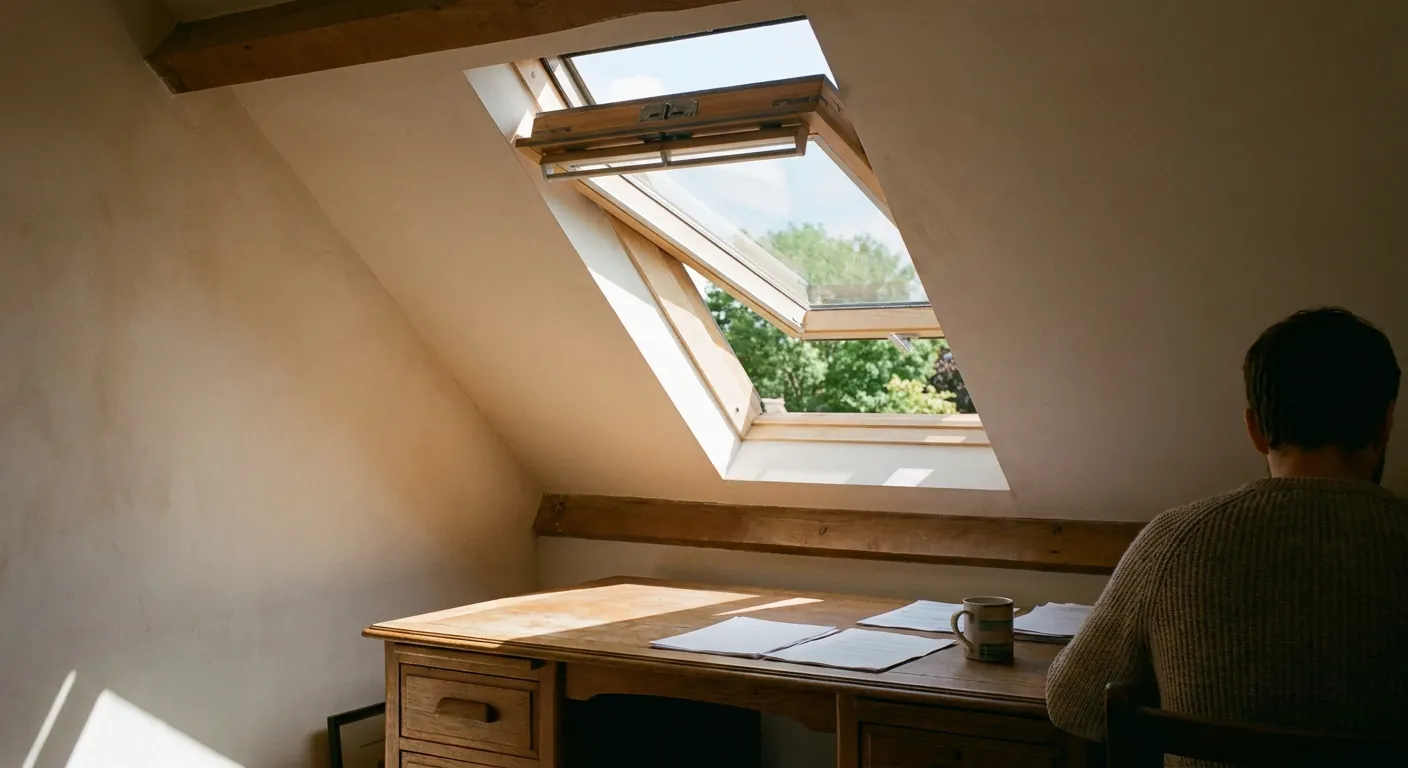
The window itself and the opening it needs
The unit is the part you can see in a brochure, but the bigger cost question is whether the roof already has a hole the right size for it.
Size and type come first. A small centre-pivot window for a landing or a bathroom sits at one end of the range; a large top-hung window, a 3-in-1 combination or a CABRIO balcony sits at the other, with more glass, more hardware and more flashing to make weathertight. Finish plays a part too: white polyurethane costs more than pine and suits bathrooms and kitchens where steam would mark bare timber. The data plate on an existing window gives its size code, and our guide to VELUX sizes and codes shows how to read it.
The opening matters more than the unit. A like-for-like swap into an opening of the same size is the lightest job: the old window comes out, the new one goes into the same rafters, and the internal lining can often stay. A new opening means cutting the roofing back, trimming one or more rafters, fitting headers and sills, and building a lining from scratch. Going up a size sits between the two, and the extra work is set out in can you fit a bigger VELUX window. Where rafters are close together, as they often are in the Victorian terraces of Romsey and Mill Road, a wide window may need two rafters trimmed rather than one, and that adds timber and time.
Flashing, roof covering and how the roof is reached
What sits on the roof around the window, and how a fitter gets to it safely, can move the cost as much as the window does.
The flashing is the kit that weathers the frame into the roof covering, and it is chosen by the roof, not by preference. Profiled concrete tiles take a different flashing from plain clay tiles, and thin slate takes another again. A recessed flashing, which sets the window lower so it sits closer to the roof plane, costs more and is often the choice on a conservation slope. Two or more windows side by side need a combination flashing. Our guide to VELUX flashing types explains which suits which roof. Older roofs add their own work: brittle slates or tiles that break when lifted need replacing, and a roof with no breathable membrane under the covering needs a membrane collar dressed in around the opening.
Access is the other roof-side factor. A bungalow slope reached from a tower or ladders with edge protection is a smaller undertaking than the rear slope of a three-storey terrace over a lean-to, where scaffold may be the only safe option. Some swaps can be done largely from inside, as covered in can you replace a VELUX window from inside, but a new opening almost always needs work from outside to set the flashing and the tiles around it.
| Factor | Lighter end | Heavier end |
|---|---|---|
| Opening | Same size swap | New or enlarged |
| Roof covering | Tiles in good order | Old slate, no membrane |
| Flashing | Single, standard | Recessed or combination |
| Access | Low slope, from inside | High slope, scaffold |
| Inside | Old lining kept | New lining, plaster, decoration |
Lining, insulation and making good inside
The finish inside the room is where a swap and a new window differ most, and it is easy to leave out of a comparison between two quotes.
A new window needs a lining: the reveal around the frame that carries the light down into the room. It is framed, insulated, boarded, plastered and decorated, and a lining splayed at the top and bottom spreads the light wider than a square-cut one. VELUX insulation collars and vapour barrier collars go in around the frame at the same stage to stop the cold spot that leads to condensation, described in our guide to insulation collars and installation kits. On a like-for-like swap, a replacement flashing often keeps the old lining intact, which saves plastering and redecorating; on older pre-2001 windows it depends on the flashing used, as explained in will a new VELUX fit my old opening.
Glass, blinds and electric operation
The extras you choose for the light and heat in the room add to the cost, and the right ones depend on which way the slope faces.
Standard double glazing suits many rooms, but a south or west slope over a loft bedroom may call for solar protection glass, and triple glazing adds cost for extra warmth and quiet. An external awning blind stops heat before it reaches the glass; a blackout blind is for sleep; a pleated or roller blind softens glare. Each is priced separately, and our VELUX blinds guide sets out which suits which slope. Electric or solar operation, through VELUX INTEGRA, costs more than a manual window and a mains version needs a supply run to the frame, but it makes a high window usable. Building Control is part of the picture too: a new opening is notifiable work, and we handle that notification where it applies.
For general UK market ranges across roof windows and rooflights, see our skylight and rooflight costs page. For a price for your roof, book a light survey and the written quote will itemise each of these points alongside the light plan for the room.
Questions people also ask
Is replacing a VELUX cheaper than fitting a new one?
Usually a like-for-like replacement is the lighter job, because the rafters are already trimmed and the lining can often be kept. A new opening adds structural work, a new lining and plastering. Our guide to replacing an old VELUX window covers what a swap involves.
Does fitting two windows cost twice as much as one?
Not quite. Access, scaffold and setting up are shared between the two, and a combination flashing is designed for windows side by side. Each window still needs its own opening, lining and finishing, so the saving is in the shared parts rather than the windows.
Why do two quotes for the same window differ so much?
They often include different things. One may cover the window and flashing only, another the lining, collars, plastering, decoration, blinds and Building Control. Check what each covers line by line before comparing totals. Our VELUX window installation page shows what our installation includes.
Does the time of year change the cost?
The work itself is the same, but a new opening needs a dry spell to open the roof, and that can affect when the job is booked. Our answer on how long a VELUX installation takes explains the time each type of job needs.
