Why a roof window needs its own kind of blind
A blind on a sloping window has to hold itself flat against glass that tilts towards the sky, stay put when the sash swings open, and close the edges tightly enough that light does not leak round the sides.
An ordinary roller or Venetian from a high street shop is built to hang. On a roof window at 35 or 45 degrees it sags into the room, swings when the window moves and leaves a bright line down each side. VELUX blinds solve that with side channels that run the length of the frame and a bottom bar that locks in place at any height. The blind is held at both edges, so it sits parallel to the glass and travels with the sash when you open the window for air or turn it round for cleaning.
They clip into brackets on the inside of the window frame. Current VELUX windows, and windows from roughly the last two decades, come with those brackets already fitted, which means a blind goes on in a few minutes with no screws into the plasterboard lining. Older windows from before the turn of the century used a different frame, and their blinds are a different pattern, so a blind for a 1990s window will not fit a current one and the reverse is also true. The guide to identifying your VELUX window generation shows how to tell which you have before you order anything.
Every VELUX blind is made for one window size. The size code on the data plate, such as CK02, MK06 or SK08, is the same code the blind is sold under, and the VELUX sizes and codes guide explains where to find the plate and how to read it. Get the code right and the blind fits the frame exactly. Guess from a tape measure and it rarely does.
There is also a safety point. VELUX blinds are operated by a handle on the bottom bar, a control rod or a motor, rather than by a looped cord, so there is no hanging cord in a child's bedroom. On a loft room used as a nursery that matters as much as the light.
Blackout blinds for rooms that need darkness
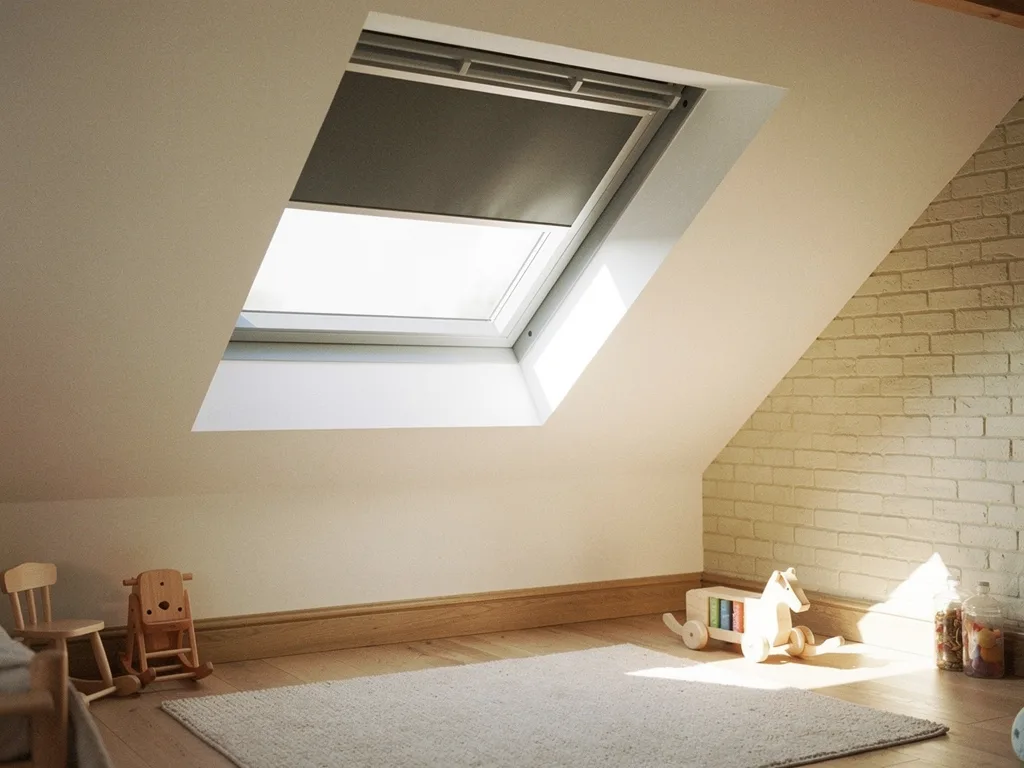
A blackout blind is the one to choose when a room must go properly dark: a loft bedroom, a nursery, a room used for a projector or a home cinema.
Cambridge sits a little above 52 degrees north. In the weeks around midsummer the sun rises before five in the morning, and the sky is light well before that. A roof window in a bedroom looks straight at that sky, with nothing in the way, so a thin curtain or a light-filtering blind will not keep the room dark. The VELUX blackout blind uses a coated fabric that stops light passing through and runs in aluminium side channels, which is what closes the gaps at the edges. With the blind down, the room is as dark as a bedroom with a lined curtain on a vertical window, and often darker, because nothing spills in over the top.
Three versions are available for most sizes. The manual blackout blind, sold under the DKL code, is moved with the handle on the bottom bar or with a control rod on a window that is out of reach. The electric version, DML, runs from the same wall switch or remote as an INTEGRA electric window. The solar version, DSL, has a small solar cell and a battery built into the top of the blind and needs no wiring, which makes it the sensible choice for a window above a stair or a high ceiling where a pole would be awkward every night.
A Duo blackout blind combines a blackout layer with a pleated layer in one unit. By day you draw the pleated fabric to soften the light and keep some privacy; at night you drop the blackout. For a guest room or a child's room that is also used for play in the day, the Duo does two jobs in one frame.
Blackout blinds come in a wide range of colours. The side facing the glass is usually a pale reflective coating, which throws back a share of the sun's heat when the blind is closed on a summer afternoon. It helps, but it is not the same as stopping the heat outside the glass, which comes later in this guide.
Roller and pleated blinds that soften the light
Roller and pleated blinds do not darken a room; they take the edge off direct sun, give privacy and change the colour and feel of the daylight.
A VELUX roller blind is a single layer of light-filtering fabric on a spring roller. Drawn down on a bright day, it turns hard sunlight into a soft, even glow across the room and removes the sharp-edged sun patch that would otherwise move across the floor or the bed. It is the simplest and lightest blind in the range, and it suits a landing, a hallway, a dressing room or a study where you want the daylight but not the dazzle. The manual version is sold as RFL, with electric and solar versions for windows out of reach.
Pleated blinds, under the FHL code for the manual version, are made from folded fabric that can be stopped anywhere on the window, not just drawn down from the top. That lets you cover the lower part of the glass for privacy while leaving the upper part open to the sky, which is useful where a roof window faces a neighbour's dormer across a narrow terrace garden, as happens on the tight streets off Mill Road and in Romsey. Pleated blinds are also the neatest looking of the internal range when they are fully open, because they fold into a slim bar.
A variation worth knowing is the energy blind, which uses a honeycomb pleat. The cells trap a layer of air, so on a winter night the closed blind slows heat loss through the glass, and on a summer day it slows some of the heat coming in. In a loft room with an older, less efficient window that is not due for replacement yet, it can make a noticeable difference to how the room feels at night.
Neither of these is the right answer on its own for a bedroom that needs darkness or a south slope that overheats. They are for the rooms and the orientations where the light is welcome and only needs gentling.
Venetian blinds for steering light away from screens and baths
A Venetian blind is the only internal VELUX blind that lets you change the angle of the light without taking it away, because the slats tilt.
The slats are aluminium, and turning them sends the daylight up onto the ceiling or down onto a desk, or closes it off almost entirely. That is a different kind of control from a roller. In a loft study where the monitor sits under the window or facing it, a Venetian lets you bounce the light off the ceiling so the room stays bright while the screen stays readable. On an east slope, where low morning sun comes in almost level and straight into your eyes, tilting the slats cuts the glare while leaving the view of the sky.
Aluminium does not absorb moisture, so the Venetian is the usual choice in a bathroom or an en suite. Fabric blinds can take steam in a well ventilated room, but a Venetian shrugs off condensation and can be wiped clean. If a new window is planned over a bath, the answer on fitting a VELUX window over a shower covers the ventilation and glass choices that go with the blind.
The manual Venetian is sold as PAL, and an electric version is available for larger sizes. It does not black a room out, because a little light always passes between the slats, so it is not the blind for a bedroom that needs darkness.
External awning blinds and shutters: stopping heat before the glass
An external blind sits on the outside of the window, where it catches the sun's heat before it reaches the glass, and that is why it keeps a room far cooler than any blind fitted inside.
Once sunlight has passed through a pane and landed on the carpet, the bed and the walls, those surfaces warm up and give that heat back to the room. An internal blind, even a blackout with a reflective back, is already on the warm side of the glass; the heat it catches is heat that is already indoors. An external blind intercepts the sun outside, and the warmth is carried away by the air moving over the roof. The difference is obvious on a July afternoon in a south or west loft room.
The VELUX awning blind, sold as MHL for the manual version, is a fine black mesh stretched across the outside of the glass. Because it is a mesh, you can still see out through it, much as you can through fly screen, and the room still gets daylight. It is fitted from inside by opening the sash, so nobody needs to go up on the roof, and it hooks onto brackets on the outside of the frame. The manual version is set by hand with the window open; the solar version, MSL, runs from a remote and can be left closed all day while you are out, which is when a loft tends to heat up.
A roller shutter goes further. It is a solid external shutter that runs down over the whole window, stops almost all heat and light, and also dulls the noise of heavy rain on the glass. On a loft bedroom under a south slope, a shutter makes the room dark and cool together, so it can do the jobs of an awning and a blackout blind at once. Shutters are electric or solar.
VELUX also sells a pack that combines an external awning with an internal blackout blind for many sizes. For a bedroom on a sunny slope, the pair covers both problems: heat by day and light at dawn. The answer on whether VELUX glass reduces heat from the sun explains how solar control glass and an awning work together, since neither does the whole job alone.
Choosing a blind by the way the slope faces
The direction the roof slope faces decides how much sun the window gets, at what time of day and from what angle, and that shapes which blind is worth buying.
Flat land around Cambridge means almost no hills or high ground to shade a roof, so a window gets the full sun its slope allows. A north slope never gets direct summer sun on the glass for more than the early and late hours, and gives a steady, cool light. An east slope takes the sun from dawn to late morning, low and bright. A south slope gets the high midday sun for several hours and the most heat. A west slope takes the afternoon and evening sun, low in the sky and landing deep into the room when it is already warm.
- North slope. Soft, steady light all day with no direct sun: even, glare-free and good for studios, kitchens and home offices.
- East slope. Bright morning sun that has moved off by lunchtime: bedrooms and breakfast rooms.
- South slope. The strongest light, peaking at midday. Worth pairing with solar-control glass or a blind to keep summer heat down.
- West slope. Warm, low evening sun: living rooms and kitchens used after work.
- The sun’s path. It rises in the east, is due south at noon and sets in the west, higher in summer and lower in winter.
| Slope | What the light does | Blind that suits |
|---|---|---|
| North | Soft, even, little heat | Roller or pleated for privacy |
| East | Early, low, glare at breakfast | Blackout in a bedroom, Venetian in a study |
| South | High sun, most heat | External awning plus an inner blind |
| West | Low, hot, late afternoon | External awning or shutter |
The table is a starting point, not a rule. A north-facing loft bedroom in June still sees a bright sky from before five, so it still needs a blackout blind for sleep, even though it will never need an awning. An east slope over a kitchen might need nothing at all, because morning sun over the breakfast table is the whole point of the window. A west slope over a living room where you watch television in the evening is where glare matters most, and a Venetian or an awning pays for itself in comfort.
The slope also changes with the season. In December the Cambridge sun at noon is only around 14 degrees above the horizon, so a south roof window lets low winter sun reach deep into the room, and you will want it. In June the noon sun is above 60 degrees and comes down steeply through the glass, which is when the heat arrives. A blind you can raise in winter and close in summer is the answer, and the light planning guide shows how the sun moves over a Cambridge roof through the year.
Choosing a blind by the room
The use of the room matters as much as the orientation, because a bedroom, a study and a bathroom want very different things from the same patch of sky.
- Loft bedroom. A blackout blind as a minimum, whatever the slope. On a south or west slope, add an external awning or choose a roller shutter, so the room is not holding the afternoon heat when you go to bed.
- Nursery or child's room. A blackout or Duo blind for daytime naps and light summer evenings. A solar or electric blind if the window is out of reach, so nobody has to climb to close it.
- Home office or study. A Venetian to steer glare away from a screen, or a pleated blind on a north slope where glare is less of a problem. On a south slope, the awning makes afternoon work far more bearable.
- Bathroom or en suite. A Venetian, or a pleated blind if the room is well ventilated. Both can be set for privacy while leaving the top of the glass clear.
- Landing, stairwell or hallway. Often no blind at all, since the point is light in a dark space. If the sun lands in your eyes on the way up the stairs, a solar roller is the practical choice for a window you cannot reach.
- Kitchen or living room in a lean-to or single storey extension. An awning where the slope faces south or west, and a roller or pleated blind inside for softer evening light.
Rooms change use. A spare room becomes a study, and a study becomes a nursery. Because every VELUX blind for a given size clips into the same brackets, swapping a roller for a blackout later is a matter of minutes, not a job for a fitter.
Manual, electric or solar, and how the blind is fitted
How you work the blind depends on how high the window is, whether the window itself is electric, and how often you will open and close it.
A manual blind is fine for a window you can reach from the floor. In a loft room with a low knee wall, the handle on the bottom bar sits within easy reach. In a room with a high vaulted ceiling, a stairwell or a window placed high for privacy, a control rod helps, but closing a blackout with a pole every night soon becomes a chore. A solar blind has its own small panel and battery, so it needs no cable into the room, and it comes with a remote. It is the most straightforward way to put a powered blind on an existing window, and it works even on a north slope, because the panel charges from daylight rather than direct sun.
If the window is an INTEGRA electric or solar window, powered blinds can be paired to the same control. One button can close the window, draw the blackout and bring the awning down together, and a rain sensor on the window will shut the sash on its own when a shower starts. The INTEGRA electric and solar guide covers how that system works, and the answer on making a VELUX window electric after fitting explains how an existing manual window can be converted.
Fitting a blind to a window that already has brackets is simple enough to do yourself. It is worth getting right in three cases. The first is an older window from a previous generation, where the correct blind may not match the current range and the better plan may be a new window. The second is an external awning or shutter on a window above a steep drop or in an awkward position. The third is a new or replacement window, where the blind should be chosen together with the glass so the two do the work between them. The guide to replacing an old VELUX window covers what happens to the blinds when the window itself changes.
How the blinds fit into a light plan
When we plan a new or replacement VELUX window, the blinds are part of the written light plan, chosen for the slope and the room before the roof is opened.
At the survey we check which way each slope faces, where the sun lands in the room through the day and across the seasons, and what the room is for. The plan then sets out the window size and position, the glass, and the blinds, with a short reason for each. A west-facing loft bedroom in a Chesterton terrace might come back with solar control glass, a solar awning and a blackout blind. A north-facing study in a 1930s semi off Hills Road might need only a pleated blind. A new home at Eddington or Trumpington Meadows with a large south slope might need awnings on every window over the living space.
Because the size code of the window sets the size of the blind, planning the two together also avoids a common frustration: choosing an unusual window size and then finding the blind you want is not made in it. We fit the blinds as part of the installation, so the room is finished and usable on the day we leave, and the fitting is covered by our 10-year workmanship guarantee along with the window. The main page on VELUX window installation in Cambridge sets out the whole service, and the costs page explains how blinds and glass options affect the overall price. When you are ready, book a light survey or message us on WhatsApp.
Questions people ask
Can I fit a VELUX blind to a very old VELUX window?
Often, but not from the current range. Windows from before about 2001 take a different pattern of blind, and the choice is narrower. If the window is misted, draughty or hard to open, replacing it with a current window gives access to the full blind range, including solar and external options.
Does a blackout blind keep a loft room cool?
It helps a little, because the pale back reflects some of the sun, but the heat is already inside the glass by then. For a south or west slope that overheats, an external awning or shutter does far more, and a blackout inside then takes care of the light.
Can I see out through an awning blind?
Yes. The awning is a fine mesh, so the view of the sky and the daylight both remain, just dimmer and with a slight tint. A roller shutter is solid and blocks the view completely.
Will a VELUX blind fit another brand of roof window?
No. VELUX blinds are made for the brackets and dimensions of VELUX frames. Other makers produce their own blinds for their own windows, so the blind has to match the make, the generation and the size code of the window it goes on.