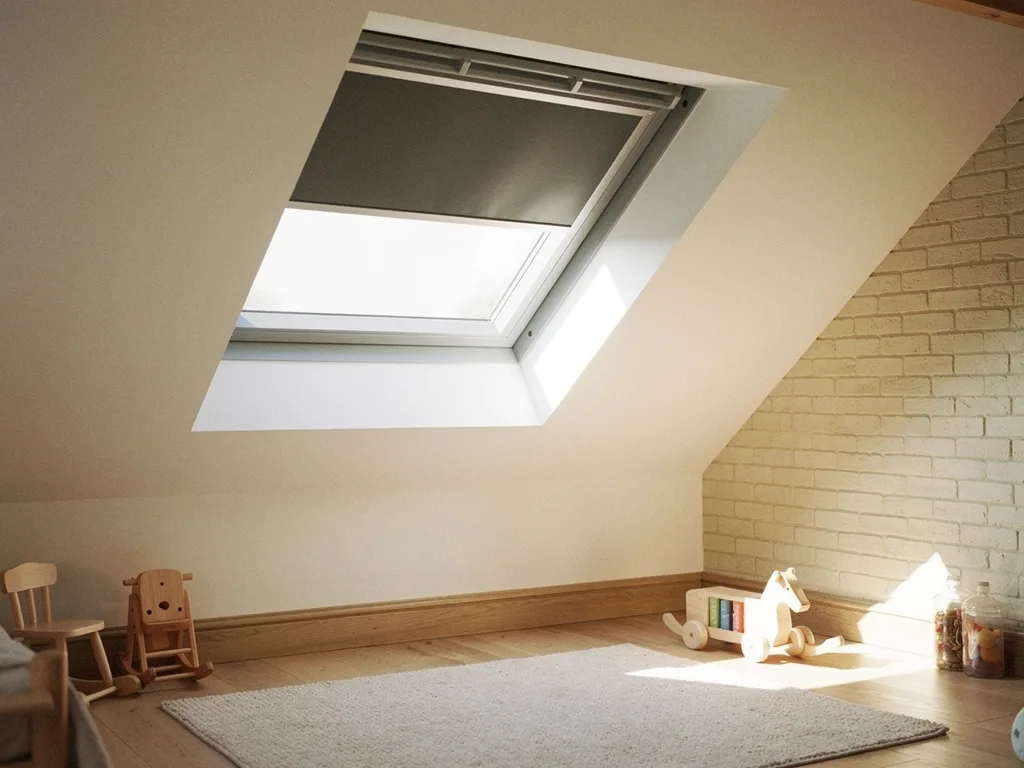
Centre pivot windows: turn the sash and set the bolt
The standard white or pine VELUX (type codes GGL and GGU) is built to be cleaned from inside: the sash rotates right round on its side hinges until the outside of the glass is facing you.
Start with the blind fully raised or pushed to the top of its rails, because a blind fitted to the sash travels with it. Take the handle bar along the top of the sash and pull it down and towards you. The sash tilts on its pivots and, past the normal opening angle, keeps going. Guide it with both hands as the top edge comes down into the room and the bottom edge rises outside, until the pane has turned almost completely over and the outer glass sits facing you at a comfortable height.
At that point look for the barrel bolt, a small sliding catch on the side of the sash near its lower corner. Slide it into its keeper on the frame and the sash is locked in the cleaning position. It will not swing back while you wipe, even if the wind catches the open gap. When you have finished, release the bolt, turn the sash back the way it came and close it with the handle until it latches.
The same movement applies to older centre pivot windows from before 2001 and the 2001 to 2013 generation, although the bolt and the handle shape differ slightly. If you are not sure which window you have, the data plate on the frame will tell you, and our guide to identifying your VELUX window generation shows what each one looks like.
Top hung and dual function windows
A top hung VELUX (GPL and GPU) opens outwards from hinges at its head for everyday use, and it has a second pivot movement kept only for cleaning.
These windows are handled from the bottom of the sash, which is why they sit higher in the slope and give a better view out. For normal ventilation the whole sash lifts outwards like a hatch and stays open at any point up to its full angle. That position is no use for cleaning, because the outer glass faces away from you and over the roof.
To clean it, the window changes mode. With the sash closed, operate the pivot release on the side of the frame (the label on the sash shows exactly where it sits on your model), then turn the sash on its centre pivots in the same way as a GGL. Once it has rotated, secure it with the barrel bolt. When it goes back, close it fully first so the top hung hinges engage again before you open it normally. Forcing a top hung sash to pivot without the release can strain the hinges, so if it will not move freely, stop and check the label rather than pushing harder.
Whether a top hung or centre pivot window suits a room better, including how easy each is to clean, is covered in VELUX window ranges compared.
Electric and solar INTEGRA windows
An INTEGRA window is a centre pivot window with a chain motor in its top frame, and the sash cannot rotate while the chain is attached.
Use the remote or wall switch to open the window a short way, then leave the control alone. On the underside of the sash, where the chain meets it, there is a bracket that releases the chain. Disconnect it as described on the window label, and the sash becomes free to turn by hand. From there it is exactly the manual routine: rotate it, bolt it, clean it, unbolt it and turn it back. Reconnect the chain to the bracket before using the remote again, or the motor will run without moving the window.
Two points catch people out. The rain sensor on an INTEGRA will try to close the window if it detects rain, so disconnect the chain before a shower arrives, not during one. And a window high in a vaulted ceiling that was made electric because it is out of reach will be just as out of reach for cleaning; a telescopic cleaning pole from inside, or easy clean outer glass, is the realistic answer there. Our guide to VELUX INTEGRA electric and solar windows covers the controls in more depth, and converting a manual window to electric explains what changes when a motor is added later.
Windows that do not turn over
Not every VELUX product rotates, and on those the outside is cleaned from the roof, a balcony or a ladder, or left to the rain and a self cleaning coating.
| Window | Everyday opening | Outer glass cleaned |
|---|---|---|
| Centre pivot (GGL, GGU) | Pivots from top handle | From inside, sash rotated and bolted |
| Top hung (GPL, GPU) | Lifts out from bottom handle | From inside, after pivot release |
| INTEGRA electric or solar | Motor and chain | From inside, chain unhooked first |
| CABRIO balcony | Top sash and balcony panel | Partly from the open balcony |
| Flat roof window | Tilts or fixed | From the roof, or rain on the curved top |
A CABRIO balcony window is the exception that helps you: once the lower section is out as a balcony, you can stand in the opening and reach much of the glass. A VELUX flat roof window has its outer surface on top of the roof, well above the ceiling; the curved glass top is shaped to let rain wash most dirt away, and the flat glass version relies on its coating and a fall across the pane.
Before you turn the sash
A few minutes of preparation makes cleaning safer and stops the window, the blind and the room from getting soaked.
- Pick a still, dry day. A rotated sash on a windy afternoon can catch gusts through the opening.
- Raise the blind fully and check nothing on the windowsill or bed below will be hit as the sash turns.
- Lay a towel on the lining, since water from the outer pane runs straight inside once the glass is facing the room.
- Use a soft cloth, a squeegee and plain water with a little washing up liquid. Avoid abrasive pads and ammonia based cleaners, which can mark coatings and seals.
- Keep children away from the rotated sash and never lean out through the gap to reach the roof.
Larger sizes, such as the tall MK08 or wide UK08, carry a heavy double or triple glazed unit, so support the sash all the way round rather than letting it drop onto the bolt. Sizes and codes are explained in VELUX window sizes and codes.
If a sash no longer turns fully, the bolt will not hold it, or the frame feels loose as you rotate it, the window has usually worn past its best. At that stage it is worth reading what changes when an old VELUX is replaced, because a current window restores the full cleaning rotation and adds better glass for the slope it faces. When you are ready, book a light survey and we will look at the window, the room and the light together.
Questions people also ask
Why will my VELUX not rotate past the normal open position?
On a top hung window, the pivot release has not been operated. On an INTEGRA window, the chain is still attached to the sash. On a manual centre pivot window, a blind, a curtain or something on the sill may be catching the sash, or on a very old unit the hinges may have worn stiff. Check each in turn before applying force, and look at the label on the sash for the steps on your model.
Where is the barrel bolt on a VELUX window?
It is a small sliding bolt on the side of the sash, near the lower corner when the window is closed. Once the sash has turned over for cleaning, it lines up with a keeper in the frame. Sliding it across holds the sash so you have both hands free. Release it before turning the sash back.
Can I clean a VELUX window with the blind still attached?
Yes, as long as the blind is fully raised. Most VELUX blinds run in side rails on the sash and turn with it, so a blind left halfway down will flap and get wet. See the VELUX blinds guide for the different blind types and how each is fixed.
Does a new VELUX window make cleaning easier?
Current windows turn smoothly on their pivots and can be ordered with an easy clean coating on the outer pane, which helps rain carry dirt away. On our VELUX window installation work we position each new window so its handle and the rotated sash are within comfortable reach, and we note that in the written light plan.
