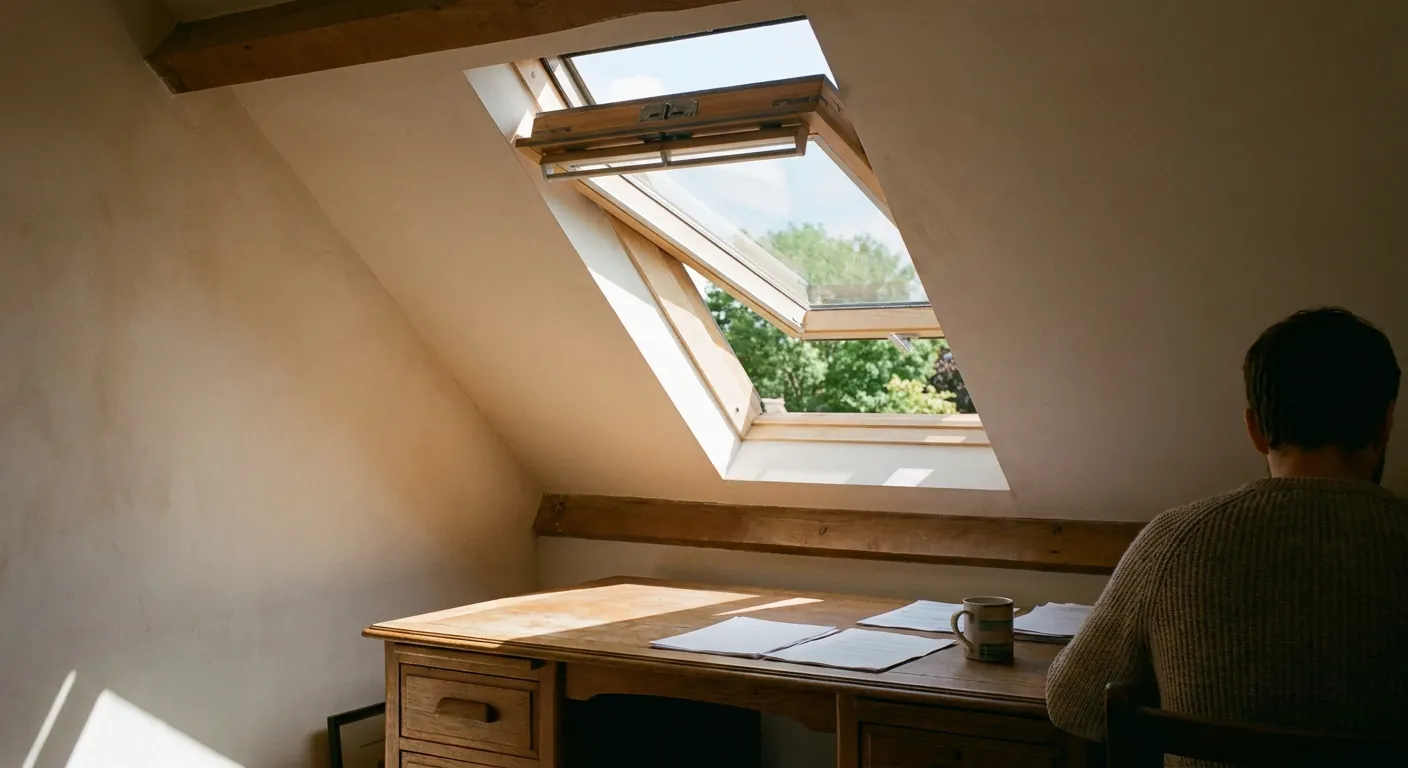
What the ventilation flap is and where to find it
The flap is the VELUX answer to a trickle vent: a narrow, adjustable slot built into the top of the sash, so a closed window still lets the room breathe.
On a centre-pivot window, the kind with the handle bar running across the top of the sash, the same bar works the flap. Pull it gently towards you and the flap opens without the sash moving; push it back and it closes. Keep pulling past that point and you open the window itself. On a top-hung window, which opens from a handle at the bottom, there is still a flap and a control on the top rail, so you can have background air without swinging the whole sash outwards. Either way, the air comes in through a grille and a thin filter at the head of the frame, well above head height on a typical loft slope.
Because the vent sits in the sash rather than the frame, nothing extra shows on the roof, and the look from the street stays the same as a window without one. That matters in parts of Cambridge where the roofscape is watched closely, and it is one reason the flap has stayed part of the standard design across the range described in our VELUX window ranges compared guide.
Fixed windows are different. A unit that does not open, such as a fixed glazed panel or some elements in a combination, may have no flap at all, so check the type code on the data plate before assuming every pane in a run of windows is ventilated.
How the flap counts towards Part F
Approved Document F treats a roof window flap the same way as a trickle vent in a wall: what matters is its equivalent area, the effective size of the opening once the grille and filter are allowed for.
Part F sets out three kinds of ventilation for a home. Background ventilation is the small, continuous flow that dilutes moisture and stale air while you sleep or while the house is locked up. Purge ventilation is a large opening you use now and then, to clear smoke from burnt toast or the heat of a summer afternoon. Extract ventilation is the fan in a kitchen, bathroom or utility room. The VELUX flap covers the first; the opening sash covers the second; neither covers the third.
| Need | What provides it | VELUX part |
|---|---|---|
| Background | Small, always-open vent | Ventilation flap |
| Purge | Large opening, used briefly | Opening sash |
| Extract | Fan in wet rooms | None; a separate fan |
The equivalent area each room needs depends on the room, the size of the home and whether it has continuous mechanical extract, so it is worked out for the job rather than read off a single figure. The flap's own equivalent area varies by window size and is published by VELUX for each size code. On a new loft room, the flaps in the roof windows are often part of how the background ventilation is met, with the sash opening sized to give enough purge ventilation for the floor area. Building Control checks the arrangement where the work is notifiable, and we handle that notification as part of the installation.
Replacing an older VELUX: keep the ventilation you had
When a roof window is replaced, the 2021 edition of Approved Document F expects the room to end up with at least as much background ventilation as before, and in many cases more.
That rarely causes a problem with a like-for-like VELUX swap, because the old window almost certainly had a flap and the new one will too. The points worth checking are the filter, which on a window that has been in the roof for twenty years may be clogged or missing, and whether the room around it has changed. A loft that was a store room when the window went in, and is now a bedroom with new insulation and a carpet, is a much tighter space than it was, and a room that has been sealed up needs its background air more, not less. Our guide to replacing an old VELUX window covers what else changes in a swap, and identifying your VELUX window generation helps you work out what you have now.
New, tighter windows can also shift where condensation forms. If the old window let air in through tired seals, and the new one does not, the moisture that used to escape now has to leave through the flap and any extract fan. Leaving the flap open in a bedroom overnight is the simple habit that keeps the glass and the lining dry, and a well-fitted insulation collar and vapour barrier stops the frame itself becoming a cold spot.
Where the flap is not enough on its own
Background ventilation keeps a room healthy day to day, but a shower room, a hot south slope or a flat roof each asks for more than a flap can give.
A bathroom or en suite needs mechanical extract under Part F whatever windows it has. A VELUX over a shower still helps, with the flap open between uses and the sash open after a long shower, but it is no substitute for the fan. Our answer on fitting a VELUX window over a shower goes into the glass and the moisture in more detail.
Heat is the other limit. Warm air rises and collects at the top of a loft room, right where the windows are. On a south or west slope over a Romsey terrace or a new house at Eddington, a July afternoon can load the room with more heat than a flap will ever shift. Opening the sash, and ideally a second window lower down or on the other slope, is what moves that air out. An external awning blind stops much of the heat before it reaches the glass, which is why the light plan we write for each quote pairs the glass and shading with the slope. How we plan the light explains that reasoning.
If you would rather not think about it, the VELUX ACTIVE indoor climate control system reads temperature, humidity and CO2 and opens electric windows for you. On flat roofs the story changes again: the VELUX flat roof windows range ventilates by opening the unit, so it is worth checking how each version provides background air before you choose one.
Questions people also ask
Is the VELUX ventilation flap the same as a trickle vent?
It does the same job in a different place. A trickle vent is usually a slotted strip in the head of a wall window frame; the VELUX flap is built into the top of the roof window sash. Both provide background ventilation, and both are judged under Part F by their equivalent area.
Should I leave the flap open all the time?
In most rooms, yes, and particularly in bedrooms, loft rooms and anywhere prone to condensation. The flow is small enough that the room does not feel draughty, and the filter keeps out insects. Close it on a bitterly cold, windy night if you need to, then open it again in the morning.
How do I clean the VELUX ventilation filter?
Open the sash and the filter can be unclipped from the top rail, rinsed in warm water, dried and pushed back. A filter that is black with dust restricts the air the flap was designed to let through, so clean it at least once a year, and renew it if it has perished.
Do I need Building Regulations approval to replace a VELUX?
Replacing a roof window is normally notifiable, and the new window has to meet current ventilation and energy rules. We notify Building Control where the work requires it. See our VELUX window installation page for how we approach the job, or book a light survey to talk through your room.
