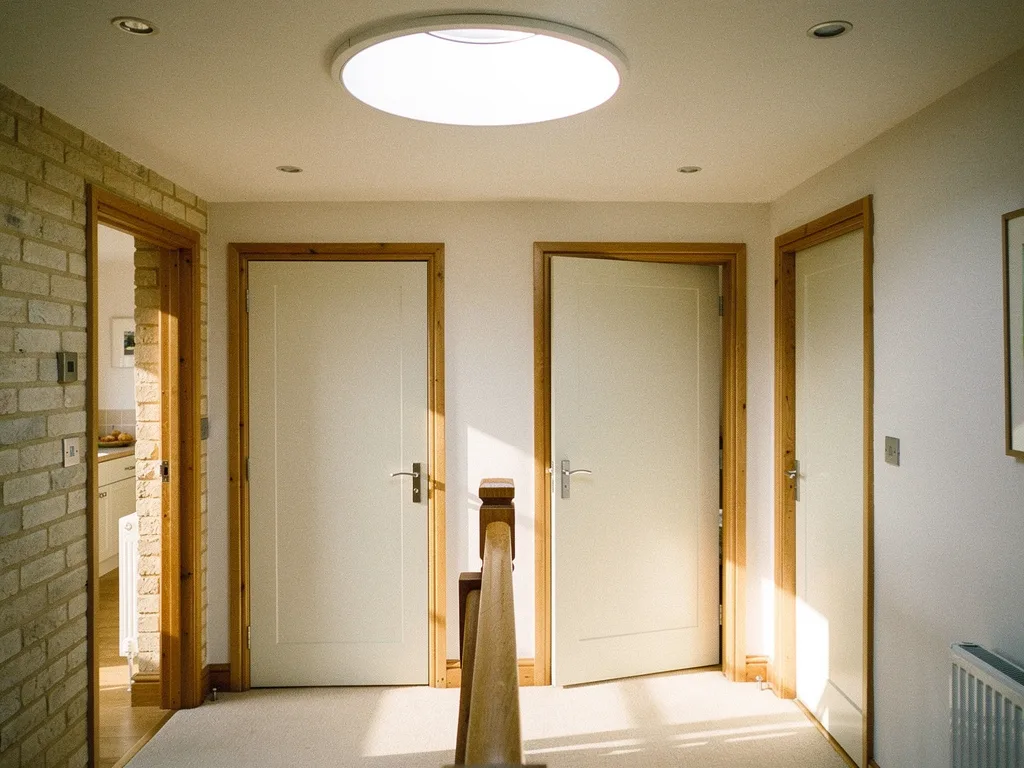
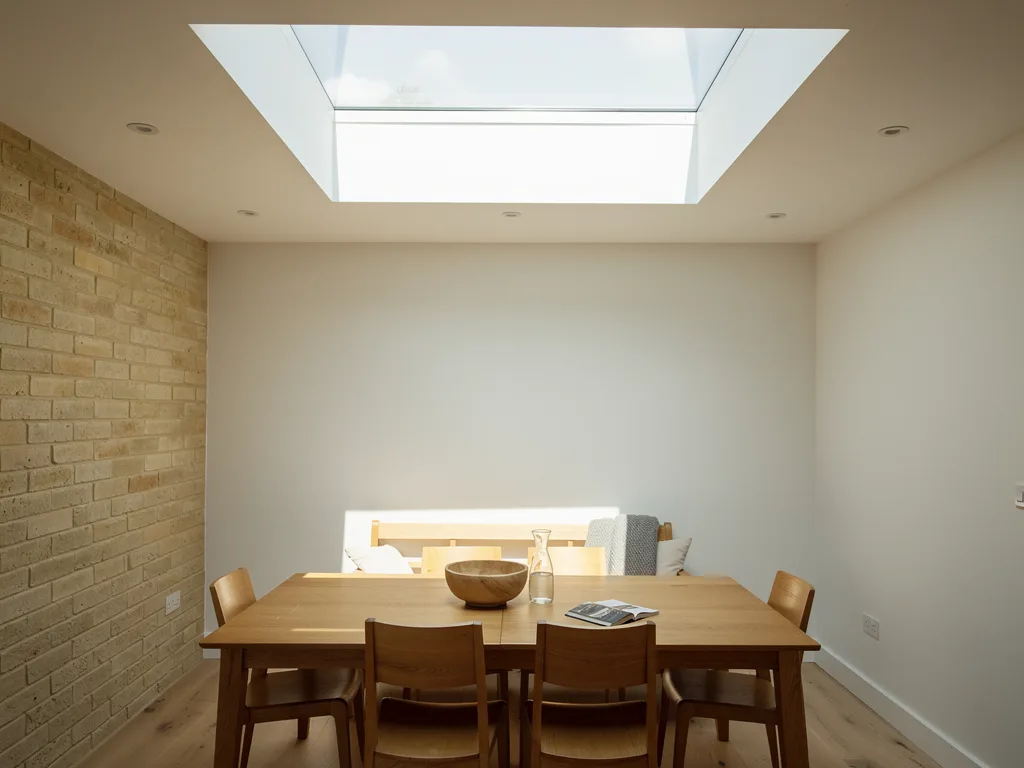
Two different ways of getting daylight through a roof
A skylight puts a pane of glass in the roof directly over the room; a sun tunnel collects light at the roof and carries it down a mirrored tube to a room that may be several metres below. That one difference explains almost everything else on this page.
A skylight, or rooflight as the trade calls it, is a window in the roof plane. On a pitched roof it is usually a roof window set between the rafters, with a lined reveal down to the ceiling. On a flat roof it is a glazed unit sitting on an upstand, with a short lined well if there is a void between the deck and the ceiling. Either way, you look up through it and see sky, and the daylight arrives in the room more or less as it fell on the glass.
A sun tunnel works on a different principle. A clear dome on the roof gathers light, a tube lined with a highly reflective surface bounces that light down through the loft, and a diffuser in the ceiling spreads it out into the room. From below, you see a round or square panel that glows. You do not see sky, cloud or sun. Our guide to how sun tunnels work follows the light through each of those three parts.
So the two products are not really rivals for the same job. A skylight suits a room that sits directly under the roof, or has only a shallow void above it. A sun tunnel suits a room with a loft, a pitched roof space or even another storey between it and the sky, where a lined light well for a rooflight would be deep, awkward or impossible. Where both are physically possible, the choice comes down to how much light you want, what kind of light, how you feel about heat, and whether a view of the sky matters to you. The rest of this guide takes those in turn and ends with a room-by-room view.
How much light, and what kind
A skylight generally delivers a great deal more light than a sun tunnel, and it delivers it as directional daylight with a moving sun patch; a sun tunnel gives a smaller amount of soft, even light from one glowing point.
The simplest way to see the difference is to compare the size of the openings. A 350mm tube, a common size for a hall or landing, has a circular opening of a little under a tenth of a square metre. A medium roof window of the size often fitted in loft rooms has a glazed area several times larger than that, and a flat rooflight over a kitchen extension can be larger again. The tube also loses some light on its way down, more with every extra metre and every bend, as our guide to sun tunnel length and bends explains. Glass area for glass area, a sun tunnel cannot compete on quantity.
What it offers instead is a different quality of light. The diffuser scatters what reaches it, so the room gets an even wash with soft edges, much like a good ceiling light, only daylight coloured. There is no hard sun patch sliding across the floor, no bright rectangle on the wall, and very little glare. In a narrow hall or on a landing that is often exactly what you want: enough daylight to walk through without switching a lamp on, and nothing to squint at.
A skylight gives you the whole range. On a bright day, direct sun falls through the glass in a shape you can see on the floor or wall, and it moves as the day goes on. That is lively and pleasant in a kitchen or loft room, and it is the thing people describe when they say a room feels alive. It is also the thing that causes glare on a screen or a TV wall, which is why position and glass matter so much with a rooflight. Makers publish light-output claims for their tubes by diameter, but these depend on test conditions, roof slope and tube length, so treat them as a guide to comparing one tube with another rather than a promise for your room. Our answer on how much light a sun tunnel gives goes into that in more detail.
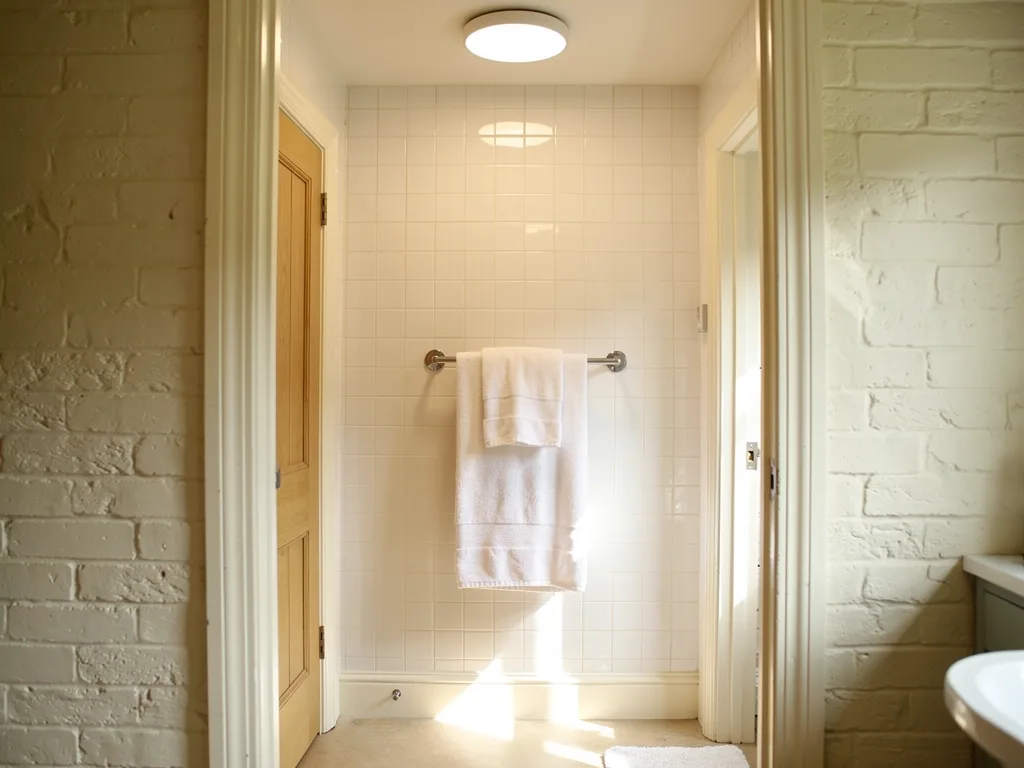
The Cambridge sun, winter and summer
At Cambridge's latitude the noon sun stands only about 14 degrees above the horizon in late December and about 61 degrees in late June, and the two products respond to that swing in quite different ways.
- Winter solstice, about 14°. The lowest noon sun of the year travels furthest: it crosses the whole room and lands high on the back wall.
- Spring and autumn equinox, about 38°. The light lands on the floor, deep in the room.
- Summer solstice, about 61°. The highest, strongest sun drops steeply and lands close under the window.
- South-facing roof window. The same opening lets in a different patch of light every month.
- Deepest reach. In December the sun patch can be on the wall opposite, which is why we plan where it falls, not just how big the glass is.
A 14 degree sun is very low. It skims across the roofs, and on a flat roof its light strikes the glass at a shallow angle, so much of it reflects away rather than passing through. A flat skylight in midwinter therefore relies mostly on light from the sky itself rather than direct sun. A roof window on a south-facing slope does better, because the slope tilts the glass towards that low sun. Either way, winter is the season when you are grateful for any light at all, and a rooflight on a well-chosen slope gives a good deal of it.
A sun tunnel dome faces the same low winter sun. The domes are shaped to catch light from low angles, and some makers add prisms or collectors inside the dome for this purpose, though the benefit varies by product and is hard to judge from a brochure. The honest expectation is that a tube gives a gentle glow on a dull December afternoon and is noticeably brighter from late spring onwards. On an overcast day the tube still carries diffuse sky light, just less of it.
In June, with the sun at about 61 degrees, the picture flips. Light pours almost straight down the tube, so a sun tunnel is at its best in summer, and it brings that light in without much heat. A rooflight at the same moment is also at its brightest, but a south slope under a high summer sun can put a lot of heat and a strong sun patch into the room below. That is manageable with the right glass and a blind, but it has to be planned. Our page on how we plan the light shows how we read the slope, the sun path and the room together before choosing either.
Heat in summer, warmth in winter
Because its opening is small and its throat is narrow, a sun tunnel lets in far less summer heat than a skylight and loses less warmth in winter; a skylight can match that comfort, but only through its glass and its shading.
Solar heat comes in through glass roughly in proportion to the area of glass facing the sun. A tube with a tenth of a square metre of opening simply cannot admit the same heat as a rooflight several times larger. On a hot July afternoon a landing lit by a sun tunnel stays close to the temperature of the rest of the house, while a loft room under an unshaded south-facing roof window can warm up by the late afternoon. For more on this, see our answer on whether sun tunnels let heat in.
The same logic applies in reverse in winter. Any roof glazing loses more heat than the insulated roof around it, and a larger opening loses more. A sun tunnel adds a small cold path through the loft; the important detail is insulating around the tube where it passes through the loft space, so warm room air cannot meet a cold tube and form condensation. A rooflight has to meet the thermal limits in the Building Regulations for new and replacement units, and good modern glazing is far better than the single-glazed or early double-glazed units still found on some Cambridge extensions.
For a skylight, heat is controlled at three points: the glass (solar control coatings with a lower g-value cut the heat that passes through), the shading (external blinds stop heat before it reaches the glass, internal blinds are less effective against heat but good for glare), and ventilation (an opening unit lets warm air escape at the highest point of the room). A sun tunnel needs none of this to stay comfortable, which is part of its appeal in rooms nobody wants to think about.
Views, fresh air and the feel of the room
A skylight gives you sky, cloud, rain on the glass and, if it opens, fresh air; a sun tunnel gives you light and nothing else unless you add a ventilation kit.
This is the difference people underestimate. Sitting under a roof window you see weather changing, birds crossing and the colour of the evening sky. That contact with outside is a large part of why a loft bedroom or kitchen extension with a rooflight feels better to be in, not just brighter. A sun tunnel diffuser tells you only roughly how bright it is outside. On a sunny day it glows more strongly, and when a cloud crosses it dims slightly, but there is no view.
Fresh air is the second difference. An opening roof window or an electric flat rooflight lets hot, stale or damp air out at ceiling level, which is exactly where it collects. A standard sun tunnel is sealed. Some makers offer combined light and ventilation units for bathrooms, which pull air out through an extract fan built into the diffuser ring, and some offer LED rings so the same ceiling panel gives light after dark. Those are useful extras, but they are separate from the core choice. An LED kit is worth planning at the start if the space is used after dark.
Finally there is the look of the ceiling. A rooflight on a pitched roof comes with a lined, plastered reveal that becomes a feature of the room, and in a loft conversion it sits naturally in the sloped ceiling. A sun tunnel leaves a flat ceiling with a neat round or square diffuser, which some people like precisely because it looks like a light fitting rather than a window. In a hall with a low flat ceiling, that tidy look is often the right one.
What drives the cost of each
A sun tunnel is usually a smaller job than a new rooflight with a lined reveal, but for either product the house and the roof set the price more than the product does.
For a sun tunnel, the cost follows the roof covering (plain clay tiles, concrete interlocking tiles, slate or a flat roof each need different flashings), the length of the run through the loft, the number of bends, the diameter, and any extras such as a dimmer, an LED kit or a ventilation unit. Access into the loft and onto the roof matters too: a bungalow with a low eave and a clear loft is a very different job from a three-storey townhouse where the tube passes through a storey before reaching the ceiling.
For a skylight, the main drivers are the structural opening (trimming rafters or joists, and whether an engineer is needed), the size and type of unit, the glass specification, whether it opens, the internal lining and plastering, and blinds. Building Control is generally involved with a new rooflight, and that brings its own process. A like-for-like swap of an old roof window is often simpler than cutting a new opening.
We do not publish a price list, because two similar-looking jobs can differ a lot once the roof and loft are seen. Our page on skylight and rooflight costs sets out general UK market ranges and explains what a survey adds. Every quote we give comes with a written light plan, so you can see what you are paying for in the room, not just on the roof.
Which rooms suit which
Match the product to the room: a sun tunnel for dark spaces with a loft or storey above them, a skylight for rooms under the roof where light, air and a view all count.
| Room | Better fit | Why |
|---|---|---|
| Hall, landing, stairs | Sun tunnel | Loft above, soft light |
| Internal bathroom | Sun tunnel | No window, vent kit |
| Walk-in wardrobe | Sun tunnel | Small, no glare wanted |
| Loft bedroom | Skylight | Under the slope, air |
| Kitchen extension | Skylight | Needs real light |
| Deep bungalow room | Either | Depends on loft depth |
Halls and landings are the classic sun tunnel room. In a Victorian terrace in Romsey or off Mill Road, the stair often runs up the party wall with no window at all, and the landing at the top sits under the loft. A tube dropped through the loft lights the head of the stair and takes the gloom out of the middle of the house. The guide to sun tunnels for halls and landings goes into positioning over stairs.
Kitchens are usually rooflight territory. A single-storey rear extension with a flat roof is already directly under the sky, and a flat rooflight or lantern over the working area gives far more light than a tube could, along with the lift in feeling that people extend for in the first place. A sun tunnel can still help in a kitchen, for example in a corner of the original house away from the extension glass, but it is rarely the main light source.
Loft rooms and top-floor bedrooms under a pitched roof are natural roof window rooms. The glass sits in the slope, there is no light well to speak of, and an opening sash gives the ventilation a bedroom needs. A sun tunnel in a loft room makes little sense unless the room has a flat ceiling with a void above it.
Bungalows are where the choice is most finely balanced. The central rooms in a bungalow (the inner hall, the bathroom, sometimes a dining area) have a loft directly above and are often dark. A short tube does well here. If the room has a vaulted ceiling or could have one, a rooflight becomes possible and gives much more light. Our guide to sun tunnels for bungalows walks through a typical plan.
Planning and Building Control for each
On an ordinary house outside a conservation area, both usually fall under permitted development if they sit low on the roof, but the Building Regulations position differs, and conservation areas and listed buildings change the picture.
For a house (not a flat or maisonette), a rooflight or sun tunnel dome is generally allowed without planning permission if it projects no more than 150mm beyond the roof plane and does not rise above the highest part of the roof. Sun tunnel domes can stand proud of a pitched roof, so the height of the specific product matters, and low-profile domes exist for this reason. In a conservation area, permitted development still applies unless an Article 4 direction removes it, but a dome on a front slope facing the street may attract attention where a flush conservation rooflight on a rear slope would not. Listed buildings always need listed building consent for either. For the details, see our answer on whether sun tunnels need planning permission, and check the constraints on your address through Greater Cambridge Shared Planning or your district council.
Building Control is a separate question. A new rooflight generally needs Building Regulations approval, because it changes the roof structure and the thermal envelope, and fire rules near boundaries and safety rules for overhead glazing apply. A sun tunnel is a smaller alteration, and whether it is notifiable can depend on whether structural timbers are cut and on local interpretation. Our answer on whether sun tunnels need building regulations sets out when it applies. Where the work is notifiable, we handle the Building Control notification as part of the installation.
Questions people ask
Is a sun tunnel cheaper than a skylight?
Usually, because it is a smaller opening with no lined reveal to build and plaster, though a long run through a tall house can narrow the gap. The roof covering and access set the real figure, which is why a survey comes before any price.
Can I have both in the same house?
Yes, and it is often the best answer. A roof window in the loft bedroom and a sun tunnel over the landing below it is a common and sensible pairing, each doing the job it suits.
Will a sun tunnel make a room as bright as a skylight?
Not for the same room. A tube gives soft, useful daylight to a small space, while a rooflight gives much more light and a moving sun patch. Our answer on whether sun tunnels are worth it looks at where the lower level is enough.
Which is better on a north-facing roof?
A north slope gives steady, cool, glare-free sky light to either product. A rooflight on a north slope gives more of it because of the larger glass; a tube on a north slope works but is dimmer, so its position and diameter need more care. At a light survey we look at which slopes the room can reach and recommend the one that lands the light where you use it, then set it out in the written light plan. You can start with the sun tunnel installation overview or message us on WhatsApp.