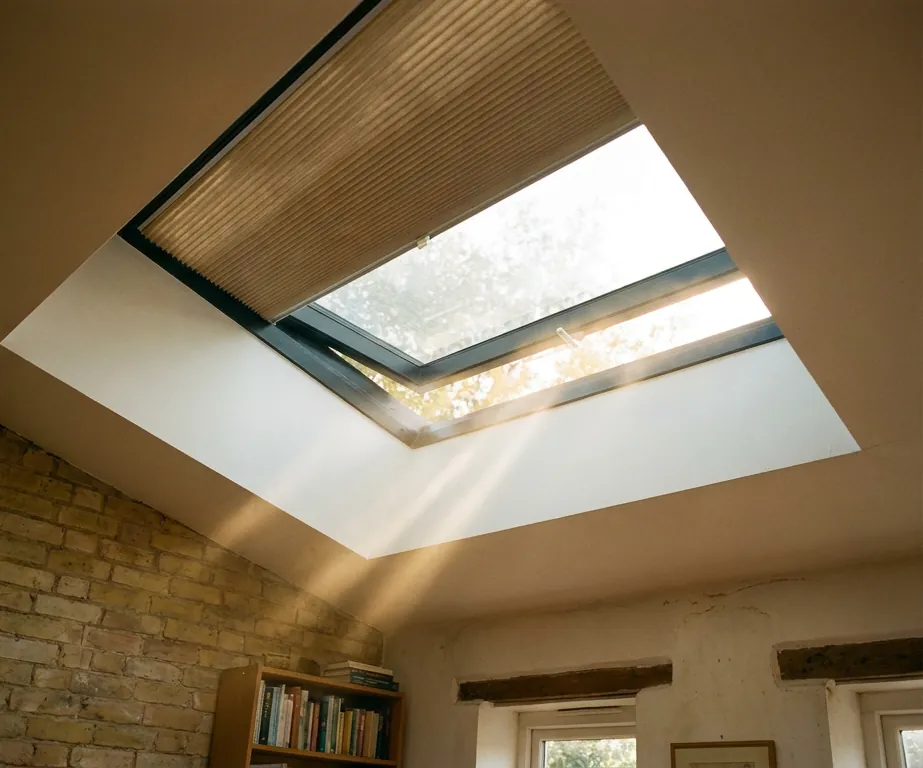
What the water on the glass actually is
Rooflight condensation is water vapour from the room turning back into liquid on a surface that is colder than the air's dew point. The glass is not letting water in; the room is putting water onto the glass.
Every room holds some moisture as invisible vapour. Warm air can carry more of it than cool air, so when room air touches a cold surface and cools, it reaches a temperature at which it can no longer hold all of its vapour. That temperature is the dew point. Below it, droplets form. A skylight is simply the coldest large surface in many rooms, which is why skylight condensation shows up there before it shows up anywhere else.
Two numbers decide whether you get droplets: how damp the air is, and how cold the inner face of the glass and frame gets. You can work on either. Drier air lowers the dew point; better glass, frames and edges raise the surface temperature. The most reliable results come from doing a little of both, because a room will always have days of cooking, bathing, drying washing and sleeping that push the humidity up for a few hours.
It helps to separate three things that people call condensation. Droplets on the room side of the glass are true condensation, and this guide is about them. Mist trapped between the panes of a sealed unit is a different problem: the edge seal has failed, moist air has got into the cavity, and no amount of ventilation in the room will clear it. Water appearing at the kerb or lining after rain, with none on the glass, points to the weathering of the roof around the unit rather than to the room air. Knowing which one you are looking at saves a lot of wasted effort.
Why overhead glass gets wet before the windows do
A rooflight faces the open sky, and on a clear night it loses heat upwards far faster than a wall window loses heat sideways. Its outer pane can drop below the air temperature outside, and the inner pane follows it down.
Glass radiates heat to whatever it can see. A wall window sees the houses opposite, trees and the ground, all of which radiate some warmth back. A horizontal or shallow-pitched rooflight sees a clear night sky, which on a still winter night behaves like a very cold surface. The outer face can frost when the air is a degree or two above freezing. This is also why rooflight U-values are now assessed with the glass in the horizontal plane: the same unit performs worse lying flat than standing upright, and the old vertical figures flattered it. Our guide to rooflight U-values explains how that assessment works.
The room side makes it worse. Warm, moist air rises, so the air sitting against a ceiling rooflight is the warmest and often the dampest air in the room. Steam from a hob or a shower heads straight for it. In a loft bedroom, the air at the top of the slope is where a night of breathing ends up.
Then there is the shaft. A flat rooflight sits on an upstand, often with a lined well of 300mm or more between the ceiling and the glass. Air in that well moves slowly and cools as it touches the cold glass and lining, so it can sit near its dew point for hours. The deeper and narrower the well, the more still the air, and the more likely the droplets.
- Outer toughened pane: heat-strengthened to take hail, foot traffic during maintenance and thermal stress.
- Solar-control coating (optional) on the inside face of the outer pane, cutting heat gain on south and west roofs.
- Argon-filled cavity: a denser gas than air, so less heat crosses the gap.
- Warm-edge spacer: a low-conductivity edge that keeps the units’ edges warmer and cuts condensation at the frame.
- Low-E coating: a microscopically thin metal layer on a cavity face that reflects room heat back inside.
- Inner laminated pane: two sheets bonded to an interlayer, so if it ever breaks, the glass stays in place overhead.
- Triple glazing only: a third pane and a second argon cavity, usually with a second low-E coating. Warmer, heavier, and it lets in slightly less light.

Reading where the droplets form
The place condensation appears tells you what is cold, and so what would change it. Look at the pattern on a cold morning before you open anything or switch on the heating.
A fine, even film across the whole centre of the pane means the glass itself is cold relative to the room's humidity. That is typical of single glazing, older double glazing without a low-E coating, and polycarbonate domes. A clean centre with a band of droplets 20mm to 60mm wide around the edge is a cold edge: an aluminium spacer bar between the panes conducting heat out. Beads running along the frame members point to a frame without a thermal break. Damp on the plaster or timber lining of the well, often with dark mould spots in the corners, points to an uninsulated upstand or lining rather than to the glass.
| Where it forms | What is cold | What changes it |
|---|---|---|
| Whole centre pane | The glass | Low-E sealed unit, better U-value |
| Band round the edge | Spacer bar | Warm edge spacer |
| Frame members | Aluminium frame | Thermally broken frame |
| Kerb or lining | Upstand or reveal | Insulated kerb and lining |
| Between panes | Failed seal | Replace the unit |
Two quick checks help. Wipe the glass dry and touch the frame and the lining with the back of your hand: whichever feels coldest is where the water will return first. And notice the time. Droplets that appear only after a shower or a big cook and clear within an hour are a ventilation question. Droplets that are there every cold morning, even in a room nobody used overnight, are a surface temperature question.
Surface temperature and the glass you choose
The job of the glazing, as far as condensation goes, is to keep the inner pane close to room temperature on the coldest nights. Each step up in specification raises that inner surface temperature by a useful margin.
The figures below are rough, for a still night with about 0°C outside and 20°C inside, and real units vary with the coating, gas fill and pitch. They show the general pattern well enough to reason with.
- Single glass or wired glass: the inner face can sit around 5°C or lower, so it runs wet on almost any winter night.
- Older double glazing, no coating, air filled: the inner face might reach 10°C to 12°C.
- Modern double glazing with a low-E coating and argon: typically 15°C or so in the centre of the pane.
- Triple glazing with two coatings: around 17°C, sometimes a little higher.
Now compare those with the dew point of the room air. At 20°C, air at 50% relative humidity has a dew point of about 9°C. At 60% it is about 12°C, and at 70%, which a kitchen or a steamy bathroom reaches easily, it is about 14.5°C. Put the two lists side by side and the logic is plain. Single glass condenses almost all the time. Older double glazing condenses whenever the room is a bit damp. A good low-E double unit stays dry through ordinary living and only fogs in the wettest moments. Triple glazing gives a few more degrees of headroom, which matters most over a kitchen, a bathroom or a north-facing bedroom.
The coating does more of this work than people expect. A low-E coating on the cavity face of the inner pane reflects heat back into the room, which keeps that pane warmer. Argon, being a poorer conductor than air, slows the heat crossing the cavity. Our guide to low-E coatings and argon fill covers how both are built into a sealed unit, and double vs triple glazed rooflights weighs the extra pane against its weight and light loss.
Frames, spacers and the cold edge
A good pane with a cold rim still condenses at the rim. The edge of a rooflight is where the frame, the spacer and the kerb meet, and it is almost always the coldest part of the whole assembly.
Aluminium conducts heat very well, which is why an aluminium frame without a thermal break can feel icy on a winter evening and collect a line of droplets along every bar. A thermally broken frame splits the profile into an inner and outer section joined by a low-conductivity polyamide or resin strip, so the inner section stays near room temperature. The effect on condensation along the frame is usually the most visible single change when an old unit is replaced. Our guide to thermally broken rooflight frames explains how the break is built in.
Inside the sealed unit, the spacer bar holds the panes apart around the perimeter. A traditional aluminium spacer is a cold bridge running right round the glass, which is what gives that tell-tale band of mist at the edge. A warm edge spacer, made from stainless steel, composite or structural foam, keeps the edge of the glass several degrees warmer. It is a small component that makes a large visible difference, and it is worth asking for by name. See what is a warm edge spacer in a rooflight? for the detail.
Below the frame sits the kerb or upstand. A timber kerb with no insulation, or a builder's upstand of blockwork, draws cold down into the reveal. On a flat roof the kerb should be insulated and wrapped so that the roof insulation, the kerb insulation and the frame line up without a gap. On a pitched roof window, the insulation collar and the lining have the same job. When those lines do not meet, the lining and the corners of the reveal become the cold spots, and mould follows.
Getting the moisture out of the room
Better glass raises the surface temperature, but it cannot make a steamy room dry. The moisture has to leave the house, and the rooflight can help or hinder that.
Start with the rooms that make the most water. Approved Document F sets intermittent extract rates for existing homes: 30 litres per second from a cooker hood, or 60 litres per second from a kitchen fan elsewhere in the room, and 15 litres per second from a bathroom fan. A kitchen with a lantern or a flat skylight overhead and a recirculating hood is sending all of its cooking steam straight up to the glass. A ducted hood that actually runs while you cook does more for the rooflight than any upgrade to the glass. Drying washing indoors in winter adds several litres of water a day to the air; a room with a rooflight is the worst place to do it.
Then look at the rooflight itself. An opening unit lets the warmest, dampest air escape from the highest point of the room, which is exactly where it collects. Ten or fifteen minutes on a vent setting after a shower clears the glass faster than a fan alone. Electric opening rooflights with a rain sensor can be left on a timed vent without worrying about a sudden shower. Most pitched roof windows have a ventilation flap in the top of the sash that lets a small, steady flow of air through while the window is closed; keeping it open over winter in a loft bedroom makes a real difference to morning condensation. A fixed flat rooflight has no such route, so the room below it needs its ventilation from somewhere else.
Newer homes deserve a mention. Houses built to recent standards are much more airtight than a Victorian terrace, so moisture does not leak away through gaps in the floors and windows. They rely on their mechanical ventilation or trickle vents to do that job, and a closed trickle vent or a switched-off heat recovery unit shows up quickly as droplets on the coldest glass in the house.
Cambridge nights, Cambridge houses
The local weather and housing both push towards condensation on roof glass. Flat land and big skies mean clear, still winter nights, and the house types each bring their own moisture pattern.
With almost no hills to shelter a roof, a Cambridge rooflight sees the whole night sky. On the clear, calm nights that follow a high-pressure spell in January or February, radiation cooling is at its strongest, and the ground mists that settle along the Cam and out towards the Fens show how close the air is to saturation. Those are the mornings when an older skylight will be streaming, even in a well-heated house.
In the gault brick terraces of Romsey, Petersfield and around Mill Road, the usual story is a side-return extension with a flat rooflight over a new kitchen, or a loft conversion with roof windows on the rear slope. The kitchen rooflight sits directly above the cooking; the loft room has a sloped ceiling that brings the glass close to the bed. Both are high-moisture positions. In the newer streets of Eddington, Trumpington Meadows and Great Kneighton, the homes are tighter and the rooms are often open plan, so a single rooflight can become the main cold surface for a large kitchen, dining and living space.
A new extension also has a first-winter effect. Plaster, screed and blockwork give off a great deal of water as they dry out over the first months. A rooflight in a new extension can run wet through its first winter and then settle down once the building has dried, so it is worth ventilating generously in that period before deciding the glass is at fault.
Orientation, blinds and where the light falls
The direction a slope faces changes how long condensation lingers, and the blind you fit can either help the glass stay dry or trap cold, damp air against it.
On an east-facing slope, the low morning sun reaches the glass early and warms it, so any overnight condensation clears within an hour or so of sunrise, and the room gets bright, fresh light at breakfast. A south slope clears a little later in winter but warms strongly by midday. A north-facing rooflight gets no direct winter sun at all, so its glass stays at its night-time temperature for longer and any droplets stay put. That same slope gives lovely even light for a study or a studio, so the answer is not to avoid it but to specify for it: better glass, a warm edge and good ventilation. Do north facing rooflights lose more heat? looks at that slope in more detail.
Blinds are the quiet cause of a lot of morning condensation. A blackout blind drawn tight across a roof window at night traps a layer of air between the blind and the glass. That air loses its heat to the glass and cannot mix with the warm room, so it reaches its dew point sooner. The result is a wet pane and sometimes a damp blind. Leaving a small gap, raising the blind slightly overnight in a humid room, or choosing a blind with a side channel that is designed for the unit all reduce this. The trade-off with summer heat is real too, and can internal blinds stop a rooflight overheating? sets out what an internal blind can and cannot do.
Replacing a unit that condenses every winter
If the glass is single, the frame is unbroken aluminium or the unit has misted between the panes, no amount of ventilation will fully solve it. Replacing the rooflight with a modern specification changes the surface temperatures at the root.
When we replace a rooflight with a condensation history, we look at the whole assembly and not just the glass. That means checking the kerb or collar, the insulation around it, the lining of the well, and the ventilation in the room below. A new unit on an uninsulated kerb will simply move the cold spot from the glass to the reveal. On older flat roofs in Cambridge terraces, the kerb is often the part that most needs renewing, and the replacement is a good moment to build up an insulated upstand at the right height above the finished roof.
The specification we look for over a damp-prone room is a low-E, argon-filled sealed unit with a warm edge spacer, in a thermally broken frame, on an insulated kerb, with an opening option wherever the room produces a lot of steam. Triple glazing earns its place over bathrooms, busy kitchens and north slopes. A replacement also has to meet current Building Regulations, including the Part L limit on heat loss, so an upgrade from an old single-glazed unit is a large step forward on warmth as well as condensation. Our guide to upgrading single-glazed rooflights covers that replacement in full, and the energy efficient rooflights page sets out how we specify glass and frames for each room and slope. Every quote comes with a written light plan, so you can see the glass, the frame and the position we recommend, and the reason for each. To start, book a light survey or message us on WhatsApp.
Questions people ask
Is some condensation on a new rooflight normal?
A little, occasionally, yes. Even a good unit can fog briefly after a long shower or a big pan of pasta, especially on a still, frosty night. It should clear within an hour with a fan or a vent open. Condensation that sits on a new unit every morning points to high humidity in the room, a cold kerb or lining, or a blind trapping air against the glass.
Will triple glazing stop skylight condensation completely?
It makes it much less likely by keeping the inner pane several degrees warmer, but it cannot remove moisture from the air. A room above about 70% humidity can still fog a triple-glazed skylight at the edges. Pair it with a warm edge spacer and proper extraction.
Why is there condensation on the outside of my rooflight?
External dew or frost forms when the outer pane radiates heat to a clear night sky and drops below the dew point of the outside air. It is common on well-insulated units, because so little heat escapes from the room to warm the outer pane. It is not a fault and it clears as the day warms up.
Can condensation from a rooflight cause damage?
Water that runs off the glass repeatedly can stain and soften plaster linings, lift paint and feed black mould in the corners of the well. Timber kerbs and linings that stay damp through the winter will deteriorate. Dealing with the cause, whether the humidity, the surface temperature or both, protects the finishes as well as the view.