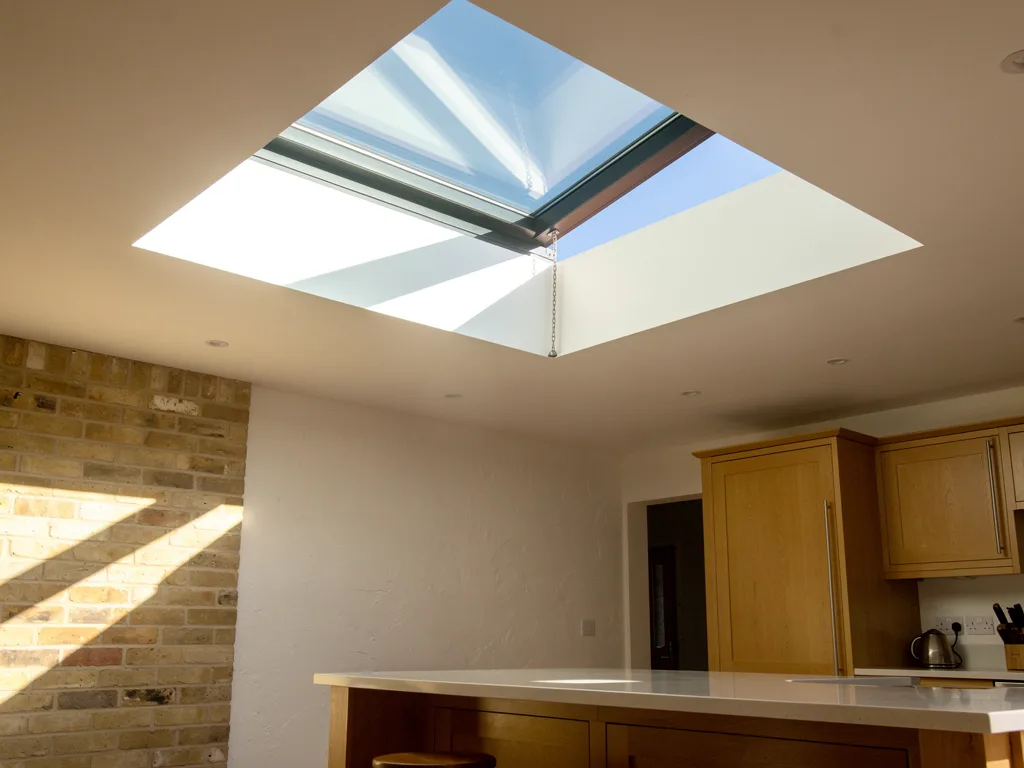
What you hear when the rooflight moves
The sound comes from the actuator, the small motor that pushes the frame open, and it only lasts as long as the frame is travelling.
Most electric opening rooflights use a chain actuator or a spindle actuator, driven by a small low-voltage motor through a gearbox. When you press the switch you hear a soft whirr, a little like an electric toothbrush heard from across the room, rising slightly as the motor takes the weight of the glazing and settling as the frame moves. On a hinged flat rooflight the chain extends and retracts through its housing with a faint mechanical ticking. On a sliding unit the sound is more of a smooth rumble as the glazed section runs along its track. Our guide to how electric rooflights work shows where each of these parts sits in the frame.
Two other small sounds are normal. At the very start of opening you may hear a gentle release as the frame lifts off its compressed seals, and at the end of closing there is a low thud as the frame pulls down onto them and the motor stops under load. That final pressing onto the gaskets is what keeps the unit weathertight, so a firm close is a good sign, not a fault.
Once the rooflight has stopped, it makes no sound at all. The control unit draws a tiny standby current and has no fan, and there is no hum from the motor while the window sits open for an afternoon.
How the motor compares with appliances in your home
Set beside the everyday sounds of a kitchen or bedroom, a rooflight motor is one of the quieter things in the house, and one of the shortest.
Sound is measured in decibels, usually weighted to match the human ear as dB(A). Each rise of 10 dB(A) sounds roughly twice as loud to most listeners. Manufacturers publish a figure for their actuators on the product data sheet, measured at a set distance, and domestic window drives are designed to sit below the level of normal conversation. The table gives typical published ranges for common household sounds so you can place the motor among them.
| Sound | Typical level | How long it lasts |
|---|---|---|
| Quiet bedroom at night | About 30 dB(A) | Background |
| Fridge running | About 35 to 45 dB(A) | Hours a day |
| Rooflight motor moving | Fridge range | Seconds |
| Normal conversation | About 60 dB(A) | While you talk |
| Kettle boiling | About 60 to 70 dB(A) | A few minutes |
| Extractor on high | About 60 to 70 dB(A) | While cooking |
Duration matters as much as level. A fridge compressor cycles for hours every day and you stop noticing it. A kettle is louder but short. The rooflight motor sits at the fridge end of the scale and runs for the shortest time of anything on the list: a full opening usually takes well under a minute, and a small vent opening for background air is over in a few seconds. If you want the exact figure for a particular model, ask for its data sheet. For any electric unit we specify, we can include it alongside the written light plan and quote.
When the sound is worth planning around
The motor is rarely a nuisance in a kitchen or living space. It matters in a bedroom, where the rooflight can move by itself while you sleep.
A rain sensor is fitted to electric opening rooflights so that the unit closes automatically at the first drops. That is exactly what you want, but in a loft bedroom in a Romsey or Chesterton terrace, where the rooflight is often a metre or two above the bed, a closing cycle at four in the morning in a summer shower is the one moment you are likely to notice the motor. It is brief, and it is the sound of the window protecting the room, but it is worth knowing about in advance. Our guide to rain and wind sensors explains how they trigger, including the dew that can set them off on clear nights.
Timed and automatic openings are the other case. If you set the rooflight to open for morning airing, or to open when the room warms up on an east slope, choose times that suit the people sleeping under it. Opening a rooflight on a timer covers how to schedule it sensibly.
Electric blinds add a second, very similar sound. A blackout blind on a south or east slope rolls with its own small motor, and in a bedroom you may prefer it and the rooflight to move together rather than one after the other. Electric blinds for opening rooflights covers pairing the two.
What keeps an electric skylight quiet
Most of what decides the sound is chosen at the specification stage and then settled by how carefully the unit is fitted.
- The drive type. Concealed drives built into the frame tend to be quieter than a surface-mounted actuator fixed to the upstand, because the frame itself damps the sound.
- Soft start and stop. Control units that ramp the motor speed remove the clunk at the end of each movement.
- A square, true upstand. If the kerb is out of level or twisted, the frame binds as it moves and the motor labours, which you hear as a strained, rising whine. A true upstand lets it run freely and helps the motor last, as explained in how long an electric rooflight motor lasts.
- Where the control unit sits. The control box is silent apart from a faint click from its relay, but placing it in a cupboard or loft void rather than above a bedhead keeps even that out of earshot.
- Low voltage. A 24V drive is the usual choice for domestic units and runs smoothly at low speed. Whether a rooflight is 24V or 230V explains the difference.
Weather noise is a separate matter from motor noise. Rain on glass is audible in any room with roof glazing, and it depends on the glass build-up rather than the motor. Laminated inner panes, specified for safety overhead, also soften the drumming of heavy rain.
If you are still deciding whether electric operation suits a room at all, manual versus electric opening rooflights sets out the trade-offs, and the electric and opening rooflight installation page covers the whole service. At the survey we look at which room the rooflight serves, who sleeps beneath it and which way the slope faces, then specify the drive, sensor and blind around that. Book a light survey and it all goes into the written plan.
Questions people also ask
Is a sliding rooflight louder than a hinged one?
Not louder as a rule, just different. A sliding rooflight moves a heavier glazed section over a longer distance, so it runs for longer, and the sound is a smooth rumble along its track rather than the whirr of a chain. See sliding rooflights for how they operate.
Does an electric rooflight make a noise when it is closed?
No. The motor only runs while the frame is moving. When the skylight is closed or parked open, nothing is running, and the control unit on standby is silent.
Why does an older electric rooflight sound louder than a new one?
A motor that sounds strained or grinding is usually working against something: debris in the frame, seals that have hardened, or a unit that was never set on a true kerb. If an older electric unit has become loud and slow, replacing it with a current model on a properly built upstand is the lasting answer.
Can I stop the rain sensor closing it at night?
You can, but it is better not to, because the sensor is what keeps rain out of the room. The kinder option in a bedroom is to leave the rooflight on a small vent opening overnight, so any closing cycle is short and quiet.
