A blind and an opening sash are one decision, not two
Electric rooflight blinds work best when they are chosen at the same time as the opening rooflight, because the blind, the sash and the controls all share the same few centimetres of space and, ideally, the same power and the same switch.
On a fixed rooflight a blind is a simple add-on: it sits below the glass, it goes up and down, and nothing else moves. An opening rooflight changes that. The sash lifts, slides or pivots, a motor drives it, a rain sensor may close it without warning, and the blind has to stay out of the way of all of that while still covering the glass when you want shade. If the blind is an afterthought, you can end up with a fabric that snags on a hinged frame, a second remote that nobody can find, or a blind that has to be drawn back before the skylight will open.
Planning the two together means answering a handful of questions before anything is ordered. Where does the blind sit relative to the sash? Does it move with the opening part or stay put on the kerb or lining? Is it powered from the same control unit as the actuator? And what should happen to each of them on a hot July afternoon, on a wet night, and when the house is empty? The rest of this guide works through those questions for the types of opening rooflight we install across Cambridge. For how the opening mechanism itself works, see how electric rooflights work.
Where the blind sits on each type of opening rooflight
The position of the blind is set by the way the rooflight opens, so the opening type comes first and the blind follows it.
Hinged flat rooflights
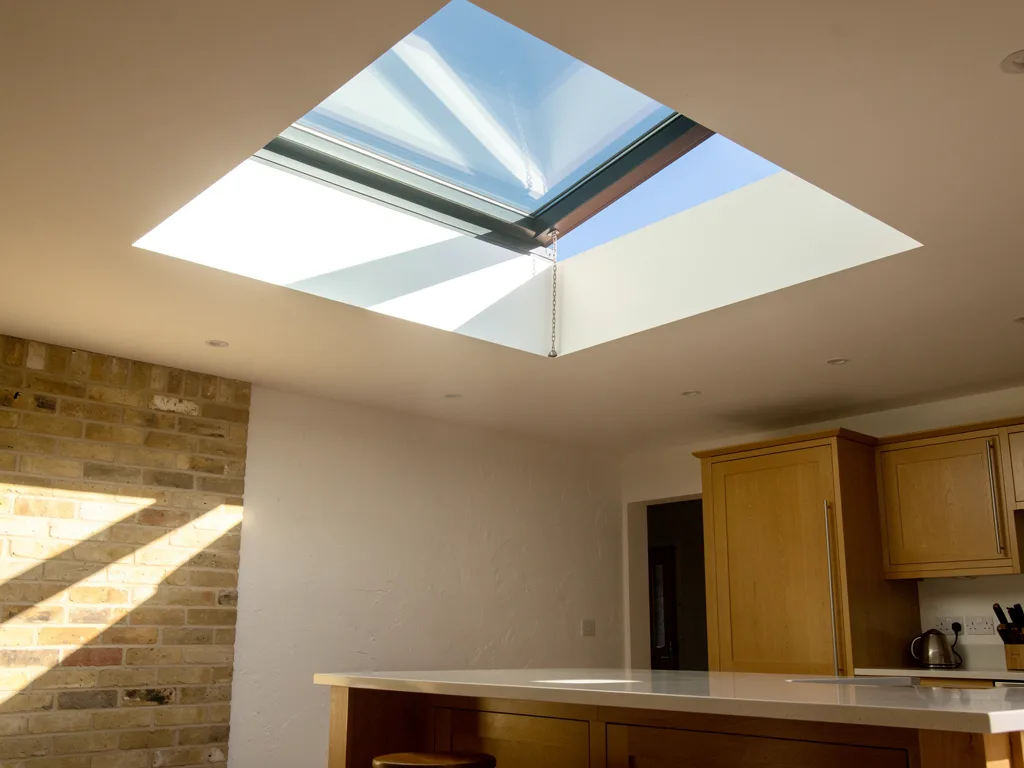
A hinged opening rooflight lifts one edge of the glass on an actuator arm, usually by a few hundred millimetres. The blind is normally fixed inside the kerb or the plastered upstand, below the level of the sash, so the glass can rise away from it while the fabric stays flat across the opening. With the blind closed and the sash open, air still moves around the edges of the fabric, and the room gets shade and ventilation at once. The detail to check is clearance: the actuator arm and any chain housing need room beside the blind cassette, and the lining has to be deep enough to hold both.
Integral blinds in the glass unit
Some opening flat rooflights can be made with a blind sealed between the panes of the double or triple glazed unit. Because the blind lives inside the glass, it travels with the sash and cannot touch the actuator or catch the wind. It never gathers dust and needs no cleaning. The trade-offs are that the choice of fabric or slat is narrower, and if the blind motor fails the whole sealed unit is involved in putting it right, so the manufacturer's warranty terms on that unit matter more than usual.
Pitched roof windows
On a centre pivot or top hung roof window, blinds clip into the sash itself and turn with it. Electric and solar blinds for these windows are designed around the window's own control system, so the same keypad or app drives both. This is also the one type where an external awning or shutter is a straightforward option, fitted to the outside of the sash.
Sliding rooflights
A sliding rooflight moves a whole pane across the roof, which leaves the full opening clear to the sky. A blind here is fixed within the upstand or ceiling void below the moving part and must be fully retracted or clear of the travel path. Sliding units are large, so the blind is usually a long motorised roller or a pleated system running in side channels to stop it sagging.

Choosing the fabric by the way the roof faces
An electric skylight blind is there to change the light in the room, so the right fabric depends on which part of the sky the glass looks at and what the room is used for.
Cambridge is flat, with almost nothing on the horizon to shade a roof, so a rooflight here sees the whole sun path. A south-facing pitched roof window in a Mill Road loft gets several hours of direct sun in summer, high in the sky around midday. A flat rooflight over a side return extension in Romsey sees the sun whatever the orientation of the house, because flat glass faces straight up. That is one reason flat rooflights on terraces can feel much brighter and warmer than people expect. For the full picture of how slope and season change the light, our page on how we plan the light sets it out.
| Situation | Fabric that suits | What it does |
|---|---|---|
| South slope or flat roof, living space | Reflective backed screen or pleated | Cuts glare and some heat, keeps a view of sky |
| East slope, bedroom | Blackout | Stops the early sun waking you in June |
| West slope, home office | Light filtering or screen | Softens low evening sun on a screen |
| North slope, any room | Light filtering, or none | Privacy and a softer look at night |
A blackout fabric on an opening rooflight never gives total darkness, because it has to leave a small gap at the sides for the sash hardware or for air to move. Side channels close most of that gap. If a bedroom needs real darkness in midsummer, say so at the survey, so the blind can be specified with channels and the lining detailed to take them.
Powering the blind and the rooflight from one system
The neatest set-up runs the blind and the opening motor from the same control unit, on the same low-voltage supply, with one set of controls.
Many electric opening rooflights use a 24V actuator fed from a control box, which in turn is fed from a fused spur. An electric blind built for the same system can plug into that control box, so there is one cable route through the ceiling or upstand, one power supply and one place to look if something needs attention. Where the blind comes from a different maker, it usually needs its own transformer and its own supply, and it will not talk to the rooflight controls without an extra module or a home automation hub. Both routes work; the first is simpler to live with. Our guide to wiring an electric rooflight covers cable routes and who does which part of the electrical work.
Solar blinds are the other route. A small panel on the blind's top rail or on the outside of the window charges a battery that drives the blind motor, so no cable is needed. They suit roof windows where the lining is already finished and nobody wants to open up a plastered reveal. On a north slope in December, a solar blind has less light to charge from, so it is worth knowing how many operations a full battery gives before choosing one for a north-facing room. The same trade-off applies to solar powered roof windows themselves.
- Same maker, shared control box: one supply, one remote, the system knows where both are.
- Different makers, separate supplies: two controls unless linked through a hub.
- Solar blind: no cable, independent battery, charging depends on the slope and the season.
- Integral blind in the glass: powered through the sash, usually from the rooflight's own control unit.
Controlling both together, and why it matters
Once the blind and the sash share a controller, you can move them as a pair, and that is where an electric rooflight starts to earn its keep in a hot room.
A pair of buttons for each is fine on day one. After a few weeks, the combinations you actually use tend to settle into three or four. Most control systems let you save those as scenes or presets, so a single press does two things. The ones that make sense in a Cambridge house are practical rather than clever:
- Morning air: sash open a small amount, blind open. Stale overnight air leaves at the highest point of the room while the light comes in.
- Summer afternoon: blind closed, sash open. The fabric stops the direct sun reaching the floor and the worktop, and warm air that builds up under the glass can escape.
- Evening: sash closed, blind closed for privacy and to keep in some warmth once the sun has gone.
- Away: sash closed, blind closed on a south slope, so the room does not bake while nobody is there to open it.
Scenes can run on a timer as well as on a button. A blind that closes at 1pm on a south-facing kitchen rooflight in summer, and a sash that opens a little at the same time, keeps the room cooler than one that waits for someone to notice. For schedules on the sash itself, see can a rooflight open on a timer. If you would rather drive it all from a phone, a voice assistant or a thermostat, that is covered in smart home control for rooflights.
A rain sensor normally closes the sash and leaves the blind where it is. That is the right behaviour: closing the blind as well would suddenly darken the room for a passing shower. It is worth checking with the specific system, though, as a few let you choose what the blind does when the sensor trips. Rain and wind sensors are explained in their own guide.
Heat: what a blind can do and what it cannot
An internal blind cuts glare and brightness well, but it can only stop part of the heat, because the sun's energy has already come through the glass by the time it reaches the fabric.
When sunlight lands on an internal blind, some of it bounces back out through the glass and the rest warms the fabric, which then warms the air around it. On a fixed rooflight that warm pocket sits trapped under the glass and slowly spreads into the room. On an opening rooflight you have a way out for it: open the sash a little with the blind closed, and the warm air rises through the gap instead of settling. That is the real advantage of pairing the two. The blind handles the light, the vent handles the heat the blind cannot stop.
The glass does the rest. A solar control glass with a low g-value lets less of the sun's energy through in the first place, so the blind has less to deal with. On a south slope or a large flat rooflight over a kitchen extension, we treat the glass as the first line against summer heat and the blind as the second, never the other way around. An external awning on a pitched roof window intercepts the sun before it reaches the pane, which is why it keeps a loft cooler than any internal fabric. On a flat opening rooflight an external blind is rarely practical, so the combination of low-g glass, a reflective internal blind and a controlled vent is the usual answer. For how much cooling an opening rooflight can realistically give, read will an opening rooflight cool my room in summer.
Clearances, insect screens and other things that share the space
An opening rooflight can carry a blind, an insect screen, an actuator and a lining finish, and they all need a place in a reveal that may be only a little deeper than the upstand.
The blind cassette, the actuator and any chain or spindle housing all fix to the inside of the upstand or the kerb. On a flat rooflight with a standard 150mm upstand above the finished roof, plus the depth of the roof build-up and the plastered lining below, there is usually enough room for all of them, but the positions have to be set out before the lining goes up. An insect screen adds another layer. Where a screen and a blind both run in the same reveal, they sit on separate tracks, with the screen normally nearest the glass so it stays closed while the blind is used day to day.
Two other points come up on real jobs. First, a blind fixed to the lining must not touch the sash when it closes, or the fabric can be pinched and the actuator's obstruction detection may stop the sash short. Second, where the rooflight is also used for access to a flat roof, as with a roof access hatch, a blind across the opening has to retract fully and quickly, and it is often better left off. The safety features guide covers how obstruction detection behaves.
Adding electric blinds to an opening rooflight you already have
Retrofitting an electric blind is often possible, but how simple it is depends on the rooflight's make, its control system and whether there is a cable route to the reveal.
Where the existing electric rooflight comes from a range that offers matching blinds, the blind can usually be added and paired with the same control unit. The survey checks the model, the control box and whether its outputs are free. Where the rooflight's range has no blind, a separate motorised blind can be fitted in the reveal with its own supply or a solar motor, and linked through a hub if you want one control. If the reveal is shallow, or the plaster runs right up to the frame, the cassette may need a small bulkhead or a trimmed lining to sit in.
Sometimes the better answer is to renew the rooflight itself. An older fixed unit with misted glass, over a room that gets too hot, may be worth replacing with an opening unit with solar control glass and a matched blind, so everything works together from the start. Our answer on whether a fixed rooflight can be changed to an opening one explains what that involves, and the costs page sets out what drives the price of blinds and controls as part of a job.
How blinds go into the light plan
Every quote we write comes with a light plan, and for an opening rooflight that plan names the blind, where it sits, how it is powered and what it is for.
At the survey we look at the slope, the time of day each room is used and where the sun patch will fall across the seasons. A loft bedroom on an east slope in Chesterton gets a blackout blind in side channels and a sash set up for morning airing. A kitchen extension with a large flat rooflight in Trumpington, facing the midday sun, gets solar control glass, a reflective pleated blind and a summer afternoon scene. A north-facing studio in a Histon cottage may not need a blind at all. Writing it down means you can see the reasoning and question it before anything is ordered.
If you are planning an opening rooflight and want the blind and the controls thought through with it, our page on electric and opening rooflight installation in Cambridge covers the full service, or you can book a light survey or message us on WhatsApp.
Questions people ask
Can the blind and the rooflight share one remote?
Yes, when both come from the same system and are connected to the same control unit. With products from different makers, one control usually needs a smart home hub or a compatible module to link them.
Will a closed blind stop the rooflight from opening?
Not on a well planned install. On hinged flat rooflights the blind sits below the sash, and on roof windows it moves with the sash, so the rooflight can open with the blind drawn. The layout is checked at the survey so nothing clashes.
What happens to an electric blind in a power cut?
It stays where it was. A solar blind carries on working from its own battery. For the sash itself, see what happens to an electric rooflight in a power cut.
Are electric skylight blinds noisy?
Blind motors are small and run for a few seconds at a time, with a soft hum similar to the sash actuator. They are quiet enough for a bedroom, and a timed scene can be set to run before you are up.