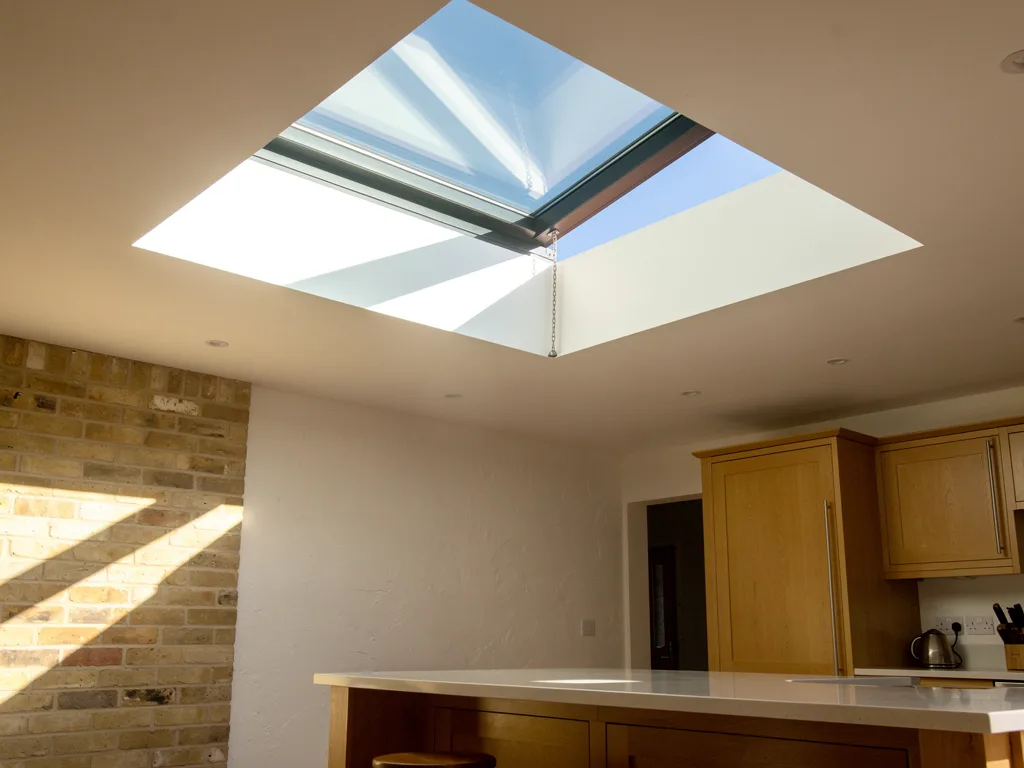
Why a fixed unit cannot simply be made to open
A fixed rooflight is built as one sealed piece, so there is nothing to add an opening mechanism to; the change is made by replacing the whole unit.
On most frameless flat rooflights the glass is bonded straight to a frame or kerb with structural silicone. There is no separate sash, no hinge line, no compression seal around an opening edge and no drainage channel to catch water when the pane lifts. Framed fixed units are similar: the frame is designed to hold the glass still, not to let a sash move within it. Even where a manufacturer makes a fixed and an opening version of the same range, the two differ in the frame section, the seals and the fixings, so parts do not transfer from one to the other.
Pitched roof windows are the partial exception. A fixed roof window from a major range is normally made in the same size codes as its opening siblings, so a fixed window can be taken out and an opening one of the same size put in, using the existing opening in the rafters. That is still a replacement rather than a conversion, but it is a light one, and it is the case covered in more detail in can an electric skylight go on a pitched roof.
So the real question is not whether the old unit can be changed but whether the roof around it can take an opening one without being rebuilt. On a flat roof, that comes down to the upstand.
The upstand: the part that decides the scope
An opening rooflight sits on a kerb, and that kerb has to be the right height, the right size and sound enough to carry a moving sash.
Current guidance for flat roofs asks for an upstand of at least 150mm above the finished roof surface, so that standing water and splashback stay below the line where the sash meets the frame. Older fixed skylights were sometimes set on lower kerbs, because a sealed pane is more forgiving of a shallow upstand. An opening unit is not: its weakest point is the gap around the sash, and that gap needs height.
The second check is the internal kerb size. Opening units are made to set dimensions, and the new rooflight must match the kerb or be matched to it. Where the old kerb is close, a timber adjustment can bring it into line. Where it is well out, or decayed, or was built without insulation around it, the sound answer is to rebuild the kerb, weather the roof covering back into it and line the inside again. In either case we confirm it on the roof before anything is ordered.
| What we find | Likely route | Scope |
|---|---|---|
| Pitched fixed roof window, standard size | Same-size opening window | Light |
| Flat kerb 150mm+, sound, size matches | Opening unit on existing kerb | Light |
| Flat kerb low or size off | Raise or adjust kerb, reweather | Moderate |
| Kerb decayed or uninsulated | New kerb, covering and lining | Larger |
Clearance matters too. A hinged sash swings up and needs free space above the roof, and a sliding unit needs a run of roof beside the opening to travel over. On a tight Romsey side return with a parapet, or a flat roof tucked under a bedroom window on a 1930s semi in Cherry Hinton, that clearance can shape which opening type is possible. The hinged opening rooflights and sliding rooflights guides set out what each one needs.
Power, control and where the cable goes
Most opening flat rooflights are electric, so the swap usually means bringing power to a place that has never needed it.
A fixed skylight has no cable. An electric replacement needs a supply to the kerb, normally from a fused spur, with the actuator and control unit either inside the rooflight frame or close to it. In a finished room the tidiest route is often along a joist void from a nearby circuit, finished in the reveal so nothing shows. Where the ceiling cannot easily be opened, a surface route in slim trunking along the lining is the fallback. Some ranges run the motor at low voltage from a transformer, others take mains to the unit; the difference is explained in are electric rooflights 24v or 230v, and who does which part of the work is covered in does an electric rooflight need an electrician.
If running a cable is genuinely awkward, a manual winder on a pole can work for a rooflight within reach, and solar-powered versions exist for some pitched roof windows. For a flat rooflight over a kitchen or stairwell, electric control with a rain sensor is the practical choice, because a rooflight you cannot easily close is one you will not open. The manual vs electric opening rooflights guide weighs the two.
Is it worth making the change?
The swap is worth it when the room overheats, holds steam or has no other high-level opening; it earns less where the fixed unit is new and the room already airs well.
Warm air rises and pools under the ceiling, which is exactly where a rooflight sits. A fixed pane lets the sun in but gives that heat no way out, so the top of a kitchen extension or a loft stairwell can feel noticeably warmer than the rest of the house on a still summer day. Opening the rooflight lets that layer escape, and with a window open lower down, the room draws fresh air through from below. The using rooflights for ventilation guide covers purge and background ventilation in more depth.
The swap is also a chance to upgrade the glass. Many older fixed skylights have a clear double-glazed pane with no solar control. A replacement opening unit brings current thermal performance and a choice of solar control coatings, so the rooflight lets in less heat in the first place. Because a replacement rooflight has to meet current thermal standards, the work can be notifiable; where it is, we handle the Building Control notification. On a listed building or in some conservation areas, a change to the external appearance may also need consent, so that is checked at the survey. A straightforward swap is usually a day on the roof, longer where the kerb is rebuilt.
What the swap does not change is the light. An opening rooflight on the same opening throws the same sun patch across the room, which is useful if you like where the light falls now. If you do not, the survey is the moment to ask whether a different size or position would suit the room better, and every quote comes with a written light plan showing why. You can read how we approach that on how we plan the light, or start from the electric and opening rooflight installation page. When you are ready, book a light survey.
Questions people also ask
Can I just add a vent to my fixed skylight?
Some fixed units can be ordered with a trickle vent in the frame, but that is built in at the factory, not added later. A trickle vent gives background ventilation only, not the purge airing that an opening sash provides.
Will an opening rooflight fit the hole my fixed one came out of?
Often, if the kerb is at least 150mm above the finished roof, sound and close to a standard size. Where it is not, the kerb is raised or rebuilt, and the roof covering is weathered back into it.
Can I add a rain sensor to the new opening unit?
Yes, and on an electric rooflight it is worth fitting from the start. It closes the sash when rain begins, so the skylight can be left open while you are out. The rooflight rain and wind sensors guide explains how they work.
Does the ceiling have to be redecorated afterwards?
Usually just the reveal around the rooflight, where the lining meets the new frame and the cable is chased in. A kerb rebuild can disturb more of the plaster at the edge of the opening, which is made good as part of the work.
