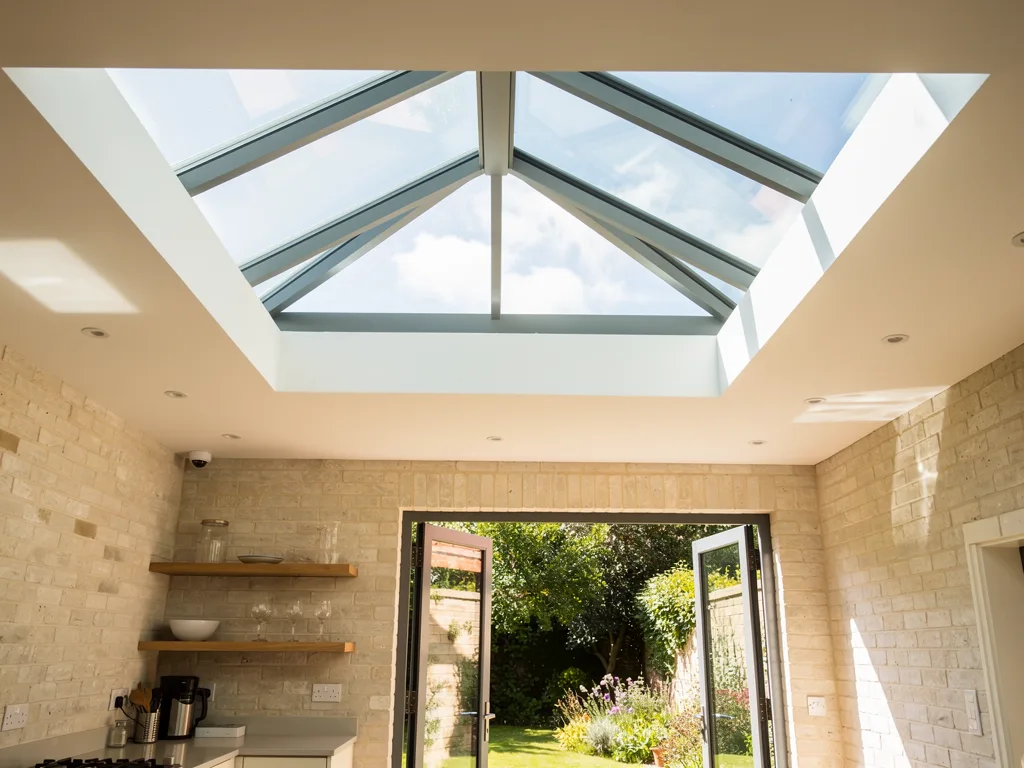
Two panes, two different jobs
A lantern's sealed units are built from two different kinds of safety glass, and each one sits where its strengths count. The outside pane faces the weather; the inside pane faces the people.
The outer pane takes hail, wind load, snow sitting on the glass after a cold night on the Fens, and the thermal stress of a low winter sun warming one corner while the rest stays cold. Toughened glass suits that job well. It is made by heating ordinary float glass to around 620 to 650°C and then cooling its surfaces quickly with jets of air. The skin sets hard while the core is still hot, so when the core cools it pulls the surfaces into compression. To break the pane, a blow has to overcome that built-in compression first, which is why toughened glass is roughly four to five times stronger in bending than the same thickness of annealed glass, and far better at shrugging off uneven heating.
The inner pane is a different case. When a toughened pane does fail, the whole sheet shatters at once into small cubes. On a door or a wall window those cubes land on the floor, which is the point of the design. Over a kitchen island or a dining table, the same shower of glass comes down on whoever is sitting there. That is why guidance on sloping and overhead glazing calls for the lower pane to be laminated: two sheets bonded to a plastic interlayer, usually PVB, so that a broken pane crazes like a spider's web but stays in its frame.
| Pane | Typical glass | What it protects against |
|---|---|---|
| Outer | 4 to 6mm toughened | Hail, snow load, thermal stress |
| Cavity | Argon, warm-edge spacer | Heat loss, condensation |
| Inner | 6.4 or 6.8mm laminated | Glass falling into the room |
Exact thicknesses vary by maker and by the size of the panes, and a large lantern may use thicker glass on both sides. The guide to roof lantern glass options covers the coatings and tints that sit on these panes; this page is only about how the glass behaves when it is hit or breaks.
- Outer toughened pane: heat-strengthened to take hail, foot traffic during maintenance and thermal stress.
- Solar-control coating (optional) on the inside face of the outer pane, cutting heat gain on south and west roofs.
- Argon-filled cavity: a denser gas than air, so less heat crosses the gap.
- Warm-edge spacer: a low-conductivity edge that keeps the units’ edges warmer and cuts condensation at the frame.
- Low-E coating: a microscopically thin metal layer on a cavity face that reflects room heat back inside.
- Inner laminated pane: two sheets bonded to an interlayer, so if it ever breaks, the glass stays in place overhead.
- Triple glazing only: a third pane and a second argon cavity, usually with a second low-E coating. Warmer, heavier, and it lets in slightly less light.
Why overhead glass is treated differently from a window
A wall window only has to be safe if someone walks into it. Roof glass has to be safe if it breaks for any reason at all, because gravity then works against you.
In England, Approved Document K deals with protection from impact with glazing in critical locations, such as doors and low-level panes, and it points to toughened or laminated glass that passes the BS EN 12600 pendulum test. Roof glazing is covered by further guidance, chiefly BS 5516 on sloping glazing and BS 6262 on glazing for buildings, which is written with falling glass in mind. The practical outcome is consistent across that guidance: glass above people should either be laminated or be protected so it cannot drop into the room. The exact rules for your project are confirmed at the Building Control stage, and we handle that notification where the work is notifiable.
There is also a quirk of toughened glass that matters overhead. Very rarely, a tiny nickel sulphide inclusion trapped in the glass during manufacture can expand over time and shatter a toughened pane with no blow at all. Makers reduce the risk with a heat soak test to BS EN 14179, which breaks susceptible panes in the factory before they are ever fitted. Heat soaking lowers the chance a great deal but does not reduce it to nothing, which is one more reason a laminated inner pane is the sensible choice above a room.
How to tell what glass a lantern has
Every pane of safety glass should carry a small permanent mark, usually etched or fired into one corner. It is the quickest way to check an existing lantern or confirm a new one.
On toughened glass the mark normally quotes BS EN 12150, the standard for thermally toughened safety glass, along with the maker's name. Laminated glass usually refers to BS EN 14449 or BS EN ISO 12543, and it may add an impact class from BS EN 12600 such as 1B1 or 2B2. The mark on the inner pane is usually readable from inside the room with a torch and a little patience; the outer pane's mark is on the outside and is best checked from a ladder by the person who installs or cleans the lantern.
If an older lantern shows no mark at all, or the inner pane is toughened rather than laminated, that is not a reason to panic. It is a point to weigh when you decide whether to keep the unit or replace it. Older polycarbonate lanterns and early glass units often fall short of the thermal performance of a current lantern as well, so an upgrade can improve safety, warmth and light together. The roof lantern installation service page explains how we assess and replace an older lantern.
What the glass choice does to light, heat and weight
Choosing laminated glass on the inside costs very little in daylight. A clear PVB interlayer passes nearly as much visible light as the glass around it, so the room will not look any dimmer.
Laminated glass also carries a quiet bonus: the interlayer blocks almost all ultraviolet light. Under a south-facing lantern in a Mill Road side return, or a big pyramid lantern over an orangery in Great Shelford, that slows the fading of oak floors, rugs and upholstery sitting in the sun patch through the summer. It does not stop the heat, though. Solar gain is controlled by the coating and tint on the glass, not by the safety build-up, and the guide to controlling heat and glare under a roof lantern explains which choices make a real difference in July.
The laminated inner pane adds some weight, and thicker toughened glass on a wide span adds more. A lantern frame is designed around its own glazing, so this is normally taken care of by the maker, but it feeds into the check on the upstand and roof structure. How heavy a roof lantern is sets out the ranges. Glass type can also change the price a little, and the costs page explains what moves a lantern quote as a guide.
In the written light plan that comes with every quote, we list the full glass build-up alongside the coating and position, so you can see which pane does what before anything is ordered. The light planning page shows how orientation and glass choice are weighed together.
Questions people also ask
Can you walk on roof lantern glass?
No. Lantern glass is designed for weather, snow and occasional loads such as a dropped branch, not a person's weight on a sloping pane. Walk-on rooflights are a separate product with thick laminated glass built as a floor. For cleaning, use a pole from a safe position; how to clean a roof lantern covers safe access.
Is triple glazed lantern glass toughened too?
Yes, the same logic applies. A triple glazed unit usually has a toughened outer pane, a toughened centre pane and a laminated inner pane. It is heavier than a double glazed unit, which is worth checking against the frame and the roof structure.
What happens if the outer pane cracks?
The toughened outer pane breaks into small pieces that mostly stay in place within the sealed unit, and the inner pane still keeps the weather and the room separate for the time being. The sealed unit then needs to be renewed. Because the glass is part of a factory-made unit, the whole unit is replaced rather than one sheet.
Does laminated glass make a lantern hotter or colder?
Not in any way you would notice. Warmth in winter depends on the cavity, gas and low-E coating, and coolness in summer depends on solar control coatings and ventilation. See do roof lanterns make a room hot for the summer side of that question.
