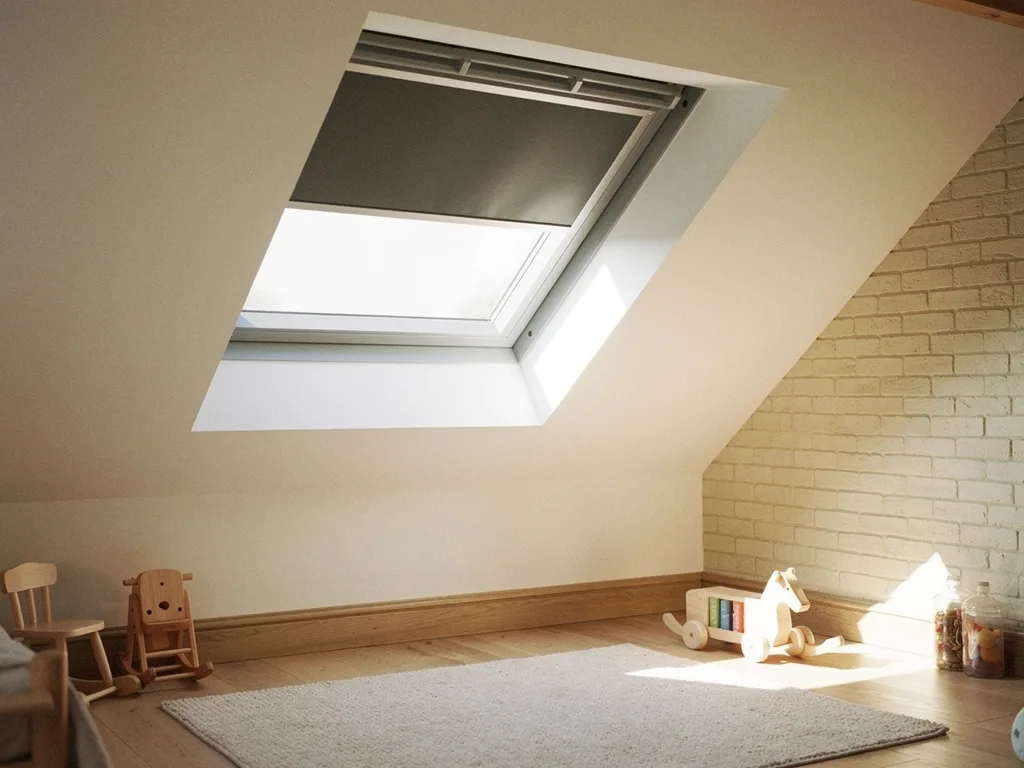
Four checks that settle the question
Whether it is worth replacing VELUX windows comes down to four things you can check from inside the room: the age of the window, the state of the glass, what happens around the frame in cold weather, and how the window looks and works for the way you use the room.
None of these needs a ladder. Stand under the window on a bright day and again on a cold morning, open and close it a few times, and look at the data plate on the top of the frame when the sash is open. The table below sets out what each finding usually points to.
| What you find | What it points to |
|---|---|
| Mist or haze between panes | Failed glass seal: replace |
| Made before 2001 | Replace when convenient |
| Draughts or wet lining | Replace the window and collars |
| Stiff hinge or loose handle | Look closer; often replace |
| Clear, sound, just too hot | Keep it; add shading |
One of these on its own is rarely decisive. Two or more together, on a window you look up at every day, is a fair sign that a new one will pay you back in comfort and in the light itself.
Age: what the generation tells you
The age of a VELUX window matters less for wear than for what it was built to. A window from before 2001 has glass, seals and insulation around the frame that fall well short of what a current window gives, and it sits at a different depth in the roof.
The data plate on the frame carries a type and size code, and the code format tells you roughly when it was made. Our guide to identifying your VELUX window generation shows how to read it, and how long VELUX windows last covers the service life you can expect from each era. A pre-2001 window in a loft bedroom that is still clear and weathertight does not have to come out tomorrow, but it is the one to plan for, ideally before the glass fails in the middle of winter.
Age also affects how easy the swap is. Older windows can usually be replaced without touching the plaster inside, because replacement flashings are made to set the new frame at the old depth. Whether yours is a straight swap is covered in will a new VELUX fit my old opening.
Glass: misting, heat and the quality of the light
Glass that has misted between the panes is the clearest case for replacement. Once the edge seal has gone, moisture keeps getting in, and cleaning the outside does nothing for it.
A misted pane also changes the light in the room. The haze scatters daylight, so the sharp sun patch on the floor turns into a dull glow and the view of the sky disappears. On a north slope, where the light is already soft, the room can feel noticeably duller than it should.
Heat is the other glass question. Older double glazing has no solar control coating, so a south or west slope over a Cambridge loft, with flat land and open sky around it, can turn the room into a hot box from late spring to early autumn. A current window can be specified with a coating that cuts the solar heat coming through while keeping the room bright; does VELUX glass reduce heat from the sun explains the options. If the glass is sound and heat is the only complaint, an external awning blind from the VELUX blinds guide may solve it without a new window.
Draughts, cold spots and condensation
Cold air around the frame and water running down the lining are signs that the window, or the insulation around it, is no longer doing its job. On older installations there was often little or no insulation collar at all.
Condensation on the inside of the glass on a cold morning is normal in a bathroom or a bedroom with the door shut, and it is not in itself a reason to replace. The warning signs are different: damp or staining on the lining boards below the window, mould in the corners of the reveal, a draught you can feel with the sash closed, or a ventilation flap that no longer seals. These point to a tired frame seal or a cold bridge where the frame meets the roof.
A replacement renews all of it together: frame seals, a new flashing matched to the roof covering, and insulation and vapour barrier collars around the frame. A new or replacement rooflight should also meet the current Part L limit for heat loss, which older units were never built to. That combination is what stops the cold spot, rather than the glass alone.
Looks, reach and how the room is used
Some replacements are about the room, not the window. A yellowed pine frame in a room you have just painted white, a handle you can only reach from a chair, or a skylight that lights the ceiling and leaves the desk in shade are all fair reasons to change.
Current windows come in white polyurethane as well as pine, and can be electric or solar powered, which helps where the window is high above a stair or a bed. An existing window can sometimes be made electric after fitting, so that alone is not a reason to swap it. Position is different. If the window is in the wrong place for the light, the replacement is the moment to move it to a better spot, because the roof is already open. We work out where the sun patch will fall through the day and the year before choosing, as set out in how we plan the light.
Keeping the window is the sensible call when it is clear, opens smoothly, keeps the room dry and sits in the right place. In that case the money is better spent on a blind, a second window or leaving it alone. If you are unsure, a light survey will tell you which checks it passes and which it fails, and the written quote sets out what a replacement would change. What drives the price is covered on our costs page, and the full service is on VELUX window installation in Cambridge.
Questions people also ask
Can I replace just the glass in a VELUX window?
For most windows the sash with its glass is replaced as a unit, and on an older window the frame, seals and flashing are usually past their best as well. Replacing the whole window renews every part together and brings it up to current Building Regulations.
Does replacing a VELUX window mean redecorating the room?
Usually not on a same-size swap. The new window goes into the old opening and the existing lining is kept, and in many cases the work is done from inside the room; see can you replace a VELUX window from inside.
Should I replace all my VELUX windows at once?
If they are the same age and one has failed, the others are likely to follow, and doing them together means one visit, matching frames and matching glass. If one is newer and sound, there is no need to change it.
Do I need planning permission to replace a VELUX skylight?
A like-for-like replacement on an ordinary house normally needs no planning permission. Listed buildings, flats and some conservation areas are different, so check before choosing a new size or position. The work should meet Building Regulations, and we handle the Building Control notification where the work is notifiable.
