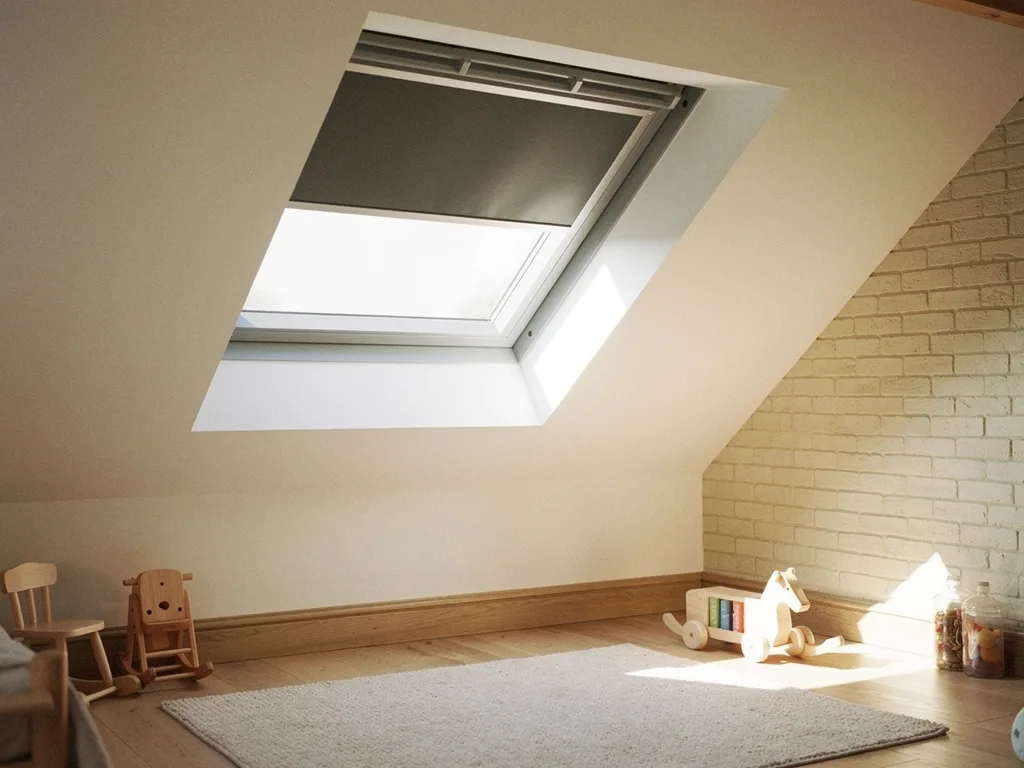
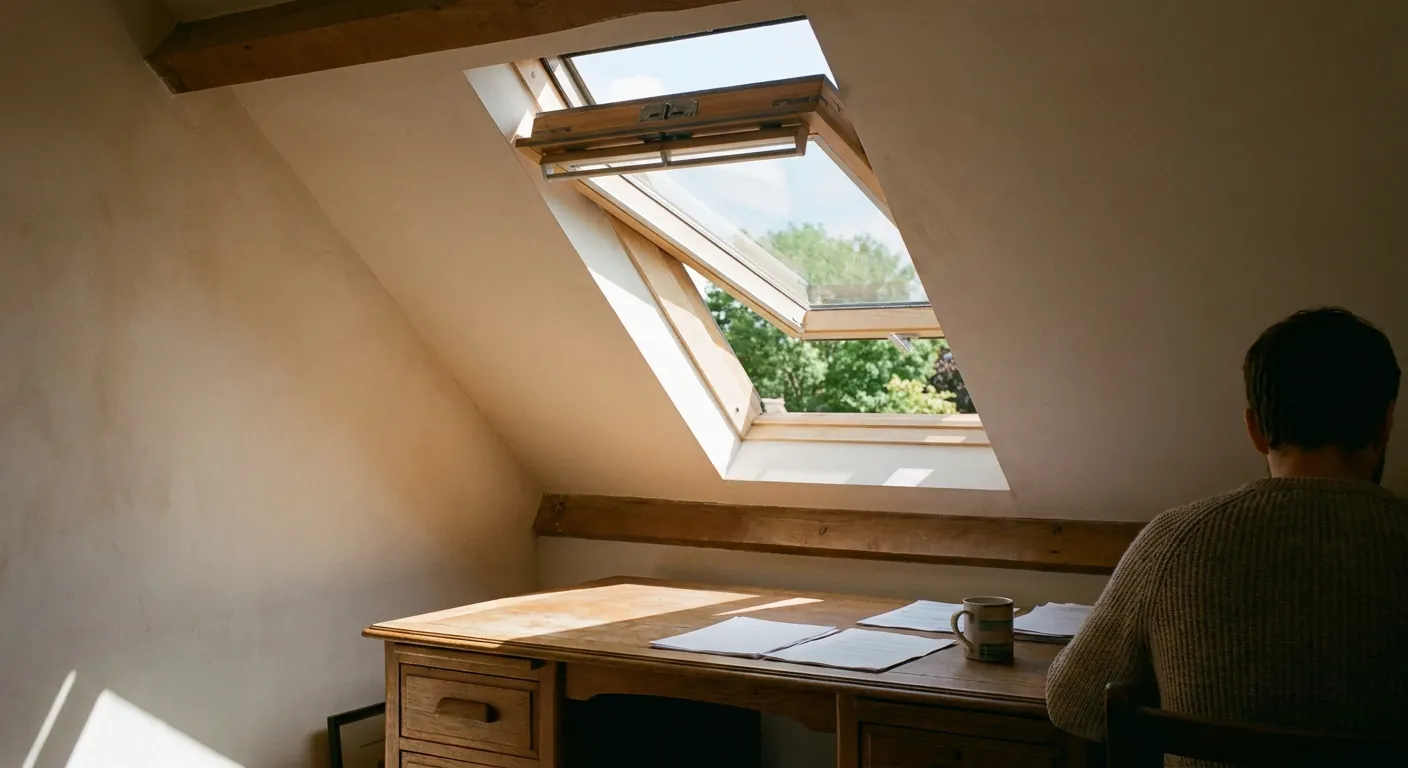
A bedroom is the hardest room to light from the roof
A loft bedroom roof window has to do two opposite jobs: flood the room with daylight when you are awake, and shut it out completely when you are not. Getting both right starts with the slope you choose, then the glass, the blinds and the way the window opens.
Most rooms want as much daylight as they can get for as many hours as possible. A bedroom is different. You spend a third of your life in it with your eyes shut, and the hours you care about most are the first and last ones of the day: the light you wake to, and the temperature of the room when you go to bed. A kitchen can live with a bright afternoon. A bedroom that has soaked up four hours of July sun through a south-facing pane will still be warm at midnight, however pleasant it looked at three o'clock.
Glass in the slope also behaves differently from glass in a wall. A vertical window in a gable sees the sky at an angle and catches the low sun only when it is in front of it. A roof window tilted back at 35 or 45 degrees faces much more of the sky, so it brings in more daylight for its size and much more direct sun on a clear day. That is why a modest loft bedroom skylight can feel generous, and why an oversized one can make the room hard to sleep in. The rest of this guide works through the decisions in the order we make them on a survey: which slope, how the light is controlled, how the heat is handled, how the room breathes, and where the bed goes.
If you are still at the stage of planning the whole loft, our guide to roof windows for loft conversions covers the numbers and layout for the full floor. This page stays in the bedroom.
Choosing the slope: which way you want to wake up
On a Cambridge house the slope usually decides itself, because a terrace or a semi has a front and a rear pitch and the dormer often takes one of them. Where you do have a choice, pick the slope for the hour of sun you want in the room, not for the most sun overall.
Cambridge sits at about 52 degrees north on flat land with very little to shade a roof, so the sun path over a loft is close to the textbook one. In late June the sun rises well round to the north-east before five in the morning, climbs to around 60 degrees above the horizon at midday and sets in the north-west after nine at night. In late December it rises in the south-east after eight, peaks at barely 14 degrees and is gone by four. Every slope therefore gives a bedroom a different character across the year.
- North slope. Soft, steady light all day with no direct sun: even, glare-free and good for studios, kitchens and home offices.
- East slope. Bright morning sun that has moved off by lunchtime: bedrooms and breakfast rooms.
- South slope. The strongest light, peaking at midday. Worth pairing with solar-control glass or a blind to keep summer heat down.
- West slope. Warm, low evening sun: living rooms and kitchens used after work.
- The sun’s path. It rises in the east, is due south at noon and sets in the west, higher in summer and lower in winter.
| Slope | Morning | Evening | In a bedroom |
|---|---|---|---|
| East | Direct sun, early | Soft, shaded | Bright waking, cool at bedtime |
| South | Sun from mid-morning | Sun into afternoon | Warmest; needs heat control |
| West | Soft, shaded | Low sun, warm | Hot at bedtime in summer |
| North | Even skylight | Even skylight | Calm, cool, little direct sun |
For a main bedroom, an east or north-east slope is usually the kindest. It gives you the brightest light when you get up, which is the light that does most to wake you up, and by early afternoon the sun has moved off the glass, so the room has hours to lose its heat before you go to bed. In summer that early sun arrives very early indeed, which is the price of an east slope: you will want a proper blackout blind if you do not plan to be up at five.
A west slope is the one to think hardest about. The low evening sun comes in almost straight through a tilted pane, hits the bed and the far wall, and warms the room in exactly the hours before you sleep. It can work well for a guest room or a teenager's room used as a study in the evening, but it needs external shading and good night ventilation to be comfortable as a main bedroom. A north slope is the opposite: steady, glare-free light all day, no direct sun for much of the year, and the coolest room in the house. Our answer on putting a roof window on a north-facing roof explains why that is often a good choice for a light sleeper or a child's room.
On many Romsey and Mill Road terraces the rear slope is taken by the dormer and the roof window goes on the front slope, which faces whichever way the street runs. That is fine. It means the light plan has to work with the orientation you have, and the glass and blinds carry more of the load.
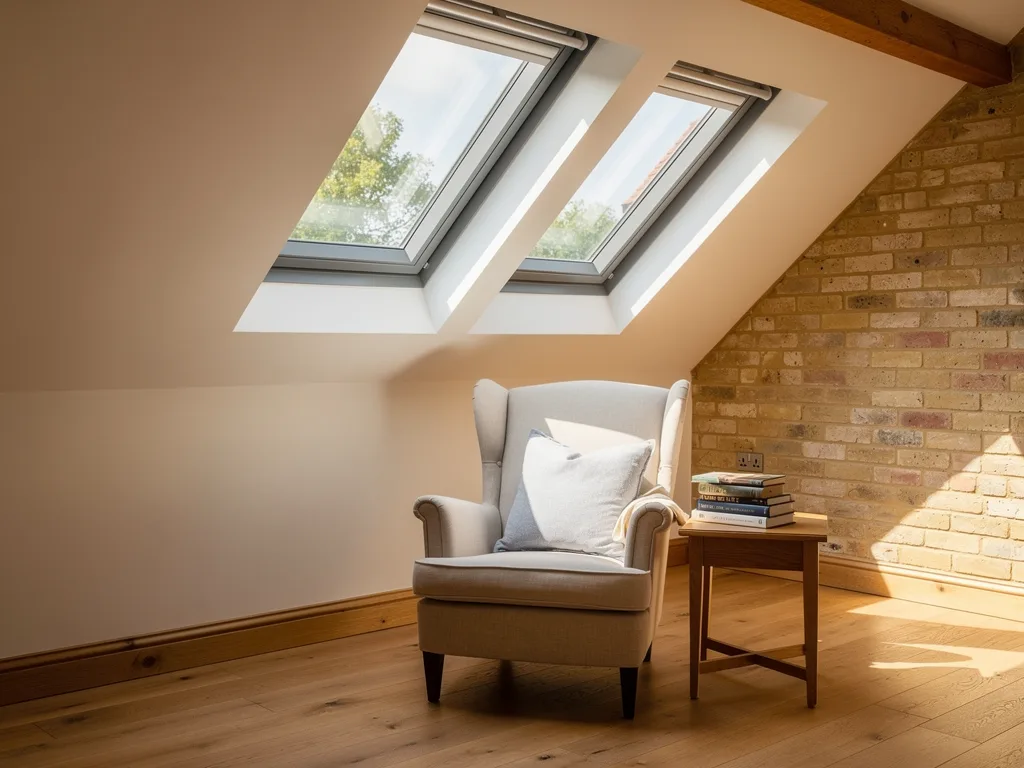
Blackout that actually blacks out
A standard roller blind on a roof window will not darken a bedroom, because light leaks round every edge and the blind sags away from the glass on a steep pitch. A bedroom needs a blind made for the window, running in side channels that seal the edges.
The blackout blinds made by roof window manufacturers are designed as part of the window. The fabric is held in aluminium side channels clipped to the frame, the bottom bar locks into position at any height, and the whole thing sits tight to the sash so it tilts with the window when you open it. The result is close to full darkness, with only a thin line of light where the channels meet the frame. For a room where someone sleeps during the day, or a baby's room in June, that is the level to aim for.
A few details make a noticeable difference:
- Duo blinds combine a blackout layer with a pleated or translucent one, so you can soften the light during the day without darkening the room.
- Electric or solar-powered blinds make sense when the window sits high in the slope out of easy reach, and some can be set on a timer to close before sunrise in summer.
- The lining around the window matters as much as the blind. A crisp plastered lining with a straight edge lets the blind close to a clean line. A bodged lining with gaps lets light in round the frame, whatever the blind is.
- Blind size follows the window size code exactly, so it is worth ordering blinds at the same time as the window and fitting them on the day, rather than living with a bright room for a month.
A blackout blind is for darkness. It is not the best tool for heat, because by the time the sun has reached a dark internal blind it is already inside the room. That is the next decision.
Keeping a loft bedroom cool enough to sleep in
Summer heat in a loft bedroom comes from two places: the sun through the glass and the warm roof itself. The window can be specified to reduce the first, and the way it opens decides how quickly the room can shed the second.
The most effective single step is external shading. An awning blind is a mesh screen that fixes to the outside of the window and is operated from inside, and it stops much of the sun's heat before it reaches the glass. On a south or west slope over a bed, it is the accessory that most often turns an uncomfortable room into a good one. It still lets you see out, which a blackout blind does not, so in summer it makes sense to use both: the awning outside during the day and the blackout inside at night.
Glass is the second step. A solar control pane has a coating that lets through visible light while reflecting a larger share of the sun's heat, measured by its g-value: the lower the figure, the less heat comes through. For an east slope a standard low-E double or triple glazed pane is usually enough. For a south or west slope over a sleeping area, a lower g-value is worth considering, accepting that the glass looks very slightly tinted from outside. Our guide to roof window glazing options compares the panes room by room, and the answer to whether a roof window will make your loft too hot goes further into slopes and shading.
The third step is getting warm air out at night. Warm air collects at the top of the room, which in a loft is just below the ridge. A roof window high in the slope, opened a little in the evening, lets that air escape while cooler air comes in lower down, and a loft room with an opening window on each slope can clear its heat surprisingly fast on a still night. That is also why a room with only a fixed skylight tends to stay warm: it lets the sun in but gives the heat no way out.
Insulation behind the plasterboard matters too. A loft bedroom insulated to current Building Regulations standards keeps the heat of the roof tiles out far better than an old boarded-out attic. The window should be installed with its insulating collar and vapour barrier collar so there is no cold or hot strip round the frame.
Fresh air without waking up to the rain
A bedroom needs a steady trickle of fresh air all night, not just a blast when you remember to open the window. Roof windows handle this with a ventilation flap in the frame, a secure open position and, on electric models, a rain sensor.
The ventilation flap is a slot in the top of the frame, opened with the handle, that lets air through while the sash stays closed and locked. It is the setting to use overnight: no draught across the bed, no rain coming in, and enough air change to keep condensation off the glass on a cold morning. Condensation is a real issue in bedrooms, because two sleeping people add a noticeable amount of moisture to a small room overnight, and cold glass is where it settles first.
When you want more air, most windows lock in a partly open position that is too narrow to climb through but wide enough to cool the room. Leaving the sash open while you sleep carries the obvious risk of a shower at three in the morning. On a manual window, a cautious approach is to use the ventilation flap overnight and open the sash only while you are awake. An electric roof window with a rain sensor closes itself when the first drops land on the glass, which suits a bedroom window that is hard to reach or one you want open on a warm night. Our guide to roof window ventilation covers the stack effect and the Part F side in more detail.
Where the window goes, and where the bed goes
In a loft bedroom the bed usually wants to sit with its head against the low side of the slope, because that is where headroom is least useful. The window position should work with that layout, not fight it.
Three layouts come up again and again. The first puts the window above the bed, set so you look up at the sky from the pillow. People love the idea, and it can be lovely on a north or east slope, but on a south or west one it puts direct summer sun on your face and on the duvet, and the window is awkward to reach across the mattress. The second puts the window beside the bed, over a side table or an alcove, which gives a view out when you sit up, easy reach for the handle and blind, and light across the room rather than onto the pillow. The third puts the window in the opposite slope or at the far end of the room, over a desk or dressing area, and leaves the bed in softer, indirect light. That is often the best arrangement for a light sleeper.
Height in the slope matters as much as position across it. A window with its bottom edge at around 900mm to 1,100mm above the floor lets you see out when you stand, and a window that runs higher in the slope throws light deeper into the room. On a shallow pitch you may need a taller window to get both. Our guide to positioning a roof window in a room covers sill and head heights in detail, and the choice between a centre pivot and a top hung window affects how close furniture can sit beneath it. A centre pivot sash swings inward at its middle, so a bedside table or chest below has to be low enough to clear it.
Think about the view from outside, too. A front-slope bedroom window on a terrace may be overlooked by the houses opposite, especially where the street is narrow. Positioning the window slightly higher, or choosing a pleated blind that gives privacy while letting light through, usually solves it without resorting to obscured glass.
Safety: escape routes, children and reach
A bedroom in a new loft storey is a room people sleep in above the ground floor, so the Building Regulations take an interest in how you would get out in a fire and how safe the window is to use.
Under Part B, a loft conversion needs a protected escape route, and in some layouts an escape window is also required. Where a roof window serves as the escape window, it has to meet minimum clear opening sizes and sit within a set distance of the floor and the eaves, so a rescuer can reach it. The detail depends on the whole loft design, and our guide to roof windows and fire escape rules sets it out. It is one reason the choice of window type in a bedroom is not just about light: a top hung or side hung escape window opens wide and clear, where a centre pivot sash leaves a pivot in the middle of the opening.
In a child's bedroom the concern runs the other way. A low roof window that opens wide is exactly what you do not want a curious four-year-old to reach. Restrictors, lockable handles and a sensible sill height all help, and an escape window can still be made child safe without losing its escape function. The answer on making a roof window child safe goes through the options.
A new roof window in a loft bedroom is notifiable building work, and it is usually part of the wider loft conversion application. Where we install as a separate job, we handle the Building Control notification where the work is notifiable, and install to current Building Regulations, including the thermal and safety requirements for the glass.
Quiet and privacy under the slope
Two things surprise people in their first month in a loft bedroom: how loud rain can be on a roof window, and how much of the neighbours' windows they can see from the bed.
Rain noise comes from drops striking the glass and the outer cladding of the frame. Laminated inner panes, triple glazing and panes described by manufacturers as reducing rain noise all help, and a heavier pane dampens the drumming more than a light one. If you are a light sleeper, it is worth asking about this at the survey rather than discovering it on the first stormy night. External awning blinds also soften the sound a little when they are closed, because the mesh breaks up the drops before they hit the glass.
Traffic and aircraft noise come through glass more readily than through an insulated roof, so on a busy road such as Mill Road or Hills Road an acoustic pane can make a real difference to the room at night. Privacy, as noted above, is usually a matter of position and blinds. Side-facing windows on a semi or terrace have extra planning conditions under permitted development, which can require obscure glazing and a fixed pane unless the opening is 1.7m above the floor, so they are worth checking before you settle on a side slope for a bedroom window.
How we plan a loft bedroom roof window
On the survey we stand in the loft, check the slope's orientation and pitch, look at what shades the roof, and ask how you will use the room: when you get up, whether anyone sleeps during the day, where the bed will go and what the room needs to feel like at bedtime in July.
From that we write the light plan that comes with every quote. For a bedroom it covers the window size and its height in the slope, the opening type, the glass and its g-value, the blinds inside and out, and where the sun will land at different times of year. If an escape window is needed, the plan shows how that sits with the rest. The same approach is described on our light planning page, and the full service, from lining to flashing, is on the roof window installation page. Our workmanship is covered by a 10-year guarantee. When you are ready, book a light survey or message us on WhatsApp.
Questions people ask
Is a skylight above the bed a good idea?
It can be on a north or east slope, where the direct sun is gentle or early. On a south or west slope, a pitched roof skylight directly above the bed puts summer sun on the pillow and warms the bed in the evening. A window beside the bed usually gives a better balance of view, reach and comfort.
Which slope is best for a loft bedroom?
East or north-east for bright mornings and a cool room at night. North for steady, cool light and the calmest room. West needs the most care, because low evening sun and heat arrive just before bedtime.
Can I get full blackout from a roof window?
Very close to it, with a blackout blind made for that window that runs in side channels, fitted to a clean internal lining. A generic roller blind will leak light round every edge.
Do I need an electric roof window in a bedroom?
Not usually. It is worth it when the window is out of reach, when you want it to close itself in rain on a warm night, or when you want blinds on a timer. A manual window with a ventilation flap works well for most bedrooms.