What a north slope actually sees
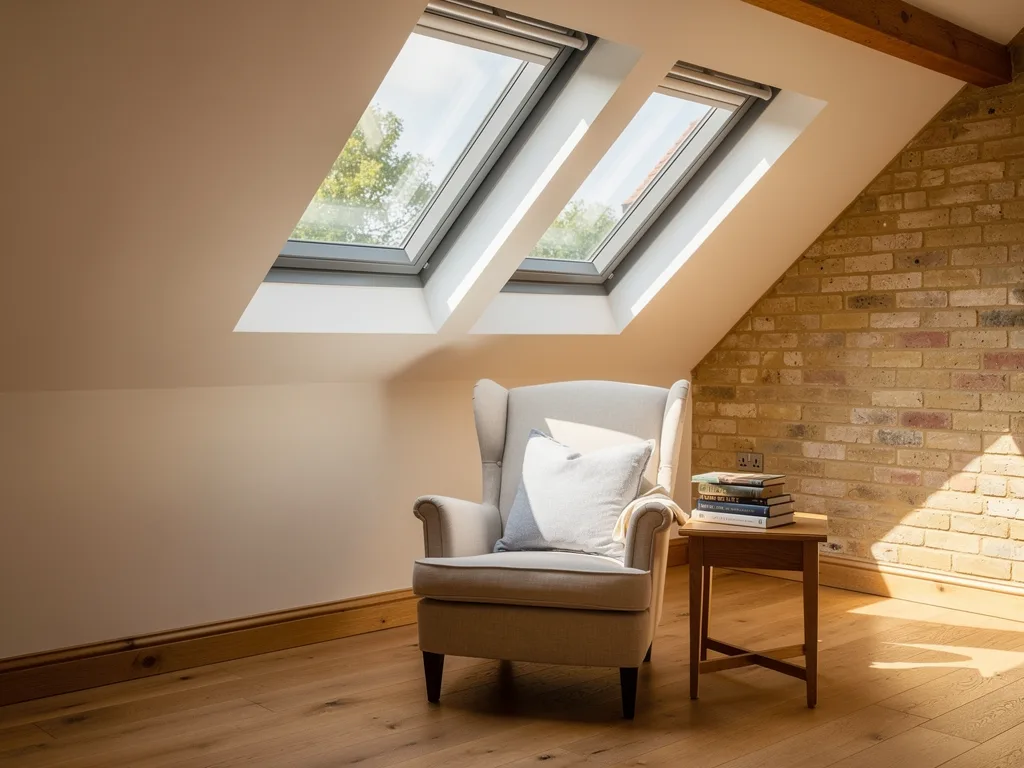
A pitched roof window on a north slope still looks up at a large share of the sky, so it collects useful daylight all year even though direct sun rarely reaches the glass.
It helps to picture the pane itself. On a typical Cambridge terrace or 1930s semi the roof is pitched somewhere between 35 and 45 degrees, so a roof window tilts back towards the northern sky at that angle. It does not face the dim northern horizon the way a wall window would. It faces a band of sky that runs from well above the horizon up towards the zenith, and on an overcast day the zenith is the brightest part of the sky. On the grey days that make up a large part of an East Anglian winter, a north-slope skylight and a south-slope one collect far closer amounts of light than people expect.
Direct sun is the difference. Cambridge sits at about 52 degrees north. At midday in late December the sun is only around 14 degrees above the southern horizon, and at the equinoxes it reaches roughly 38 degrees. A north slope pitched at 40 degrees therefore gets no direct sun on its glass from about the autumn equinox to the spring equinox. In summer the picture changes: the midday sun climbs to around 61 degrees and skims the pane, and early mornings and late evenings bring low sun in from the north east and north west. So a north roof window is not sunless. It is sunless in winter and gently sunlit at the edges of long summer days.
- North slope. Soft, steady light all day with no direct sun: even, glare-free and good for studios, kitchens and home offices.
- East slope. Bright morning sun that has moved off by lunchtime: bedrooms and breakfast rooms.
- South slope. The strongest light, peaking at midday. Worth pairing with solar-control glass or a blind to keep summer heat down.
- West slope. Warm, low evening sun: living rooms and kitchens used after work.
- The sun’s path. It rises in the east, is due south at noon and sets in the west, higher in summer and lower in winter.
The flat Cambridge landscape matters too. With few hills or tall ridges to cut off the sky, the main obstruction is usually a neighbouring roof or a chimney stack. On a tight Romsey or Petersfield terrace, the rear slope of the house opposite can block part of the low northern sky, so we check what sits in front of the window at the survey.
Rooms that suit north light
North light is prized wherever people need to see clearly for hours: desks, easels, drawing boards and screens.
The quality of the light is the selling point. There is no hard beam crossing the floor, no bright stripe moving across the desk through the afternoon and no colour shift from warm morning sun to orange evening sun. Artists and architects asked for north-lit studios for exactly this reason, and the same logic applies to a loft office or a spare room turned into a workroom. A screen under a north roof window stays readable all day without closing a blind, which is the problem our answer on where a roof window should go for a home office spends most of its time solving on other slopes.
Bedrooms also do well. A north-facing loft bedroom stays cool on a July night and does not fill with sun at five in the morning, although people who like waking to early light may prefer an east slope, which our guide to roof windows for loft bedrooms covers. Stair landings, dressing rooms and bathrooms are easy wins because the aim is simply more daylight, not sun.
The one room where a north slope asks more of you is a living space you want to feel sunny. It will be bright, but it will not have that warm patch of sunlight on the floor. If the loft has both a north and a south slope, a common answer is to put the main glazing on the north side and a smaller, controlled window on the south.
Getting enough light through a north roof window
Because a north slope delivers diffuse light rather than sunshine, the size, height and glass of the window do more of the work.
A few choices make a clear difference:
- Go a size up where the rafters allow. A taller window sees a wider band of sky. Our guide to types of roof window sets out the sizes and opening styles.
- Set the window higher in the slope. A higher pane sees more of the bright upper sky and throws light deeper into the room. The balance with view and reach is covered in positioning a roof window in a room.
- Splay the lining. Angling the reveal at the head and sill spreads diffuse light across the ceiling instead of trapping it in a deep box.
- Pair windows. Two windows side by side, or a stacked pair, give a north room the brightness of a much larger opening.
Glass choice runs the other way from a south slope. Heavy solar control coatings exist to cut heat and glare, and on a north slope there is little of either to cut, so they mostly cost you light. A clear, high light transmission low-E double glazed unit, with a laminated inner pane for safety overhead, is usually the right starting point. Triple glazing lowers heat loss further but also trims the light a little, so on a north slope it is a trade to weigh rather than an automatic upgrade. Our page on roof window glazing options compares them.
| Season | Direct sun on a 40° north slope | What the room feels like |
|---|---|---|
| Winter | None | Soft, even, cooler light |
| Spring and autumn | Little or none | Bright on clear days, no glare |
| Summer | Early, late and a midday skim | Brightest, still comfortable |
Practical points that differ on the north side
The fitting is the same as on any slope, but a north slope stays colder and damper, which affects a few details.
North roof slopes dry out more slowly after rain and dew, which is why moss and algae tend to gather on them. A roof window with a rotating sash lets you clean the outside pane from inside the room, and the flashing kit matched to the roof covering keeps water moving past the frame. Our guide to roof window flashings explains the options for tiles, slate and pantiles.
The glass on a north slope also gets no winter sun to warm it, so a room with drying laundry or a shower can show condensation on the inner pane on cold mornings. Good trickle ventilation through the window's vent flap, a sensible heating pattern and a warm edge spacer in the glass unit all help, and roof window ventilation covers the detail.
Rules do not change with orientation. A new roof window is normally notifiable under the Building Regulations, and we handle the Building Control notification where it is. Planning follows the usual permitted development limits for rooflights, with extra care in a conservation area, and a rear north slope that is out of public view is often the easier one to agree. Our answer on whether roof windows need building regulations goes through it.
How we plan a north-facing roof window
At the survey we confirm the true orientation of the slope, measure the pitch and look at what sits in front of it, then write down what the room will get.
Many slopes described as north actually face north east or north west, and that matters: a north west slope in Cambridge catches low evening sun from late spring through summer, which is lovely in a sitting room and awkward on a west-facing desk. The written light plan that comes with every quote sets out the position, size, glass and blinds for your slope and the reason for each, and all our work carries a 10-year workmanship guarantee. You can read more about the approach on how we plan the light, or see the full service on our roof window installation page. When you are ready, book a light survey or message us on WhatsApp.
Questions people also ask
Is a north-facing roof window darker than a south-facing one?
On a sunny day, yes: a south slope receives direct sun that a north slope does not. On an overcast day the difference is much smaller, because both look up at the bright sky overhead. A slightly larger or higher north window closes most of the gap.
Will a north-facing roof window make the loft cold?
Not if it meets current Building Regulations. The glass has to meet the Part L thermal limit whichever way it faces. The room simply misses out on free winter sun warmth, which is small in December on any slope.
Can you put a pitched roof skylight on a north facing roof with a low pitch?
Yes, within the window's rated minimum pitch. A shallower north slope actually sees more sky and gets a little more summer sun on the glass. Below the rated pitch a different product is needed, as our answer on the minimum roof pitch for a roof window explains.
Is north light good for a painting studio?
It is the classic choice. North light keeps a steady colour and intensity through the day, so colours on the easel look the same at 10am and 3pm, and there are no moving sun patches on the work.