Start in the room, then look up
The right sun tunnel position on the roof is found from below: first decide where the light should land in the room, then trace a line upwards and see what the roof above that spot can offer.
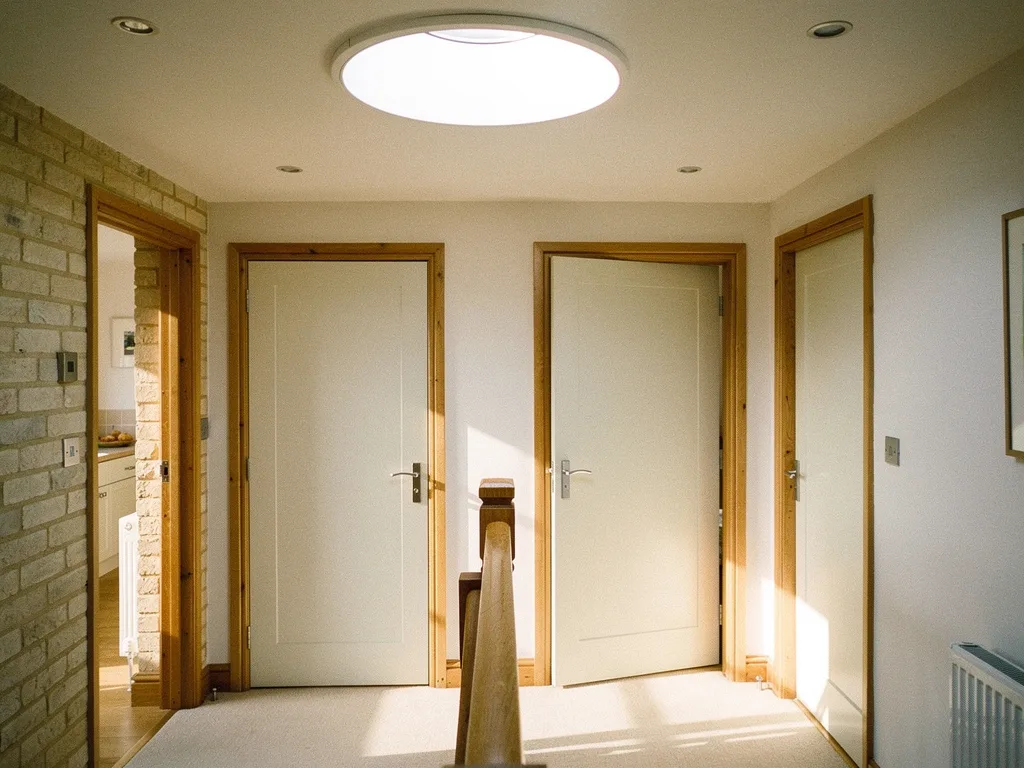
It is tempting to begin on the roof, pick the sunniest slope and work down from there. That route often ends with a diffuser in the wrong part of the ceiling, lighting a strip of landing nobody stands on while the stairs stay dim. A tubular skylight gives a pool of light centred on the diffuser, brightest directly below and fading towards the walls, so the ceiling position sets what the room will feel like. In a windowless bathroom that usually means over the basin and mirror, not the middle of the floor. On a landing it means the head of the stairs, where people need to see their footing. In a hall it may mean the stretch between the front door and the kitchen, where coats and bags collect.
Once that spot is marked, the question becomes what sits directly above it. Sometimes the answer is an open south slope and the job is simple. Often it is a valley, a chimney breast, a water tank or a purlin in the loft, and the position has to move. The rest of this guide is about making that move well: which slope to prefer, how far a dome can shift before the tube suffers, and what on a Cambridge roof steals sky. For the principle of how the dome, tube and diffuser work together, the sun tunnel installation hub is the place to start.
What a dome actually sees
A sun tunnel dome collects light from the sky it can see, so the best position is the one with the widest open view of sky and the longest spells of direct sun, not simply the one facing south.
Two kinds of light reach the dome. The first is direct sun, which is strong but moves: its height and direction change hour by hour and month by month. The second is diffuse light from the whole sky, which on an overcast Cambridge day is almost all the light there is. A dome that sees a large, open patch of sky does well in both. A dome tucked against a chimney or a taller wall loses direct sun for part of the day and also loses a slice of the sky dome, which costs it light even when the weather is grey. There is more on how that grey-day light behaves in do sun tunnels work on cloudy days.
Cambridge helps here. The city and the land around it are flat, with no ridge of hills to cut off the low sun, so the horizon a roof sees is mostly made by other buildings and trees rather than by landform. That makes the neighbouring roofline the thing to study, and it means the difference between a good spot and a poor one on the same roof can be a metre or two.
The sun's height is the other half. At noon on the shortest day the sun over Cambridge stands only about 14 degrees above the horizon. At the spring and autumn equinoxes it reaches about 38 degrees at noon, and at midsummer about 61 degrees. Those three numbers explain most of what follows, because a sun that low in winter is easily blocked, and a roof slope can tilt a dome towards it or away from it.
- Winter solstice, about 14°. The lowest noon sun of the year travels furthest: it crosses the whole room and lands high on the back wall.
- Spring and autumn equinox, about 38°. The light lands on the floor, deep in the room.
- Summer solstice, about 61°. The highest, strongest sun drops steeply and lands close under the window.
- South-facing roof window. The same opening lets in a different patch of light every month.
- Deepest reach. In December the sun patch can be on the wall opposite, which is why we plan where it falls, not just how big the glass is.
Choosing between slopes
On a pitched roof, the slope decides how steeply the sun strikes the dome, and the difference between a south and a north slope is largest in the months when daylight is scarcest.
A roof slope tilts the dome's base. On a south slope the tilt leans the dome towards the noon sun, adding the roof pitch to the sun's height. On a north slope it leans the dome away, taking the pitch off. East and west slopes sit side-on to the noon sun and come into their own in the morning or evening. The table below works this through for a typical 40 degree pitch, showing the angle of the noon sun above the plane of the roof. It is geometry, not a light reading, and it describes direct sun only.
| Dome on | Midwinter noon | Equinox noon | Midsummer noon |
|---|---|---|---|
| Flat roof | About 14° | About 38° | About 61° |
| South slope, 40° | About 54° | About 78° | About 79° |
| East or west slope, 40° | About 11° | About 28° | About 42° |
| North slope, 40° | Below the roof | Level with the roof | About 21° |
Read across the rows and the pattern is plain. A south slope gives the dome a steep, generous angle to the sun all year, and in December it does better than a flat roof by a wide margin. That is the slope to prefer for a room that needs its light in winter mornings and afternoons, such as a hall or a landing used every day. It is also the slope that brings the most warmth down the tube in July, which is worth knowing for a small bathroom; there is more on that in do sun tunnels let heat in.
An east slope collects the morning. The sun rises in the south east in winter and the north east in summer, so an east-facing dome gets direct light early and loses it after midday. That suits a bathroom or kitchen corner used before work. A west slope does the reverse and suits a room used in the late afternoon and evening.
A north slope sees no direct noon sun from roughly the autumn equinox to the spring one, and only a modest angle in summer, though in June it catches the early and late sun as it rises and sets in the north east and north west. What it keeps all year is the bright sky overhead, which gives steady, even light with very little glare. Plenty of homes have only a north slope over the room in question, and a sun tunnel there still works; the details are in can a sun tunnel be fitted to a north facing roof.
What steals sky on a Cambridge roof
With no hills on the horizon, the things that shade a Cambridge dome are close to home: chimney stacks, taller walls, dormers, trees and, on newer estates, the next block along.
The winter sun angle turns small obstacles into big ones. An object shades the dome from the sun whenever its top sits higher, as seen from the dome, than the sun does. With a noon sun at about 14 degrees, that happens when the obstacle is taller than roughly a quarter of its distance away. A chimney stack standing 1 metre above the dome and 4 metres to the south of it is enough to put the dome in shade at noon on the shortest day. Move the dome 2 metres further along the slope, out of line with the stack, and the winter sun comes back. In summer, with the sun at about 61 degrees, the same stack barely matters.
That is why positions on terraced roofs in Romsey, Petersfield and around Mill Road need care. Stacks sit on the party walls, back additions step down behind the main roof, and a neighbour's rear dormer can rise well above your slope a few metres away. On the gault brick terraces of Chesterton and De Freville, mature garden trees add a seasonal layer: bare in winter, when a tree lets through much of the low sun, and in full leaf in summer, when the sun is high enough to clear it. On new homes at Eddington or Trumpington Meadows, three and four storey blocks and tight streets mean a low-rise roof can lose its winter sun to the building opposite for part of the day.
Solar panels deserve their own mention. A dome placed just north of an array can sit in the panels' shadow for much of the winter, and a dome placed just south of it can shade the bottom row. Keeping a clear gap, and leaving room to reach both, is part of choosing the spot.
Where on the slope, not just which slope
Once the slope is chosen, the dome's height up the roof and its line across it decide how long and straight the tube can be, which matters as much to the light as the direction the slope faces.
Low on a pitched roof, near the eaves, the loft is shallow. A dome there gives a short drop to the ceiling, but the space can be too tight to work in, and the tube may have to pass through the thickest part of the insulation at a flat angle. High up, towards the ridge, the loft is roomy but the drop to the ceiling is long. The sweet spot on most houses is somewhere in the lower half of the slope, positioned so the tube runs as close to straight down to the diffuser as the rafters and joists allow.
Each bend and each extra metre of tube costs light, which is why a slightly less sunny spot with a short, straight route can beat a sunnier one reached through two elbows and a long run. Sun tunnel length and bends explains that trade in detail. As a working habit, we look for the best open sky within a short, straight reach of the ceiling spot before we consider anything further away.
A few practical limits narrow the choice further:
- Clear of valleys, hips and the ridge, where water gathers or the covering is cut and fixed differently.
- Between rafters where the diameter allows, so no structure needs cutting; a larger tube may need a rafter trimmed, which is planned in advance.
- Away from the line directly below a chimney, where water and debris run off the stack.
- Clear of the zone beside a party wall, where fire rules for the roof covering apply; Building Control will confirm what applies to your roof.
- Clear of loft obstacles such as water tanks, purlins, flues and vent pipes, which can force a bend if ignored.
How each covering is flashed, from slate to plain clay tiles, is covered in sun tunnels for pitched roofs.
Positioning on a flat roof extension
On a flat roof the dome sees the whole sky, so the main questions are how close it sits to the taller wall of the house and how it drains, not which way it faces.
A flat roof has no slope to tilt the dome, which makes the result more even through the day. The risk is the wall behind it. Many rear extensions in central Cambridge sit on the north side of a two storey house, because the garden faces north. That rear wall throws a long shadow in winter: a wall rising 5 metres above the extension roof blocks the noon sun at 14 degrees for roughly 20 metres out, which is further than most extensions reach. In other words, a dome on that roof will get little or no direct winter sun wherever it goes, and the position should favour open sky instead. Setting it towards the garden end, away from the wall, gives it a larger view of the sky and less of the brickwork.
Where the extension faces south or sits in a side return with the main house to one side, the house wall shades the dome for only part of the day, and moving the dome a metre or so away from the wall can buy an extra hour or two of direct sun in winter. The upstand, falls and drainage for a flat roof dome are set out in sun tunnels for flat roofs; for positioning, the point to remember is that the dome should never sit where water ponds.
Front slope, back slope and the view from the street
Most sun tunnel domes can go on either side of the roof, but the rear slope is often the easier choice where the street view matters, and in some places it is the only sensible one.
Fitting a sun tunnel to a house is usually permitted development, provided the dome does not project more than 150mm beyond the roof plane and does not rise above the highest part of the roof. Many domes stand taller than that, which is one reason low-profile domes and careful positioning come up so often. In a conservation area the planning officer's interest is the view from the street, so a dome on a rear slope out of public view is generally the more comfortable position. Flats, maisonettes and listed buildings follow different rules, and an Article 4 direction can remove permitted development in parts of some conservation areas. Before settling on a front slope in a place like Newnham, Grantchester or the older village centres, check the position with Greater Cambridge Shared Planning or your district council. The specifics are in can sun tunnels be fitted in a conservation area.
This is one place where the light and the planning can pull in different directions. A south front slope may give the best winter light, while a north rear slope is the planning-friendly option. Knowing both answers lets you choose with open eyes, and sometimes a larger diameter on the rear slope makes up much of the difference; choosing a sun tunnel diameter explains how size and room area relate.
How we settle the position before fitting
We fix the dome position at the survey, on your roof and in your room, and write it into the light plan that comes with the quote, so the spot is agreed before anything is cut.
The survey follows the same order as this guide. We start in the room and mark where the light needs to fall. We go into the loft to see what lies above that mark: rafters, joists, purlins, tanks and insulation, and whether a straight drop is possible. We look at the roof from the garden and, where we can, from the street, noting stacks, dormers, trees and panels. Then we check the orientation of each candidate slope and read the sun path for the times of year you care about. If you use a room mainly on winter mornings, an east or south position matters more than the summer picture. If the room is used all day and glare would be a nuisance, a north position can be the calmer choice.
The written light plan records the slope, the position on it, the diameter, the route of the tube and the reason for each choice, alongside the Building Control notification where the work is notifiable. It is the same method we use for every rooflight and skylight, described in full on how we plan the light. If you would like us to look at your roof, book a light survey.
Questions people ask
Is a south-facing slope always the best position for a sun tunnel?
It gives the most direct sun, especially in winter, but it is not always the best choice. If the south slope is shaded by a stack or a neighbour's dormer, or reaching it needs a long tube with bends, a shorter, straighter run from an east, west or even north slope can put more light into the room. A south position also brings the most summer warmth down the tube.
Can the dome sit away from the room it lights?
Yes, within limits. The tube can be offset with angled sections to reach a better patch of roof, but every bend and extra length reduces the light that arrives. We weigh the gain from a sunnier or less shaded dome position against the loss from a longer route before recommending one.
Does a tree near the house rule out a sun tunnel?
Not usually. A deciduous tree is bare in winter, when the sun is low and most needed, and in summer the sun is high enough to clear many garden trees for much of the day. An evergreen or a tall tree close to the south of the dome is a bigger concern, and moving the dome along the slope out of its shadow often solves it.