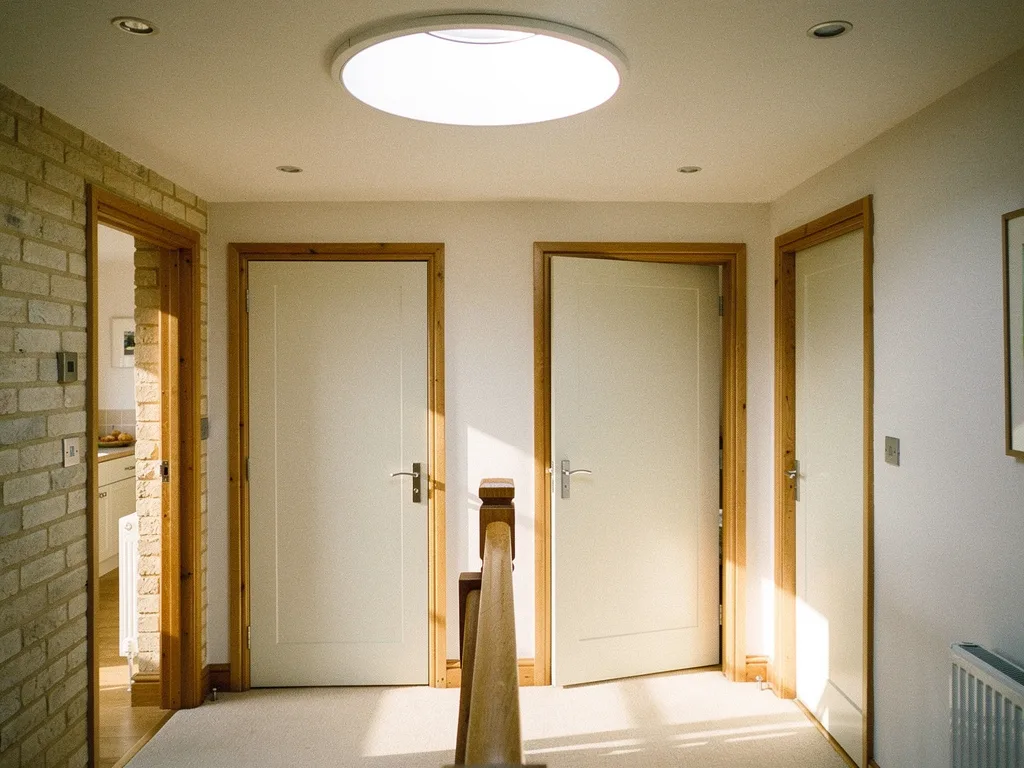
The route decides the brightness
Two sun tunnels with identical domes and diffusers can light a room very differently, and the difference is almost always the route between them: how far the light has to travel and how many times it has to turn.
A sun tunnel, or tubular skylight, has no lens and no pump. It is a mirror-lined pipe that passes daylight from a dome on the roof to a diffuser in the ceiling, one reflection at a time. Every reflection hands on nearly all of the light that reaches it, but never quite all of it. So the question of sun tunnel length and bends is really a question of how many reflections the light makes on the way down, and how much each one keeps.
That is why we treat the route as the first thing to design rather than the last thing to fit. The roof position gives you the sky, the diameter gives you the size of the beam, and the route decides how much of that beam survives to the ceiling. If you want the underlying mechanics of dome, tube and diffuser first, how sun tunnels work sets them out. This guide stays with the route: what each metre costs, what each change of direction costs, how the two add up, and where the sensible limit sits for a particular product.
- Dome: a clear, UV-stable dome that catches daylight from a wide angle.
- Flashing: a flashing plate that sits into the tiles or slates, like a roof window flashing.
- Rigid reflective tube: a highly reflective lining bounces the light down its length. Rigid tube loses far less light than flexible.
- Adjustable bends step the tube around joists, purlins or tanks. Every bend and every metre costs some light, so the run is kept short and straight.
- Ceiling diffuser: a ring and a frosted lens that spread the light evenly and seal the ceiling.
- Light into the room: a hallway, landing or bathroom with no window gets real daylight.
- Loft insulation made good around the tube, which is often sleeved in the loft to limit condensation.
It helps to picture the finished room while reading. A short, straight tube over a bathroom gives a disc on the ceiling that is bright enough to shave by on a February morning. The same kit pushed through a long, crooked loft route to a ground floor hall can give a disc that glows pleasantly at midday in June and looks grey by three o'clock in December. Nothing about the dome or the diffuser changed; only the journey did.
What a metre of straight tube costs
Length on its own does not absorb light. What it does is give the light more chances to hit the wall, and each hit keeps a slightly smaller share than the last.
Light enters the dome at the angle of the sun and zigzags down the tube, striking one wall, then the opposite wall, until it reaches the diffuser. The lining is the whole story here. High specification rigid tubes use a polished or coated silver or aluminium finish, and makers quote reflectivity figures for their premium linings in the high nineties per cent per reflection. Flexible tubes use a thinner foil pleated into ribs, and the figures makers quote for them are lower, partly because the ribs scatter light sideways instead of passing it cleanly on.
Those per-reflection numbers look almost perfect, but they compound. A little arithmetic shows why a few percentage points matter so much:
- At 99 per cent kept per reflection, twenty reflections leave roughly four fifths of the light.
- At 98 per cent, the same twenty reflections leave about two thirds.
- At 95 per cent, twenty reflections leave a little over a third.
These are illustrations of the maths, not forecasts for any particular tube. They explain two things you will see in brochures. First, makers of rigid systems tend to quote only a small loss per metre of straight tube, often in the low single figures of per cent, because their linings sit at the top of that range. Second, the per-metre figures makers quote for flexible tubing are markedly higher, and some flexible kits are sold only for short runs for exactly that reason. The detailed comparison of the two tube types lives in rigid vs flexible sun tunnels; here the point is simply that every extra metre multiplies whatever the lining loses.
Diameter changes the count too. A light ray crossing a 350mm tube travels further between walls than one crossing a 250mm tube, so over the same metre it makes fewer reflections. A wider tube is therefore not only bigger at the dome but more forgiving of length. If a route has to be long, stepping up a size is often worth more than any other change. Choosing a sun tunnel diameter covers matching size to the room itself.
Why length hurts more in a Cambridge winter
The cost of each metre is not fixed through the year. A low sun sends light into the tube at a shallow angle, and shallow light bounces far more often per metre than light arriving from high overhead.
In Cambridge the sun at noon reaches about 61 degrees above the horizon in midsummer and only about 14 degrees at midwinter. Take a simple case: a 350mm tube dropping straight down through a flat roof. With the summer sun at 61 degrees, a ray entering the tube travels steeply and makes only one or two reflections per metre. With the winter sun at 14 degrees, the same ray enters almost sideways and makes something like eleven or twelve reflections per metre of drop.
Put that into a three metre run. In June the light arrives after perhaps five reflections; in late December it may need more than thirty. At a lining that keeps 98 per cent per reflection, that is the difference between about nine tenths of the light and about half of it reaching the diffuser, before anything else is counted. And the winter sky is dimmer to begin with, so the tube is losing a bigger share of a smaller supply at the time of year you most want the help.
Two things soften this. Many domes include a collector or a shaped inner lens meant to catch low sun and turn it down the tube at a steeper angle, which cuts the reflection count. And on an overcast day, which describes a good part of a Cambridge winter, the light comes from the whole sky rather than one low point, so a share of it enters closer to vertical. The practical conclusion stays the same: a long run is judged by its winter performance, not its summer one.
What each bend does to the light
A bend is where length turns into loss much faster. Light that was travelling cleanly down the tube meets a wall at a new angle, reflects more often through the turn, and some of it is sent back the way it came.
Rigid systems make changes of direction with elbow sections. These are usually adjustable within a set range, so an installer can match the pitch of the roof and then turn the tube to vertical above the ceiling. Makers quote a light loss for each elbow, and the figure rises with the angle: a gentle adjustment of a few degrees costs little, while a sharp turn costs noticeably more. Figures makers quote for a single elbow are typically several times the loss they give for a metre of straight rigid tube. That is a useful way to think about it: in a rigid run, one elbow can cost as much light as a few extra metres of straight tube.
An offset, where the tube has to step sideways past a purlin or a water tank and then carry on in the original direction, needs two elbows. So a route that looks like a small dog leg on paper actually carries two bends' worth of loss. A route with a roof angle turn at the top, an offset in the middle and a ceiling turn at the bottom can end up with four elbows, which is where a tube starts to feel dim even in good weather.
Flexible tube bends by curving the foil. The inside of every curve bunches the ribs into tighter folds, and those folds scatter light in every direction. A long, gentle sweep does far less harm than a tight kink, and a curve that is left to sag between fixings loses more than the product sheet suggests, because the folds deepen wherever the tube is not pulled taut. The figures makers quote for flexible tube are measured on a fully extended, properly supported sample, which is the standard the fitting has to meet if the room is to get anything like that light.
The angle of the roof itself counts. On a pitched roof, the dome sits on the slope and the tube usually needs to turn at least once to drop vertically into the ceiling. On a roof pitched at around 40 degrees, as on many Victorian terraces in Romsey and Petersfield, that first turn is a real bend. On a low pitch bungalow roof, it is a small adjustment. Sun tunnels for pitched roofs explains the flashing and angle at the top of the run.
Adding up a real route
A route is only as good as its total of metres and bends taken together. The table sets out some typical Cambridge situations and what each tends to mean for the light at the ceiling.
| Situation | Typical run | Bends | Light at the ceiling |
|---|---|---|---|
| Flat roof extension, straight drop | Under 1m | None | Close to the best the kit gives |
| Bungalow, low pitch | About 1m | One gentle | Strong |
| Terrace loft to landing | 1.5 to 3m | One or two | Good with rigid tube |
| 1930s hipped semi, around a tank | 2 to 3.5m | Two to four | Needs careful routing |
| Through an upper floor | 4m and over | Two or more | Wider rigid tube essential |
The rows are a guide to the shape of the problem, not measured results for any particular house. A flat roofed rear extension off a Mill Road terrace is the ideal case: the dome sits directly over the kitchen or dining ceiling, the tube may be shorter than the kerb is tall, and there is nothing to turn. Sun tunnels for flat roofs covers those short vertical runs. A bungalow comes next, which is why a sun tunnel in a bungalow can light a windowless central room so well.
The two storey house is where routes get interesting. From a spot on the rear slope of a gault brick terrace in De Freville or Chesterton down to the landing, you might have two metres of tube and a turn at each end. In a hipped 1930s semi in Cherry Hinton, the roof slopes in from three sides and the old cold water tank often sits over the stairwell, so the tube may need an offset as well. In a new home at Eddington or Great Kneighton, trussed rafters set the gaps the tube can pass through, and a route that would be straight in an open cut roof has to thread between truss webs that cannot be cut.
The last row is the hard one. Carrying daylight through a bedroom or a cupboard to a ground floor room can work, but it asks everything of the tube. Our answer on whether a sun tunnel can go through two floors looks at when it is worth doing.
The practical maximum, product by product
There is no single maximum length for a sun tunnel. Each system has its own limit, set by its maker from its lining, its diameter and its fixings, and the product's own figure is the one that counts.
What can be said in general is where those limits tend to fall. Rigid systems are sold with straight extension sections, and some ranges allow runs of up to about six metres in total with extensions, though others stop well short of that and the permitted length can drop as elbows are added. Flexible kits are generally intended for much shorter runs, and makers themselves advise keeping flexible sections short, straight and fully extended. A few systems combine the two, using rigid sections for the long straight part and a short flexible link where the route has to adjust.
A maker's maximum is a physical limit, not a promise of good light. A tube can be within the maker's permitted length and still give a room too little light for how it is used. So we work to two limits at once:
- The product limit: the maximum length and number of elbows the maker allows for that specific system and diameter, which we never exceed.
- The room limit: the length and number of bends beyond which the disc on the ceiling would no longer do the job the room needs, on a dull winter day as well as a bright summer one.
The room limit is usually the tighter of the two. A walk-in wardrobe or a cloakroom that needs enough light to find things by can take a longer route than a landing where people read the post, and a landing can take a longer one than a kitchen corner where people cut vegetables. How much light a sun tunnel gives compares tube output with familiar lamps, which helps set what the room actually needs.
When a route runs up against either limit, the honest answer is sometimes a different product. A rooflight or roof window gives far more light for its size on a room directly below the roof, and sun tunnel vs skylight sets out which rooms suit which.
Shortening and straightening the route
Most of the light saved in a sun tunnel installation is saved at the planning stage, by moving one end of the tube a short distance so the route loses a metre or a bend.
Several changes tend to help, and they can be combined:
- Move the dome up or down the slope. A dome higher on the roof sees more sky but lengthens the tube; one lower down shortens the tube but may sit in the shade of a neighbouring roof or a chimney. There is a balance point for each roof, and where to put a sun tunnel on the roof covers finding it.
- Move the diffuser a little. A diffuser 300mm along the landing ceiling from the ideal spot may still light the space well and remove an offset entirely.
- Choose the other slope. On a terrace running east to west, the front and rear slopes face different ways. A slightly less sunny slope with a straight route can beat a sunnier one with two extra elbows, especially in winter.
- Go wider. A larger diameter makes fewer reflections per metre and per bend, which recovers much of the light a long route would otherwise lose.
- Use rigid tube for the length. Keep any flexible section as a short link only, fully extended and properly supported.
- Clear the path. Relocating a redundant water tank or rerouting a cable run can turn a crooked route into a straight one.
The loft side of the tube also needs insulating, whichever route is chosen, so the tube does not become a cold channel through the warm envelope of the house. A longer route means more tube in the cold loft, and so more to insulate. The insulation is wrapped close around the tube along its whole loft section.
How we draw the route in your light plan
Every quote we give comes with a written light plan, and for a sun tunnel the route is the heart of it: the dome position, the tube type and diameter, the length, each change of direction and the reason for it.
At the survey we measure the roof pitch and covering, go into the loft, and trace the path from the best patch of sky to the point on the ceiling where the light is needed. We note every purlin, truss, tank and cable on the way. Then we compare two or three possible routes on paper and choose the one with the fewest metres and the gentlest bends that still serves the room. If the best achievable route would leave the room short of light in winter, the plan says so plainly and sets out the alternatives, whether that is a wider tube, a different position or a rooflight instead. The same way of thinking runs through all our work, and how we plan the light explains it for every kind of roof glazing.
The installation follows the drawn route exactly, with the tube fully extended, sealed at every joint and supported along its length, and the Building Control notification handled where the work is notifiable. The fitting work carries our 10-year workmanship guarantee. To see what a tube would do for your hall, landing or bathroom, see our sun tunnel installation in Cambridge service, or book a light survey and we will trace the route with you.
Questions people ask
How long can a sun tunnel be?
It depends on the product. Some rigid systems allow runs of up to about six metres with extension sections, others less, and flexible kits are meant for much shorter runs. The maker's limit for that system and diameter is the ceiling; the light the room needs in winter often sets a shorter practical length.
How much light does each bend lose?
Makers quote a loss for each elbow that rises with the angle of the turn, and for a rigid system a single elbow is typically quoted as costing several times the loss of a metre of straight tube. Tight bends in flexible tube lose more, especially if the tube sags. Fewer, gentler bends always help.
Is a longer tube with no bends better than a short one with two?
Often, yes, in a rigid system, because a straight metre loses less than an elbow. But the answer depends on the tube, the diameter and the sky the dome sees, so we compare the actual routes at the survey rather than follow a rule of thumb.