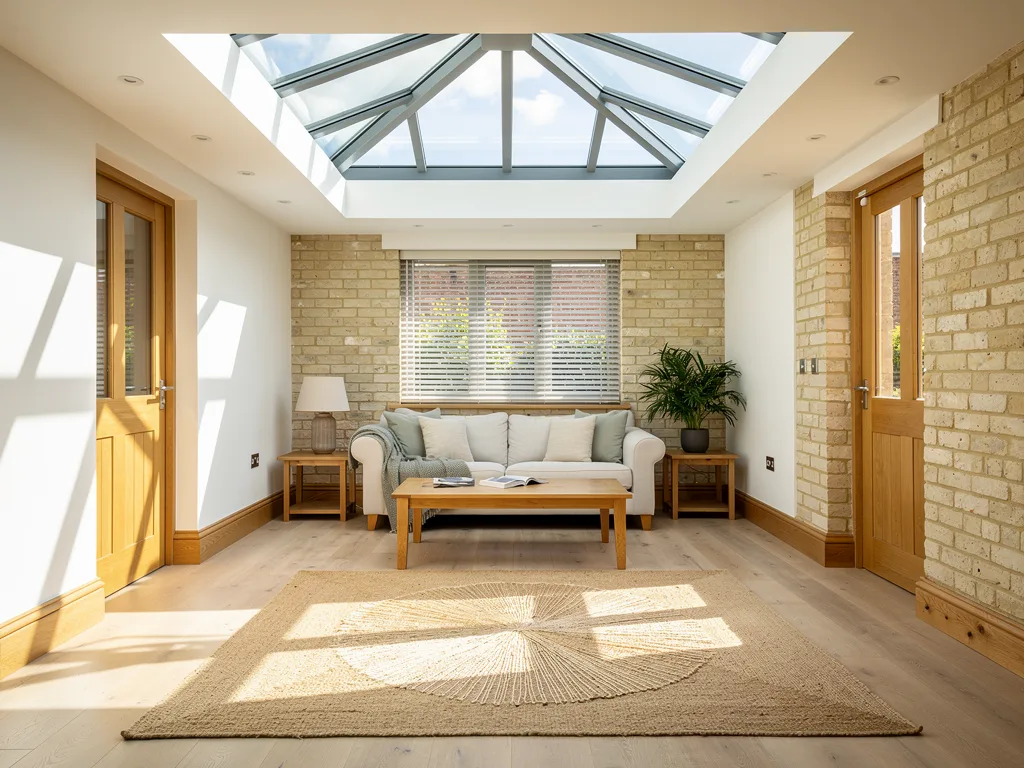
How a heat loss calculation sees a rooflight
To the person sizing a heat pump, a rooflight is simply a patch of roof with a much worse U-value than the insulation around it. It is counted element by element, the same way as walls, floors and wall windows.
A room by room heat loss calculation, the kind an MCS installer works through to the BS EN 12831 method, takes each surface of a room and multiplies three numbers: its area in square metres, its U-value in W/m2K, and the gap between the design indoor temperature and the design outdoor temperature. The results are added up, ventilation and air leakage are added on top, and the total tells the designer how many watts the room needs on a cold winter night.
For a Cambridge home the outdoor design figure sits a couple of degrees below freezing, and a living room is usually designed for about 21°C, so the temperature difference is somewhere in the low twenties. Every watt a rooflight loses at that difference has to be replaced by the emitter in the room, whether that is a radiator or underfloor heating.
The U-value that should go into the sum is the whole-unit figure, frame and upstand included, measured in the horizontal position that Part L now uses. That figure is higher than a centre-pane number or an old vertical test, and our guide to rooflight U-values explains why the difference matters.
What the numbers look like for one square metre
Worked through for a single square metre at a 23 degree difference, a modern rooflight loses a few times more than the insulated roof it replaces, and an old single-glazed skylight loses many times more.
These are illustrative figures using typical U-values, not a design for any particular house. They show why the age and type of the glass matter far more than the fact that a rooflight is there at all.
| Element (1 m2) | Typical U-value | Heat loss at 23K |
|---|---|---|
| Insulated roof | 0.15 | about 3 W |
| Triple glazed rooflight | 1.0 | about 23 W |
| Double glazed, low-E | 1.4 | about 32 W |
| Old single glazed | 5.5 | about 127 W |
A typical house in Cambridge might need somewhere between 4 and 8 kW at design conditions, and heat pumps come in steps of a kilowatt or more. Thirty extra watts from a small roof window does not move a whole-house figure across one of those steps. A 3 by 2 metre roof lantern over a side-return kitchen in Romsey is a different case: its sloping faces give it more glass than its footprint, and with a double glazed unit it can add something like 200 W to that one room, compared with the flat roof it sits in.
Where it really shows: the radiator in that room
The whole-house size is rarely the issue. The room-level emitter is, because a heat pump runs at a low flow temperature and radiators give out much less heat at 45°C than they did on a gas boiler.
A heat pump is at its most efficient when the water in the radiators is kept cool, often 45 to 50°C at the coldest, rather than the 70°C or so a gas boiler used. At those temperatures a radiator delivers perhaps a third to a half of its old boiler rating. So the extra 200 W from a lantern, or the extra 250 W from two old skylights in a loft bedroom, has to come from a bigger radiator, an extra panel, or underfloor heating with enough pipe in the floor.
This is where a rooflight upgrade can pay back in a way that has nothing to do with the heat pump itself. If one room in the house needs a warmer flow temperature than all the others, the designer either raises the flow temperature for the whole system, which costs efficiency every hour it runs, or oversizes that room's emitter. Replacing a poor rooflight before the heat pump goes in can remove the problem room. Our answer on replacing an old rooflight to save energy looks at that choice in more detail.
The parts of a rooflight a designer can miss
The glass is only one route out for heat. The frame, the upstand and the seal around an opening sash all add to the loss, and older units often leak air as well as heat.
- The frame. A non-thermally broken aluminium frame conducts heat straight out, which is why whole-unit figures are worse than centre-pane ones. Thermally broken frames close that gap.
- The upstand or kerb. A timber kerb on a flat roof that is not insulated on its inner face acts as a cold bridge around the whole opening.
- Air leakage. A tired opening skylight with a worn seal adds to the room's ventilation loss, which the calculation handles separately from the U-value.
- Measured area. The area should be the full unit size, not the visible glass or the internal ceiling opening.
If you are having a heat loss survey, it helps to give the designer the product name and its declared whole-unit U-value. Without it they will usually fall back on a cautious default, and a cautious default for a rooflight of unknown age tends to push the radiator size up.
Choosing rooflight glass with a heat pump in mind
Good double glazing is enough for most rooms; triple glazing earns its place over bedrooms, large lanterns and north slopes that never see winter sun.
For a new loft room or extension in Trumpington or Great Kneighton that will be heated by a heat pump from the start, a lower U-value keeps the emitter in that room modest and the flow temperature low. Our comparison of double and triple glazed rooflights covers the trade in weight and light. Keep the summer side in view too. A heat pump that also cools is rare in UK homes, and a south-facing skylight with a high g-value can overheat a room in July however well it holds heat in January, so the glass choice is a balance we set out in every written light plan. Any new or replacement unit also has to meet the Part L limit for rooflights.
If you are planning a heat pump and have old roof glazing, or are adding a lantern or roof window, book a light survey and we will give you the unit's U-value for your heating designer along with the light plan. You can see the wider picture on our energy efficient rooflights page.
Questions people also ask
Will a skylight make my heating bills higher with a heat pump?
A modern unit adds a small amount to running costs compared with solid insulated roof, and it can save some daytime lighting. Our answer on whether skylights increase heating bills works through the balance.
Should I replace old rooflights before or after the heat pump goes in?
Before, where you can. The heat loss survey then uses the better U-value, and the radiators are sized for the house you will actually have rather than the one you are about to improve.
Do north-facing rooflights count differently?
Not in the design calculation, which ignores sun on every slope. In daily running, a north slope gets no winter gain to offset its loss, which is covered in our answer on north facing rooflights.
Does a sun tunnel affect heat pump sizing?
Only slightly. Its ceiling diffuser is small, typically 250 to 350mm across, so even with a modest U-value the loss is a few watts, well inside the margin of any heat loss calculation.
