Why a standard VELUX usually passes the 150mm test
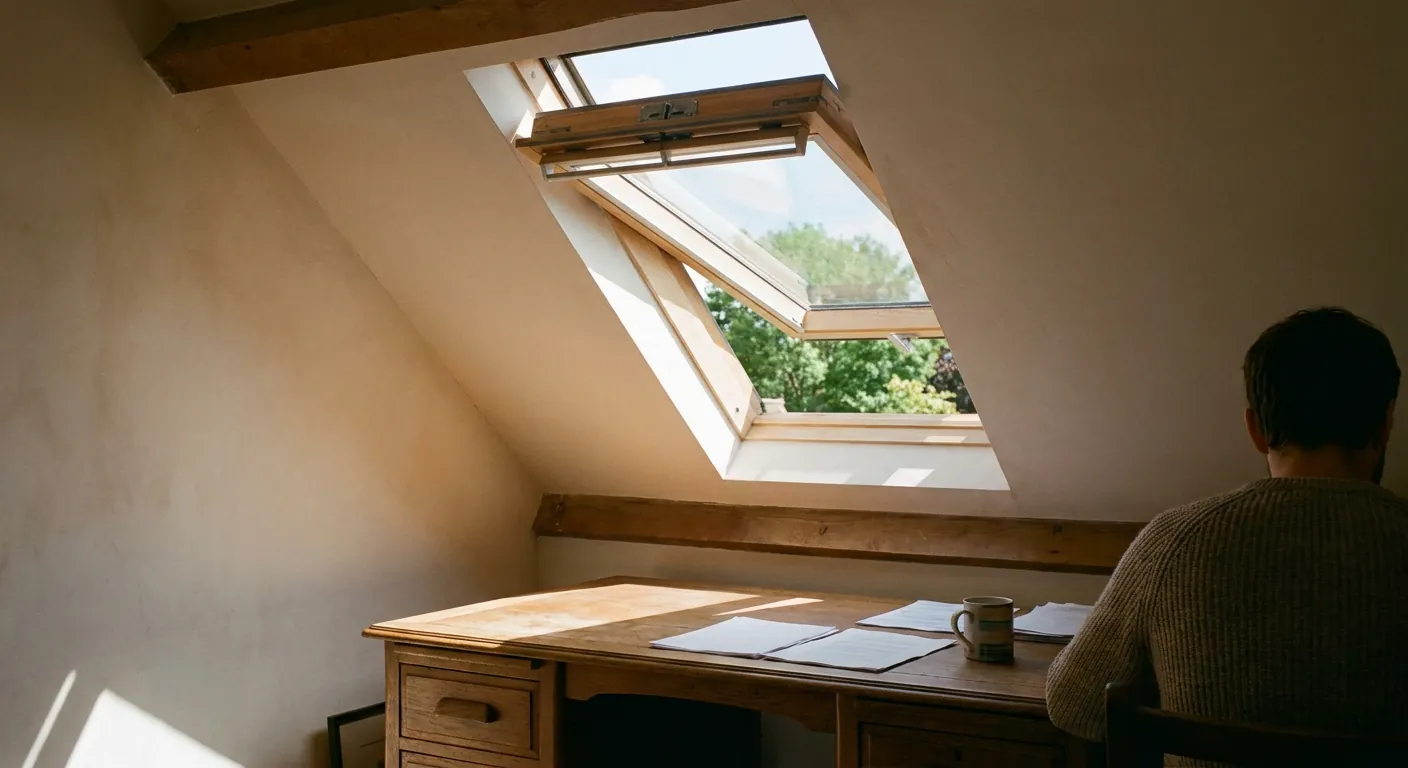
A VELUX roof window is designed to sit down among the tiles or slates, so on a normal pitched roof it stays well inside the 150mm projection limit set by Class C of the General Permitted Development Order 2015.
The measurement runs at right angles to the plane of the roof slope, from the surface of the covering to the outermost point of the window. With a standard flashing such as EDZ for profiled tiles or EDW for thin slates, the sash and cladding usually stand a few centimetres proud of the roof. Recessed flashings set the window about 40mm lower into the roof, which is why they appear on conservation drawings, but the ordinary installation depth is already comfortably under the line. Our guide to VELUX flashing types explains the differences between each kit.
Class C also says the window must not be higher than the highest part of the original roof. A roof window cannot sensibly go above the ridge, so this one rarely matters for a VELUX. The limit that does catch people out is the third one: a window in a roof slope that faces the side boundary must be obscure glazed, and fixed shut unless the opening part is more than 1.7m above the floor of the room. On a semi-detached house in Cherry Hinton or a 1930s pair along Hills Road, a hipped side slope facing next door falls under that rule.
Where the exceptions start
Permitted development belongs to houses, and it can be taken away, so the answer changes for flats, listed buildings, some conservation streets and some newer estates.
- Flats and maisonettes. Class C rights do not apply. A new VELUX in the roof of a converted flat or a block needs a planning application, and usually the freeholder's consent too.
- Listed buildings. Any new roof window, and often a replacement that changes the look, needs listed building consent, whatever its size.
- Article 4 directions. A council can remove roof alteration rights in a defined area. Directions of this kind exist in parts of Greater Cambridge and in East Cambridgeshire conservation areas including Ely, Soham and Burwell. Where one covers roof alterations facing the street, a VELUX on the front slope may need an application while one on the rear slope does not.
- Planning conditions. Newer developments sometimes had permitted development rights removed when the estate was approved. Owners at Eddington, Trumpington Meadows or Great Kneighton should read their original permission before assuming Class C applies.
Being in a conservation area on its own does not remove Class C for roof windows. It does make a street-facing window more likely to draw attention, and in the city's 18 conservation areas the council expects a low, flush profile wherever a roof window is visible. Our VELUX conservation windows guide covers when that style is enough.
Checking your own roof in Cambridge
Greater Cambridge Shared Planning handles applications for both Cambridge City and South Cambridgeshire, and its constraints map is the quickest way to see whether your address sits under a direction or a listing.
Start with the "check for constraints on development" page on the city council website, which shows conservation area boundaries, listed buildings and Article 4 areas. Outside the shared service, East Cambridgeshire, Huntingdonshire and Uttlesford each run their own maps. If the answer is still unclear, a Lawful Development Certificate is a formal confirmation from the council that the work is permitted development. It is optional, but useful when you plan to sell, or when the window sits on a slope a neighbour can see.
| Your situation | Planning route |
|---|---|
| House, rear slope, standard flashing | Usually permitted development |
| House, side slope facing a neighbour | Permitted if obscure and fixed below 1.7m |
| Front slope under an Article 4 direction | Planning application |
| Flat or maisonette | Planning application |
| Listed building | Listed building consent |
Replacements, bigger windows and balconies
Swapping an old VELUX for a current one of the same size and position is not normally something planning is concerned with, but enlarging it, moving it or choosing a balcony window can change that.
A like-for-like replacement does not materially change the outside of the house, so it does not need planning permission on an ordinary home. That includes renewing a pre-2001 window with a current model in the same opening, as covered in replacing an old VELUX window. On a listed building, check anyway: a change of glazing or colour can count as an alteration.
A larger opening or a new position is assessed like a new window, so the Class C limits apply again. See can you fit a bigger VELUX window for the structural side. The CABRIO balcony window is the product most likely to prompt a question, because its lower sash opens outwards to form a small balcony. Councils do not all treat that the same way, and our CABRIO balcony window guide sets out the planning points to raise before ordering.
Planning is not the same as Building Regulations
Even when no planning application is needed, a new VELUX window that cuts a new opening is building work, and Building Control normally has to be told about it.
The regulations look at how the roof is trimmed around the opening, the thermal performance of the window under Part L, ventilation under Part F and, for windows within reach, safety glazing under Part K. A new opening usually goes through a building notice or full plans application with the council or an approved inspector. We handle the Building Control notification where the work is notifiable, and install to current Building Regulations. If you are weighing up doing it yourself, can you fit a VELUX window yourself explains the duty that comes with it.
Questions people also ask
Do you need planning permission for VELUX skylights on a bungalow?
Not usually. A bungalow is a house, so Class C applies in the same way, including the side slope rule, which matters on hipped bungalow roofs where most slopes face a neighbour.
Can I put a VELUX on the front of my house without permission?
On an ordinary house outside an Article 4 area, yes, provided it meets the 150mm and ridge limits. Check the constraints map first, because Article 4 directions are usually aimed at the slopes a street can see.
Does a loft conversion with VELUX windows need planning permission?
A loft conversion that only adds roof windows, with no dormer, normally stays within Class C. It will still need Building Regulations approval for the conversion itself. Our VELUX window installation page covers loft layouts.
How long does a Lawful Development Certificate take?
The statutory target for a decision is eight weeks. It is not required to start work, so many owners go ahead once they are confident the window meets the Class C limits.