Why the names overlap
The words blur because three groups use them differently: the trade, the manufacturers and the people searching online.
In the UK building trade, "rooflight" is the umbrella term for any glazed opening in a roof, from a small fixed pane on a flat roof to a large lantern over a kitchen extension. "Skylight" means the same thing in everyday speech and is the word typed into a search box. "Roof window" is narrower. Manufacturers use it for a unit designed to sit in the slope of a pitched roof, between or across the rafters, with a sash that opens and a handle you can reach. Any roof window tends to get called a "Velux", after the best-known brand, which adds a fourth name to the pile.
Building Regulations do not separate them much either. Approved Document L, for example, sets one limiting U-value for rooflights and roof windows together. So the difference is not legal or technical so much as practical: what the unit does, where it sits and whether a person can use it like a window.
What makes a roof window a roof window
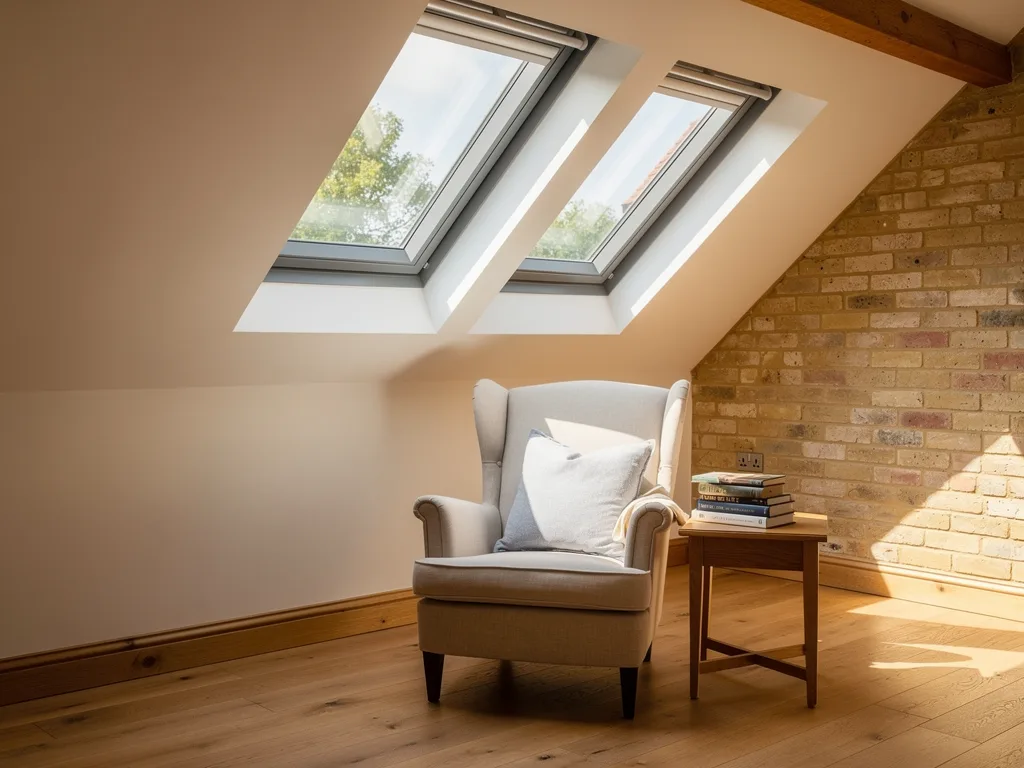
A roof window is built to be used as well as looked through: it opens, it can be reached, and it often gives you a view.
Three things usually mark one out. It sits in a pitched roof, typically at 15 degrees or steeper, with a flashing kit that ties it into the tiles or slates around it (our guide to roof window flashings covers how that works). It has an opening sash, hung at the centre, the top or the side, with a handle placed so an adult can operate it without a pole. And it is positioned with a person in mind: low enough to reach, high enough to look out of, in a room people stand and sit in.
That last point is why roof windows dominate loft conversions. In a loft bedroom under a Cambridge terrace roof, a roof window is the ventilation, the view of the sky and, in the right size and position, the fire escape route as well. The different ways a sash can open are set out in types of roof window, and the escape rules in roof windows and fire escape rules.
Where a skylight is a different thing
Once the glazing moves onto a flat roof, or rises out of reach, the name usually shifts from roof window to a skylight or rooflight.
A flat rooflight on a single-storey rear extension is the clearest example. It sits on an upstand at least 150mm above the finished roof, the glass is set at a slight fall so rain runs off, and it is usually fixed. Where it does open, it is normally by an electric motor with a wall switch or remote, because the frame may be three metres above the floor. Roof lanterns and walk-on rooflights belong to the same flat-roof family.
A second group sits in pitched roofs but still reads as a skylight rather than a roof window: a fixed pane high in a vaulted ceiling, a small unit lighting a stairwell, or a slim conservation rooflight on an older cottage. None of these are meant to be leaned out of. Then there are sun tunnels, which carry light down a reflective tube and give no view at all.
| Roof window | Skylight or rooflight | |
|---|---|---|
| Roof type | Pitched | Flat or pitched |
| Opening | By hand, usually | Often fixed, or electric |
| Reach | Within reach | Often overhead |
| View out | Sky and rooftops | Mostly sky |
| Main job | Light, air, view | Light |
How each one lights the room
The two are shaped differently, so they place light differently, and that matters more to how the room feels than the name on the box.
A roof window in a slope faces one direction. On a south slope it takes low winter sun deep into the room and a lot of heat in summer; on a north slope it gives steady, soft light with little glare. Because the glass is angled, the light travels across the room as well as down, and you get a view of sky and rooftops from a standing position.
A flat rooflight looks straight up at the whole sky. On Cambridge's flat, open land there is little to shade it, so it gathers more daylight for its size than an upright window, and the direct sun falls as a sharp patch of sunlight that moves across the floor through the day. That is good over a dining table in the middle of a deep terrace plan, and less good over a television or a desk.
Which one your project needs
The roof usually decides first, and the way the room is used decides second.
- Loft conversion or room in the roof: roof windows, because you need air, a view and often an escape opening. See roof windows for loft conversions.
- Single-storey extension or side return: a flat rooflight or lantern, since the roof is flat and the glass will be overhead.
- A shallow pitched roof: check the pitch first, as standard roof windows have a minimum rating; roof windows for low-pitch roofs covers the options.
- A high vaulted ceiling: either, with electric opening on anything out of reach.
Both types are normally notifiable under Building Regulations when they are new openings, because they affect the structure, insulation and fire performance of the roof. We handle the Building Control notification where the work is notifiable, and the detail is in do roof windows need building regulations. If you are weighing up both in one project, our roof window installation page explains how we survey, and you can book a light survey for a written light plan.
Questions people also ask
Is a Velux a skylight or a roof window?
Velux is a brand name. Most of the units people call a Velux are roof windows: pitched, opening and within reach. The same maker also produces flat roof skylights and sun tunnels, so the name alone does not tell you which type you have.
Can a skylight open?
Yes. Many flat rooflights are made in opening versions, usually hinged and driven by an electric actuator, and some include rain sensors that close them automatically. An opening rooflight can help with ventilation, particularly as a high outlet for warm air.
Is a roof window or a skylight better for a loft?
In a habitable loft room a roof window is almost always the right choice, because it opens by hand, gives a view and can be sized as an escape window. A fixed skylight suits a loft only where it lights a stair or a corner no one needs to reach.
Do roof windows and skylights cost the same?
Not usually. The price depends on size, glass, opening type and how much structural and lining work the roof needs, and flat rooflights add the upstand and roof finish. Our costs page gives general UK ranges as a guide.
