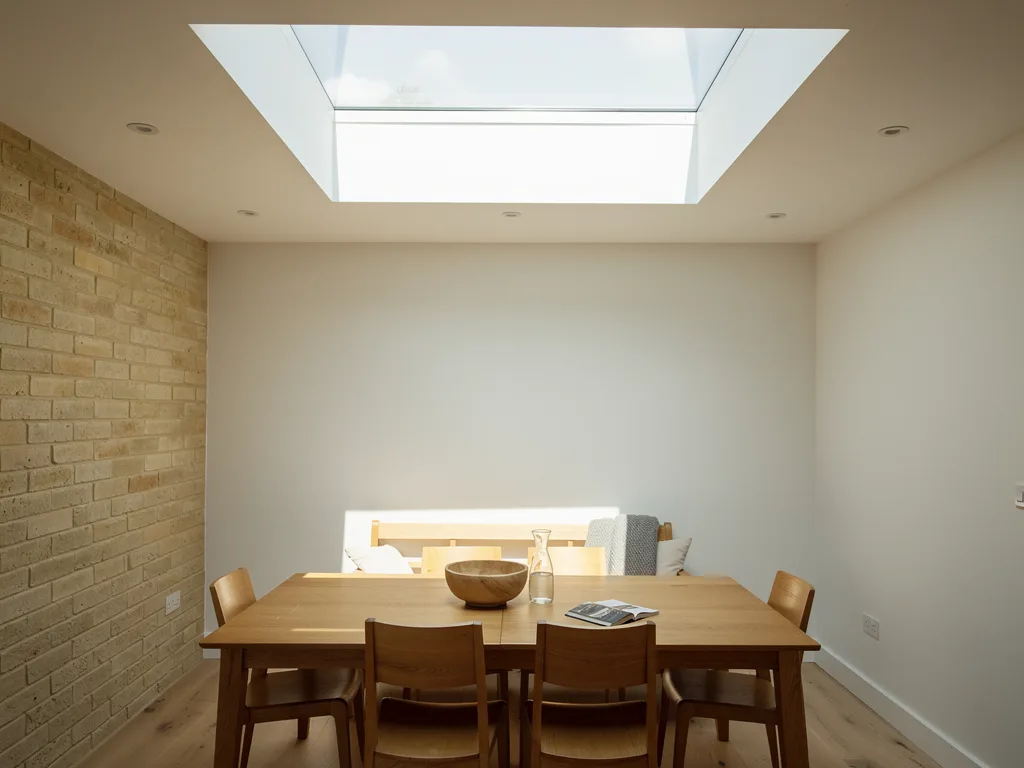
The standard colours, and what RAL means
Anthracite grey is the default on a large share of aluminium flat rooflights, with black and white as the usual alternatives at no great change in lead time.
RAL is a European colour reference system, so a number such as 7016 describes one exact shade whoever mixes it. That matters on an extension where the rooflight should match the bifold doors, the window frames or the fascia: if the doors are RAL 7016 in a matt finish, the rooflight can be ordered in the same code and finish, and the two will sit together rather than looking like near-misses. Finish is part of the specification too. The same RAL number can be supplied in matt, satin or gloss, and a textured or fine-structure finish is common on grey and black because it hides fingerprints and light scuffing during fitting.
Colours outside the standard set are normally possible with aluminium frames, since the frame is powder coated before assembly. Expect a longer lead time for a special colour, because the profiles have to be coated in a separate batch. Frames made from uPVC or composite plastics are more limited, and are often supplied in white or grey only. The colour and finish are confirmed in writing with the rest of the flat roof rooflight installation specification before the unit is ordered.
Inside and outside can differ
A dual-colour frame lets the outside match the building and the inside match the ceiling, and it is widely offered on aluminium units.
A common pairing on Cambridge extensions is anthracite outside, to match slim grey door frames and a grey or black single-ply roof, with white inside so the frame disappears into a white ceiling. On a gault brick terrace in Romsey or Petersfield, where the rear extension might have a black zinc or dark EPDM finish, black outside and white inside is another sensible choice. Owners of newer homes at Eddington or Trumpington Meadows sometimes carry a darker interior colour through deliberately, to echo black window frames and steel-look internal doors.
Check how a dual-colour option is made. On a thermally broken frame the inner and outer aluminium sections are separate, so coating each side differently is straightforward. On a single-skin frame it may not be offered at all. Our guide to framed vs frameless flat rooflights explains how the frame is built on each type.
What you actually see from the room below
On many flat rooflights the frame sits on top of the upstand and shows only as a thin line from below; the deep sides you look up into are the internal reveal.
This is the point that surprises people. The kerb or upstand lifts the glass at least 150mm above the finished roof, and the ceiling, insulation and joists add more depth beneath it. Looking up, you see a shaft lined in plasterboard or a factory liner, with the frame edge at the top. On a frameless unit the frame line is thinner still, often little more than a black ceramic band printed around the glass edge to hide the bonding. How thick a flat rooflight is sets how deep that shaft becomes.
So choosing a frame colour for the interior is often really a choice about the reveal. A white reveal and a white inner frame read as one clean opening. A dark inner frame at the top of a white reveal draws a crisp line around the sky, which some people like as a picture-frame effect.
How frame colour changes the brightness you perceive
A dark frame and reveal do not reduce the daylight entering through the glass, but they raise the contrast at the edge of the opening, and that changes how bright and how glary the room feels.
Your eye judges brightness against its surroundings. A pane of bright sky edged by black or anthracite looks intense, because there is a sharp step from dark to very bright. The same pane edged by white, with a white reveal splayed out to the ceiling, looks softer: the light surfaces pick up daylight and pass it outward, so the ceiling around the opening is brighter and the step down is gentler. That is why light reveals are the usual advice where glare is a worry, for example over a desk or a sofa facing a television.
| Inner frame and reveal | How the opening reads | Suits |
|---|---|---|
| White frame, white reveal | Soft edge, light spreads onto ceiling | Studies, living rooms, low ceilings |
| Dark frame, white reveal | Crisp outline, sky framed like a picture | Kitchens and dining spaces |
| Dark frame, dark reveal | Strong contrast, opening looks smaller | High ceilings, deliberate feature |
Orientation makes the effect stronger or weaker. On a flat roof the glass sees the whole Cambridge sky, and on a clear summer day that sky is very bright wherever the unit sits, so the edge contrast is at its highest. Under the grey, even light of a winter afternoon the difference between a dark and a light edge matters less. Our note on how we plan the light sets out how sun path and season feed into these choices.
Outside: roof, surroundings and heat
Outside, the frame colour is mostly a matter of matching the roof finish and the elevations, though a dark frame does run warmer in sun.
A flat rooflight on a single-storey extension is often visible only from upstairs windows or a neighbour's garden, so its outside colour is usually chosen to match the membrane and the door frames. Dark aluminium absorbs more sunlight than white and gets hotter to the touch, but the frame is a small area and a thermally broken frame keeps that heat from reaching the room in any meaningful way. The frame colour is not a significant planning issue on a rear extension in its own right; our answer on whether a flat rooflight needs planning permission covers what does count.
Questions people also ask
Can I paint a rooflight frame a different colour later?
It is not a good idea on a powder-coated aluminium frame. Site-applied paint does not bond as well as the factory coating and may affect the product warranty. Choose the colour at ordering stage, when getting it right takes little extra effort.
Will a blind match the frame?
Many integral and fitted blinds come in white, grey or black to go with standard frame colours. Our answer on whether a flat rooflight can have an integral blind explains the options.
Which colour makes a narrow side return feel brightest?
White inside, on both the inner frame and the reveal, because it spreads light onto the walls of a narrow room. The guide to skylights for side-return extensions covers the rest of that layout.
Do frame colours differ between flat skylights and roof lanterns?
The same RAL palette is generally offered on both, so a flat skylight and a lantern on the same house can match. To see how colour, glass and position fit your own room, book a light survey.
