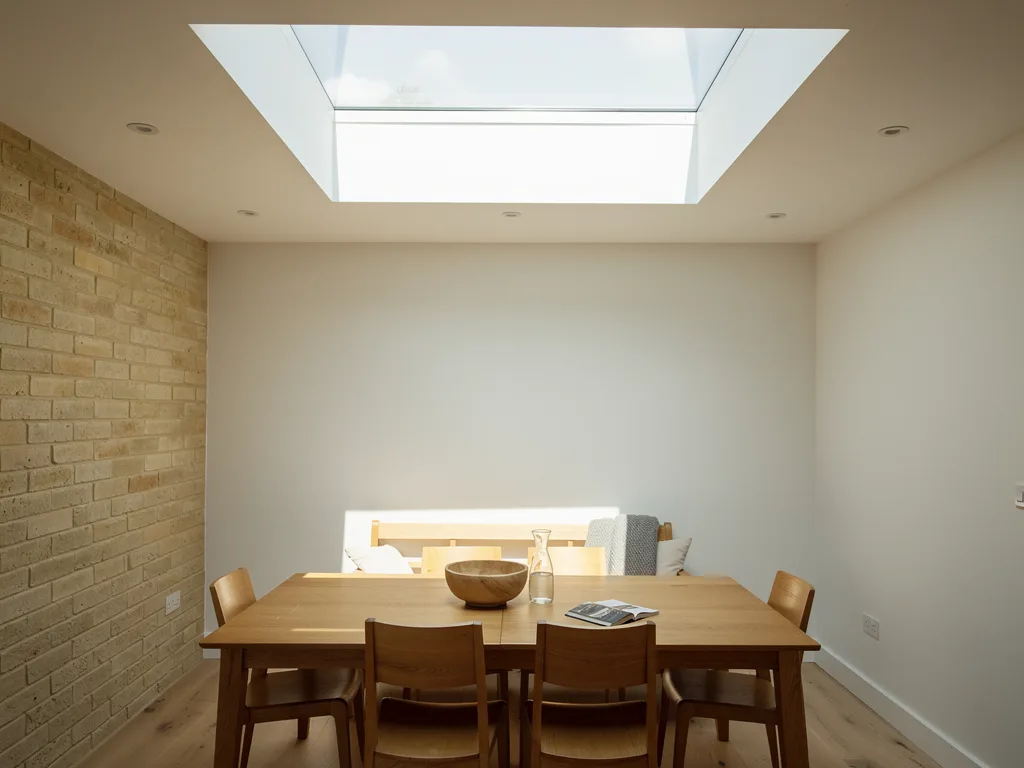
Two jobs a rooflight can do near a wall
Close to a wall, a rooflight lights the wall itself and the room reads brighter and taller; further out, the same skylight puts its light on the floor, the table and the middle of the room.
Daylight from a flat rooflight arrives mostly from above and spreads outwards from the opening. When one edge of that opening sits tight to a wall, part of the spread grazes straight down the wall face. A pale, matt wall lit this way becomes a large, soft reflector: it bounces light back across the room and lifts the whole side of the space. On the long flank wall of a terrace side return in Romsey or Petersfield, this can be the difference between a corridor that feels like a slot and one that feels generous.
Move the opening away from the wall and less light lands on the vertical surface. More of it reaches the horizontal ones: the floor, a worktop, a dining table. The room gets a stronger pool of light in its working zone, but the walls around it stay comparatively dim, and a dim wall makes a room feel smaller than its floor area. Neither approach is wrong. The question to answer first is which surface in the room matters more to you. Our guide to positioning a flat roof skylight covers the wider picture of worktops, windows and screens; this answer stays with the wall.
Working distances, measured from the inside face of the wall
Measure from the finished plaster to the inner edge of the rooflight opening, because that edge is where the light starts its fall into the room.
These bands are a practical starting point for a single-storey extension with a ceiling around 2.4 to 2.7 metres. They describe the effect on the room, and they assume the roof structure and covering allow the position, which is checked at the survey.
| Inner edge to wall | What the light does | Suits |
|---|---|---|
| 0 to 300mm | Grazes the full height of the wall | Side returns, shelving, feature brick |
| 300 to 900mm | Lights the top of the wall and the floor near it | Kitchen runs, general brightness |
| 1 to 1.5m or more | Pools on the floor and furniture | Tables, islands, deep rooms |
A zero distance is rarely a true zero. The roof covering has to turn up the wall at the abutment and turn up the rooflight kerb, and the roofer needs room between the two to dress both and keep water moving to the outlet. On a membrane roof that gap is typically a few hundred millimetres, which is why the kerb itself usually sits a little off the wall even in the wall-washing band. A splayed internal reveal then carries the light the last stretch to the wall face, so the room sees an opening that meets the wall even though the kerb stands slightly clear of it. The guide to flat rooflight upstands explains how the kerb and reveal are formed.
Where the sun patch goes in a Cambridge room
Direct sunlight falls at an angle, so on sunny days the bright patch lands some distance from the opening, and that offset changes the answer for a wall on the side away from the sun.
Cambridge sits at about 52 degrees north. At midday in late June the sun stands roughly 61 degrees above the horizon; at the spring and autumn equinoxes it is about 38 degrees; in late December it is only about 14 degrees. Take a rooflight whose glass sits 2.7 metres above the floor. At midsummer noon its sun patch lands around 1.5 metres north of the opening. At the equinox that offset grows to about 3.5 metres. In midwinter the low sun cannot reach the floor at all in a normal room: the beam strikes the north wall, often high up.
That geometry works for you or against you. A rooflight set close to a south wall throws sunlight deep into the room through spring and autumn, which suits a long, dark plan. A rooflight set close to a north wall puts summer sun straight onto that wall, which can be lovely on pale gault brick and a glare source if the wall carries a television. East and west walls get the low morning or evening sun raking across them. Our light planning page shows these paths season by season.
- Winter solstice, about 14°. The lowest noon sun of the year travels furthest: it crosses the whole room and lands high on the back wall.
- Spring and autumn equinox, about 38°. The light lands on the floor, deep in the room.
- Summer solstice, about 61°. The highest, strongest sun drops steeply and lands close under the window.
- South-facing roof window. The same opening lets in a different patch of light every month.
- Deepest reach. In December the sun patch can be on the wall opposite, which is why we plan where it falls, not just how big the glass is.
Limits that override the design
Some distances are set by regulation or structure rather than by the light, and they are fixed before any light planning begins.
A wall shared with next door is the main one. Guidance under Approved Document B keeps rooflights out of a strip of roof either side of a party or compartment wall, so the wall-washing position is not available against it. The reasons and dimensions are set out in our answer on how close a rooflight can be to a party wall. Near a site boundary, the glazing's external fire rating also comes into play, which tends to affect the product choice rather than the spacing.
Structure is the other limit. The opening is formed by trimming joists, and the wall plate, a steel beam or a line of joist hangers near the wall can decide where the edge can go. The answer on whether a flat roof needs strengthening covers when trimming is straightforward and when an engineer specifies new members. Where the work is notifiable, we handle the Building Control notification and install to current Building Regulations.
Choosing for your room
Decide what the room is for, then pick the distance that serves it; with more than one rooflight you can do both.
A narrow side return with one long wall benefits from a unit or a run of units close to that wall, and our guide to linear and modular rooflights covers strip glazing along a rear or side wall. A deep kitchen extension on a 1930s semi, where the table sits in the middle, is better served by an opening set well out from the walls over the zone you use. A room with two or three rooflights can mix the two, one near the rear wall to lift it and one over the table, as described in planning multiple flat rooflights. Every quote comes with a written light plan that states the position and the reason for it, and the full service is set out on our flat roof rooflight installation page. To test a position on your own room, book a light survey.
Questions people also ask
Does a rooflight near a wall make a room look bigger?
It can, because a brightly lit wall pushes the edge of the room visually outwards. The effect is strongest on pale, matt surfaces and weakest on dark paint or heavy texture, which absorb much of the light that reaches them.
How far from the wall should a skylight be over a kitchen worktop?
Set the opening so its light arrives slightly in front of the worktop edge rather than over the wall cupboards. That usually means the inner edge sits a little beyond the depth of the worktop, around 600 to 700mm from the wall, so the light falls on the surface and not on the back of the cook's head.
Can a rooflight be fitted right up against an external wall?
Not quite flush on a flat roof, because the covering needs room to turn up both the wall and the kerb. A splayed internal reveal can close the remaining gap visually so the light still meets the wall face.
Does the distance from the wall change the size I need?
It can. A rooflight tight to a wall spends some of its light on that wall, so if the priority is floor-level brightness a unit set further out can be a little smaller for the same effect. The guide to flat rooflight sizes relates size to the room below.
